

Mattie Kuehn was bleeding cash.
Spending $1,700 a month on rental cars for work simply didn't make sense anymore.
So, he bought a brand-new 2026 Toyota Prius XLE Nightshade, and now he wants to drive it to the moon and back.
A High-Stakes Bet on Hybrid Longevity
Mattie, a dedicated road warrior hailing from Fox Lake, Illinois, recently shared his ambitious strategy on the Toyota Prius 5th Gen Club Facebook page.
His work schedule is relentless, requiring him to travel across 14 states and average roughly 5,000 miles every single month.
After a year of throwing money away on rental vehicles, he purchased his 2026 Prius brand new with just 50 miles on the odometer.
In only two weeks of ownership, the car's digital instrument cluster was already displaying 3,300 miles.
Now, Mattie has set his sights on a major milestone: keeping this fifth-generation hybrid running like brand new while pushing the odometer past the 300,000, 400,000, or even 500,000-mile mark.

In my thirty-plus years in the automotive industry, I have watched the Prius evolve from a quirky science experiment into the undisputed king of high-mileage fleet durability.
However, driving 60,000 miles a year puts a vehicle into a "severe operating duty" category that standard dealership service menus simply aren't designed to handle.
As I point out in my previous Prius report, the smaller 17-inch wheels allow for a taller tire sidewall, which acts as a secondary shock absorber before the suspension even has to work, providing a quieter and more cushioned ride for heavy highway commuting.
If Mattie wants his 2026 XLE Nightshade to survive this extreme highway torture test, he has to look beyond the basic owner's manual.
Read More: See why luxury car owners are ditching premium brands for fuel economy as a former BMW 5 Series owner trades his luxury sedan for a 2026 Prius Prime with zero regrets.
The Severe-Duty Maintenance Roadmap
To get a fifth-generation Prius to half a million miles, you must treat fluid life and heat management as your absolute top priorities.
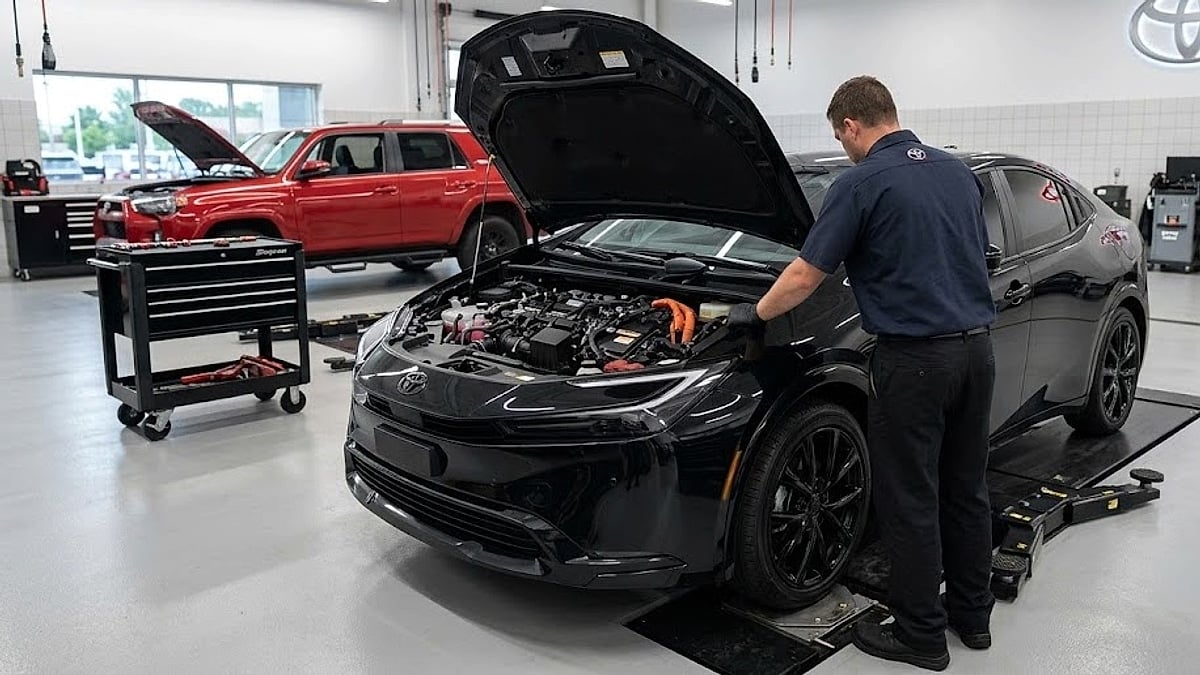
Here is the precise, high-mileage maintenance sequence required to protect this vehicle's highly advanced powertrain over the next decade.
1. Accelerate the Engine Oil Changes: Every 5,000 miles (1 month).
Forget the standard 10,000-mile interval recommended for normal driving. At 5,000 miles a month of high-speed highway driving, Mattie's engine experiences significant thermal stress. Drain and refill with genuine Toyota 0W-16 fully synthetic oil to keep the high-compression Dynamic Force engine thoroughly protected.
2. Perform Proactive Transaxle Fluid Drain-and-Fills: Every 50,000 miles.
Toyota technically considers the eCVT (electronic Continuously Variable Transmission) fluid a "lifetime" fill under normal conditions, but "lifetime" typically refers to the length of the factory warranty. The eCVT houses two powerful electric motor-generators that run incredibly hot. Draining and refilling the transaxle with genuine Toyota fluid every 50,000 miles is the single most critical step to prevent transmission failure.
3. Flush Both Engine and Inverter Coolant Loops: Every 100,000 miles.
The 2026 Prius utilizes two completely independent cooling systems: one for the internal combustion engine and one for the high-voltage hybrid inverter. If the inverter overheats, the vehicle will shut down immediately to prevent catastrophic electrical damage. Flush and replace both systems using Toyota Super Long Life Coolant.
4. Clean the Hybrid Battery Intake Filter: Every 15,000 miles.
The high-voltage lithium-ion battery package sits beneath the rear seats and relies on cabin air for temperature regulation. This system pulls air through a dedicated intake vent that can quickly clog with dust, pet hair, and debris. Inspecting and cleaning the battery fan's mesh intake filter is paramount to keeping the hybrid cells cool and extending their operating lifespan.

The Hidden 12-Volt Electrical Danger
While Mattie has already started personalizing his Prius with a full ceramic window tint and smoked side markers, he has also ventured into territory that warrants a serious technical warning.
He recently installed a Sonic Beat amplifier and has already ordered replacement speakers and sound-deadening materials to make his 5,000-mile monthly commute more comfortable.
On a standard, non-hybrid vehicle, adding an aftermarket amplifier and heavy audio equipment simply strains a large, belt-driven alternator.
On a 2026 Prius, the entire dynamic changes.
Hybrids do not have a traditional alternator; instead, they rely on an electronic component called a DC-DC converter.
This converter takes high-voltage power from the main hybrid battery pack and steps it down to keep the car's small auxiliary 12-volt battery charged.
The auxiliary 12-volt battery in a Prius is physically tiny and has very little reserve capacity compared to a conventional car battery.
Adding high-draw aftermarket audio amplifiers can easily overload the DC-DC converter or deplete the small 12-volt battery during short accessory-on periods.
If Mattie wants to prevent strange dashboard warning lights, deep voltage drops, or getting stranded on the side of a multi-state highway, he must ensure his amplifier's current draw is well within the safe limits of the Prius's electrical system.
For road warriors putting extreme highway miles on their new hybrid, discover how unlocked Toyota Prius rear doors can fly open at highway speeds and what temporary safety bypasses you need to deploy while waiting for backordered recall parts.
The Long-Term Economics of 500,000 Miles
By choosing the Prius over his previous rental habit, Mattie is positioned to save an astronomical amount of money over the next few years.
Let's look at how the math shakes out when we compare his old rental routine against the real-world cost of owning and maintaining his brand-new hybrid.
The Bottom Line: By transitioning from rentals to the 2026 Prius, Mattie stands to keep an estimated $15,562 per year in his pocket. Over a five-year, 300,000-mile run, that translates to over $77,000 in total savings, more than enough to completely offset the vehicle's initial purchase price and any high-mileage repairs.
If Mattie keeps his foot off the floor, uses high-quality parts, and strictly adheres to the proactive fluid intervals outlined above, his goal of reaching the 500,000-mile mark isn't just an ambitious dream.
It is a highly achievable, cash-saving reality.
Tell Us What You Think: Would you attempt to push a brand-new vehicle to 500,000 miles, or do you prefer to trade your cars in before the warranty expires?
If you are already running a high-mileage hybrid, what is your secret to keeping it on the road? I want to hear about your own high-mileage goals and maintenance strategies.
Leave a comment in the red "Add new comment" link below and let me know your thoughts.
There’s More Coming… Also check out my Torque News Home Page for more of my informative Toyota Prius news articles.
About The Author
Denis Flierl is a 14-year Senior Reporter at Torque News and a member of the Rocky Mountain Automotive Press (RMAP) with 30+ years of industry experience. Explore his full investigative reporting archives and technical guides at DenisFlierl.com.
Based in Parker, Colorado, Denis leverages the Rockies' high-altitude terrain as a rigorous testing ground to provide "boots-on-the-ground" analysis for readers across the Rocky Mountain region, California EV corridors, the Northeast, Texas truck markets, and Midwest agricultural zones.
A former professional test driver and consultant for Ford, GM, Ram, Toyota, and Tesla, he delivers data-backed insights on reliability and market shifts. Denis cuts through the noise to provide national audiences with the real-world reporting today’s landscape demands.
Connect with Denis: Find him on LinkedIn, X @DenisFlierl, @WorldsCoolestRides, Facebook, and Instagram.
Photo credit: Denis Flierl via Mattie Kuehn
Set Torque News as Preferred Source on Google
Follow us today...