
A 2025 Cybertruck AWD showed a PCS2 MOSFET health-check failure at 31,250 miles, and the useful detail was the service screen, not the warning alone. I checked the post, the service-mode image, Tesla service context for the Cybertruck Power Conversion System, and NHTSA Cybertruck recall background. This does not show that every truck is affected. It shows that this alert points Cybertruck drivers toward power-conversion and charging documentation before service ever opens the repair order.
The Cybertruck driver, posting in a Tesla CyberTruck group, said the warning appeared at 31,250 miles on a 2025 AWD truck. He said he opened a service ticket at 9:30 p.m. Eastern time and received an automated response around 10 p.m. saying free Supercharging had been enabled on the truck while he waited for scheduling.

That last detail is important, but it should be handled carefully. This is an owner-reported support response. It does not prove that Tesla enables free Supercharging for every Cybertruck with this warning. It shows that, in this reported case, Tesla offered a temporary charging accommodation while service scheduling was pending.
What Torque News Checked
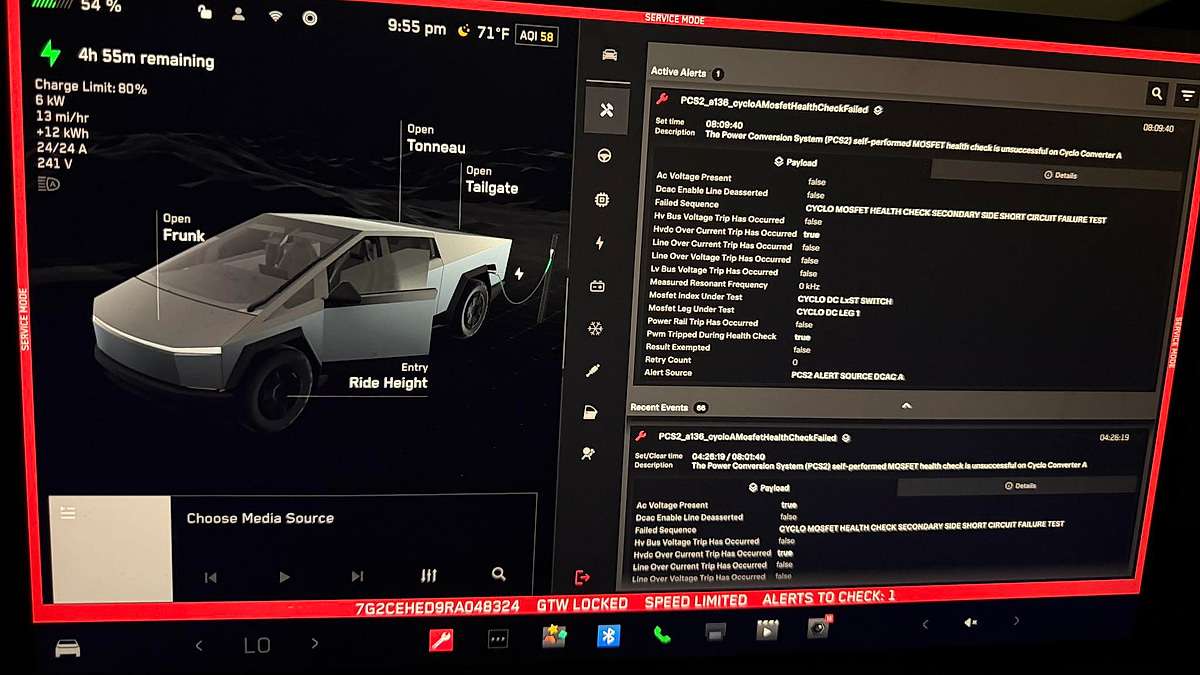
Torque News checked the service-mode screenshot first because it contains the hard evidence. The active alert shown on the screen is PCS2_a136_cycloAMosfetHealthCheckFailed. The description says: "The Power Conversion System (PCS2) self-performed MOSFET health check is unsuccessful on Cyclo Converter A."
The same screen shows the truck in Service Mode, with "Speed Limited" displayed along the lower red bar. The charging panel shows the truck at 54 percent state of charge, a charge limit of 80 percent, 4 hours and 55 minutes remaining, 6 kW, 13 miles per hour, +12 kWh, 24/24 amps, and 241 volts.
That does not tell the whole repair story, but it gives owners a useful symptom pattern: the truck can still be plugged in, yet the service screen is showing a power-conversion health-check failure and reduced-looking AC charging behavior.
Torque News also checked Tesla's Cybertruck service documentation. Tesla lists the Power Conversion System as a service component with remove-and-replace procedures. That matters because the alert text is not vague. It identifies PCS2 and Cyclo Converter A inside the power-conversion system.
Finally, Torque News checked the NHTSA context because Cybertruck owners have already seen MOSFET language in another issue. NHTSA recall 24V832 covered certain 2024 Cybertrucks for a drive-inverter problem involving MOSFETs, with a potential loss-of-propulsion risk. That recall is useful background, but it should not be confused with this case. The screenshot here names PCS2, not the drive inverter, and Tesla would need to confirm whether any parts or failure modes overlap.
How modern EV’s fail
Modern EVs do not fail like older trucks. A warning can point to a power-electronics self-check, an onboard charging path, a drive-inverter concern, a high-voltage isolation issue, a software limit, or a sensor condition. To the driver, it may all feel like "the truck has a problem." To the technician, the exact alert name matters.

In this case, the screen's wording matters because the Power Conversion System is tied to how the vehicle handles electrical power. The owner did not report a dead truck. The image shows charging in progress. But the truck is also in Service Mode, speed-limited messaging is visible, and the alert says a PCS2 MOSFET health check was unsuccessful.
The free Supercharging detail also becomes more interesting in that context. If a Cybertruck has a power-conversion issue that affects home or AC charging confidence, temporary Supercharging support can reduce the owner's immediate range problem while Tesla schedules service. But that should not be read as proof that DC fast charging is unaffected in every PCS-related case. It only shows how this owner said Tesla responded.
The comment thread also suggests this is a known anxiety point among Cybertruck owners. One commenter called it a "rite of passage." Another said his 2025 truck had already had the relevant part replaced a month earlier. Those comments are not enough to establish a defect rate, but they do show why the screenshot matters: owners are watching for this warning and comparing outcomes.
For a Cybertruck owner, the practical takeaway is not to panic or self-diagnose. It is to document the alert precisely.
What it means for Cybertruck owners
If a PCS2 warning appears, take photos of the active alert page, the exact alert code, the description text, the charging screen, the service-mode status, and the Tesla app message showing any temporary charging support. Note the mileage, state of charge, charge rate, amperage, voltage, whether the truck is speed limited in actual driving, and whether AC or DC charging behaves differently.
Then open the service ticket with the exact alert text, not a vague description like "charging problem" or "battery warning." The difference matters. A truck that shows a PCS2 self-check failure is giving Tesla a more specific diagnostic trail than the owner may realize.
This case does not prove that every Cybertruck will face a PCS2 problem. It does show why owners should learn the difference between a warning light and a power-conversion alert. The next time a Cybertruck shows a technical service message, the most important detail may not be the warning itself. It may be the exact system name buried inside Service Mode.
Cybertruck owners, have you seen a PCS, inverter, speed-limited, or charging-related service alert? Share the mileage, alert text, and whether Tesla offered temporary charging support while the truck waited for service.
Comment down below.
Images by Jp Kinney
About The Author
Noah Washington is an automotive journalist based in Atlanta, Georgia, covering sports cars, luxury vehicles, and performance culture. His reporting focuses on explaining the engineering, design philosophy, and real-world ownership experience behind modern vehicles.
Noah has been immersed in the automotive world since his early teens, attending industry events and following the enthusiast communities that shape how cars are built and driven today. His work blends industry insight with enthusiastic storytelling, helping readers understand not just what a car is, but why it matters.
Noah is also a member of the Southeast Automotive Media Association (SAMA), a professional organization for automotive journalists and industry media in the Southeast.
His coverage regularly explores sports cars, luxury vehicles, and performance-driven segments of the automotive industry, including the evolving culture surrounding Formula Drift and enthusiast builds.
Read more of Noah's work on his author profile page.
You can also follow Noah here:
Set Torque News as Preferred Source on Google
Follow us today...