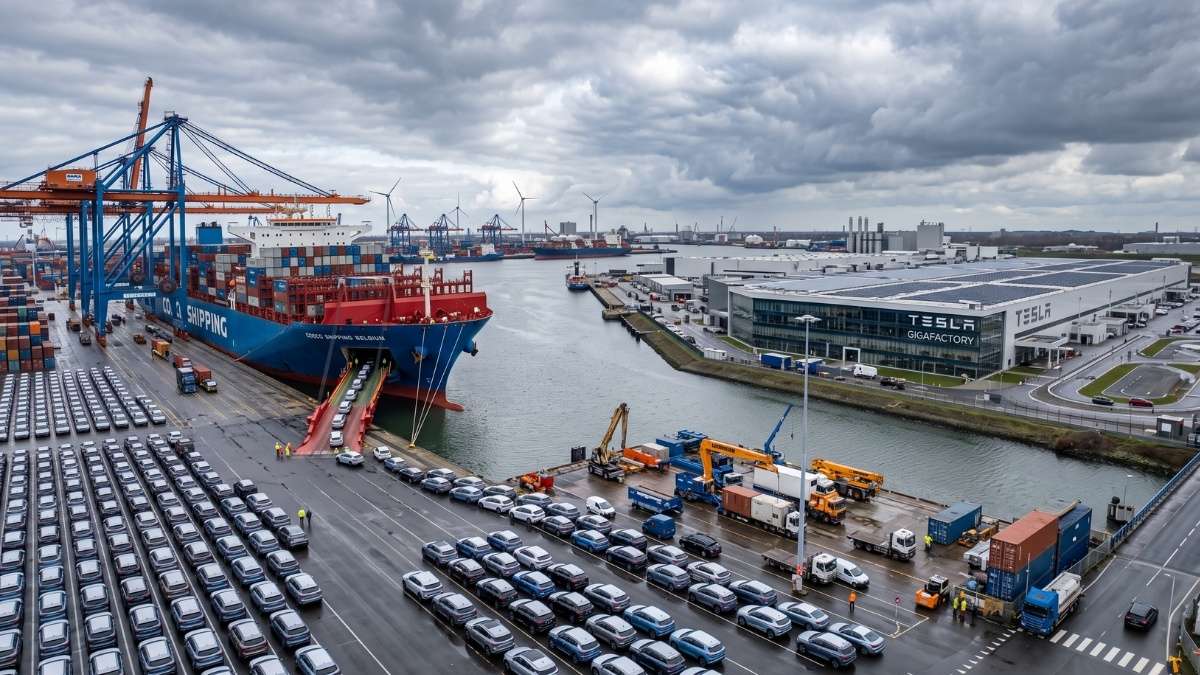

For years in the automotive industry, we have watched a fascinating strategic chess match play out between the traditional legacy automakers and the new electric vanguard. Yet, the most critical rivalry of the decade is no longer between legacy internal combustion giants and electric vehicle upstarts. The true battle for global automotive supremacy has distilled down to two undisputed heavyweights: Elon Musk’s Tesla and Wang Chuanfu’s BYD.
As we close out the first half of 2026, the unthinkable—at least for Tesla loyalists—has occurred. According to newly released data, the two companies have reached an astonishing state of parity in one of the world's most critical and highly regulated automotive theaters. The latest industry figures demonstrate unequivocally that BYD and Tesla closed the first half of 2026 with the exact same European market share.
This is not a statistical anomaly. It is the result of a meticulously executed corporate strategy by BYD, playing out against a backdrop of geopolitical tension, newly imposed European Union tariffs, and a Tesla that has arguably taken its eye off the fundamental ball of consumer automotive expansion. Let us dive into the mechanics of this market shift, analyze how BYD is successfully navigating the regulatory minefield, and determine what this means for the future of Tesla in Europe.

The Relentless Evolution of BYD’s Competitive Position
To understand how BYD caught up to Tesla in Europe, one must examine the fundamental differences in their operational philosophies. Tesla is, at its core, a technology and software company that happens to manufacture automobiles. They rely heavily on massive brand equity, centralized platform engineering, and the promise of future software breakthroughs like Full Self-Driving (FSD).
BYD, conversely, is an applied materials and battery engineering juggernaut that aggressively vertically integrated its way into becoming a car company. Over the last five years, BYD’s competitive position has improved dramatically because they control practically their entire supply chain. While other automakers, including Tesla, have occasionally struggled with battery material sourcing and supply chain bottlenecks, BYD manufactures its own revolutionary Blade batteries, its own semiconductor chips, and even owns the massive maritime transport vessels used to ship their cars globally.
In Europe, this translated directly into a highly adaptable product cadence. While Tesla essentially offers the Model 3 and Model Y to mainstream European buyers, BYD flooded the zone. They introduced the Atto 3, the Dolphin, the Seal, and various plug-in hybrid options that catered specifically to diverse European sensibilities, sizing preferences, and economic brackets. BYD did not try to force a single, Silicon Valley-designed lifestyle vehicle onto the European consumer; they built a diverse portfolio that matched legacy European automaker catalogs, drastically improving their competitive positioning and brand visibility on the streets of Oslo, Munich, and Paris.

Can BYD Sustain Its Market Share Advantage Against Tesla?
Tying for market share is a monumental achievement, but the automotive graveyard is full of companies that captured lightning in a bottle for a single quarter before fading. The pressing question is whether BYD can sustain this momentum and turn this tie into a durable market share advantage over Tesla.
The analytical evidence points to a strong "yes," provided BYD maintains its focus on execution. BYD’s structural cost advantage is deeply entrenched. Even when factoring in the elevated costs of doing business internationally, their domestic manufacturing scale allows them to iterate on vehicle design and push technological updates faster than Tesla’s current product lifecycle.
Furthermore, BYD has successfully penetrated the lucrative European corporate fleet market. In Europe, a massive percentage of new vehicle registrations are company cars. BYD established traditional dealer networks and localized service centers to reassure fleet managers that these vehicles could be maintained efficiently. Tesla’s direct-to-consumer model and historically fraught service center wait times have created friction with these vital fleet operators. Because corporate fleets operate on predictable, cyclical replacement schedules, capturing this segment provides BYD with a sustainable, recurring revenue moat that will be incredibly difficult for Tesla to breach without fundamentally changing its localized service model.
The Strategic Roadmap Tesla Must Follow to Counter BYD
If Tesla is to stop BYD from transforming this tie into outright European dominance by 2027, Elon Musk and his executive team must immediately pivot their strategy. The era of resting on the laurels of the Model Y—despite it being the world’s best-selling car in previous years—is over.
First and foremost, Tesla must dramatically accelerate the launch of its mythical next-generation, low-cost platform. Often referred to as the "Model 2" or "Project Redwood," a vehicle priced at or below €25,000 is strictly non-negotiable for European success. The European market heavily favors compact hatchbacks suitable for tight urban environments. BYD already dominates this space with the Dolphin. Tesla cannot fight a ground war in Europe with crossover SUVs and expensive luxury sedans alone; they need a true mass-market European commuter car.
Secondly, Tesla needs to hyper-localize its marketing and public relations strategy. Tesla relies primarily on Musk’s social media presence on X and word-of-mouth. While this worked brilliantly for early adopters, crossing the chasm into the mainstream European market requires a different touch. European consumers value heritage, localized economic contribution, and customer service. Tesla needs to launch traditional, localized marketing campaigns highlighting the contributions of Giga Berlin to the European economy and actively combat the narrative that it is a distant, American tech monopoly.
Finally, Tesla must aggressively overhaul its European service network. Vehicle downtime is the enemy of consumer trust. If Tesla can match the legacy dealership service experience that BYD is smartly piggybacking on through local European dealership partnerships, they can staunch the bleeding of brand loyalty.

Dodging the EU Tariffs: BYD’s Localized Playbook
The most fascinating aspect of BYD tying Tesla’s market share in H1 2026 is that they accomplished this while swimming upstream against severe regulatory headwinds. Recognizing the existential threat posed by cheap Chinese EVs, the European Commission previously imposed steep tariffs on Chinese-made electric vehicles, aimed directly at crippling the pricing advantage of companies exactly like BYD.
So how is BYD continuing to grow and actively working to circumvent these tariffs? The answer lies in rapid, aggressive localized capital expenditure. BYD is not simply accepting the tariffs; they are fundamentally restructuring their geographic footprint.
Their primary mechanism is the rapid construction of European manufacturing hubs. By breaking ground on a massive passenger car factory in Szeged, Hungary, BYD is planting a flag firmly inside the European Union. Vehicles produced in Hungary will not be subject to the punitive import tariffs placed on vehicles manufactured in Shenzhen.
Furthermore, BYD has engaged in clever supply chain maneuvering, heavily utilizing Completely Knocked Down (CKD) and Semi Knocked Down (SKD) manufacturing. By shipping major vehicle components to strategically located assembly plants in regions with favorable trade agreements—such as Turkey, which enjoys a customs union with the EU—BYD is effectively legally washing the "imported" status from their vehicles.
In the short term, while these factories are spinning up, BYD has demonstrated a willingness to simply absorb a significant portion of the tariff costs directly into their industry-leading profit margins. They are deliberately sacrificing short-term profitability to ensure their market share continues to expand, relying on their domestic Chinese profits to subsidize their European assault.
Will BYD’s Anti-Tariff Strategies Succeed?
Analyzing the geopolitical and economic chessboard, it is highly probable that BYD’s localized manufacturing strategy will be wildly successful. Hungary is a full EU member state with a government eager for foreign direct investment, essentially guaranteeing that vehicles rolling off the Szeged line will enjoy frictionless, tariff-free access to the rest of the continent.
Legacy European automakers rely heavily on complex, slow-moving bureaucratic structures. BYD operates with the speed of a startup but with the capital resources of a nation-state. Their ability to construct, tool, and scale a manufacturing facility is historically much faster than their Western counterparts. While the European Union may attempt to close regulatory loopholes regarding CKD assembly, they cannot legally place tariffs on goods manufactured completely within their own borders without violating the core tenets of the EU single market. BYD has found the backdoor, and they are driving a massive truck through it.
The Doomsday Scenario for Tesla
What happens to Tesla if—or rather, when—BYD successfully operationalizes its European factories and completely neutralizes the tariff barrier? It presents a borderline doomsday scenario for Tesla’s current European operational model.
Tesla’s Giga Berlin was built to supply Europe efficiently and protect Tesla from import logistics. However, if a fully localized BYD can produce vehicles in Hungary using their vertically integrated battery supply chain, their baseline cost of manufacturing will still be significantly lower than Tesla’s production costs in Germany, a country with notoriously high labor and energy costs.
If BYD achieves tariff-free status, they will unleash a devastating price war that Tesla is ill-equipped to win in Europe. Without the artificial price floor created by the EU tariffs, BYD can systematically undercut the Model 3 and Model Y while remaining profitable. Tesla would be forced to choose between surrendering market share or slashing prices to levels that would obliterate their automotive gross margins—margins that Wall Street deeply relies upon to justify Tesla’s immense corporate valuation.
If BYD bypasses the tariffs, Tesla will no longer be competing against a penalized importer; they will be fighting a hyper-efficient, localized manufacturer that has a superior cost structure and a broader product portfolio perfectly tuned for the European consumer.
Wrapping Up
The automotive sector is entirely unforgiving of strategic complacency. As the data from the first half of 2026 clearly illustrates, BYD’s relentless push into Europe has successfully neutralized Tesla’s early-mover advantage. By heavily leveraging vertical integration, catering specifically to European vehicle preferences, and aggressively establishing local manufacturing footholds to legally bypass protectionist tariffs, BYD has proven they are not merely a Chinese domestic champion, but a global apex predator.
For Tesla, the alarm bells should be ringing at maximum volume in Austin and Berlin. Software promises and brand mystique are no longer sufficient to hold off an adversary capable of matching them vehicle-for-vehicle on European soil. To counter this threat, Tesla must urgently return to its roots of aggressive automotive innovation, rapidly deliver a true mass-market European vehicle, and optimize its localized customer service. If they fail to do so before BYD fully activates its European and Turkish manufacturing hubs, the current market share tie we are witnessing today will be remembered not as an anomaly, but as the moment Tesla permanently lost the European continent.
Disclosure: Images rendered by Artlist.io
Rob Enderle is a technology analyst at Torque News who covers automotive technology and battery developments. You can learn more about Rob on Wikipedia and follow his articles on TechNewsWord, TGDaily, and TechSpective.
Set Torque News as Preferred Source on Google
Follow us today...