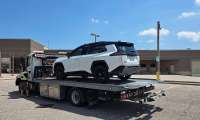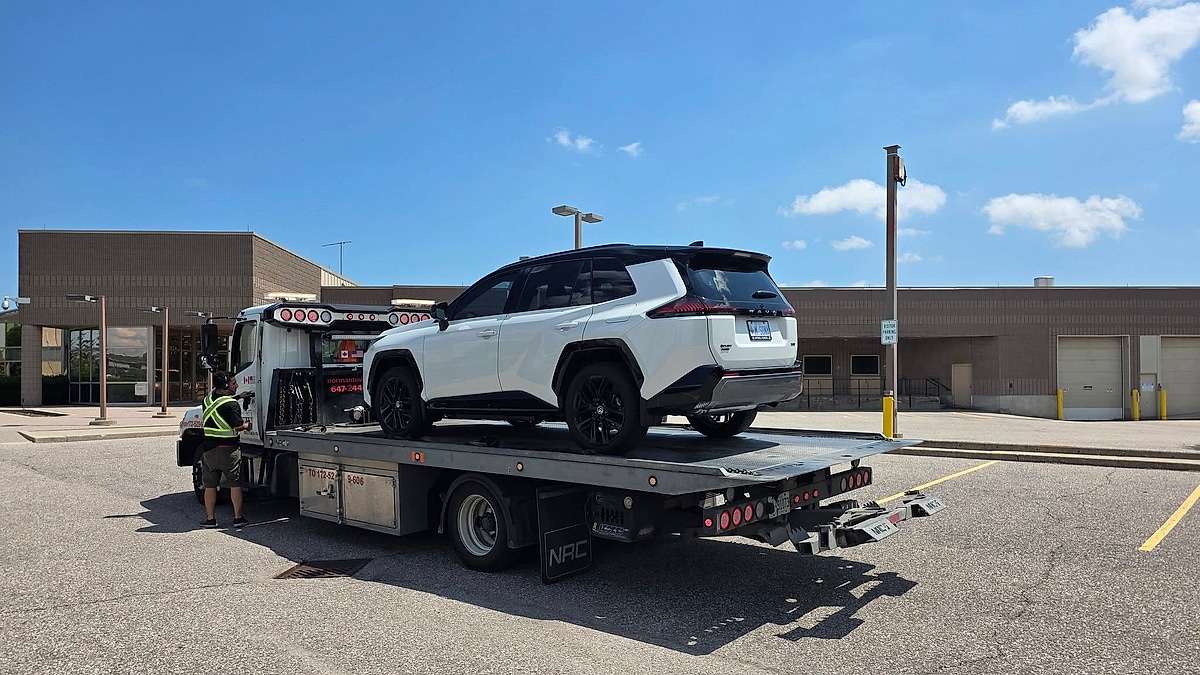

A Toyota RAV4 Plug-In Hybrid owner had roughly 1,710 miles on his vehicle when it ended up on a flatbed. Mohsen Alhalfawy says the vehicle stopped after only a few minutes of driving.
Alhalfawy says the vehicle stopped after only a few minutes of driving. His dashboard displayed “Hybrid System Malfunction, Visit Your Dealer,” followed by “Check Engine, Visit Your Dealer.” Toyota Roadside Assistance handled the tow. A few hours later, the dealership told him the issue was “minor,” and the RAV4 was working again.
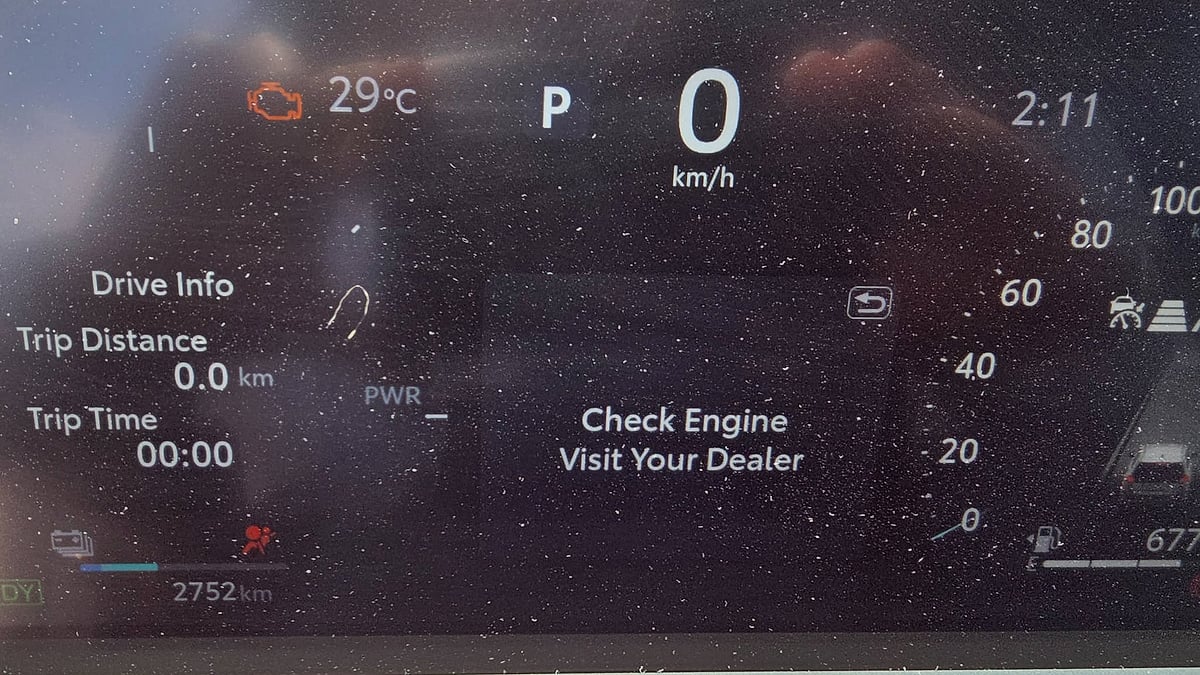
- The dashboard still showed 29% traction-battery charge and the READY indicator. That makes an empty high-voltage battery unlikely, but it does not identify the system that stopped the vehicle.
- Two RAV4s displayed similar warnings at low mileage, but the photographs may show different vehicle generations. The same message alone cannot establish a shared defect.
- Owners should photograph every warning, preserve the tow record, and request the diagnostic codes, freeze-frame data, battery-test results, and repair details before the dealer clears anything.
The flatbed is the most honest photograph in this Facebook post. Whatever was recovered at the dealership, the owner had already lost the use of a nearly new vehicle and needed roadside assistance to finish the trip.
The dealer’s description may eventually prove accurate. The supporting evidence remains behind the service counter. Alhalfawy did not receive a cause in the account he shared, and the supplied material includes no repair order, diagnostic trouble code, test result, failed component, software version, or written correction.
“Minor” has no diagnostic value by itself.
The Dashboard Identified the Crisis and Hid the Culprit
Alhalfawy’s photographs preserve several details that matter. The odometer reads 2,752 kilometers. The ambient temperature is 29 degrees Celsius, approximately 84 degrees Fahrenheit. The traction-battery display shows 29 percent, and the green READY indicator is visible when the photographs were taken.
Those details make a completely depleted traction battery look unlikely at the moment of the photograph. They do not identify the failed circuit, control module, sensor, battery, relay, or software condition that triggered the warning.
“Hybrid System Malfunction” is an umbrella message. A Toyota scan tool must look beneath it. The useful information lives in the current, pending, history, and permanent diagnostic trouble codes, along with any available freeze-frame or failure-record data. The repair order should say which codes were found, which tests were run, what failed those tests, what the technician changed, and how the repair was verified.
Cars have always broken down. Modern cars have learned to regain their composure before the paperwork catches up.
That creates a miserable service-lane ritual. The owner arrives with a tow receipt and dashboard photographs. The vehicle starts normally for the technician. The warning has gone quiet. A service advisor uses words such as “glitch,” “low voltage,” or “minor,” and everyone waits to see whether the car repeats the performance in a less convenient place.
A disappearing warning can leave stored evidence. Alhalfawy should request a copy before the codes are cleared or the repair order is closed.
The 12-Volt Theory Needs Numbers
Several commenters immediately blamed the auxiliary 12-volt battery. That theory is plausible. A plug-in hybrid still depends on a conventional low-voltage battery to wake computers, close relays, and bring the high-voltage system online. A weak battery can cause a car with plenty of traction-battery energy to behave as though the entire machine has forgotten its purpose.
Plausibility cannot select the failed part.
One commenter said his own problem may involve the 12-volt system, parasitic draw, charging behavior, software, or hardware after two dealer visits failed to identify a root cause. Another blamed a parking-light setting. Others treated a jump-start as confirmation. These accounts supply leads for a technician and no verdict for Alhalfawy’s RAV4.
The test results would make the 12-volt theory useful. The repair order should record battery voltage, the battery’s measured health or conductance, its performance under an appropriate test, terminal condition, and the low-voltage charging output while the vehicle is READY. If the battery passed, the technician should document which other systems were checked. If it failed, replacing it answers only part of the question when parasitic draw or charging control remains possible.
TorqueNews has already documented a Prius Prime owner who reported reaching his third 12-volt battery by 19,000 miles, along with broader RAV4 owner concerns about auxiliary-battery drain and difficult intermittent diagnosis. Those cases explain why owners reach for the 12-volt answer so quickly. Alhalfawy’s vehicle still deserves its own test data.
His post also mentions that he had finally received the original Toyota charging cable before this happened. The chronology is clear. The supplied evidence offers no electrical measurement, charging log, code, or dealer note connecting that cable to the shutdown. It belongs in the history given to the technician and nowhere near the diagnosis until the records support a link.
A Second RAV4 Posted the Same Warning With Reduced Power
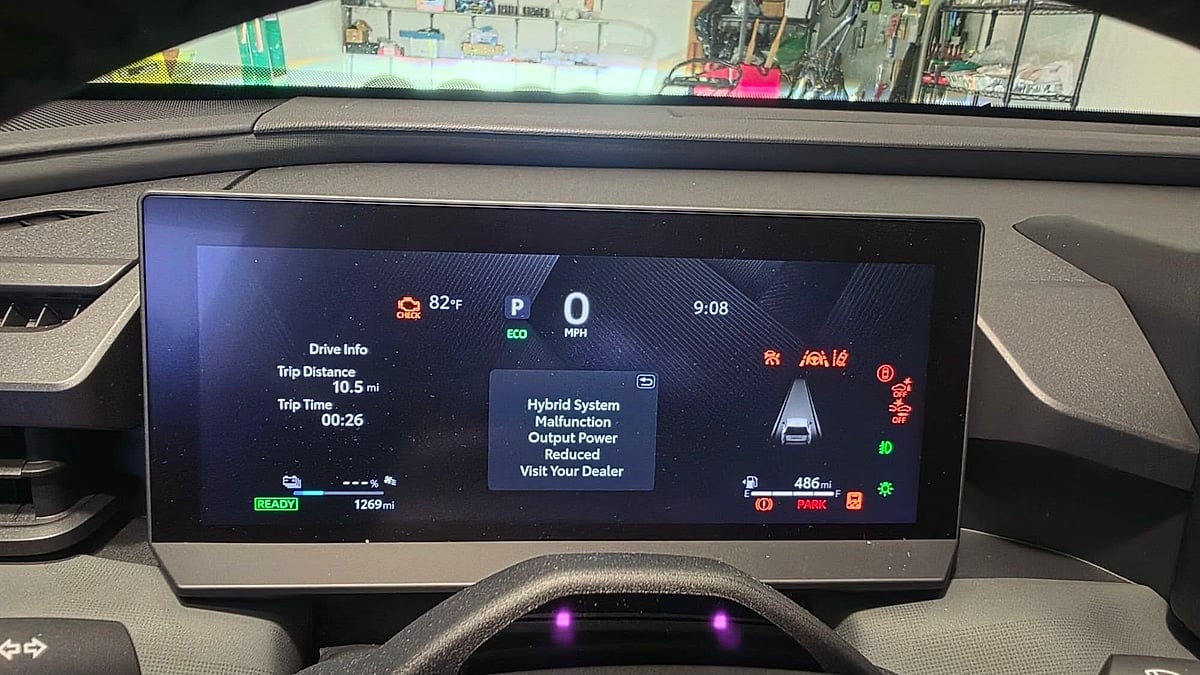
The discussion gained weight when Tom Vatov replied, “Same,” and posted a separate dashboard image.
Vatov’s display reads “Hybrid System Malfunction, Output Power Reduced, Visit Your Dealer.” The odometer shows 1,269 miles, the trip meter shows 10.5 miles, and the outside temperature reads 82 degrees Fahrenheit. Several driver-assistance warnings are illuminated alongside the check-engine light.
The dashboard layout appears to belong to Toyota’s redesigned RAV4 generation. Toyota says the 2026 RAV4 introduced its Arene software platform, a new multimedia system, Toyota Safety Sense 4.0, and a sixth-generation plug-in hybrid powertrain. The photograph alone cannot confirm Vatov’s model year, trim, VIN, powertrain, or root cause. It remains a second-owner report, and the common root cause is unproven.
That distinction matters because Alhalfawy’s tow photograph shows the outgoing RAV4 body. His post appeared in a group named “2026 Toyota RAV4,” and Meta’s automated title labeled the incident as a 2026 case. Alhalfawy’s own text never states the model year. Toyota’s 2025 model retained the outgoing body and adopted the RAV4 Plug-In Hybrid name previously carried by the RAV4 Prime.
The two photographs may span two generations. That possibility makes their common warning more interesting and their missing codes more important. It also blocks any honest claim that Toyota has one new 2026 defect.
I checked the National Highway Traffic Safety Administration’s model-specific recall feed for the 2026 RAV4 Plug-In Hybrid on July 11, 2026. It returned zero campaigns. The result gives us no basis for a recall angle and leaves the individual diagnostic records as the decisive evidence.
A Flatbed Ride Deserves More Than a Verbal Reset
Toyota Canada says every new Toyota receives a basic warranty for 36 months or 37,282 miles. At 2,752 kilometers, Alhalfawy had used about 4.6 percent of it.
Warranty coverage can handle the bill. Confidence returns after the owner receives a documented explanation.
I can accept a dealer describing a fault as minor. I need the sentence that follows. Was the 12-volt battery weak? Which code recorded that conclusion? Did a connector fail? Was a software update installed? Did the technician reproduce the fault? Was Toyota’s technical assistance line involved? Did the dealer clear the codes and return the vehicle because every test passed?
A clean repair order can answer those questions in a few lines. A vague repair order creates the owner’s next problem. If the warning returns, a documented first visit establishes date, mileage, symptoms, tow, codes, and the dealer’s response. That record can matter during warranty escalation, a manufacturer case review, or a safety complaint.
Owners should photograph the full instrument panel, record the mileage and conditions, save the roadside-assistance invoice, and avoid clearing codes before diagnosis. Ask the dealer to write the customer complaint exactly as it occurred, including any loss of propulsion or inability to restart. Request the codes and test values before accepting “could not duplicate” as the entire record.
A regulator needs the VIN, date, mileage, failure sequence, warning text, dealer findings, and repair history. A Facebook warning thread gives owners a community. A complete complaint gives investigators usable data.
Alhalfawy summed up the ownership problem cleanly: “A vehicle shouldn’t stop unexpectedly and display these warnings at such low mileage.”
He is right about the consequence. The cause still belongs to the records of Toyota, and the dealer has yet to put it into this account.
If your 2026 RAV4 or RAV4 Plug-In Hybrid has displayed “Hybrid System Malfunction,” share the model year, trim, mileage, state of charge, whether the vehicle remained READY, every DTC on the repair order, the 12-volt test result, the repair, and whether the warning returned. Those details can turn two dashboard photographs into evidence that other owners can actually compare.
Comment below with your thoughts.
Images by Mohsen Alhalfawy. The separate 1,269-mile dashboard image was posted by Tom Vatov in the owner discussion.
About The Author
Noah Washington is an automotive journalist based in Atlanta, Georgia, covering sports cars, luxury vehicles, and performance culture. His reporting focuses on explaining the engineering, design philosophy, and real-world ownership experience behind modern vehicles.
Noah has been immersed in the automotive world since his early teens, attending industry events and following the enthusiast communities that shape how cars are built and driven today. His work blends industry insight with enthusiastic storytelling, helping readers understand not just what a car is, but why it matters.
Noah is also a member of the Southeast Automotive Media Association (SAMA), a professional organization for automotive journalists and industry media in the Southeast.
His coverage regularly explores sports cars, luxury vehicles, and performance-driven segments of the automotive industry, including the evolving culture surrounding Formula Drift and enthusiast builds.
Read more of Noah's work on his author profile page.
You can also follow Noah here:
Set Torque News as Preferred Source on Google
Follow us today...