
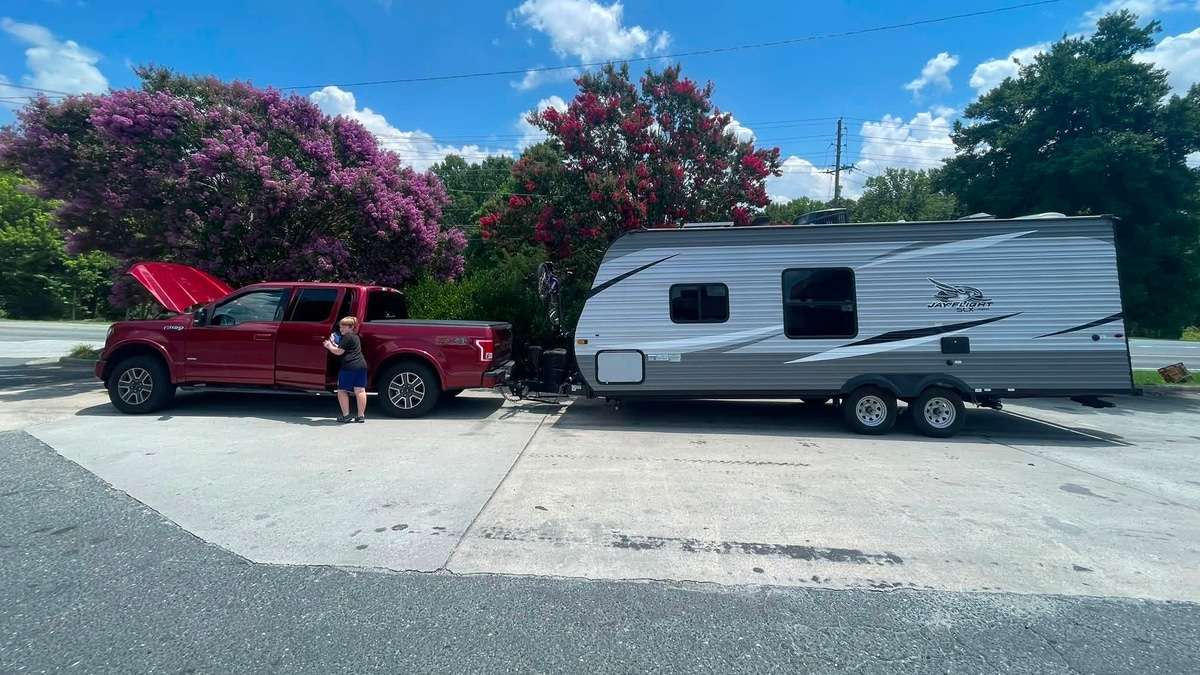

A sudden orange wrench light shouldn't ruin a family beach trip.
But for one high-mileage Ford F-150 EcoBoost owner towing a 6,500-lb Jayco camper, it turned the highway into a recurring, dangerous limp-mode nightmare.
Even worse, multiple mechanics and a local dealership couldn't find a single visual defect or active code once the engine was turned off.
As a third-generation Colorado native and automotive journalist with 30 years of industry experience, I have seen this exact diagnostic wall trip up truck owners for decades.
When you are pulling a heavy trailer up steep highway grades, the extreme thermal load and exhaust volume place a massive strain on the powertrain that standard service bay tests can never replicate.
The Cry For Help That Exposes A Systematic Ford Diagnostic Flaw
This isn't an isolated incident; it’s a terrifying trend quietly exploding across truck forums and social media. Dave Pagel from North Carolina shared his exact frustration on the Ford F-150 Owners Facebook page after his holiday was brought to a grinding halt.
"Just bought a 2021 Jayco 224bh camper and hooked it up to our 2016 Ford F-150 EcoBoost 2.7L V6 with 160k miles for a beach trip," Pagel stated. "While towing up highway hills, a wrench light popped up, the truck went completely limp, and I had to cycle the ignition five times just to keep moving under 60 mph while three different mechanics, including a Ford dealership, couldn't find the issue visually after it threw a temporary P2099 code."
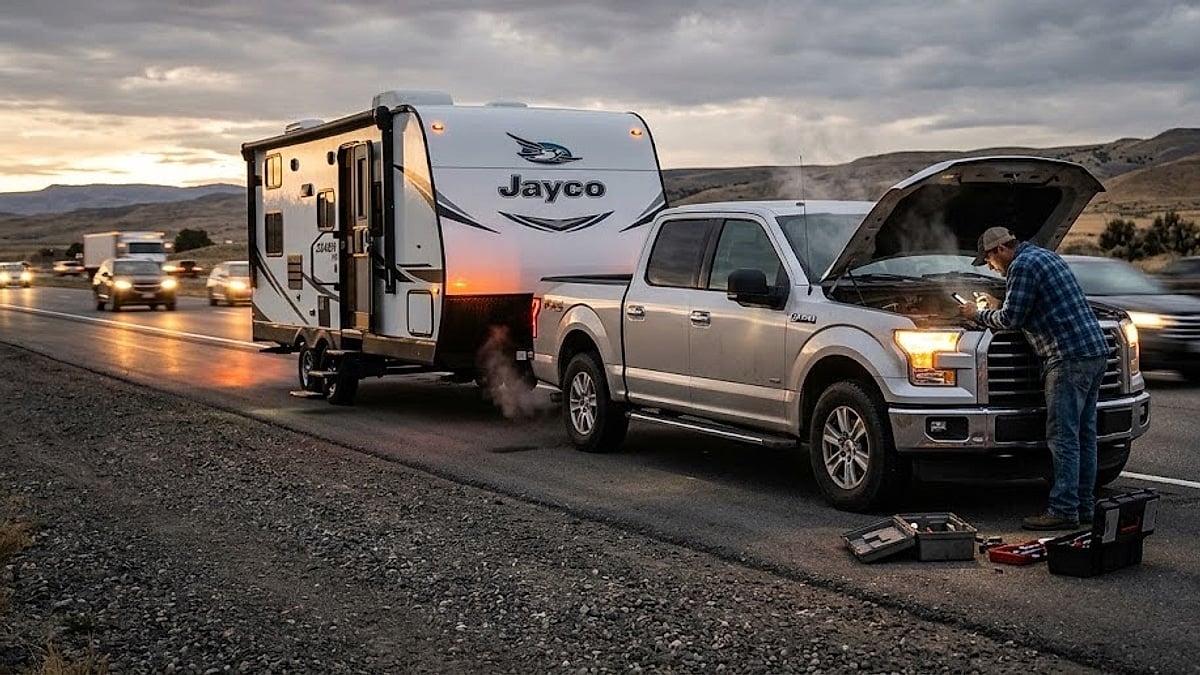
This owner's experience perfectly mirrors a broader pattern of software and electrical anomalies that continue to plague older, high-mileage half-ton platforms under heavy stress.
In fact, a recent report by Car and Driver detailed how the National Highway Traffic Safety Administration upgraded a massive transmission investigation into a recall affecting nearly 1.4 million Ford F-150 pickups due to sudden, unexpected drops in sensor signals.
While that specific recall addresses a different sensor group inside the transmission lead frame, it highlights a persistent reality: Ford’s powertrain control modules are highly sensitive to sudden voltage and signal interruptions when components get hot.
Why The Service Bay Is Blind To Real-World Towing Stress
When Dave's dealership test-drove his unladen truck around a flat city block, they declared the powertrain perfect because that brief trial couldn't recreate what happens when twin turbochargers cook under sustained boost.
According to technical analysis data from Blue Springs Ford Parts, severe engine shuddering and subsequent safety protections are triggered by condensation pooling inside the charge air cooler.
When a driver suddenly accelerates to climb a hill while towing a 6,500-lb camper, the massive surge of air draws that accumulated moisture or unburned oil vapor straight into the combustion chambers, causing an immediate misfire and an air-fuel imbalance that forces the vehicle into a protective "zero boost" limp mode.
This diagnostic blind spot highlights a critical truth from ongoing used-vehicle analysis: safely operating a high-mileage pickup truck depends less on a flawless dealership service record and far more on identifying how prior miles were logged and actively managing severe duty cycles.
You can read my full, data-driven diagnostic action plan in my detailed guide on Why a Used Ford F-150 With High Mileage Is the Secret to Beating Inflated Dealership Prices.
The Rocky Mountain Altitude Factor: A Brutal Real-World Testing Ground
Living and testing vehicles here in Parker, Colorado, as a member of the Rocky Mountain Automotive Press, I frequently use our high-altitude mountain passes to push powertrains to their absolute breaking points.
Up at 11,000 feet on the I-70 Eisenhower Tunnel Pass, the ambient air is thin, forcing the EcoBoost's twin turbochargers to spin significantly faster and hotter to compress enough oxygen to maintain power.
If your truck has a microscopic exhaust leak or a slightly worn wastegate actuator, the thin mountain air will instantly amplify the pressure differential. The engine control module tries to compensate by dumping extra fuel into the cylinders, instantly triggering a rich condition, a P2099 code, and a sudden drop in power.
This behavior is why many long-time truck owners end up missing the simpler, linear power delivery of a naturally aspirated engine when heavy towing is a regular requirement. As I recently documented in an F-150 long-term comparison piece, many veteran drivers often find themselves stuck between the effortless low-end grunt of a twin-turbo platform and the traditional simplicity of a V8.
Read more about this performance dynamic in my analysis of The High Tech 2025 Ford F-150 Is a Genius on The Highway That Still Makes Me Dream of The Raw Power in The Ten Year Old Truck I Left Behind.
How To Safely Intercept Limp Mode Before It Leaves You Stranded
If you find yourself in Dave’s shoes, pulling a heavy camper with the wrench light flashing rhythmically on your dashboard, you do not have to wait until something catastrophically breaks. The absolute first step is to buy an inexpensive OBD2 Bluetooth scanner and plug it into your truck's port permanently while towing.
This allows your passenger to capture "freeze frame data" the exact second the wrench light pops up on a hill, recording the exact boost pressures, fuel rail inputs, and exhaust temperatures that the dealership needs to see.
Additionally, you should inspect the turbocharger bypass valves and check for soot marks on the backs of the cylinder heads, which immediately indicate a warped exhaust manifold leaking under high thermal pressure.
Switching to a high-quality 5W-30 full synthetic oil and shortening your spark plug replacement intervals to every 30,000 miles can also dramatically reduce high-load ignition misfires.
What Should You Do If Your Truck Safely Restores Power After Cycling The Ignition?
If turning your truck off and on immediately clears the wrench light on the dashboard and restores full engine power, it indicates that your F-150 is experiencing a soft software fault rather than permanent mechanical component failure.
The vehicle's computer resets its operational parameters upon startup, but it will inevitably trigger limp mode again as soon as the exhaust gas temperatures and turbo boost thresholds exceed the safe target map during your next long highway incline.
The Final Verdict On High-Mileage EcoBoost Towing Safety
Towing a heavy travel trailer with a high-mileage turbocharged truck requires proactive mechanical diagnostics rather than waiting for a complete component blowout on the side of the road. By understanding how extreme thermal expansion triggers hidden air-fuel imbalances, owners can correctly isolate these vanishing faults and keep their family road trips completely safe.
How About You? Have you ever experienced a sudden, terrifying limp mode event while pulling a camper up a steep highway grade?
Tell us what you think in the comments section below! Please leave a comment in the red “Add new comment” link to share your diagnostic stories, your truck's mileage, and how you finally fixed your towing issues.
Wait, There’s More… Also check out my Torque News Home Page for more of my informative Ford F-150 news articles.
About The Author
Denis Flierl is a 14-year Senior Reporter at Torque News and a member of the Rocky Mountain Automotive Press (RMAP) with 30+ years of industry experience. Explore his full investigative reporting archives and technical guides at DenisFlierl.com.
Based in Parker, Colorado, Denis leverages the Rockies' high-altitude terrain as a rigorous testing ground to provide "boots-on-the-ground" analysis for readers across the Rocky Mountain region, California EV corridors, the Northeast, Texas truck markets, and Midwest agricultural zones.
A former professional test driver and consultant for Ford, GM, Ram, Toyota, and Tesla, he delivers data-backed insights on reliability and market shifts. Denis cuts through the noise to provide national audiences with the real-world reporting today’s landscape demands.
Connect with Denis: Find him on LinkedIn, X @DenisFlierl, @WorldsCoolestRides, Facebook, and Instagram.
Photo credit: Denis Flierl via Dave Pagel
Set Torque News as Preferred Source on Google
Follow us today...







Comments
Well that is exactly what…
Permalink
Well that is exactly what was happening to my low mile 65,000 2013 3.5 Ecoboost. Never went into limp mode without a trailer on it. But many times it put me in limp mode on the freeway which was very sketchy and dangerous especially towing a decent size load. I did however figure out a fix. 2024 Ford Tremor 1 ton with the 7.3. Problem solved.