
There's something deliciously ironic about the electric vehicle revolution's collision with the oldest force known to travelers: wind. Here we are, armed with the most sophisticated automotive technology ever conceived, bristling with sensors and computers that can calculate range down to the decimal point, and yet we're still getting schooled by the same invisible adversary that tormented covered wagons crossing the prairie. XMasta19's recent education in atmospheric dynamics while towing his U-Haul behind a Ford F-150 Lightning serves as a perfect metaphor for our species' eternal struggle between technological confidence and natural reality.
The setup reads like a classic American road story: man, machine, and the open highway, with the added twist of electricity instead of gasoline providing the motivation. Our protagonist approached his 300-mile journey with the kind of cautious pessimism that has become the hallmark of early electric vehicle adoption, expecting his Lightning to deliver the disappointing performance that internet forums had conditioned him to anticipate.
“TLDR: truck is amazing lol.
Obviously, one of the most common things online about EV trucks is the poor towing performance due to the impact on range. The towing power itself is ridiculous, and many (myself included) comment on how it’s barely even noticeable that something is being towed.
With that being said, I planned a 300-mile round trip with a loaded U-haul trailer and fully expected to barely get 100ish miles of range or so… for most of the first leg of the trip (charging station was exactly halfway), I was at a whopping 1.8 mi/kWh! That was roads at 45-55mph for the beginning, then the remainder on the Interstate at 65mph. I literally thought something was broken with that type of efficiency being reported lol.
On the way back (with the empty trailer), I attempted to increase up to the Interstate’s 70mph speed limit. I was instantly humbled when my range kept decreasing to the point that I wasn’t sure if I’d actually make it to the Supercharger lol. It was the weirdest thing that I couldn’t seem to figure out, so for the last few minutes, I dropped the speed a bit and arrived just under 10% battery remaining.
Grateful for all of the online support and information available, as I know how to manually calculate range based on a given mi/kWh efficiency, so I just kept updating my math accordingly based on what I was seeing. My original numbers had me arriving at the charging station with around 23% SOC, even factoring in the lower 1.3 mi/kWh I was seeing… when it kept going below that, I definitely knew something was up!
I finally realized that I might have been dealing with another factor I hadn’t originally considered… THE WIND haha. Sure enough, the storms off the coast of Florida and the cold front moving in from the north were causing a pretty steady southerly breeze. That totally tracks how I was able to get the final number of 1.7 mi/kWh on the 150-mile trip south, but only 1.4 mi/kWh as the efficiency with an empty trailer heading back north.
Overall, I’m still very impressed with how the truck performed! We don’t plan on towing that far very regularly, more so within a range of 100 miles. This pleasant towing experience doesn’t have me scared to buy a trailer now.”
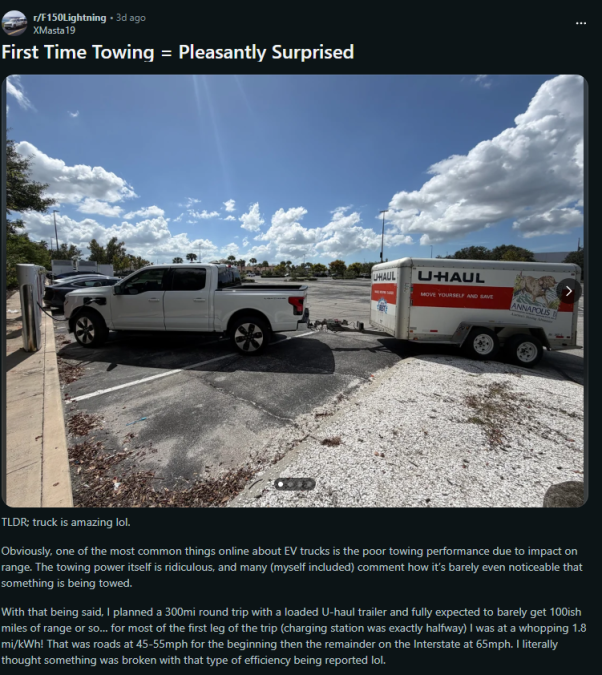
This observation reveals the fundamental disconnect between electric vehicle capability and public perception, where instant torque delivery makes a mockery of traditional towing struggles while range anxiety dominates the narrative. The first leg of his journey delivered results that seemed to mock every dire prediction about electric towing, achieving an efficiency figure that defied conventional wisdom with the casual indifference of natural law. With that being said, I planned a 300-mile round trip with a loaded U-haul trailer and fully expected to barely get 100ish miles of range or so... for most of the first leg of the trip (charging station was exactly halfway) I was at a whopping 1.8 mi/kWh!
The disbelief in his account reflects our modern condition perfectly: we've become so conditioned to expect technological disappointment that genuine success feels like an equipment malfunction. I literally thought something was broken with that type of efficiency being reported lol. This reaction speaks to something deeper about our relationship with technology. We've learned to distrust good news, to assume that positive results must be errors, because our experience with complex systems has taught us that Murphy's Law governs more often than manufacturer specifications.
The homeward leg would provide the kind of education that only comes from direct confrontation with physical reality, beginning with a decision to push the speed limit that would quickly reveal the difference between favorable conditions and neutral physics. On the way back (with the empty trailer), I attempted to increase up to the Interstate's 70mph speed limit. I was instantly humbled when my range kept decreasing to the point that I wasn't sure if I'd actually make it to the Supercharger lol.
The word "humbled" carries particular weight here, suggesting not just surprise but a fundamental recalibration of confidence that comes when nature reminds us who's really in charge. The mathematical panic that followed reveals the analytical mindset that electric vehicle ownership demands, where success depends not on intuition or experience but on constant calculation and recalibration of variables that remain largely invisible. Grateful for all of the online support and information available, as I know how to manually calculate range based on a given mi/kWh efficiency, so I just kept updating my math accordingly based on what I was seeing.
This real-time number crunching represents a fundamental shift in the driving experience, where the romantic notion of hitting the road gives way to spreadsheet-level precision in energy management. The growing discrepancy between calculated expectations and harsh reality created the kind of range anxiety that has become the defining neurosis of electric vehicle ownership. My original numbers had me arriving at the charging station with around 23% SOC, even factoringin the lower 1.3 mi/kWh I was seeing... when it kept going below that, I definitely knew something was up!
The revelation, when it came, was both embarrassingly simple and profoundly educational. I finally realized that I might have been dealing with another factor I hadn't originally considered... THE WIND haha. Sure enough, the storms off the coast of Florida and the cold front moving in from the north were causing a pretty steady southerly breeze.
LankyTraffic3601's response cuts through the confusion with the kind of technical clarity that makes online forums invaluable resources for understanding complex systems. FYI, unless you are in stop-and-go driving or all-city driving, the weight inside that trailer will have almost no impact on your range. It's the drag and wind resistance from the mere hauling of a trailer, empty or loaded, that matters. This insight challenges one of our most basic assumptions about towing, where intuition suggests that heavier loads should always mean worse performance.
The physics lesson embedded in this comment reveals why electric vehicles operate according to different rules than their internal combustion predecessors. While traditional engines struggle with additional weight across all operating conditions, electric motors handle increased loads with the casual indifference of industrial machinery, making aerodynamic drag the dominant factor in highway efficiency. This represents a fundamental shift in automotive physics that most drivers haven't yet internalized, creating opportunities for exactly the kind of surprise that our Lightning owner experienced.
The community response also illustrates something beautiful about automotive enthusiasm in the digital age: the willingness of strangers to share hard-won knowledge for the benefit of fellow travelers. But then comes mdk2004's reality check, delivered with the subtle cruelty that characterizes much online discourse: You averaged 40 mph..... this matters a lot. Try it again and average 80. It's going to be a huge difference. The ellipsis and multiple periods suggest barely contained disdain for what the commenter perceives as naive enthusiasm, revealing the darker side of automotive communities where knowledge becomes a weapon for establishing hierarchy rather than a tool for mutual education.
Our protagonist's response demonstrates the defensive instincts that emerge when practical wisdom meets theoretical criticism: LOL, I have no intention of going 80mph while towing! I like your math; however, I believe those "trip" timers are factoring in the entire time spent charging and/or loading, unloading, and unhooking the trailer while the truck was "idling". This exchange perfectly captures the tension between real-world operation and laboratory conditions, where safety considerations and operational requirements create constraints that pure efficiency testing ignores.
The Physics of Electric Towing Reality
- Wind resistance creates the primary efficiency challenge, making trailer profile more important than cargo weight in determining range impact during highway operation.
- Weather patterns can create efficiency swings of 20% or more, turning favorable conditions into range anxiety with changes in wind direction or intensity.
- The exponential relationship between speed and energy consumption becomes dramatically amplified when towing, making small speed increases result in disproportionate range penalties.
- Success requires continuous monitoring and mathematical adjustment of range projections, transforming driving from an intuitive to an analytical activity.
This tale of wind-induced humility speaks to larger questions about our relationship with technology and nature in the 21st century. We've created machines of incredible sophistication, capable of hauling heavy loads with whisper-quiet efficiency, yet we remain subject to the same atmospheric forces that challenged our ancestors. The difference is that our ancestors expected to be at nature's mercy, while we've been conditioned to believe that technology should insulate us from such primitive concerns.
The Lightning's performance under favorable conditions created a false sense of mastery that the return journey quickly corrected. This cycle of confidence and humbling represents the essential electric vehicle experience, where exceptional capability coexists with environmental sensitivity in ways that challenge traditional automotive assumptions. The truck could effortlessly pull the trailer, but it couldn't overcome the fundamental physics of air resistance any more than a sailing ship can ignore the wind.
The educational value of this experience extends far beyond individual enlightenment to inform broader discussions about electric vehicle towing capabilities and realistic expectations for electric truck adoption. Real-world experiences like this provide more valuable insights than controlled testing environments, where variables like wind, temperature, and operational constraints get minimized or eliminated entirely.
The psychological impact of exceeding expectations, followed by an environmental reality check, reflects the learning curve that accompanies any significant technological transition. Overall, I'm still very impressed with how the truck performed! We don't plan on towing that far very regularly, more so within a range of 100 miles. This pleasant towing experience doesn't have me scared to buy a trailer now. This conclusion demonstrates the kind of adaptive thinking that successful technology adoption requires, where initial assumptions give way to practical understanding based on actual experience.
Practical Electric Towing Wisdom
- Understanding weather patterns and wind conditions becomes as important as route planning and charging station locations for successful electric towing.
- Maintaining conservative speeds while towing provides significant range benefits that outweigh time savings from higher speeds, particularly when charging stops are required.
- Success depends on understanding that electric towing operates according to different rules than traditional towing, requiring adjustment of assumptions and practices.
- Shared experiences from real-world operations provide more practical guidance than manufacturer specifications or controlled testing environments.
There's something poetic about wind serving as the primary educator in this tale of electric vehicle enlightenment. Wind represents the most democratic of natural forces, affecting rich and poor, sophisticated and simple, with equal indifference. It doesn't care about your truck's advanced aerodynamics, sophisticated battery management system, or precisely calculated range projections. It simply exists, creating resistance that must be overcome regardless of the elegance of your propulsion system.
The Lightning owner's discovery that environmental factors could outweigh mechanical considerations represents a return to fundamental truths that our technological sophistication sometimes obscures. Sailors have understood wind's power for millennia, but we've somehow convinced ourselves that automotive technology should be immune to such primitive influences. The electric vehicle revolution, for all its technological advancement, hasn't repealed the laws of physics or eliminated our dependence on atmospheric conditions.
The ongoing development of electric vehicle technology will undoubtedly address some of the challenges revealed by experiences like this, with improvements in aerodynamics, battery efficiency, and charging infrastructure all contributing to better towing performance. But the fundamental relationship between vehicles and atmospheric conditions will remain, making experiences like this valuable regardless of technological advancement.
The ultimate lesson may be that successful electric vehicle adoption requires not just technological sophistication but also humility in the face of natural forces that remain beyond our control. The wind that humbled our Lightning owner serves as a reminder that, for all our technological advancement, we remain participants in rather than masters of the natural world. This recognition doesn't diminish the achievement of electric vehicle technology but rather places it in a proper context as one element in the complex equation of sustainable transportation solutions.
Have you experienced moments where natural forces reminded you of technology's limitations, and how do you balance confidence in modern automotive capabilities with respect for environmental factors beyond our control? What role do you think community knowledge sharing plays in helping us understand the real-world performance of advanced technologies like electric vehicles? Share your thoughts on the intersection of technology and nature in modern automotive experiences in the comments below.
Image Sources: Ford Media Center
Noah Washington is an automotive journalist based in Atlanta, Georgia. He enjoys covering the latest news in the automotive industry and conducting reviews on the latest cars. He has been in the automotive industry since 15 years old and has been featured in prominent automotive news sites. You can reach him on X and LinkedIn for tips and to follow his automotive coverage.
Set Torque News as Preferred Source on Google
Follow us today...