
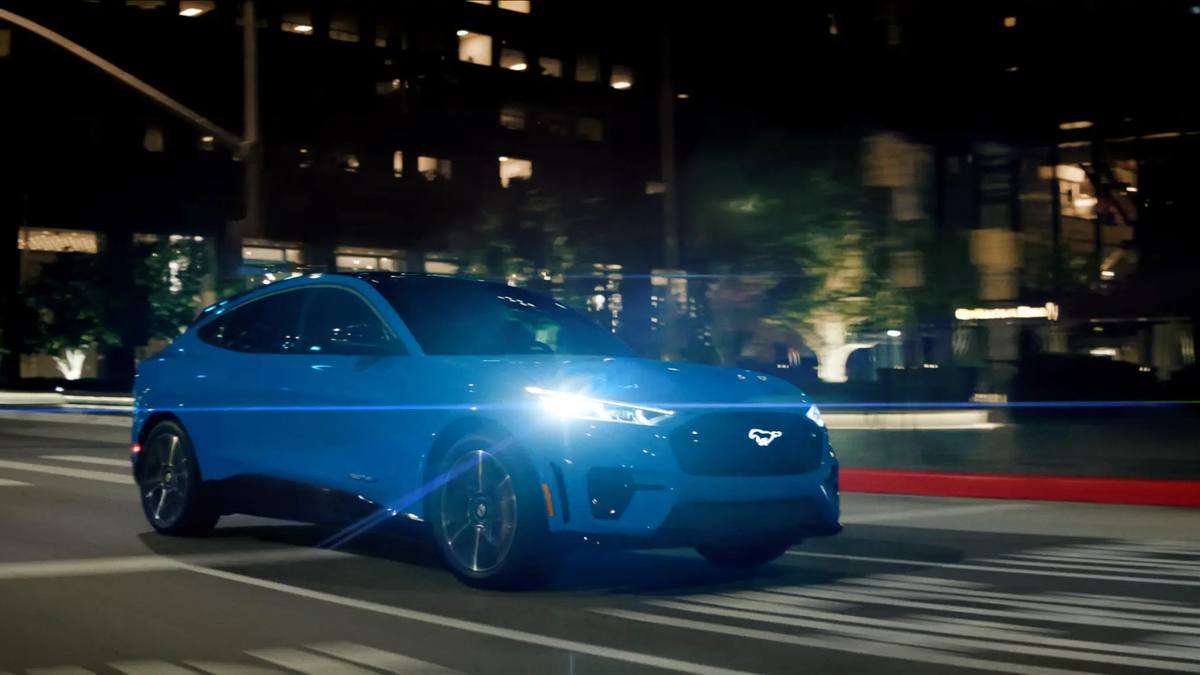

Coming home after weeks overseas is supposed to be a relief. For one 2024 Mustang Mach-E GT owner in Raleigh, North Carolina, it turned into a shock that still has no clear explanation and no warranty help from Ford.
The owner says he left the country for three weeks beginning January 12, parking his Mach-E in the same spot where his previous Mach-E had lived without issue for years. While he was gone, recorded outdoor temperatures hovered around 55°F. No heat waves.
No summer sun. No extreme conditions. When he returned, he says the A, B, and C pillars on his nearly new Mach-E were visibly melted and warped, distorted along their entire length rather than in a single concentrated spot.
“I went away overseas for three weeks. I left on January 12. I live in Raleigh, North Carolina. The Hyatt recorded a temperature while I was gone of 55 °. I parked my Maki in the same spot since I bought my 2022 Mach EGT back in 21. Earlier this year, I traded that in for the model 2024 when I came back; the entire A, B, and C pillars were melted into a distorted shape. I have East-West exposure, so there’s no direct sun until sunset, and even then, it’s at a far angle and greatly weakened by the winter. Ford summarily dismissed my claim, saying that this is clearly damaged and caused by solar reflection. Except there’s nothing to reflect, and it’s across as I said the AB and C pillars. And it’s not just one spot, it’s the entire pillar that’s melted in each case. Has anyone ever seen this?”
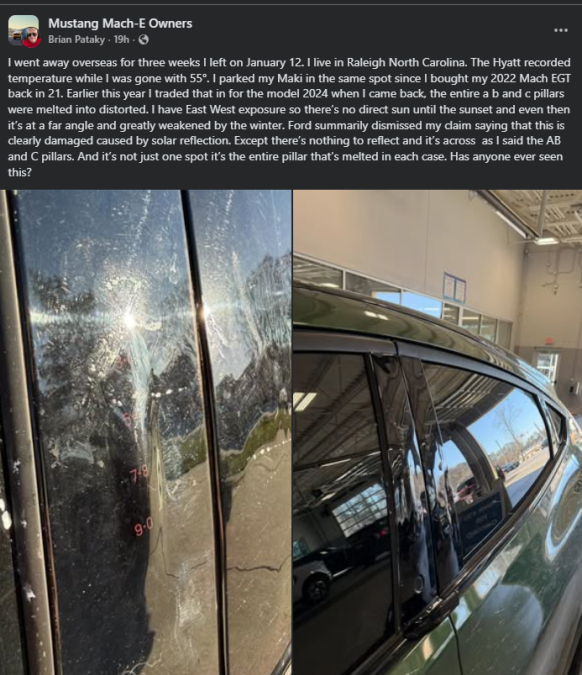
What makes the situation more puzzling is the location. The owner notes that his parking spot has east-west exposure, meaning there is no direct sun during most of the day. Any sunlight in winter would arrive low and late, at an oblique angle and significantly weaker than summer conditions. Despite that, Ford quickly denied the warranty claim, stating that the damage was “clearly caused by solar reflection.”
Ford Mustang Mach-E: Battery Placement & Steering
- Battery placement under the floor gives the Mach-E a planted feel through long sweepers, reducing the top-heavy sensation common in tall crossovers.
- Steering tuning favors predictability and ease over detailed feedback, which suits commuting but may feel muted to drivers expecting sports-car communication.
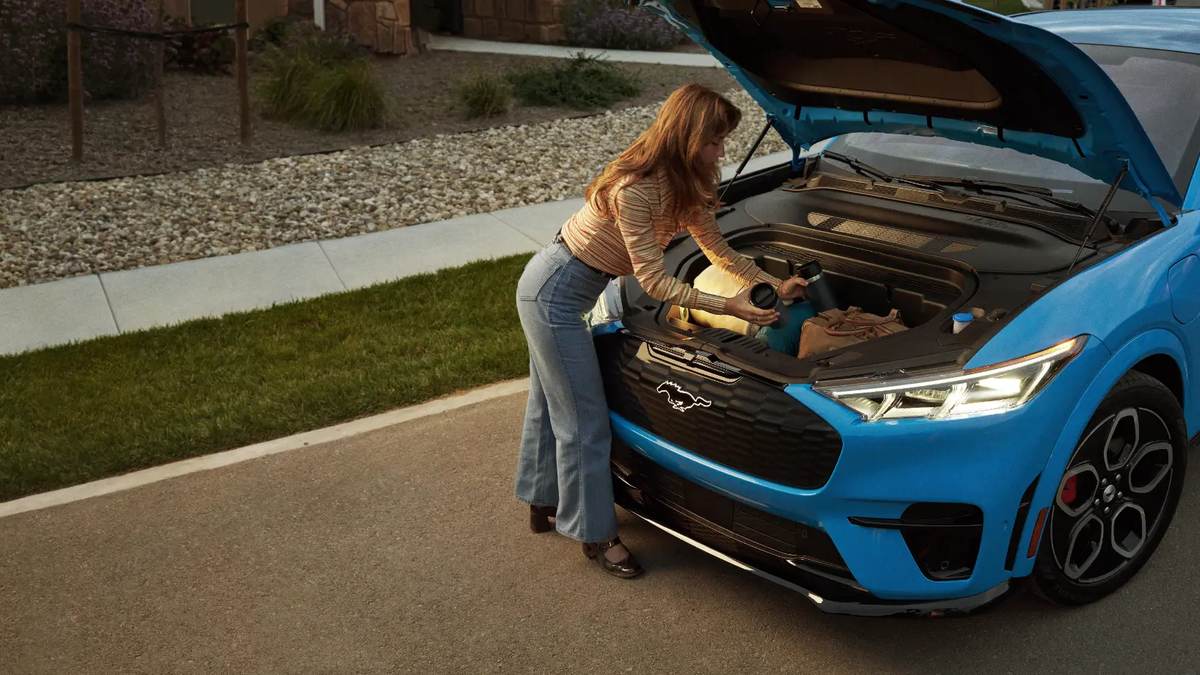
- The frunk adds genuinely useful sealed storage for charging cables or dirty gear, helping separate everyday items from the main cargo area.
- Real-world usability depends heavily on software behavior, with comfort features, charging routines, and driver-assistance behavior shaped by updates over time.
That explanation did not sit well with the owner. According to him, there is nothing nearby that could reasonably act as a reflector, such as large glass façades or mirrored surfaces. More importantly, he points out that solar reflection damage typically appears as a localized burn or melt pattern. In his case, the distortion spans entire pillars on both sides of the vehicle, suggesting something systemic rather than a focused heat beam.
The comparison to his prior vehicle only deepened the frustration. He had parked a 2022 Mach-E GT in the same location since 2021 without a single issue. Nothing about the environment changed. Only the vehicle did. That raises uncomfortable questions about whether material changes were made between model years, particularly in exterior trim plastics and coatings.
Responses from other owners were divided. Some urged him to bypass the dealership entirely and escalate directly to Ford corporate, arguing that dismissing such extensive damage outright feels premature at best. Others sided with Ford, pointing to well-documented cases where modern energy-efficient windows can reflect and intensify sunlight enough to melt automotive plastics, siding, and even vinyl fences, regardless of ambient temperature.
Still, skepticism remains. Even those familiar with solar reflection cases acknowledge that they usually affect small, sharply defined areas. Entire pillars deforming uniformly is harder to explain away. As one commenter bluntly put it, car manufacturers are well aware that the sun exists, and exterior materials should be engineered to survive prolonged exposure, even in worst-case scenarios.
The larger issue here is not just whether Ford is technically correct, but how quickly the claim was dismissed. For a vehicle still well within its early ownership period, owners expect investigation, documentation, and clear reasoning, not a one-line conclusion that shifts responsibility entirely onto the customer.
At this point, the owner is left weighing next steps, including further escalation or potentially involving insurance. Either path feels wrong for the damage that appeared while the car sat unused in mild winter weather. Whether this turns out to be an isolated environmental anomaly or a sign of a material vulnerability in newer Mach-E trims remains unclear.
What is clear is that stories like this erode confidence, especially among owners who believed parking an EV outdoors in winter would be one of the safest scenarios imaginable. If 55-degree weather and indirect sunlight can leave visible deformation behind, owners understandably want answers that go beyond “solar reflection” and a closed warranty case.
Image Sources: Ford Media Center
Noah Washington is an automotive journalist based in Atlanta, Georgia. He enjoys covering the latest news in the automotive industry and conducting reviews on the latest cars. He has been in the automotive industry since 15 years old and has been featured in prominent automotive news sites. You can reach him on X and LinkedIn for tips and to follow his automotive coverage.
Set Torque News as Preferred Source on Google
Follow us today...


Comments
Since its not a real Mustang…
Permalink
Since its not a real Mustang, can you get the dealer to take it back?
Too fast for those "real"…
Permalink
In reply to Since its not a real Mustang… by Buzz Wired (not verified)
Too fast for those "real" mustang fellers.
At work we parked in the…
Permalink
At work we parked in the structure below the offices. Some of the tandem spots assigned to our company were directly under hot water pipes that supplied the building. My Expedition's external heat sensor was directly above the windshield. It registered 92°. Luckily, the pillars were unaffected. I stopped parking in those middle spots.