
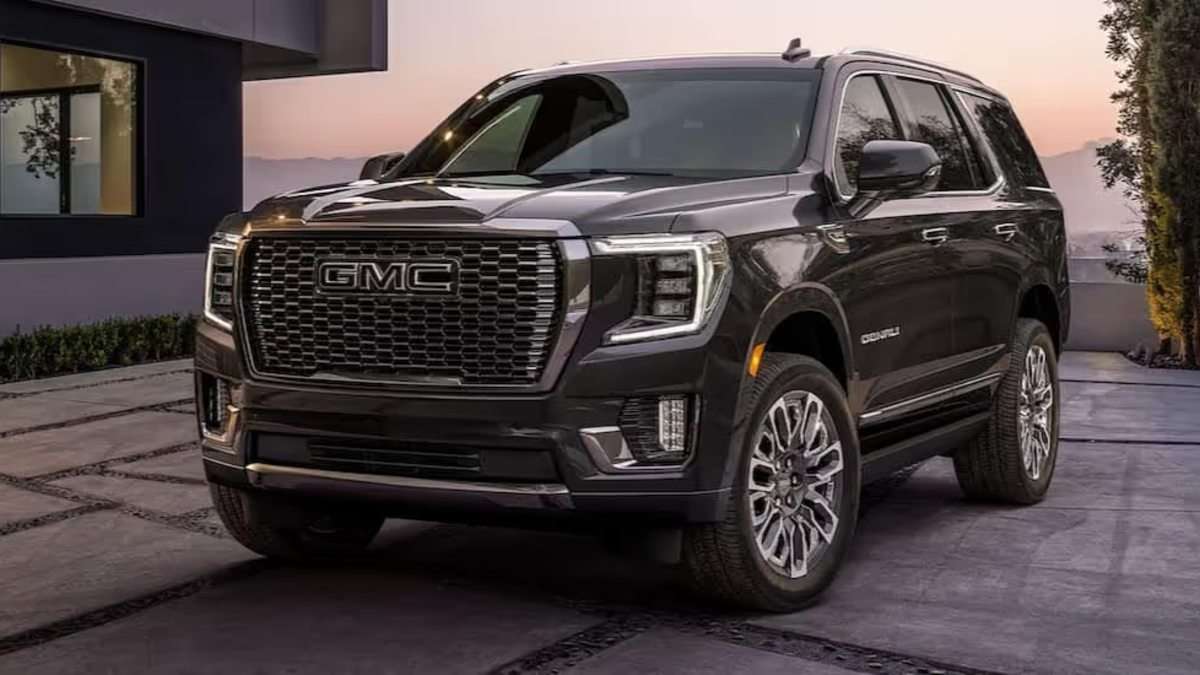

There are few phrases in the modern car world more jarring than “needs a new engine,” especially when they are attached to a vehicle that still smells new inside.
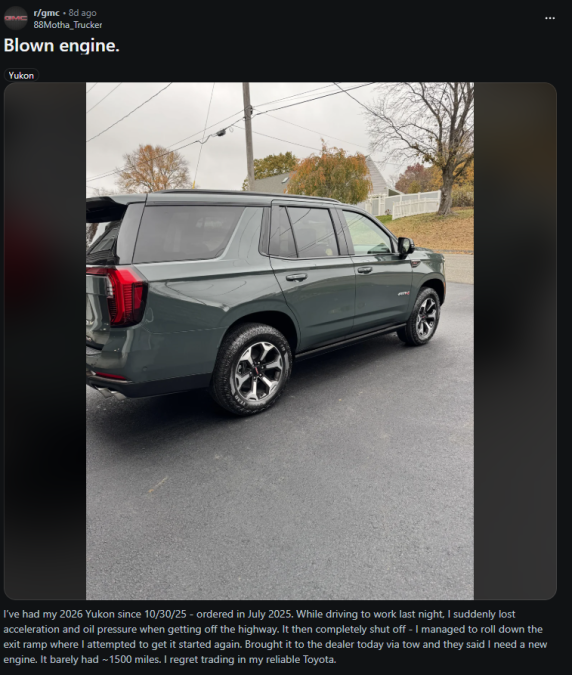
That is the situation one 2026 GMC Yukon owner recently described on r/gmc, after losing acceleration and oil pressure while exiting the highway with barely 1,500 miles on the odometer. Within moments, the SUV shut itself down completely. A tow followed. The diagnosis from the dealer was blunt and final: engine replacement required.
What makes the story resonate is not just the mechanical failure, but how abruptly it arrived. This was not a long, noisy decline or a dashboard slowly lighting up with warnings over weeks. The Yukon simply gave up. One second, it was doing exactly what a full-size SUV is supposed to do; the next, it was coasting off an exit ramp with no oil pressure and no power. For an owner who had just traded in a “reliable Toyota,” the sense of regret practically writes itself.
“I’ve had my 2026 Yukon since 10/30/25 - ordered in July 2025. While driving to work last night, I suddenly lost acceleration and oil pressure when getting off the highway. It then completely shut off - I managed to roll down the exit ramp, where I attempted to get it started again. Brought it to the dealer today via tow, and they said I need a new engine. It barely had 1500 miles. I regret trading in my reliable Toyota.”
The reaction from other owners was swift and unsparing. One commenter put it plainly, noting that at today’s prices, basic engine reliability should be a given, not a bonus feature. Another suggested that if buying again, they would choose the diesel until the gasoline V8s prove themselves trustworthy again. That sentiment reflects a growing skepticism among longtime GM customers who remember when full-size SUVs were defined by durability more than technology.
GMC Yukon: Body-on-Frame Construction and Ride Quality
- The Yukon’s body-on-frame construction prioritizes towing strength and long-distance stability, though it contributes to a firm ride over uneven pavement when unladen.
- Interior space is a central advantage, with generous third-row accommodations and a large cargo area that remains usable even when all seats are occupied.
- Steering and handling emphasize predictability rather than agility, reflecting the vehicle’s size and weight in urban driving and tight parking situations.
- Fuel consumption remains a key consideration, as the Yukon’s size and powertrain options trade efficiency for capability and passenger capacity.
Several replies widened the lens beyond this single failure. One user remarked that the Yukon, once a benchmark for long-term reliability, now feels like a vehicle that has moved backward. The old 5.3-liter LS engines earned their reputation the hard way, by surviving abuse, neglect, and astronomical mileage. It is not uncommon to still see early-2000s Silverados, Suburbans, and Yukons quietly doing daily duty decades later. That history hangs heavily over stories like this.
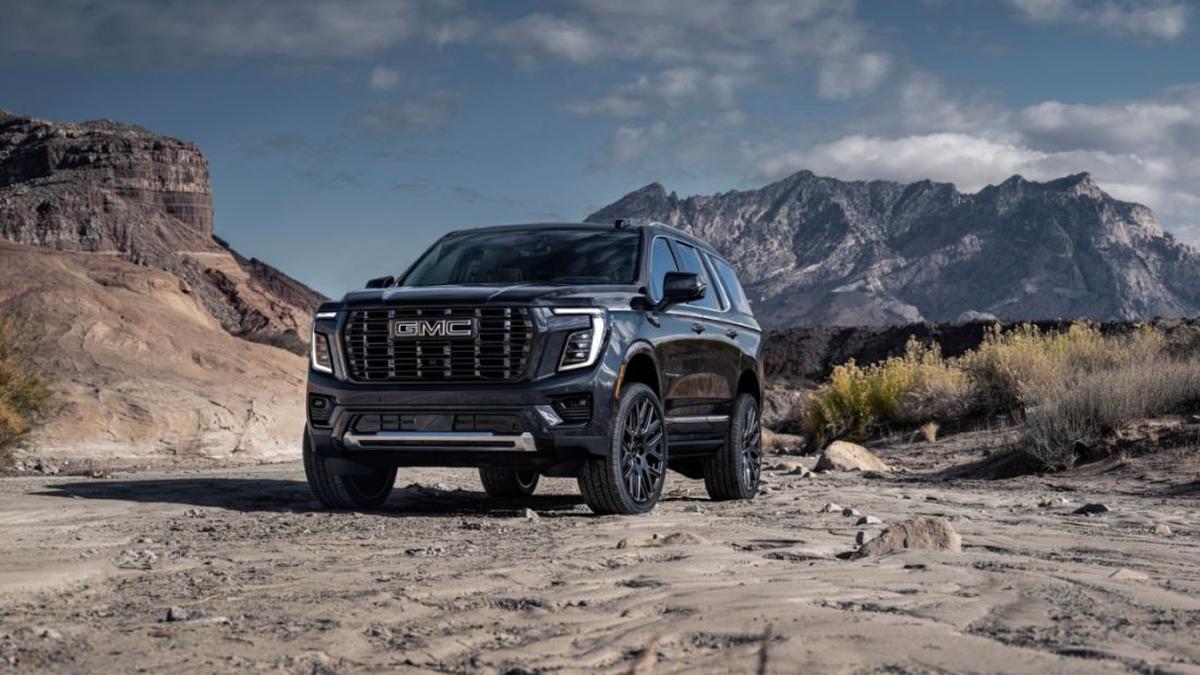
More alarming still was a response from an owner of a 2023 Yukon Denali Ultimate who described living through three engine replacements already, with a fourth now required after lifter failure. Their comment reads less like a complaint and more like a legal brief, listing a second transmission, a second differential, steering failure at highway speed, and repeated engine catastrophes. The frustration culminated in contacting GM’s legal leadership and eventually retaining lawyers. Whether representative or extreme, it adds weight to the sense that these are not isolated frustrations.
At the center of the discussion is GM’s 6.2-liter V8, the engine confirmed by the original poster. On paper, it is a powerhouse, delivering effortless speed in a vehicle that weighs as much as a small house. In practice, reports of lifter failures, oiling issues, and early engine replacements have eroded confidence. The technology that enables efficiency and performance, such as cylinder deactivation, has also introduced new failure points that did not exist in simpler engines.
What makes these stories especially difficult to swallow is the context. These are premium vehicles, often cresting well into luxury-car pricing territory. Buyers are not just paying for leather, screens, and badge prestige. They are paying for the assumption that the fundamentals are bulletproof. When those fundamentals fail early and dramatically, goodwill evaporates quickly.
To be clear, one failed engine does not define an entire brand, and online forums naturally concentrate on worst-case scenarios. But patterns matter, and when multiple owners describe repeated engine replacements with remarkably low mileage, it raises questions that marketing alone cannot answer. Reliability is not about perfection. It is about predictability, and predictability is exactly what these owners feel they have lost.
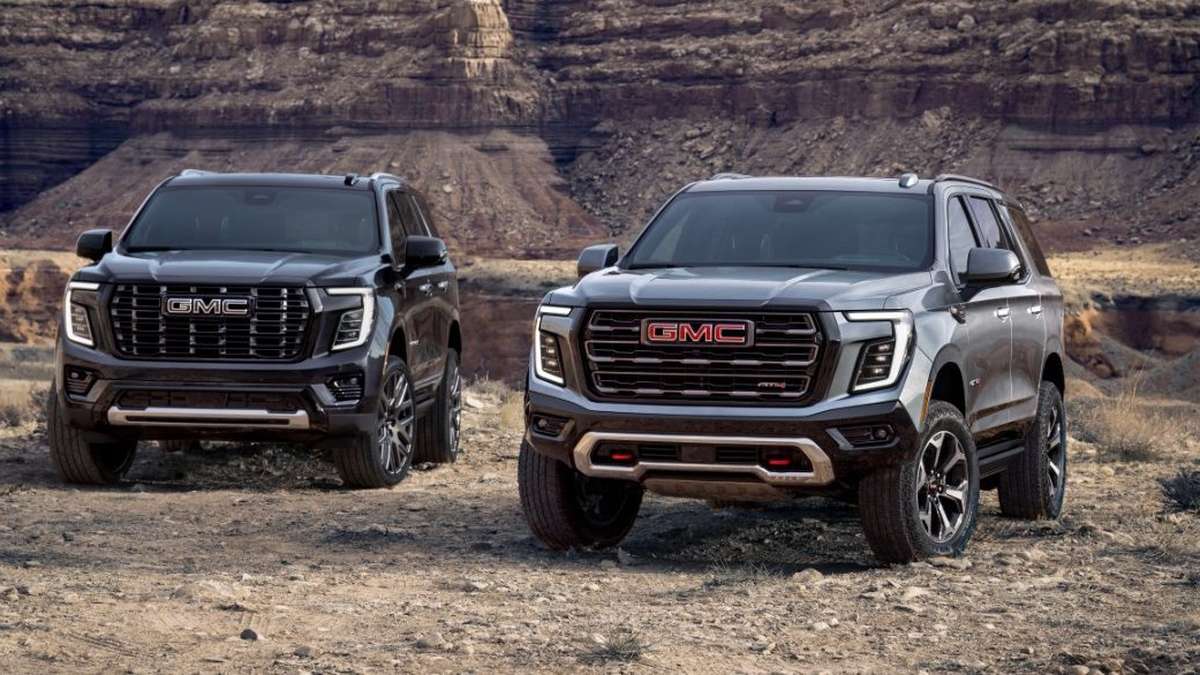
For the original poster, the immediate concern is simple: getting a working engine in a nearly new vehicle. For GM, the concern should be much larger. Trucks and SUVs like the Yukon built their reputations over decades, not model years. Stories like this, shared widely and read closely, chip away at that legacy far faster than any spec sheet can rebuild it. In a market crowded with capable alternatives, the expectation is not excellence. It is competence. And at a bare minimum, an engine that survives its first oil change.
Image Sources: GMC Media Center
Noah Washington is an automotive journalist based in Atlanta, Georgia. He enjoys covering the latest news in the automotive industry and conducting reviews on the latest cars. He has been in the automotive industry since 15 years old and has been featured in prominent automotive news sites. You can reach him on X and LinkedIn for tips and to follow his automotive coverage.
Set Torque News as Preferred Source on Google
Follow us today...




Comments
Zero chance I will buy any…
Permalink
Zero chance I will buy any new American made vehicle. Wouldn't even waste my time looking at them.