
New model years arrive with fresh sheetmetal, revised calibrations, and launch events full of confident PowerPoint slides. Yet, beneath the gloss, the same stories keep coming around. Veteran mechanics talk about it like the weather. Younger drivers read it in forum threads and wonder why their elders keep muttering about old iron that never died and new engines that sometimes do. Every generation has its heroes, its problem children, and its cautionary tales. The latest one wears a 2025 GMC badge and a 3.0 Duramax emblem on the fender.
The story surfaced in a corner of the internet that has essentially replaced the dealership coffee lounge: Reddit’s r/gmcsierra. There, user u/Name_Groundbreaking laid out a post that reads like a modern parable about expectations and reality in the age of high-tech diesels:
“Knock Knock"
"Who's there?"
"Rod bearing"
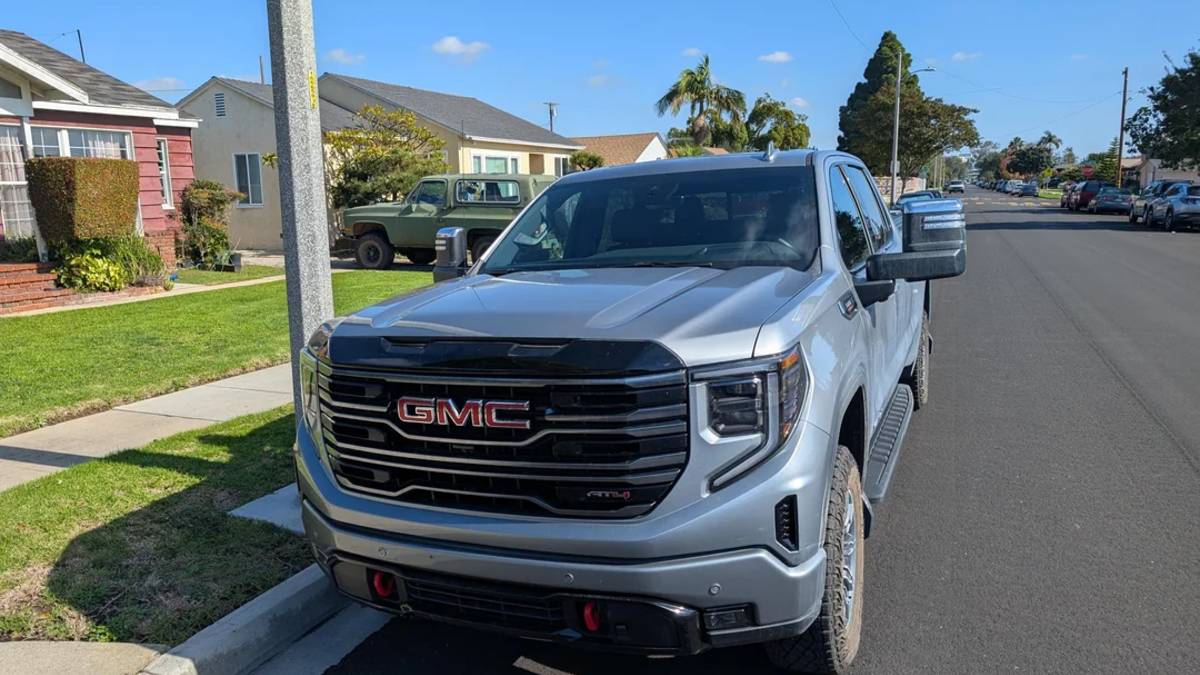
2025 1500 AT4 3.0, bought new at the end of July.
Got a check engine light last night and code p06dd, and it started to sound like a woodpecker above idle. Seems like something wiped out at least one rod bearing, and who knows what else. My best guess is it's the thrust bearing issue documented in 25-NA-307, but I won't know until the dealer gets a chance to dig into it this week.
Advertising
But in any case, I've never heard an engine sound like this and be anything other than a total loss. This seems to be common knowledge now, but buyer beware on the 25/26 3.0 trucks. Back in July, when I bought it seemed like it was the most reliable engine in the half-ton lineup, but with the info that's come out in the last couple months, it might actually be a worse bet than 6.2 if you get an engine from before they figured out the thrust bearings were a problem.
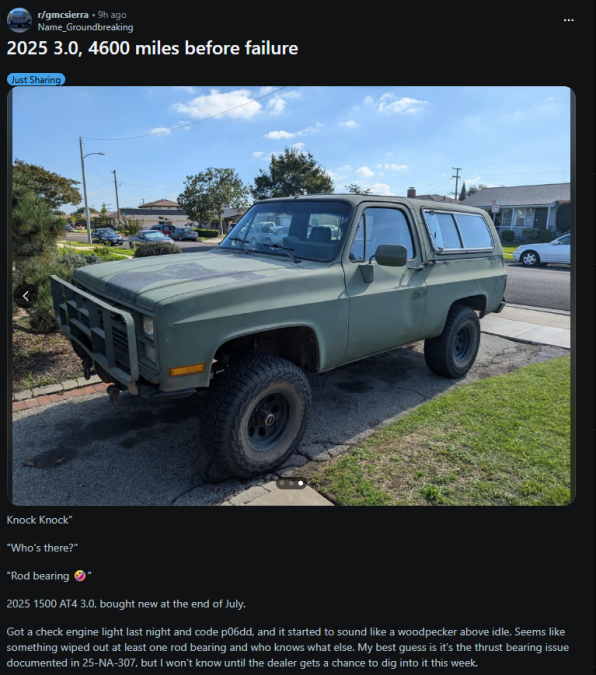
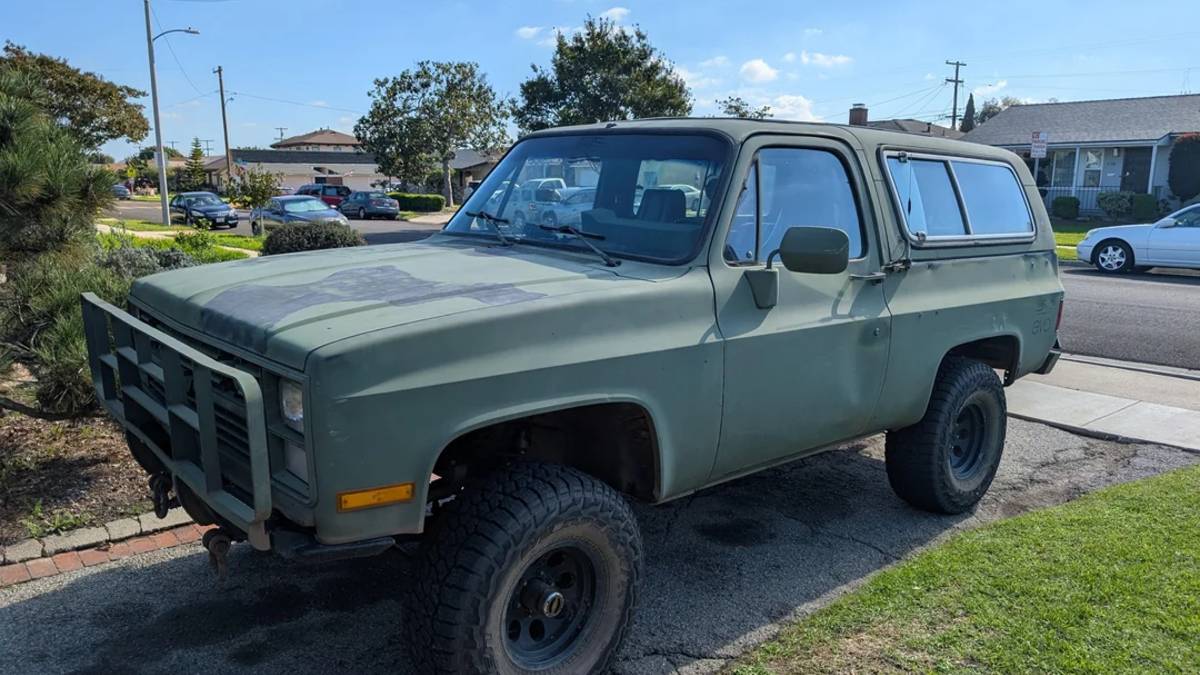
Now I'm back to driving my reliable truck, a K5 with the venerable GM/Detroit 6.2L diesel. It taught two generations of infantrymen how to drive off-road and then sat in a field until I bought it at auction for $2k, after which I spent the last decade daily driving and beating the shit out of it everywhere from Glamis to Moab. At this point, it's 40 years old and has who knows how many hundreds of thousands of miles on it, and it drives like it has decades of life remaining.”
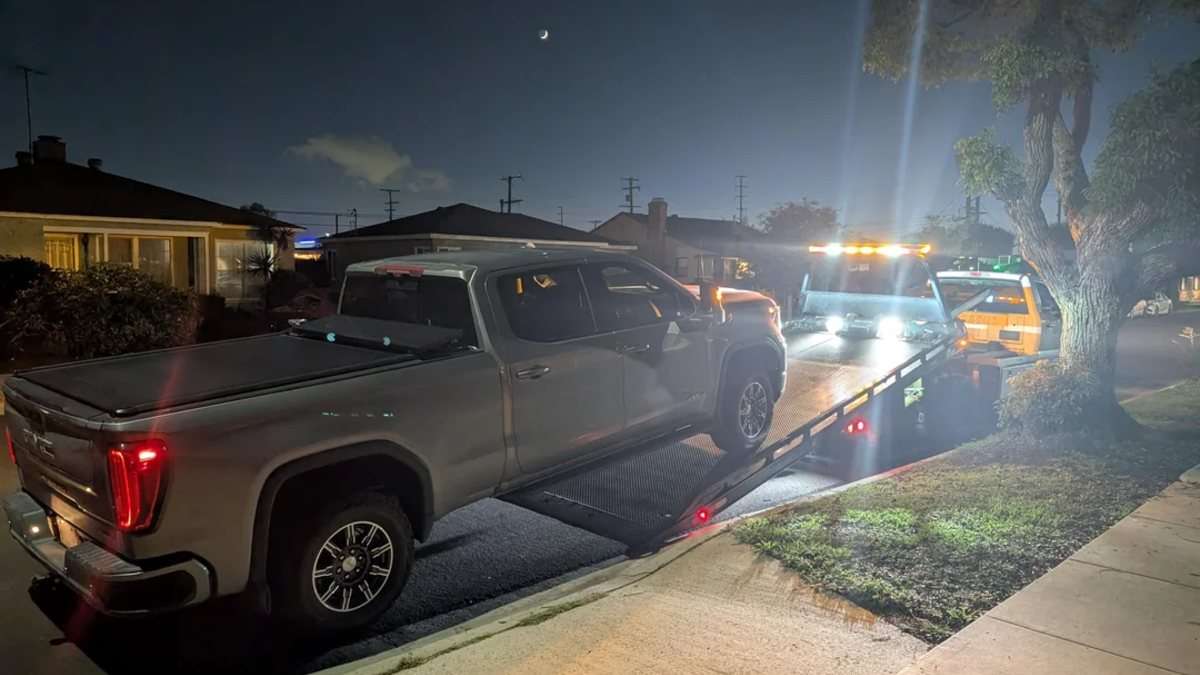
The bare facts are simple enough. A 2025 Sierra 1500 AT4 with the 3.0 Duramax, bought new in late July, runs beautifully for roughly 4,600 miles. No dramas, no hints of trouble. Then, on a mundane run to copy keys at a hardware store, the truck throws a check engine light and a code P06DD. The dash lights up with a reduced power warning. By the next morning, there is a sharp knock from the bellhousing area, the kind of mechanical percussion that makes any driver reach for the ignition key and their phone in the same motion. The owner does exactly what a rational, modern truck owner should do: calls a tow truck, sends the Sierra to the dealer, and heads to Reddit to compare notes.
The comments that follow read like a chorus of familiar refrains. One member chimes in with a 2.7-liter Sierra whose transmission failed scarcely six weeks into ownership and is still parked at the dealer waiting for parts. Another asks a critical question that has echoed through garages for a century: Were there any warning signs? According to the original poster, there were none. The truck drove smoothly, quietly, and confidently until the moment the computer finally detected something internal going wrong. Only then did the engine begin to speak up, with a new and unwelcome rhythm from deep in its lower end. If you have ever owned a mechanical object long enough to trust it, then watched that trust evaporate in one strange noise, you know the feeling.
Where this case becomes technically interesting is in the owner’s suspicion that the failure may be related to the thrust bearing concerns referenced in internal service bulletin 25-NA-307. He notes that he has built engines himself and always checked crankshaft endplay carefully, and he expresses genuine disbelief that an assembly plant could let an out-of-spec unit leave the line. Yet here we are, with multiple internet reports describing similar early failures in some 2025 and 2026 3.0 Duramax engines. There is no recall at the time of his writing, only a bulletin and a warranty process that begins after symptoms appear. Dealers are not tearing inspection covers off every engine on arrival. Whatever quality checks happen upstream are all that an owner gets.
Complicating matters is the reality of the truck’s configuration. This is not a bare bones work special. The AT4 in question carries a rare half-ton crew cab with a 6.5-foot bed, outfitted with a full overlanding style setup in the back. Bed cover, solar system, large lithium house battery, pressurized water supply, onboard air, fridge, and stove on slides. It is a rolling base camp that did not assemble itself. The owner admits he does not want to go through a lemon process unless absolutely necessary, in part because finding another truck spec’d like this would be difficult, and transferring all that hardware to a replacement would be a project measured in weeks, not afternoons.
Then there is the counterpoint sitting quietly in his driveway: a forty-year-old K5 Blazer powered by the old 6.2-liter Detroit diesel. This thing did time in uniform, teaching young soldiers how to drive off-road, then spent years parked in a field before being bought at auction for two grand. Since then, it has been daily driven and hammered across places with names like Glamis and Moab. No one would describe that engine as high tech. It is agricultural, simple, and built for a world where refinement took a back seat to longevity. Yet in this story, it is the old soldier who shoulders the load without complaint while the new recruit sits on a lift waiting for a diagnosis.
That contrast is the heartbeat of the whole episode. Modern trucks are astonishing machines. They deliver power, efficiency, comfort, safety, and quiet that would have felt like science fiction when that K5 rolled off the line. The 3.0 Duramax, in particular, arrived with a reputation as one of the more refined and efficient diesel options in the half-ton market. That makes early failures, even if statistically rare, emotionally loud. At the same time, those older mechanical diesels were designed in an era of generous tolerances and fewer variables. They do not have to juggle modern emissions strategies, complex oiling architectures, or calibration targets. They simply burn fuel and turn shafts, and their simplicity can mask a multitude of sins.
So we end up back where we started, hearing an old story told with new details. A new truck, purchased with rational expectations of reliability, encounters an early engine failure that may be tied to a specific bearing concern. An owner leans on warranty coverage and the patience required to wait for parts. An older machine, written off by time and parked in a field, simply keeps working. Enthusiasts gather in a digital space to share data, offer sympathy, and quietly hope their own serial numbers fall on the right side of the bell curve.
Image Sources: GMC Media Center
Noah Washington is an automotive journalist based in Atlanta, Georgia. He enjoys covering the latest news in the automotive industry and conducting reviews on the latest cars. He has been in the automotive industry since 15 years old and has been featured in prominent automotive news sites. You can reach him on X and LinkedIn for tips and to follow his automotive coverage.
Set Torque News as Preferred Source on Google
Follow us today...