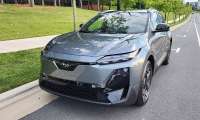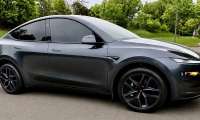

Electric vehicles are better than gas-powered in almost every way. Here’s another great example of why. They can perform unusual maneuvers like “tank turns” and “crab walk” because their hardware and software work in ways that gas-powered vehicles cannot match. We’ve enjoyed watching how these crazy EV maneuvers have caught the eye of social media. Here’s an Instagram post from joelfeder:
“The ‘tank turn’ is a cute party trick, but Rivian put the concept in motion with ‘kick turn’ making it so the new R1 Quads can spin while driving. Wild.”
On the r/electricvehicles subreddit, tm3_to_ev6 defended zero-radius turns as a legitimate driving aid:
“…It can help out people who are really, really bad at parallel parking (and trust me, I know a LOT who struggle even with a backup camera).”
Over on the r/Rivian subreddit, cybergrafx posted:
“The new R1T Quad’s kick turn has me wanting to upgrading. I watched a few videos, one of a new Quad speeding up a dirt road with switchbacks and killing the turns. Looks fun!”
Responding to questions about the usefulness of the GMC Sierra EV’s “crabwalk” Tyler Brown posted on the GMC Sierra Nation Facebook page:
“It works decently in traffic and if you want to maneuver a truck around tight corners as well. They used to have the QuadraSteer back about 20 years ago, but it was unreliable and too expensive to fix. Just imagine having power steering lines go to the rear of your vehicle. Now they have electric racks that barely have issues.”
Why Crazy Steering Maneuvers Work Much Better on EVs
The technical term for the crazy maneuvers that some EVs can perform is “differential steering.” Technology like quad motors enables EVs to control each wheel independently, so the vehicle can send one side forward and the other side backward with instant and precise torque. This level of control comes from electric motors that deliver power at zero RPM without needing gears, transmissions, or mechanical linkages that would normally bind under stress. Software and sensors manage wheel speed, traction, and rotation with incredible accuracy, which allows the vehicle to pivot smoothly on loose surfaces. Also, with their low battery placement, EV have a lower center of gravity which keeps them more stable during sharp rotation movements. Gas vehicles rely on a single, laggy engine, mechanical differentials, and slower power delivery, which makes these kinds of tight turning tricks mechanically impossible. We broke crazy EV maneuvering into four general techniques.
Sideways EVs That Spin Like Office Chairs
Some experimental EVs are exploring true sideways motion by rotating each wheel a full 90 degrees. The Geely EX5 prototype in China and Hyundai’s Ioniq 5 fitted with the Mobis e-Corner system both use independent hub modules at each wheel that combine an in-wheel motor, steer by wire, braking, and suspension in one compact unit. Each wheel can swivel until it is perpendicular to the body of the car, which lets the vehicle move completely sideways for parking or rotate in place for a near zero radius turn. The big advantage is unbelievable low speed maneuverability in tight urban spaces and parking structures. Drivers could slide into a space or spin the vehicle around without a multi-point turn. The downsides include extra cost, mechanical complexity, and durability concerns for steering and wiring that must work through such extreme angles. These prototypes make the Ioniq 5 and Geely EX5 special because they show how an EV skateboard platform can unlock completely new ways of moving that are not realistic for gasoline cars.
Diagonal Crawling with GM CrabWalk Trucks
GM’s CrabWalk system takes a more traditional approach that still looks wild in motion. On the GMC Hummer EV and the GMC Sierra EV, the front and rear wheels use four-wheel steering controlled by an electric rear steering actuator. At low speeds, the rear wheels turn in the same direction as the front wheels instead of the opposite direction that is used for a tighter normal turn. This alignment points all four wheels along a diagonal path, so the truck can ease sideways around rocks, posts, or tight parking lot obstacles while still facing mostly forward. The big advantage is improved off road agility for such a large vehicle, along with easier parking in town. Drivers also get a very dramatic visual effect that fits the Hummer personality. Downsides include higher hardware cost and more components that may need service over time, plus the feature works only at low speed for safety. The Hummer EV is special because it combines CrabWalk with height adjustable air suspension and huge off-road tires, which turns the whole truck into a kind of electric rock crawler that still has a luxury cabin.
From Cancelled Tank Turn to Smarter Kick Turn
Rivian drew huge attention when it teased a true tank turn for the quad motor R1T and R1S. The original concept used one electric motor at each wheel. The left side wheels would spin one way, the right side wheels the opposite way, which could rotate the truck in place on loose dirt like a tank or skid steer. On paper the tank turn showed off the precision of four independent motors and looked incredible in early videos. In practice Rivian realized there were serious downsides. A full tank turn could dig deep ruts into trails, damage fragile terrain, stress tires, and create safety concerns if used in the wrong place. The company eventually announced that tank turn would not ship to customers. Rivian later introduced a more controlled feature called Kick Turn. Instead of spinning in place, Kick Turn uses motor control and braking to help pivot the truck partway around tight off-road switchbacks on suitable surfaces. The advantage is improved maneuverability on trails with less risk of damage. The main downside is that it is more limited and less flashy than the viral tank turn, although it still highlights the unique capabilities of Rivian’s quad motor setup.
Subtle Rear Wheel Steering That Makes Big EVs Feel Smaller
Several modern EVs use four-wheel steering in a more subtle way that focuses on everyday drivability. The Tesla Cybertruck, Kia EV9, and various EVs from Audi, Volkswagen, and Porsche offer rear wheel steering systems powered by electric actuators on the rear axle. At low speeds the rear wheels turn slightly in the opposite direction of the front wheels, which shortens the effective wheelbase and tightens the turning circle. Large vehicles like the EV9 or Cybertruck feel more like compact crossovers in parking lots or crowded trailheads. At higher speeds the rear wheels turn in the same direction as the fronts to improve stability during lane changes. The advantages are easier parking, and a more agile feel without dramatic tricks. Downsides include added cost and complexity and a potential learning curve since the rear can feel more responsive than some drivers expect. Models like the Porsche Taycan stand out because engineers tune rear steering to work with sophisticated torque vectoring and air suspension, which creates a very composed and sporty feel that would be difficult for a similar gas car to match.
Bottom Line
Special steering tricks in EVs all come from the same basic ingredients, electric motors with precise control, steer by wire systems, and low flat battery packs that help keep the vehicle stable during unusual movements. Some approaches chase dramatic party tricks such as zero radius spins or diagonal rock crawling, while others quietly make big EVs easier to live with in tight cities and crowded parking lots. Each method brings tradeoffs in cost, complexity, and potential impact on tires or terrain. The interesting pattern is that once wheels are freed from the mechanical chains of engines, driveshafts, and fixed differentials, automakers can experiment with completely new ways for vehicles to move, which hints that EV handling still has plenty of room to evolve.
The GMC Hummer EV
The GMC Hummer EV is a bold all-electric truck and SUV that launched in late 2021 as part of General Motors’ effort to bring high-performance electric vehicles to the mainstream. What makes the Hummer EV stand out is its combination of massive power, off-road capability, and unique features like CrabWalk and Extract Mode that let the truck move in ways most vehicles cannot. Its electric motors deliver astonishing torque and acceleration that often rival supercars, while fast charging support makes long trips easier. The Hummer EV starts around the high six figures for the launch edition models, with more affordable trims closer to the mid $80,000 range depending on specs and options. It is sold in pickup truck and SUV body styles, giving buyers a choice between open-bed utility or a more enclosed adventure-ready ride.
What Do You Think?
Which of these EV maneuvers would you actually use in real life, and which ones feel like pure entertainment?
Do you think the GMC Hummer EV’s CrabWalk is genuinely useful or mostly a marketing gimmick?
Chris Johnston is the author of SAE’s comprehensive book on electric vehicles, "The Arrival of The Electric Car." His coverage on Torque News focuses on electric vehicles. Chris has decades of product management experience in telematics, mobile computing, and wireless communications. Chris has a B.S. in electrical engineering from Purdue University and an MBA. He lives in Seattle. When not working, Chris enjoys restoring classic wooden boats, open water swimming, cycling and flying (as a private pilot). You can connect with Chris on LinkedIn and follow his work on X at ChrisJohnstonEV.
Photo credit: Provided by author
Set Torque News as Preferred Source on Google
Follow us today...