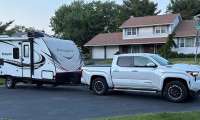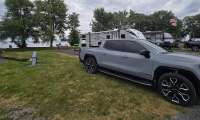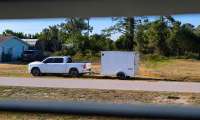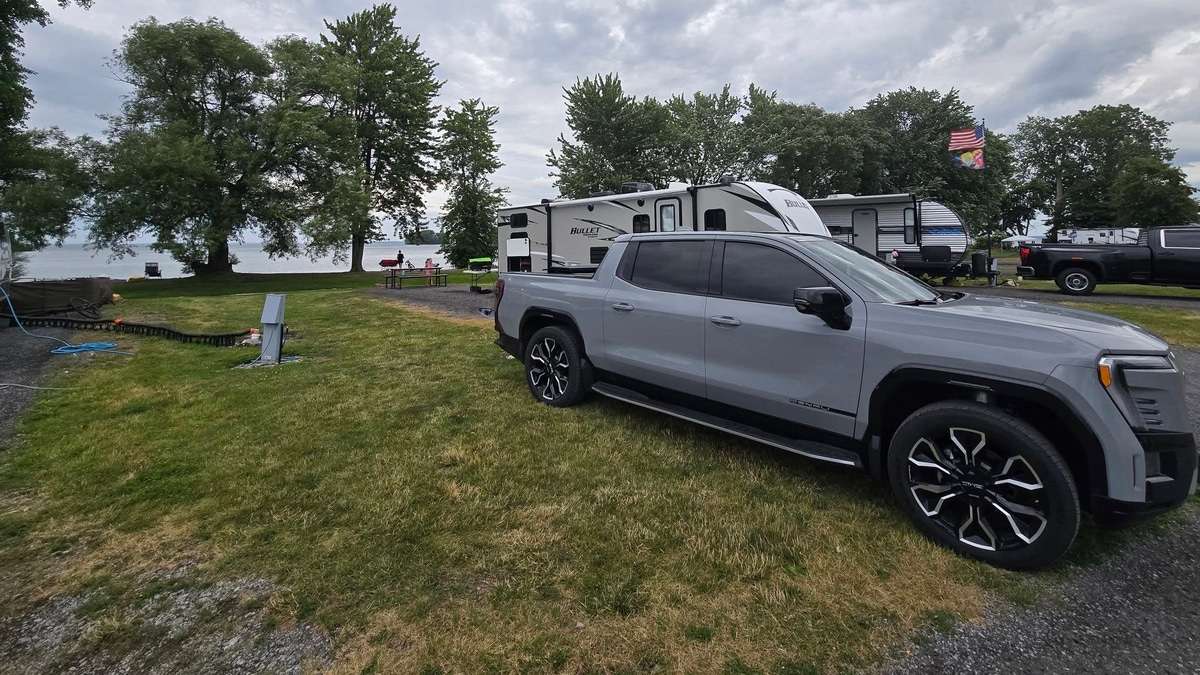

A 2024 GMC Sierra EV Denali Edition 1 averaged 1.0 to 1.1 miles per kWh at 60 mph while towing a 33-foot Keystone camper. Its battery gave one family plenty of range margin, but the charging-site layouts created the real compromises.
The electric pickup left the Jersey Shore charged to 100 percent with a 33-foot Keystone Bullet travel trailer attached behind it.
Owner Paul Cat Jr. and his family reached their campsite in upstate New York 375 miles later with the Sierra EV still showing 48 percent.
The trip required two charging stops, but Paul said it never became a search for the next available plug. He estimated that his family spent approximately an extra hour charging beyond what the truck actually needed.
“At no point did I worry about range, and it never felt like we were charger hopping,” Paul wrote in the GMC Sierra EV Group.
The truck’s enormous battery helped make that possible. The problem he encountered was outside the truck. One charging location described as trailer-friendly still required him to disconnect the camper, while the second only worked conveniently because the nearly empty lot allowed him to occupy several spaces at an angle.
For electric trucks, battery range is becoming manageable. Charging stations that can physically accommodate what those trucks are towing remain far less consistent.
The Sierra EV Became a Roughly 230-Mile Tow Vehicle
Paul drove about 180 miles before making his first stop at IONNA’s Scranton-area Rechargery in Dickson City, Pennsylvania. He arrived with 23 percent remaining.
A simple projection from that first leg puts the truck’s full-to-empty towing range at approximately 234 miles:
180 miles divided by 77 percent of the battery used equals about 234 miles.
That closely matches Paul’s estimate that he could have driven approximately 230 miles under those conditions.
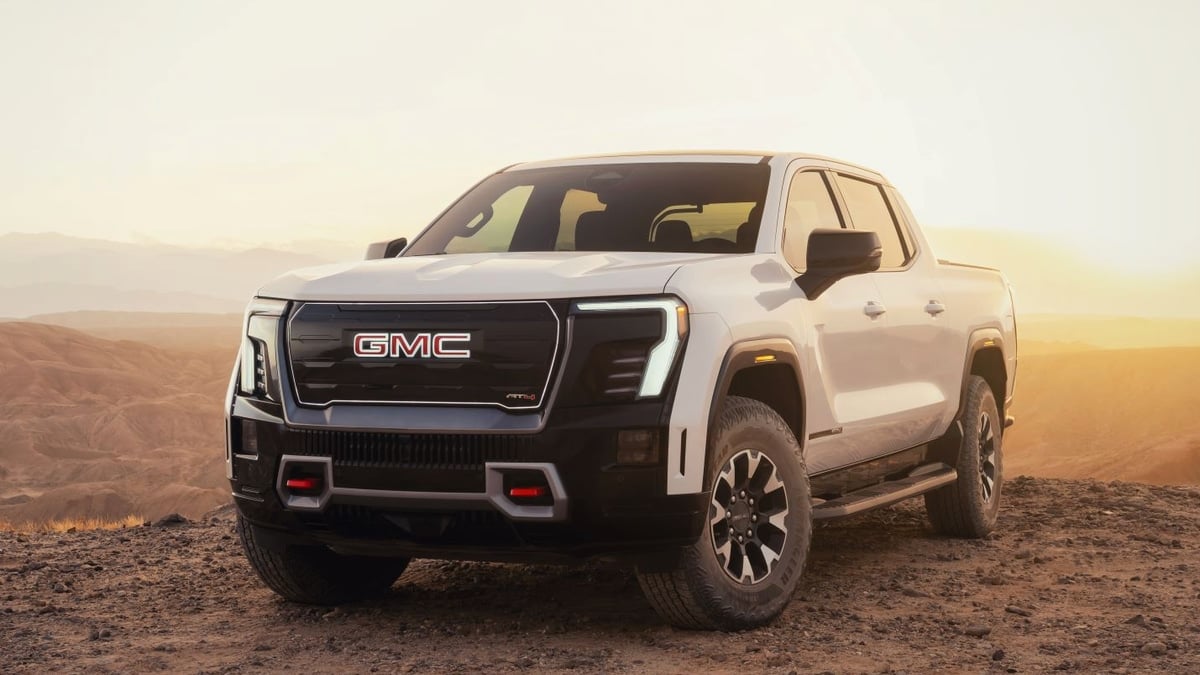
GMC originally rated the 2024 Sierra EV Denali Edition 1 at a GM-estimated 440 miles of unloaded range. It also advertised a maximum towing capacity of 10,000 pounds and DC fast-charging capability of up to 350 kW.
Paul’s projected towing range was therefore about 52 percent of GMC’s original 440-mile estimate.
That does not mean every Sierra EV will lose half its range whenever a trailer is attached. Trailer height and shape, actual loaded weight, speed, wind, temperature and elevation can move the result considerably. It does show how profoundly a large travel trailer can change the operating range of even one of the longest-range electric pickups sold in the United States.
Paul was also deliberately avoiding the bottom of the battery.
During an earlier towing trip, he pushed his Sierra EV to 4 percent, received the yellow turtle warning, saw the remaining-mile display change to “Low,” and experienced reduced power.
“I had no interest in repeating that,” he explained.
That earlier experience changed his trip planning. The theoretical distance available mattered less than reaching each stop with enough reserve to absorb weather, traffic, charger trouble, or an unexpected detour.
Sixty MPH Appears to Be This Combination’s Sweet Spot
Paul held the Sierra EV close to 60 mph for most of the drive, briefly reaching 65 or 70 mph while passing.
At 60 mph, the truck generally returned between 1.0 and 1.1 miles per kWh. Larger climbs sometimes pulled that figure down toward 0.9 miles per kWh.
“I still do not see much difference between 55 and 60 mph, but once you get closer to 65, the efficiency starts dropping off more,” he wrote. “For my setup, 60 to 62 mph seems to be the sweet spot.”
His observation follows basic aerodynamics. Drag rises with the square of velocity. With the trailer, weather and surrounding air held constant, increasing speed from 60 to 65 mph raises the aerodynamic drag force by approximately 17 percent. At 70 mph, the increase is approximately 36 percent.
Those percentages describe the aerodynamic portion of the load, rather than the truck’s total energy consumption. Rolling resistance, drivetrain losses, and climbing still contribute. However, a tall, wide travel trailer presents an enormous surface to the air, so relatively small increases in highway speed can become expensive.
That makes Paul’s speed data more useful than a single towing-range number. A driver attempting the same trip at 70 mph, into a headwind or through colder weather, could see a considerably shorter first leg.
Paul said this was his best towing efficiency after more than 10 trips with the truck. He believes the combination is now “all dialed in.”
The First “Trailer-Friendly” Stop Still Required Unhitching
Paul’s first stop was the IONNA Rechargery near Dickson City.
The location currently appears in IONNA’s network as its Scranton-area Rechargery, and Paul said the charger delivered power quickly.
The charging session was also nearly frictionless electronically. Paul said he connected the truck and charging began through GMC Energy Pass without requiring a separate payment process.
That experience matches GM’s current Energy Pass system, which supports Plug & Charge at compatible IONNA locations. Once the owner has activated the service and stored a payment method, the vehicle and charger can handle authentication and billing in the background.
The physical experience was less seamless.
Paul said the location was listed as trailer-friendly, yet he still had to disconnect the Keystone and leave it nearby before backing the Sierra EV into the charger.
The stop worked because the family had already planned to eat lunch. Unhitching was inconvenient rather than trip-ending, but it exposes the loose meaning of “trailer-friendly.”
A site can have enough surrounding space to temporarily store a trailer and still lack a true pull-through charging stall. That distinction matters to someone towing in heavy rain, traveling alone, arriving after dark or stopping only long enough to add 50 miles.
Paul charged from 23 percent to 99 percent because the truck finished later than the family finished lunch.
Charging to 99 Percent Was a Trip Decision, Not His Daily Routine
One commenter warned Paul that charging to 99 percent would take a toll on the battery.
GMC recommends keeping most of its EV batteries near 20 to 80 percent for regular daily use and avoiding repeated charging to 100 percent. GMC also says owners can set a higher target when extra range is needed for a longer trip.
That makes context important.
Repeatedly charging to 100 percent and then leaving the truck sitting fully charged is different from occasionally charging above 80 percent during a road trip and immediately driving the vehicle.
The more immediate penalty during a fast-charging stop is time. GMC notes that charging power drops significantly around 80 percent as the battery fills.
Paul recognized that he had charged far beyond what was necessary. He simply had no reason to interrupt lunch and move the truck sooner.
That distinction changes how the stop should be interpreted. The Sierra EV did not require a 76-percentage-point charging session to continue the trip. His family’s lunch happened to last long enough for one.
The Second Stop Was Chosen Around Storms, Not the Battery
Paul initially planned to stop at a Tesla Supercharger in Parish, New York, for approximately 10 minutes. He estimated that the family needed only another 25 to 50 miles of range to reach the campsite.
Large storms were moving through the area, and his wife preferred stopping earlier. They instead used an EVolve NY station.
Paul arrived at that charger with 48 percent and reached 80 percent in about 20 minutes.
This location also had limited room for the combined truck and trailer. Since the site was empty, he angled the Sierra EV and camper across the parking spaces.
That solution worked because no other drivers needed them.
The family then encountered road closures and longer detours before reaching the campsite, yet still arrived with 48 percent.
“Some people may look at that and say we charged too much, and they would be right,” Paul acknowledged. “We likely spent about an extra hour charging that we did not really need.”
He considered that hour a choice. The family ate, avoided part of the approaching weather and maintained a much larger battery reserve than the route required.
Many EV road-trip comparisons treat every stationary minute as a failure. Families already stop for food, restrooms, children and weather. Charging can overlap with those needs, although an unnecessary hour remains an hour that a gas or diesel tow vehicle probably would not have spent refueling.
Paul’s account supports a narrower conclusion: The Sierra EV gave him enough capacity to choose caution and convenience instead of optimizing every charging stop.
Super Cruise Covered More Than 350 Miles While Towing
Paul also reported that Super Cruise handled more than 350 miles of the 375-mile trip.
That would place approximately 93 percent of the drive on compatible roads where the system could assist with steering and speed.
GM allows Super Cruise to operate while towing on properly equipped vehicles. The system adjusts its control strategy when it detects a trailer, although automatic and driver-requested lane changes are unavailable while trailering. Super Cruise still requires the driver to watch the road and remain ready to take control.
Paul said the assistance made the long drive substantially easier.
For a family towing trip, that may be as consequential as the charging speed. The truck spent more than six hours covering 375 miles before accounting for traffic, detours and stops. Reducing the steering workload during most of that distance can change how tired the driver feels upon arrival.
What This Trip Still Cannot Tell Us
Paul supplied speed, distance, state of charge, route, efficiency and charging-stop information, which is considerably more detail than most social-media towing reports provide.
Several important numbers remain unknown.
He did not provide a scale ticket showing the camper’s loaded weight, the Sierra EV’s payload sticker, tongue weight, axle loads or the amount of equipment and cargo carried by the family. He also did not provide charging receipts, energy delivered by each station, or a complete weather log.
Without those figures, this trip cannot establish a universal towing range or serve as a complete tow-rating audit. It also cannot support a fair cost comparison against a similar gas or diesel truck.
What it provides is a detailed operating example from one owner who has repeated the same kind of towing more than 10 times.
Under these conditions, his 2024 Sierra EV could cover roughly 180 miles before a comfortable first charging stop, return 1.0 to 1.1 miles per kWh near 60 mph, fast-charge quickly and arrive with a substantial reserve.
The battery gave him options. The charging-site geometry still required improvisation.
Electric pickups now advertise ranges, towing capacities and charging speeds that would have sounded improbable a few years ago. The next meaningful improvement for owners towing 30-foot campers may come from concrete and parking stripes: Pull-through chargers that allow the vehicle and trailer to remain connected.
A 350-kW charge port is far less useful when reaching it requires unhitching in the parking lot.
One image by Paul Cat Jr.
About The Author
Noah Washington is an automotive journalist based in Atlanta, Georgia, covering sports cars, luxury vehicles, and performance culture. His reporting focuses on explaining the engineering, design philosophy, and real-world ownership experience behind modern vehicles.
Noah has been immersed in the automotive world since his early teens, attending industry events and following the enthusiast communities that shape how cars are built and driven today. His work blends industry insight with enthusiastic storytelling, helping readers understand not just what a car is, but why it matters.
Noah is also a member of the Southeast Automotive Media Association (SAMA), a professional organization for automotive journalists and industry media in the Southeast.
His coverage regularly explores sports cars, luxury vehicles, and performance-driven segments of the automotive industry, including the evolving culture surrounding Formula Drift and enthusiast builds.
Read more of Noah's work on his author profile page.
You can also follow Noah here:
Set Torque News as Preferred Source on Google
Follow us today...