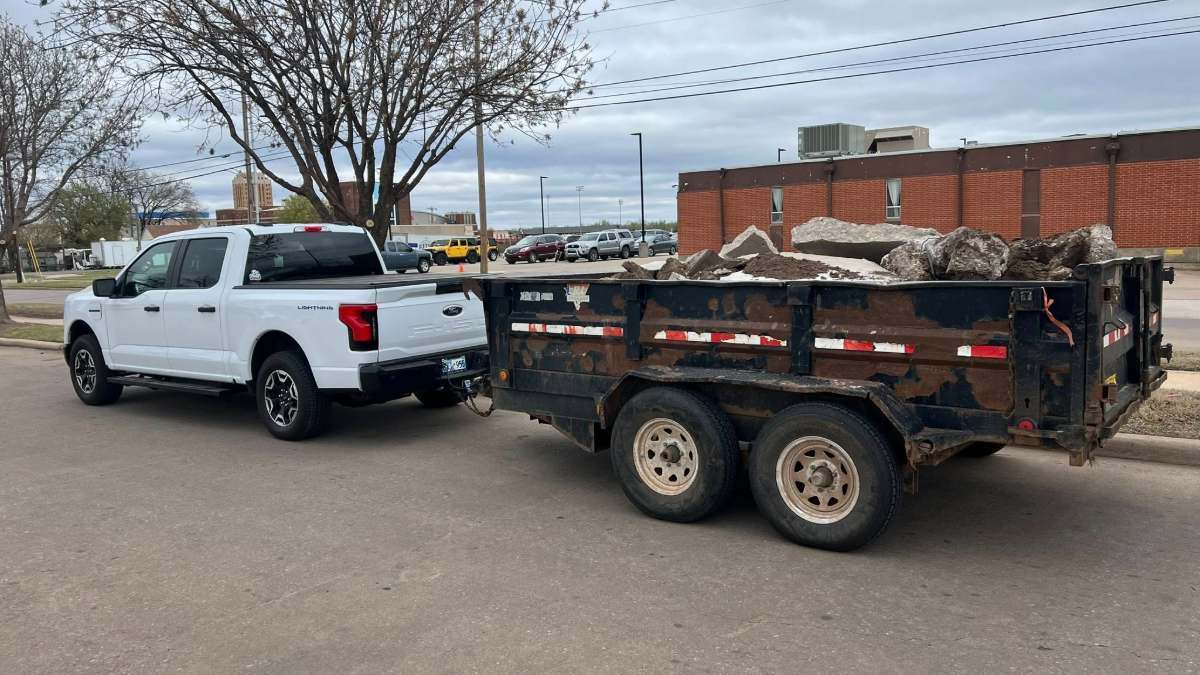

There has always been a kind of unwritten code in American truck culture. A truck proves itself through the work it does, not the badge on its fender or the opinions floating around at the local coffee shop. Yet the electric pickup has become the one machine that gets judged long before it ever hooks itself to a trailer. Nowhere is that tension more visible than with the Ford F-150 Lightning, a truck that performs its job with quiet determination while some bystanders struggle to reconcile their expectations with what the truck is actually doing. The divide is not mechanical; it is psychological, and it defines this moment in the evolution of American pickups.
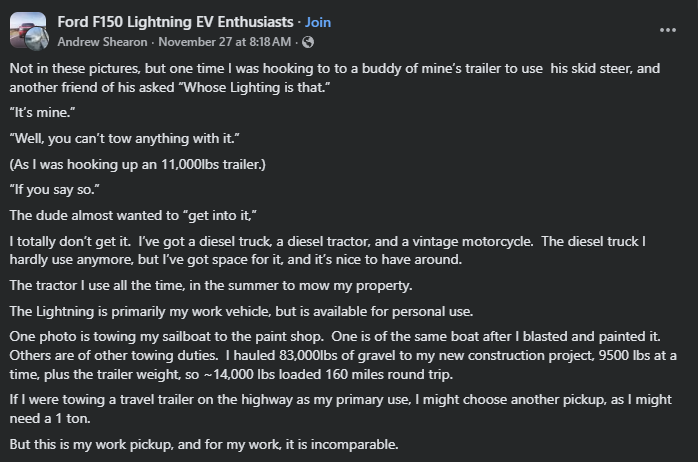
That divide came into sharp focus when Lightning owner Andrew Shearon shared his recent experience online. His account is worth presenting exactly as he wrote it:
“Not in these pictures, but one time I was hooking up to a buddy of mine’s trailer to use his skid steer, and another friend of his asked, 'Whose Lighting is that? '”
“It’s mine.”
“Well, you can’t tow anything with it.”
(As I was hooking up an 11,000lbs trailer.)
“If you say so.”
The dude almost wanted to “get into it,”
I totally don’t get it. I’ve got a diesel truck, a diesel tractor, and a vintage motorcycle. The diesel truck I hardly use anymore, but I’ve got space for it, and it’s nice to have around.
Advertising
I use the tractor all the time, in the summer to mow my property.
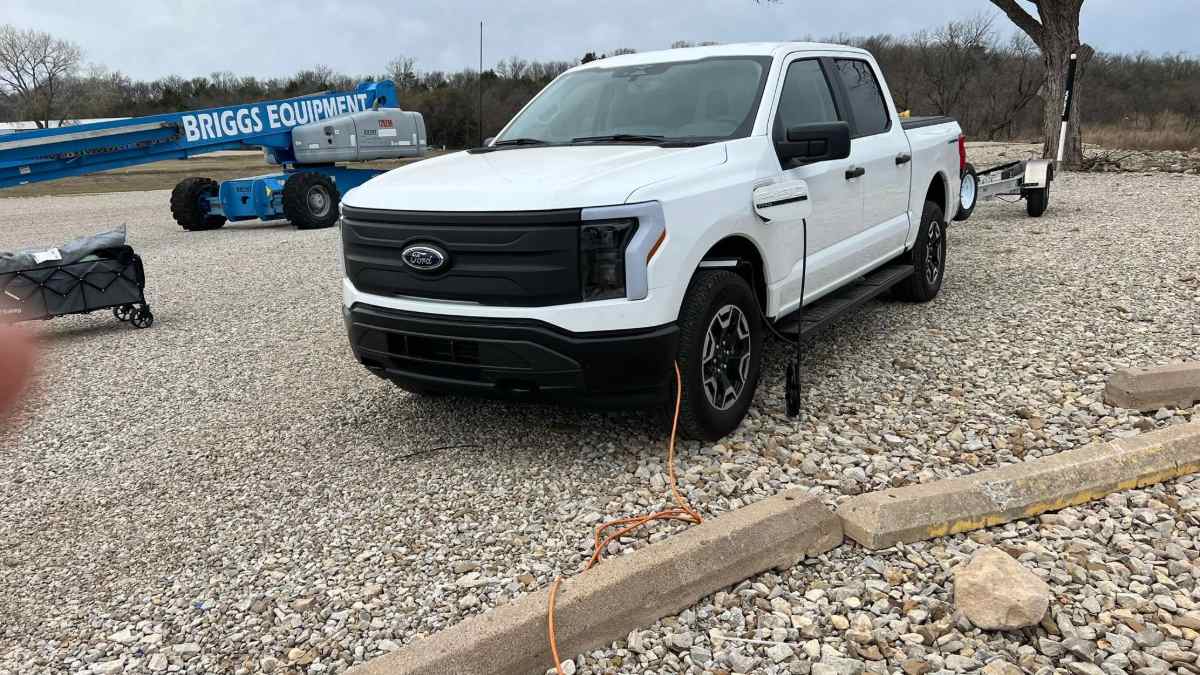
The Lightning is primarily my work vehicle, but it is available for personal use.
One photo is towing my sailboat being towed to the paint shop. One is in the same boat after I blasted and painted it. Others are of other towing duties. I hauled 83,000lbs of gravel to my new construction project, 9500 lbs at a time, plus the trailer weight, so ~14,000 lbs loaded 160 miles round trip.
If I were towing a travel trailer on the highway as my primary use, I might choose another pickup, as I might need a 1-ton.
But this is my work pickup, and for my work, it is incomparable.”
In a single anecdote, Shearon captured a remarkable contradiction. He had just demonstrated the capability of the truck by connecting it to an 11,000-pound trailer, yet someone standing a few feet away insisted it could not tow. The exchange reflected a broader refusal to acknowledge what the Lightning is accomplishing in the real world. Shearon was not staging a debate, and he was not trying to convert anyone. He was simply doing a job. The exchange only served to show how entrenched some perceptions remain, and how far reality has already moved beyond them.
Ford F-150 Lightning: Towing Capacity
- The Ford F-150 Lightning comes in various trim/battery configurations. Depending on the battery you choose, it can deliver an EPA-estimated electric range of up to ~320 miles (with the extended-range battery).
- On the charging side: using Level-2 home charging (240 V), a full charge typically takes around 8–14 hours, depending on battery size and charger, practical overnight. For rapid DC fast charging (15–80%), times are significantly shorter (though actual time depends on charger type and battery state).
- When properly equipped (extended-range battery + Max Tow Package), the Lightning can tow up to 10,000 lbs, putting it in serious work-horse territory for an EV pickup.
- For everyday capability, even standard configurations still offer impressive specs: all-wheel drive (dual motors), up to 775 lb-ft torque, crew-cab + bed layout, and enough payload/towing flexibility to make it a versatile EV truck substitute for traditional gas-powered pickups.
Other owners echoed his experience with the same matter-of-fact tone. Shawn O’Meara explained that he has towed a moderate RV and an enclosed utility trailer, each around 5,000 pounds, and covered about 150 miles on a single charge. His comparison between his Cummins-powered Ram 2500 and the Lightning offered genuine insight. He noted that with the diesel, he can feel a heavy dump trailer at every stoplight, while with the Lightning, he hardly notices an 11,000-pound load behind him. It is the kind of observation that comes only from actual seat time, and it shows how the inherent characteristics of an electric powertrain can change the entire towing experience.
Then there was the practical perspective of business owner Neil Bonneville. He pointed out that people often warn him he will get half the range while towing, and he simply chooses not to argue. The truck automatically adjusts the range estimate once it senses a trailer, something his Super Duty does as well, only with a falling fuel gauge instead of a digital readout. To him, the criticism stems from people interpreting the same information differently depending on the vehicle involved. In an internal combustion truck, a doubling of fuel consumption is accepted as routine. In an electric truck, the digital equivalent is treated like a verdict instead of a data point.
Another owner, Larry Fannon, added his experience towing a 9,500-pound camper and a 5,000-pound boat. He reported that the Lightning handles both loads better than his F-250 and returns a towing range of about 150 to 160 miles. His belief that wind drag affects range more than weight itself demonstrates an understanding of the fundamentals at play. Rather than claiming exceptionalism, he described the truck as a tool that performs predictably within the limits of physics. In doing so, he contributed a clear and practical voice to the discussion.
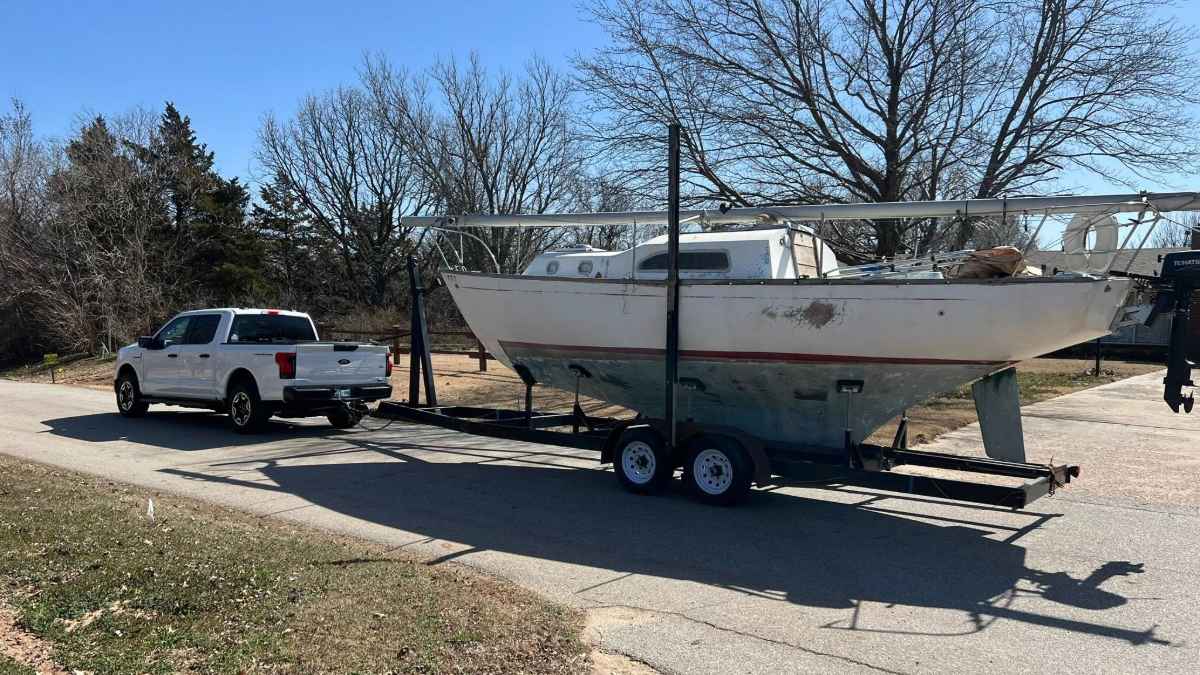
Together, these owners formed a consistent narrative. They were not defending the truck out of brand loyalty, and they were not making excuses for it. They were working with it. They were hauling gravel, towing boats, moving equipment, and navigating the day-to-day demands of their trades. In each case, the truck performed in a way that made sense for the job at hand. The skepticism surrounding electric pickups often ignores this basic truth. It focuses on the edge cases where a heavy-duty diesel remains the right tool, while missing the substantial share of real-world tasks where the Lightning already fits perfectly.
The lingering misconceptions about electric trucks will not disappear overnight, but stories like Shearon’s illustrate where the conversation is heading. The debate is shifting away from speculation and toward lived experience. These owners are not theorizing about capability. They are demonstrating it in the form of gravel loads, equipment trailers, sailboats, campers, and daily commercial operations. With each of these accounts, the gap between perception and performance narrows. For now, the Lightning continues to do its work quietly and without theatrics, proving itself in the oldest way a truck can: by getting the job done.
Image Sources: Ford Media Center
Noah Washington is an automotive journalist based in Atlanta, Georgia. He enjoys covering the latest news in the automotive industry and conducting reviews on the latest cars. He has been in the automotive industry since 15 years old and has been featured in prominent automotive news sites. You can reach him on X and LinkedIn for tips and to follow his automotive coverage.
Set Torque News as Preferred Source on Google
Follow us today...