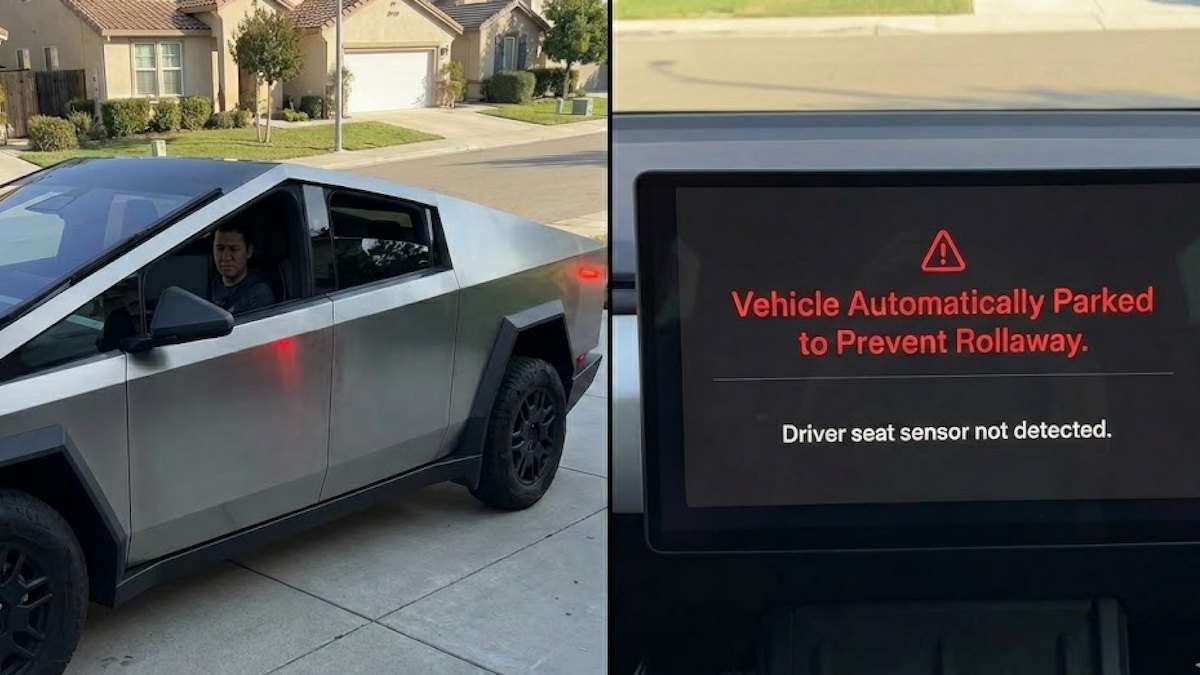

Imagine creeping through a parking lot or inching forward at a traffic light when your $100,000 Tesla Cybertruck suddenly slams on the brakes, shifts itself into Park, and flashes a red warning: "Vehicle Automatically Parked to Prevent Rollaway."
You are still in the driver’s seat. Your seatbelt is on. But the truck doesn’t believe you.
This is the terrifying "Phantom Park" scenario emerging from the Cybertruck Owners Club forums and recent Reddit threads. While mainstream coverage has focused on cosmetic issues such as frozen door handles or shattered roof glass, this phantom braking issue represents a potentially dangerous structural or software defect that directly affects vehicle control.
The "1.4 MPH" Trap
To understand why this is happening, we need to examine the Cybertruck’s specific software logic. According to the Tesla Owner’s Manual, the "Rollaway Protection" protocol is designed to engage if the vehicle determines the driver is leaving.
- Crucially, the manual states the vehicle will automatically shift into Park if:
- The driver’s seatbelt is unbuckled (or detected as such).
- The driver sensor detects no weight.
- The vehicle is traveling slower than 1.4 mph.
This "1.4 mph" threshold is where the danger lies. Owners aren't experiencing this at highway speeds; they are experiencing it during "creeping" maneuvers—pulling into a garage, edging out of a driveway, or inching forward in stop-and-go traffic.
In these delicate moments, if the seat sensor glitches for a millisecond, the truck thinks you have jumped out of a moving vehicle and slams the emergency brake to save itself.
Owners Speak Out: "It’s Downright Dangerous"
Buried in recent owner logs and service threads (Dec 2025), the frustration is understandable. The issue seems to be escalating as more trucks hit the road.
User "Cybertruck26" (November 23, 2025) posted on the Cybertruck Owners Club: "It turns out that Tesla has notoriously [bad] seat sensors... my seat wouldn't recognize I was seated... hence the roll away (sudden stop)." He noted that while he saw similar issues in his Model Y, the Cybertruck’s reaction feels more violent.
User "hemiarch," a trauma surgeon and Cybertruck owner, confirmed the failure mode in the same thread: "If this sensor is faulty, the car may interpret that the driver has left, even if they are still there."
Other owners have reported that simply shifting their weight to adjust a wallet or phone in their back pocket can be enough to break the capacitive connection, triggering the panic stop.
"It feels like being brake-checked by your own car," one commenter noted.

A Tale of Two Failures
Service centers are currently diagnosing this issue as a failure in one of two key components. For owners facing this issue, knowing the specific part numbers can help expedite the service process:
1. The Restraint Control Module (RCM) Failure. The RCM is the "brain" that processes safety data. Recent service alerts suggest that on some units, the RCM is going "offline" or losing communication with the Controller Area Network (CAN bus).
Symptoms: You might see a "Restraint Control Module MIA" error in the Service Mode menu, even if no warning light is on the main dash.
The Part: The specific unit for the Cybertruck is often identified as Part #1872985-00-A. If this module glitches, it defaults to the safest state: stopping the truck.
2. The 48V Seat Occupancy Sensor. Unlike older Teslas, the Cybertruck uses a 48-volt electrical architecture. This means the seat sensors are new, specific parts (likely Part #1879496-00-B).
The Defect: Owners suspect the capacitive mat is either too small or calibrated too strictly. If a driver sits "light" or uses an aftermarket seat cushion, the sensor reads "Empty."
The Fix: Tesla Service is replacing the entire seat cushion in some cases, but parts availability for 48V specific components remains a bottleneck.
Is A Recall Imminent?
This isn't just a nuisance; it’s a safety hazard. If this "Rollaway Protection" triggers while a driver is pulling into a busy intersection or maneuvering a trailer, the sudden, uncommanded stop could easily cause a rear-end collision.
Ford recently recalled over 23,000 Super Duty trucks for a rollaway risk (related to a transmission washer), proving that NHTSA takes "unintended movement" (or lack thereof) seriously. With Cybertruck owners now documenting these "Phantom Park" events, it may only be a matter of time before a federal investigation is opened.
What To Do If It Happens To You
If your Cybertruck slams into Park while you are driving:
1. Check Service Mode: Go to the Service menu on your screen and look for active alerts regarding the RCM (Restraint Control Module) or OCS (Occupant Classification System).
2. Remove Cushions: If you use a beaded seat cover or thick cushion, remove it immediately to see if the sensor sensitivity improves.
3. Report It: Log the time and date of the incident in the Tesla App service request so technicians can pull the specific vehicle logs.
Have You Experienced This?
Is your Cybertruck acting like a nervous backseat driver? If you’ve experienced the "Phantom Park" or "Risk of Rollaway" warning while driving, let us know in the comments below. We are tracking this issue closely.
With over 30 years of industry experience, Denis Flierl brings an insider’s perspective to Torque News, where he has been a Senior Reporter since 2012. Before picking up the pen, Denis consulted for the automotive industry's biggest brands and honed his skills as a test driver. He cuts through the noise to deliver the latest auto news, compelling owner stories, and the expert analysis necessary to navigate today's changing automotive market.
Have a tip or question? Follow me on X @DenisFlierl and @WorldsCoolestRides, or connect with me on Facebook, Instagram, and LinkedIn.
Photo credit: Denis Flierl
Set Torque News as Preferred Source on Google
Follow us today...