
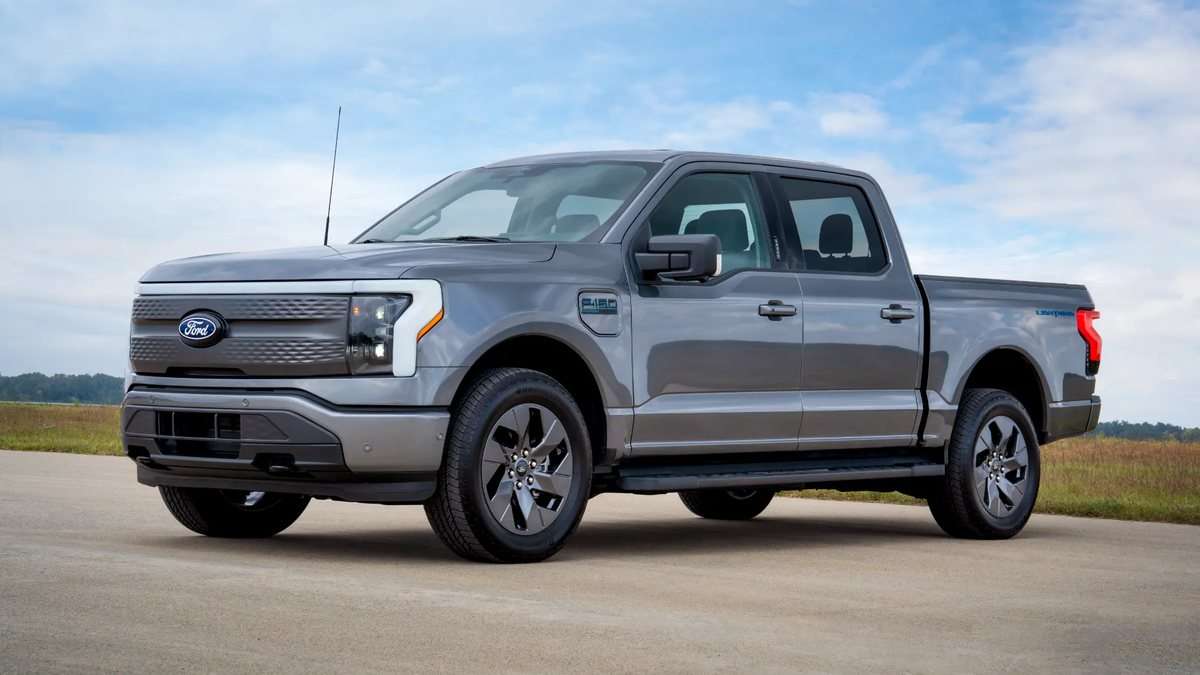

The promise of convenient public charging for electric vehicles often clashes with the reality of implementation, a disconnect vividly illustrated by a recent Ford F-150 Lightning owner's experience. What should have been a straightforward charging stop at a Ford dealership quickly devolved into a frustrating encounter, revealing the persistent challenges EV drivers face, even within a manufacturer's own network. This incident raises serious questions about dealer preparedness and the clarity of Ford's public charging initiatives.
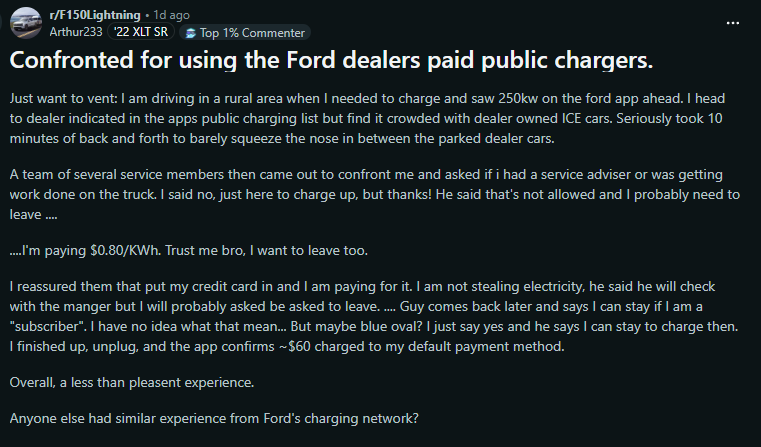
The owner, identified as Arthur233, shared their ordeal on the r/F150Lightning subreddit, stating:
"Just want to vent: I am driving in a rural area when I needed to charge and saw 250kw on the Ford app ahead. I head to the dealer indicated in the app's public charging list, but find it crowded with dealer-owned ICE cars. Seriously took 10 minutes of back and forth to barely squeeze the nose in between the parked dealer cars.
A team of several service members then came out to confront me and asked if I had a service adviser or was getting work done on the truck. I said no, just here to charge up, but thanks! He said that's not allowed and I probably need to leave ....
....I'm paying $0.80/KWh. Trust me, bro, I want to leave too.
I reassured them that I put my credit card in and I am paying for it. I am not stealing electricity, he said he will check with the manager, but I will probably be asked to leave. .... Guy comes back later and says I can stay if I am a "subscriber". I have no idea what that means... But maybe blue oval? I just say yes, and he says I can stay to charge then. I finished up, unplugged, and the app confirms ~$60 charged to my default payment method.
Overall, a less-than-pleasant experience.
Has anyone else had a similar experience with Ford's charging network?"
This account is not an isolated incident; it's a symptom of a broader systemic failure within the dealership model to adapt to the EV transition. While Ford invests in charging infrastructure and promotes its BlueOval Charge Network, the actual execution at the ground level, particularly at dealerships, frequently falls short. The presence of internal combustion engine (ICE) vehicles blocking charging spots is a rookie mistake that no reputable dealership should be making in 2026.
Ford F-150 Lightning: Navigating the EV Charging Landscape
- The Ford F-150 Lightning offers a maximum DC fast charging rate of 150 kW, allowing it to charge from 15% to 80% in approximately 41 minutes under ideal conditions. Its battery capacities range from 98 kWh (Standard Range) to 131 kWh (Extended Range), providing EPA-estimated ranges of 240 to 320 miles.
- Public charging infrastructure remains a critical bottleneck for widespread EV adoption, with issues like charger availability, reliability, and pricing transparency frequently cited by owners. Dealerships, intended to be part of this network, often struggle with basic operational aspects such as keeping charging stalls clear of non-EVs.
- The BlueOval Charge Network, managed by Ford, aggregates various public charging providers, aiming to simplify the charging experience for Ford EV owners through a single app and payment system. However, the network's effectiveness is only as strong as its weakest link, which can often be individual charging locations.
- Charging costs can vary wildly, from free Level 2 chargers to DC fast charging rates that can exceed $0.80/kWh, influenced by location, time of day, and subscription status. These fluctuating prices and inconsistent experiences contribute to range anxiety and dissatisfaction among EV drivers.
One commenter, u/E90alex, echoed this sentiment, advising: "Treat dealer chargers as a last resort exactly for those reasons. Crazy high rates, often blocked, usually only have 1 or 2 plugs, which may be out of commission because they don’t care and have no incentive to keep them running."
This perspective is brutally honest and, unfortunately, accurate. Dealerships, historically focused on sales and service of gasoline-powered vehicles, often view EV charging as an afterthought or a necessary evil rather than a core customer service offering. The lack of operational incentive to maintain these chargers, combined with exorbitant pricing, creates a hostile environment for EV owners who are simply trying to utilize an advertised public service. It's a classic case of corporate directive meeting dealer indifference, and the customer is caught in the middle.
The confrontation itself reveals a fundamental misunderstanding by dealership staff regarding public charging access. To question a paying customer's right to use a publicly listed charger, especially one charging at a premium rate of $0.80/kWh, is absurd. This rate is significantly higher than typical home charging and even many commercial fast chargers, making the owner's frustration about being asked to leave entirely justified. The "subscriber" confusion further shows a lack of training and clear communication from Ford to its dealer network.
The situation is further complicated by the inherent conflict of interest. Dealers profit from service appointments, not from customers simply using their chargers. This creates a perverse incentive to discourage casual charging, even if it's publicly advertised and paid for. The $249 "appointment" charge mentioned by u/yachtzee21 for a simple tailgate check on an ICE F-150 perfectly illustrates the dealership's profit-driven mindset, which often prioritizes revenue over customer convenience or loyalty.
Another commenter, u/Alternative_Pilot_92, shared a contrasting, albeit potentially unsustainable, experience: "Dealer near me has a free fast charger. Not sure that they realize it is free, but I've been using it periodically for months."
While a free charger is a welcome anomaly for any EV owner, this anecdote reveals the chaotic and inconsistent nature of dealership charging. The fact that the commenter isn't sure if the dealer realizes it's free speaks volumes about the lack of oversight and standardized practices. It's a lottery, not a reliable network, and that's a problem for a brand trying to establish itself as an EV leader.
The frustration extends beyond charging, touching on broader dealership quality. As u/IWTLEverything bluntly put it: "Dealers are the worst, and I blame them in part for the discontinuation of this awesome vehicle."
While blaming dealers for a vehicle's discontinuation might be an overstatement, it captures a deep-seated resentment among consumers. The dealership experience, from sales tactics to service quality, frequently tarnishes a brand's reputation. For EVs, where the technology is still new to many, a poor dealership experience can be a significant deterrent to adoption, pushing potential buyers towards direct-to-consumer models or more EV-savvy brands.
The final comment from u/yachtzee21, detailing an outrageous $249 charge for a quick tailgate check, reinforces the perception of dealerships as profit centers rather than customer service hubs. "big time- SOME dealerships are absolutely horrible and so bad so that they overshadow the good dealerships and bring the brand down Ex: bringing my ICE 150 in because the tailgate would not open consistently (maybe 3 out of 10 times it opened by fob or hand) guy hits the fob it opens, refuses to try it repeatedly, then charges me $249 for the ‘appointment’ which involved me driving to the lot and spending 10 minutes there."
This kind of predatory pricing for minimal service erodes trust and undermines the entire brand image. Whether it's an F-150 Lightning owner trying to charge or an ICE F-150 owner seeking a simple repair, the underlying issue is a dealership model that often fails to prioritize the customer experience. Ford, and indeed all legacy automakers, must address these inconsistencies if they hope to successfully navigate the transition to an electrified future.
Arthur233's experience is a microcosm of the larger challenges facing the EV ecosystem. Ford has made significant investments in its EV lineup and charging infrastructure, but these efforts are severely hampered by a dealer network that appears ill-equipped, poorly trained, or simply unwilling to fully embrace the electric future. Until these foundational issues are resolved, the path to widespread EV adoption will remain fraught with unnecessary obstacles and frustrating encounters for early adopters.
Image Sources: Ford Media Center
Noah Washington is an automotive journalist based in Atlanta, Georgia. He enjoys covering the latest news in the automotive industry and conducting reviews on the latest cars. He has been in the automotive industry since 15 years old and has been featured in prominent automotive news sites. You can reach him on X and LinkedIn for tips and to follow his automotive coverage.
Set Torque News as Preferred Source on Google
Follow us today...



Comments
I make frequent trips to…
Permalink
I make frequent trips to Anaheim from Seattle and always use Tesla's Supercharger network. They are reliable, numerous and cheaper the EA locations. I pay for a month subscription when I travel and drops the rates from $.54 to anywhere from $.44 - $.33 and can be even cheaper if you charge off peak. I have found as low as $.17. I cancel the $13 subscription when I get back home. It's well worth it. Only issue is charging at older Tesla chargers with their short cords. However, I look for stations that have 12 or more chargers to avoid conflict or charge at their new V4 stations which have longer cords.
I think Ford and other manufacturers should work with Tesla to install longer cords on older stations or pay them to install more locations. They know how to do it right. Hope this helps my fellow F150 Lightning owners.
Danny