
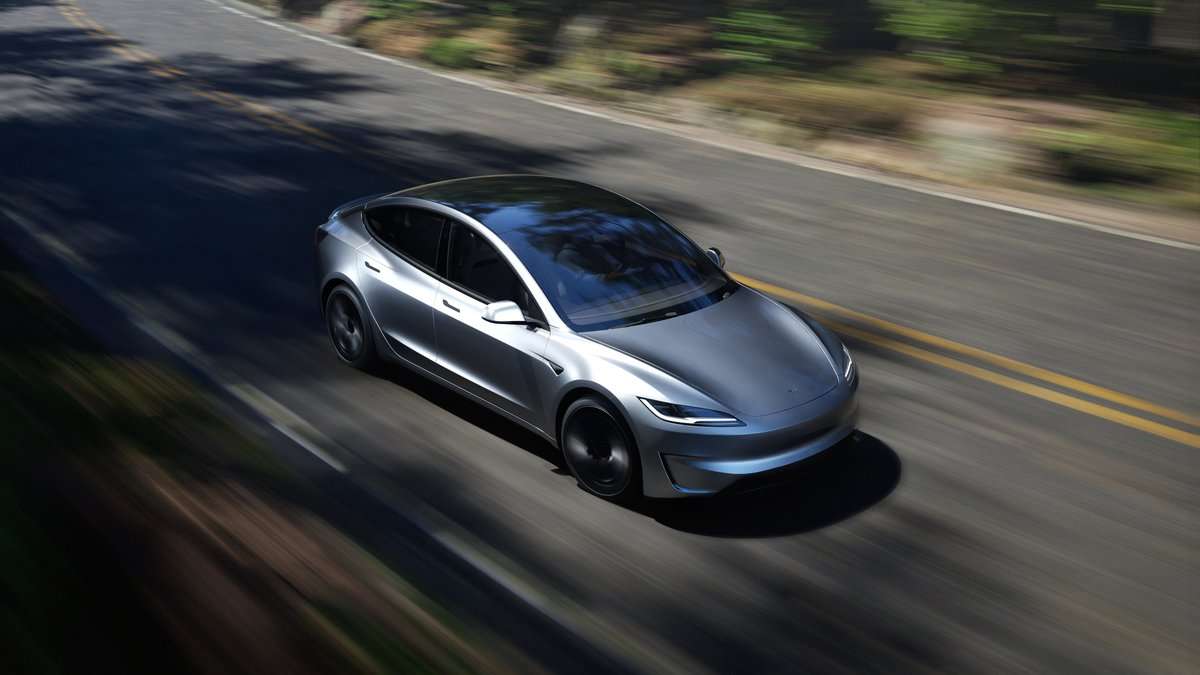

Are EVs truly a cost-saving revolution? Or are they just fancy gadgets with a hidden price tag?
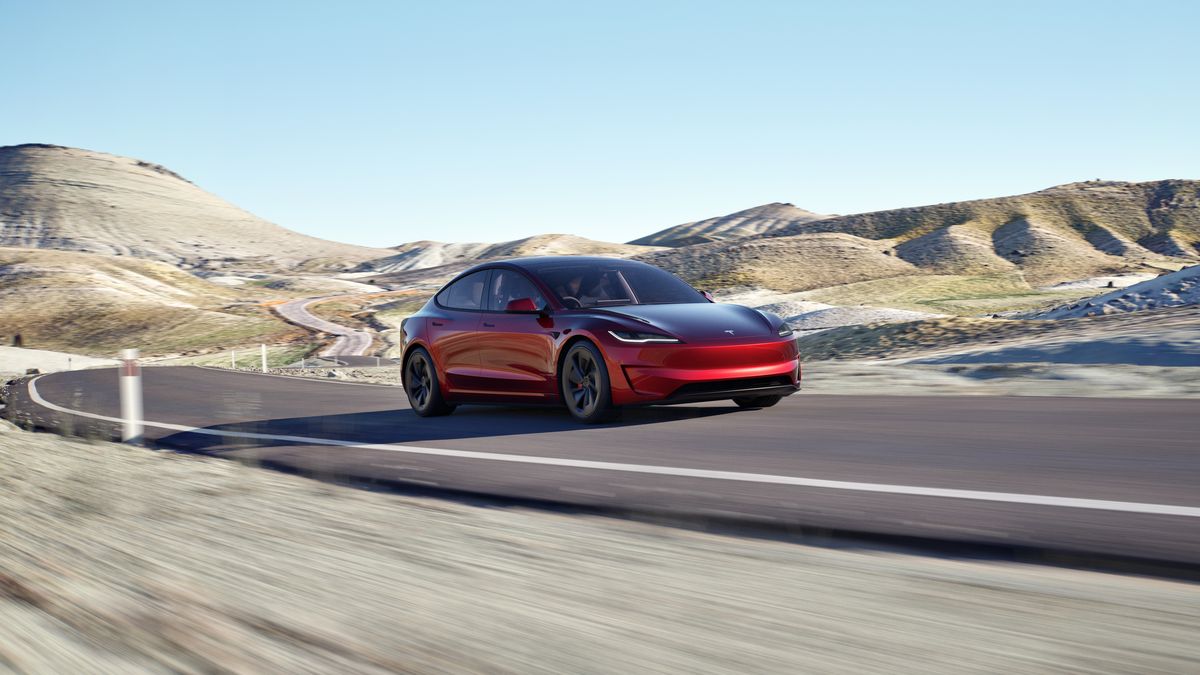
One Reddit user, armed with spreadsheets, has taken it upon himself to track the cost per mile of his Tesla Model 3 and Chevy Bolt against his trusty, old-school Toyota Corolla.
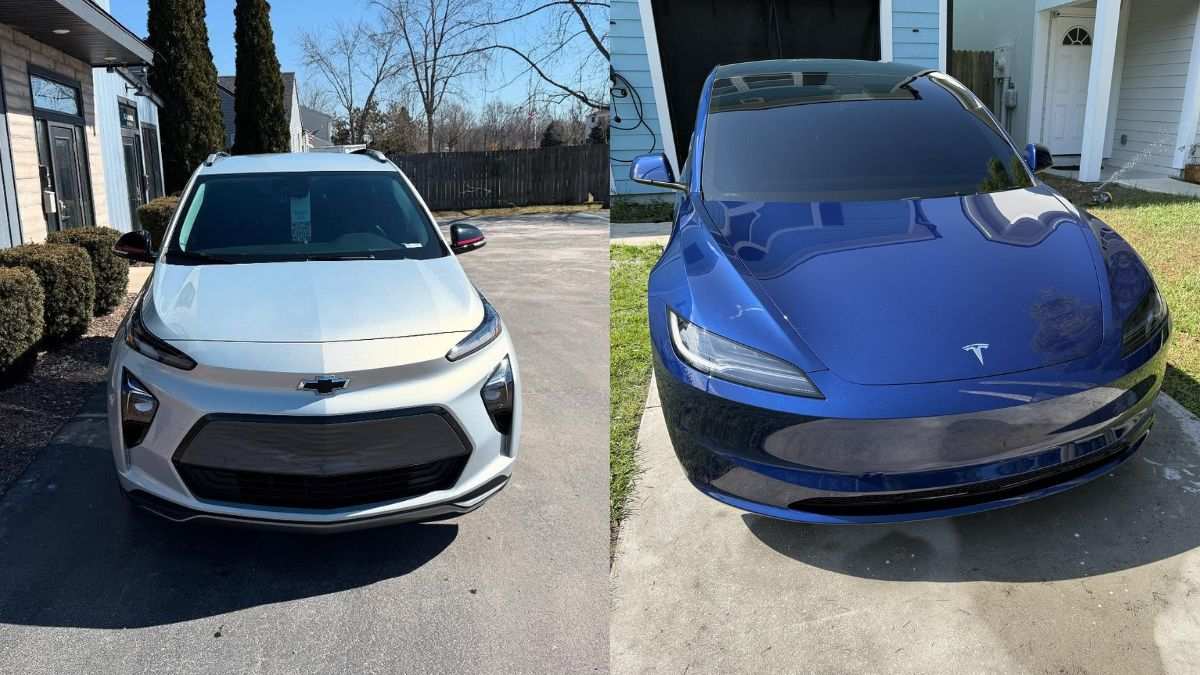
The results are surprisingly counterintuitive, shattering some common EV myths and revealing a few hard truths about the cost of owning an electric car.
50,000-Mile Cost Breakdown of Tesla Model 3 vs. Chevy Bolt vs. Toyota Corolla
Erv, shared some insights and data on r/electricvehicles after driving 50,000 miles across a Tesla Model 3 and Chevy Bolt EUV. The kicker? His old Toyota Corolla still beats them both in one crucial metric.
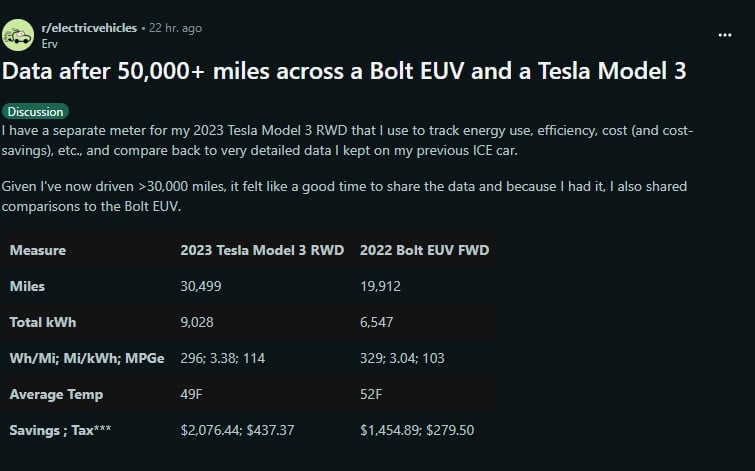
"I have a separate meter for my 2023 Tesla Model 3 RWD that I use to track energy use, efficiency, cost (and cost-savings), etc., and compare back to very detailed data I kept on my previous ICE car.
Given I've now driven >30,000 miles, it felt like a good time to share the data, and because I had it, I also shared comparisons to the Bolt EUV.
*I benchmarked the fuel costs against my prior car, a Toyota Corolla, which got 33.17 mpg over the 100,000+ miles I tracked it, and I also benchmarked against current gas prices, which in my area have been roughly $3/gallon, but I am using nuanced monthly averages for my state. I also bake in a $30 oil change per 5,000 miles as "fuel".
**I also calculated the portion of my savings that is due to taxes I'm not paying at the pump (0.285+0.184 per gallon) - which is relevant politically given we can expect a $250/year EV surcharge to attempt to "close that loophole", which for me, looks to be "fair" if it were state + federal, but just being federal and combined with my state's surcharge ($75), it is not.
I have insurance, tabs, depreciation, maintenance, as well but wanted to focus on "fuel". Those costs are all higher than the Corolla due to the Tesla (and Bolt) being much newer cars (and fully insured instead of minimally insured), and the heightened costs do offset the fuel savings for now. I'll be curious to see over 100,000+ miles how the total cost to own tightens up and I expect the Tesla to win out.
Advertising
Currently, depreciation/any cost of the vehicle, the Tesla is already winning at 15c/mile vs. the Corolla's 16c/mile due to the cheaper maintenance and fuel despite the higher insurance and tabs. But taking into account depreciation changes, that comparison to $0.34 vs. $0.20 in favor of the Corolla, for now. Which is a price I'm comfortable paying for enhanced safety, comfort, etc.
EFFICIENCY
Because it's always interesting to discuss - this is my "efficiency" based on the electricity I am actually paying for, so it includes losses (and I am adding in charging away from home, but that's been extremely minimal). The Tesla itself reports a different number: 239 Mi/kWh (vs 296), which is partially due to losses and partially due to the car not reporting preconditioning. Similarly, the Tesla app says 8,771 kWh charged vs. I have logged 9,028 (a 3% variance), which tells me the 20% variance on Mi/kWh is primarily preconditioning and not charging losses, which is surprising given I do not precondition very frequently and I do not use Sentry. I charge L2."
Tesla Model 3 vs. Chevy Bolt EUV: Performance, Range, and Space Comparison
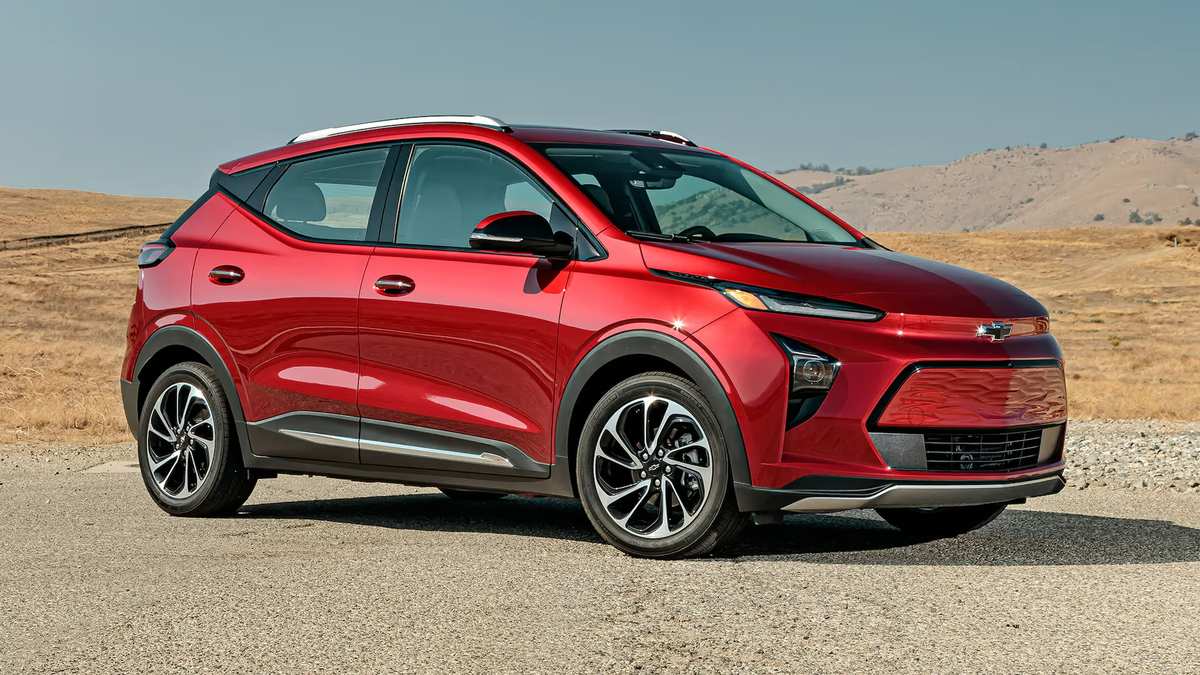
- The Tesla Model 3 offers a dual-motor all-wheel-drive system producing 460 horsepower, achieving 0–60 mph in 2.9 seconds, with an EPA-estimated range of up to 342 miles. In contrast, the Chevrolet Bolt EUV features a single front-mounted motor delivering 200 horsepower, reaching 0–60 mph in approximately 7 seconds, and provides an EPA-estimated range of 247 miles.
- The Model 3, a compact sedan, offers 97 cubic feet of passenger volume and 24 cubic feet of cargo space. The Bolt EUV, a subcompact crossover, provides similar passenger volume at 97 cubic feet but offers slightly less cargo space at 16.3 cubic feet.
- Tesla's Model 3 includes a minimalist interior with a 15-inch touchscreen interface, advanced driver-assistance features, and access to Tesla's Supercharger network. The Bolt EUV comes equipped with Chevrolet's infotainment system, supports Apple CarPlay and Android Auto, and offers GM's Super Cruise hands-free driving technology on compatible roads.
- The 2025 Tesla Model 3 starts at approximately $42,490, positioning it in the premium EV segment. The Chevrolet Bolt EUV offered a more affordable entry point, with prices starting around $27,800, making it one of the most budget-friendly electric vehicles available at the time of its release.
Erv, in the kind of methodical tone that could make an actuary swoon, detailed everything: kilowatt-hours, miles per gallon equivalent (MPGe), oil changes priced to the penny, and even the political nuances of gas taxes and EV surcharges.
According to his logs, the Model 3 RWD clocked in at 15 cents per mile in fuel and maintenance. The Bolt? Slightly worse. But even those figures paled next to his dearly departed Corolla, which, once depreciation was factored in, ran just 20 cents per mile overall. The Tesla ballooned to 34 cents. That’s not a minor difference.
Depreciation and Maintenance, How Reddit Users React to True EV Ownership Costs
The Reddit horde, predictably, pounced. One commenter, Hsaphoto, praised the inclusion of depreciation: the forgotten financial bogeyman. Another, neutralpoliticsbot, scoffed at the $30 oil change estimate with a sarcastic “$30 oil change where?”, the internet equivalent of flipping a table.
Erv held the line, citing years of discount coupons and standard oil. Welcome to Reddit, where every car becomes a case study and every assumption gets litigated like a class-action suit.
Beyond the Spreadsheet, User-Reported Efficiency and Cost Highlights from Bolt and Hybrid Owners
One Bolt owner, Low_Thanks_1540, bragged about getting 5.1 mi/kWh in Detroit, averaging just 3 cents per mile. Another user brought their Ford Maverick hybrid into the ring, reporting a paltry $0.129 per mile in operating costs. Suddenly, the Model 3's efficiency crown didn’t feel quite so regal.
The Tesla still wins where it matters to many, comfort, safety, and long-term efficiency. It delivered 114 MPGe versus the Bolt’s 103, despite colder temps and nearly 11,000 more miles logged. And with LFP batteries under the floorboards and a 239 mi/kWh efficiency reported by the car itself (after adjusting for preconditioning losses), the Model 3 proved not only cost-effective but technologically superior. As one user noted, “It’s well documented that the Tesla Model 3 RWD is more efficient than a Bolt with all things being equal.” The key phrase is that all things being equal, which in the real world, they rarely are.
MPGe Demystified, How EPA’s Miles-Per-Gallon-Equivalent Rating Works for EV Buyers
- MPGe is determined by equating the energy content of electricity to that of gasoline. Specifically, 33.7 kilowatt-hours (kWh) of electricity is considered equivalent to one gallon of gasoline. To calculate MPGe, the distance an electric vehicle can travel on 33.7 kWh is measured, allowing for a comparison with traditional miles-per-gallon (MPG) ratings of gasoline vehicles.
- MPGe was introduced to provide consumers with a familiar metric to compare the energy efficiency of electric vehicles (EVs) to that of internal combustion engine vehicles. By translating electric energy consumption into a gasoline-equivalent format, it aims to simplify the decision-making process for potential EV buyers.
- While MPGe offers a standardized measure, it doesn't account for various real-world factors such as driving habits, terrain, climate conditions, and accessory usage (like air conditioning), all of which can significantly impact an EV's actual efficiency. Consequently, two vehicles with similar MPGe ratings might perform differently under everyday driving conditions.
- MPGe focuses solely on the energy consumed by the vehicle during operation, neglecting the efficiency and environmental impact of electricity generation and transmission. For instance, electricity produced from renewable sources has a different environmental footprint compared to that generated from fossil fuels, but MPGe does not differentiate between them.
Still, the most revealing part of this Reddit saga was the emotional math. Erv knows his Tesla costs more. He admits it. But he’s comfortable paying that premium for the intangible upgrades, refined ride, cleaner footprint, and the sense that he’s driving the future. That, right there, is the fine print most car reviews miss. We’re not always chasing the cheapest ride. Sometimes, we’re chasing the one that feels right. Even if it costs 14 cents more per mile.
Shifts in Car Ownership
So what does this all mean? It means the automotive world is no longer defined solely by horsepower and leather trim. It’s defined by kilowatt-hours, tax credits, and Reddit threads that dissect your every mile like a neurosurgeon studying a brain scan.
The EV revolution forces you to confront what you value, numbers or nuance, cost or conscience. And if you’re still wondering whether to switch, don’t just take it from the marketing brochures. Sit down with the math geniuses in the back booth of Reddit and let them show you what owning an EV actually costs.
Because in the end, the Tesla might feel like the future, the Bolt might get you there frugally, and the Corolla? That humble little gas-sipper might still be the most honest ride of all.
Have you done your own cost breakdown on EV ownership versus your previous ICE vehicles? What unexpected costs or savings did you encounter? Share your experiences with us in the comments!
Image Sources: Tesla Media Center, Chevy Newsroom, KBCustoms Facebook Page, Joseph L Young Sr. Facebook Page
Noah Washington is an automotive journalist based in Atlanta, Georgia. He enjoys covering the latest news in the automotive industry and conducting reviews on the latest cars. He has been in the automotive industry since 15 years old and has been featured in prominent automotive news sites. You can reach him on X and LinkedIn for tips and to follow his automotive coverage.
Set Torque News as Preferred Source on Google
Follow us today...





Comments
Why is they? I'm slaying…
Permalink
In reply to Well he did say he had full… by Chad (not verified)
Why is they? I'm slaying about the "they" that replaced dead and degraded battery cells? I don't hear about tesla doing this (they only replace entire battery packs because they make more money) if someone other than Tesla does a repair or replacement on anything on a Tesla vehicle, the company loves to remove supercharging capabilities and all software updates to the vehicle. Why can't someone hack the software and give everything to the consumer for $5,000 for life? (Or some reasonable price)
Incorrect. He used a 25 year…
Permalink
In reply to So In other words, it saved… by Thad m ncielly (not verified)
Incorrect. He used a 25 year old car vs the worst efficiency Model 3 to show a tiny savings on the upfront cost, lol.
Fair point! Comparing a…
Permalink
In reply to Incorrect. He used a 25 year… by Kyle (not verified)
Fair point! Comparing a fully depreciated car to new ones definitely has limitations. Thanks for diving into the details.
Then why not compare a used…
Permalink
In reply to Incorrect. He used a 25 year… by Kyle (not verified)
Then why not compare a used Tesla (you choose the model and trim.) Against a cheap Prius? Cheapest insurance and depreciation. Tell me who wins. I know it will take hundreds of thousands of miles to save money over my $4,400 Toyota Avalon from 2003. Don't forget that not everyone owns a home and can install a level 2 charger.
Only because it's a stupid…
Permalink
In reply to So In other words, it saved… by Thad m ncielly (not verified)
Only because it's a stupid comparison. Of course if you factor in depreciation and insurance on a new car vs an old, fully depreciated car, the costs are going to be higher. In fact if you did the comparison with a new Corolla vs his old one the gap would be even greater.
Totally agree on the tire…
Permalink
In reply to Only because it's a stupid… by Brett (not verified)
Totally agree on the tire costs! That’s definitely a factor I should’ve highlighted more. Thanks for keeping it honest!
.15. Cents a mile? At .12 a…
Permalink
In reply to So In other words, it saved… by Thad m ncielly (not verified)
.15. Cents a mile? At .12 a KW here in Arizona, I drive my Tesla 100 miles for just over 4 bucks. Tires do not have to cost $400 each and comparing a chevy Bolt (i had one) or Corolla is not even close in luxury performance or comfort.
Nice! Those rates make all…
Permalink
In reply to .15. Cents a mile? At .12 a… by CT (not verified)
Nice! Those rates make all the difference. Your setup sounds way more cost effective than mine. Appreciate sharing the real numbers!
I'm fairly certain that he…
Permalink
In reply to .15. Cents a mile? At .12 a… by CT (not verified)
I'm fairly certain that he wasn't trying to make this a comparison of the cars and theirs features. He suggested he likes all the tech in the Tesla and thought that made it worth it. Just say you want to drive faster, or you want the latest tech. Don't say that you have solar panels on your house, so your car pays you to drive it is so cheap. I can think of no smart financial reason to purchase an EV of you don't own a home and you can install a level 2 charger (or have solar panels that supply most of you energy needs) If you purchase an older Honda or Toyota it could take 30 years to make up the amount of $$$ you spend on expenses for these vehicles. The EV might be greener than the ICE, but when you factor in how little of the battery can be recycled at this point, how much damage the mining for the lithium creates, how much of a carbon footprint the electricity makes (they only started finding a way to get rid of the windmill blades that didn't involve burying them in the last 10 years) or how long the solar panels last and how much petroleum it took to manufacture them, and the impact of disposing them when they quit working. It's very complicated to compare the impact. It won't fit in a simple spreadsheet.
Why can't you just say you…
Permalink
In reply to .15. Cents a mile? At .12 a… by CT (not verified)
Why can't you just say you want a Tesla (or some EV)? He was comparing cost not the cars and their features.
Thanks for that! Yeah, for…
Permalink
In reply to So In other words, it saved… by Thad m ncielly (not verified)
Thanks for that! Yeah, for me the savings were mostly gas and maintenance over time. Batteries do wear out but so do engines just depends on your situation.
Thanks for sharing your…
Permalink
In reply to So In other words, it saved… by Thad m ncielly (not verified)
Thanks for sharing your perspective! EVs definitely come with unique costs and benefits but for some the overall savings and driving experience still make them worthwhile. Always good to weigh all factors.
We're tires included in the…
Permalink
We're tires included in the costs? I'm seeing Teslas go through a set of tires in 20-30 thousand miles. And they aren't cheap. The Toyota could probably go 60k plus miles on a set of tires that cost 1/4 of the EV tires.
Absolutely! tire wear and…
Permalink
In reply to We're tires included in the… by Shawn (not verified)
Absolutely! tire wear and replacement costs are a real part of EV ownership that deserve more attention. Thanks for the solid reminder!
Up next: battery replacement.
Permalink
Up next: battery replacement.
Most data shows these Tesla…
Permalink
In reply to Up next: battery replacement. by SKG (not verified)
Most data shows these Tesla batteries are projected on average to go 300k, so…
Right! That's what I'm…
Permalink
In reply to Most data shows these Tesla… by Shawn (not verified)
Right! That's what I'm hoping for. The longevity data keeps getting better.
Yep, battery replacement is…
Permalink
In reply to Up next: battery replacement. by SKG (not verified)
Yep, battery replacement is definitely on my radar for future costs.
Quit promoting these…
Permalink
Quit promoting these dangerous RC cars these things will get somebody killed
Sure, because no one has…
Permalink
In reply to Quit promoting these… by Johndaily (not verified)
Sure, because no one has ever died in an ICE car!
Yeah accidents happen with…
Permalink
In reply to Sure, because no one has… by Karl Sloman (not verified)
Yeah accidents happen with all types of vehicles.
I understand your concern…
Permalink
In reply to Quit promoting these… by Johndaily (not verified)
I understand your concern and safety is definitely personal. Thanks for the feedback!
Teslas are great vehicles
Permalink
Teslas are great vehicles
Agreed! They have their pros…
Permalink
In reply to Teslas are great vehicles by Andrew (not verified)
Agreed! They have their pros and cons but I'm happy with mine overall.
My 2013 Tesla I bought at 8…
Permalink
My 2013 Tesla I bought at 8 years old had only 46,000 origanal milesfor $39,900 needed a new full battery at 16,000 new roof seal,1600, new window motors, new battery charging port, 2 new regular car batteries, full car window resealing and the worst treatment at the Tampa customer service center. Uggh.
I loved driving it but fortunately sold it.and love my 2017 Toyota Prius $13,000
Oh that's a nightmare list…
Permalink
In reply to My 2013 Tesla I bought at 8… by Bernie (not verified)
Oh that's a nightmare list of repairs. No wonder you switched back to Toyota.
WRONG old cars POLLUTE toxic…
Permalink
WRONG old cars POLLUTE toxic fumes into the only air we breath. That is why China and other countries are getting the Polluting vehicles gone.
China constantly builds coal…
Permalink
In reply to WRONG old cars POLLUTE toxic… by Terrence Robb (not verified)
China constantly builds coal plants to satisfy the demand for energy. All these electric cars they produce use the dirtiest energy imaginable.
Yeah their coal dependence…
Permalink
In reply to China constantly builds coal… by Leo (not verified)
Yeah their coal dependence is a real issue.
China is getting rid of gas…
Permalink
In reply to WRONG old cars POLLUTE toxic… by Terrence Robb (not verified)
China is getting rid of gas cars to help air pollution?
How many unregulated coal power plants do they build every year to make electricity for those electric cars? lol
China is one of the most pollution producing countries in the world.