
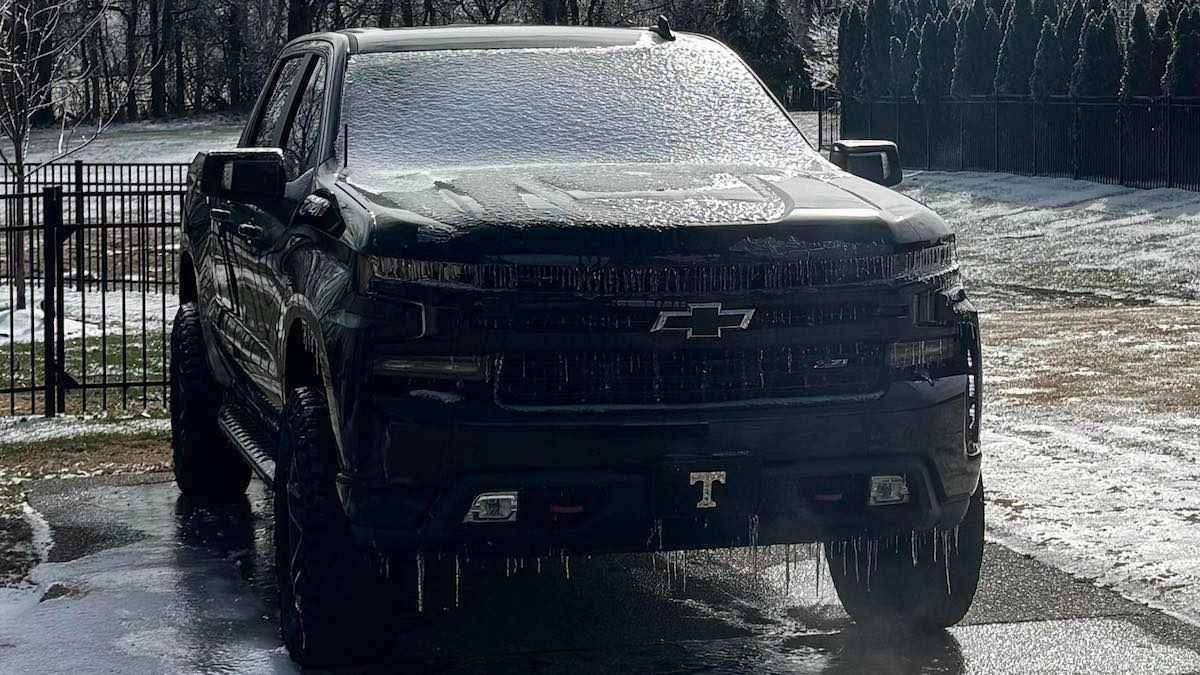

Forget the Chevrolet dealership's "normal" maintenance schedule; if you don't address these two hidden factory flaws today, your Silverado is already living on borrowed time.
In my three decades consulting with the Detroit Big Three, I’ve seen plenty of "planned obsolescence," but the current transmission crisis facing 2019-2026 Silverado and Sierra owners is a different beast entirely. When Reid Powers shared on the 2019 - 2026 Chevy Silverado & GMC Sierra Owners Facebook page that his 2019 transmission "blew up" at just 58,000 miles, he wasn't just venting; he was sounding the alarm on a mechanical ticking time bomb that I have been tracking for years.
Reid’s warning was blunt: “Get a thermal bypass valve and an AFM/DFM disabler as soon as you get your hands on your truck... or else you’ll end up like me.” As a senior reporter who has sat across the desk from industry engineers and under the lifts with master mechanics, I’m here to tell you that Reid is 100% correct. If you own a modern GM half-ton, you are currently participating in a high-stakes gamble where the house has rigged the deck in favor of fuel economy over longevity.
The "Silent Killer": The 190-Degree Factory Trap
The first part of the "Nightmare" is thermal degradation. Most owners assume that if the needle is in the middle, they are safe. But as I explored in this analysis, why a 2023 Silverado transmission failed at 65K while a 2008 model reached 244K, the factory thermal bypass valve is designed to keep your transmission fluid "cooking" at high temperatures to reduce internal friction and squeeze out a fraction of a mile per gallon.
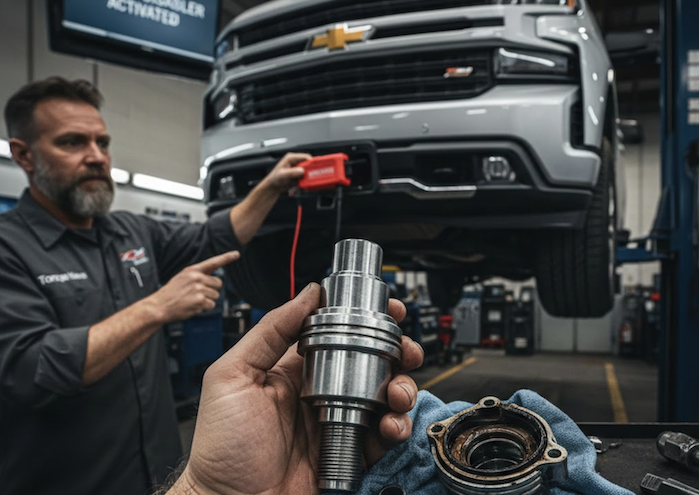
By the time the valve opens to let the fluid reach the cooler, the damage to your internal seals is often already done. Upgrading to a 70°C (158°F) thermal bypass valve is essentially a $100 insurance policy against a $9,000 replacement bill.
The "Rumble Strip" and the AFM/DFM Scourge
The second part of the survival kit is an AFM/DFM disabler. Active Fuel Management (AFM) and its newer cousin, Dynamic Fuel Management (DFM), are engineering marvels that turn your V8 into a V4 or even a V2. However, the constant "cycling" of the cylinders creates micro-slips in the torque converter clutch (TCC).
This results in the infamous "Chevy Shudder," a sensation akin to driving over rumble strips. This isn't just an annoyance; it’s the sound of your transmission shedding friction material into the fluid. I’ve documented this exact cycle of despair before, specifically when a 2019 Silverado owner had his transmission flushed at 72K, only for the shudder to return at 99K, showing that once contamination starts, a simple fluid change is rarely a permanent fix.
Why the Dealership Won't Help You (Until It's Too Late)
So, if these parts are so important, why doesn't GM just install them at the factory?" The answer is simple: Regulations. GM is legally bound by Corporate Average Fuel Economy (CAFE) standards. They have to run the engines lean and the transmissions hot to meet federal targets.
This often leaves owners stranded just as the 60,000-mile powertrain warranty expires. I recently reported on a heartbreaking case in which a 2019 Silverado owner experienced a dual failure of the transmission and engine lifters, resulting in a staggering $8,700 estimate. In that scenario, the DFM system didn't just kill the transmission; it collapsed the lifters, too.
The $250 Insurance Policy vs. The $9,000 "Transmission Tax"
If you are looking for the "Industry Secret" to keeping your truck on the road, it’s not found in the owner's manual. It’s found in taking control of your maintenance.
- Install a Thermal Bypass Valve: Keep temperatures below 150-160°F.
- Plug in an AFM/DFM Disabler: Keep all eight cylinders firing. This prevents the torque converter from "hunting" and protects the TCC from premature wear.
We are seeing a disturbing trend of "disposable trucks," as I noted in my report about a 2020 Silverado owner who had reached his sixth torque converter and had finally given up on the brand. Don't let that be your story.
Wait, There More: The "Red Tape" Behind Factory Failure
As a senior rep who has spent years walking the service departments of the Detroit Big Three, I often get asked: “Denis, if these two parts are the 'holy grail' of longevity, why doesn't GM just build the trucks this way?” The answer isn't that the engineers don't know it’s that their hands are tied by a regulatory knot they can’t untie.
The CAFE Trap
General Motors is currently under immense pressure to meet Corporate Average Fuel Economy (CAFE) standards, which in 2026 are more stringent than ever. To hit these numbers, every fraction of a mile-per-gallon counts. The Thermal Bypass Valve is a primary tool for this; by keeping your transmission fluid at nearly 200°F, it thins the lubricant to reduce internal drag. While this helps GM satisfy the EPA, it’s a death sentence for your transmission's internal seals and friction plates over the long haul.
EPA Credits vs. Mechanical Integrity
Similarly, AFM and DFM systems exist purely to earn "off-cycle" emissions credits. By shutting down cylinders, GM can market a V8 that theoretically delivers fuel economy comparable to a V6. However, the constant engagement and disengagement of the torque converter clutch (TCC) to smooth those transitions is what causes the "Chevy Shudder."
The Warranty Catch-22
Because these systems are essential to the vehicle's certified emissions and fuel profile, GM cannot officially recommend disabling them. In fact, if a dealer finds an aftermarket disabler plugged in during a failure, they may attempt to flag your powertrain warranty. It’s a classic "Planned Obsolescence" scenario: the manufacturer builds the truck to survive the 60,000-mile warranty period while hitting federal targets, leaving you to foot the bill for the "transmission tax" the moment that clock runs out.
In my view, you have to decide who you’re looking out for: the EPA’s data sheets or your own bank account.
My Verdict
In 2026, a truck is the second most expensive investment most people make. Relying on "factory specs" designed for EPA lab tests rather than real-world durability is a recipe for financial disaster.
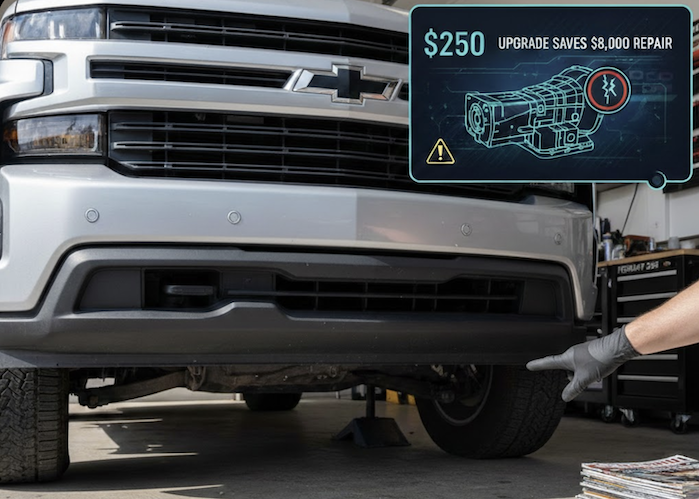
Spend the $250 today. Buy the bypass valve. Plug in the disabler. Because, as Reid Powers learned the hard way at 58,000 miles, the only thing more expensive than a Silverado is a Silverado with a dead transmission.
How About You?
Have you noticed your 2019-2026 Silverado or Sierra starting to "shudder" or run hot, or have you already pulled the trigger on these two preventative upgrades to save your transmission? Whether you’re a high-mileage veteran or a new owner looking to avoid a $9,000 nightmare, your experience can help a fellow truck owner stay on the road. Please share your story and leave a comment in the red “Add new comment” link below.
Next Up: The Dual-Threat Failure Every Silverado Owner Fears
Think a blown transmission is the only thing standing between you and a $10,000 repair bill? In my next report, I dive into the "Double-Whammy" affecting the 5.3L and 6.2L EcoTec3 engines. It isn't just the 10-speed gearbox that's on the clock; the very system designed to save you fuel might be the same one that collapses your lifters and bends your pushrods.
I recently reviewed a heartbreaking case in which a 2019 Silverado owner experienced simultaneous failures of the transmission and engine lifters, resulting in a staggering $8,700 estimate. Read on to see why "maintenance" alone isn't enough to stop this mechanical domino effect.
Denis Flierl is a Senior Reporter at Torque News with over 30 years of hands-on experience in the automotive industry. Having served as a professional test driver and industry consultant for major automakers such as Chevrolet, Ford, Toyota, Honda, and Tesla, Denis provides a "boots-on-the-ground" perspective that goes beyond standard reporting. Since joining Torque News in 2012, he has specialized in cutting through market noise to deliver data-backed analysis and real-world owner stories. His work focuses on navigating the transition to EVs and the shifting automotive market.
Have a tip or question for Denis? > Engage with him directly on LinkedIn for industry analysis, or follow his latest updates on X @DenisFlierl and @WorldsCoolestRides. You can also find his latest car features on Facebook and Instagram.
Photo credit: Denis Flierl via Reid Powers
Set Torque News as Preferred Source on Google
Follow us today...





Comments
I own a 2021 traiboss 4.3 V
Permalink
I own a 2021 traiboss 4.3 V
I own a 2021 trailboss at…
Permalink
I own a 2021 trailboss at 108k i noticed the first signs of shuddering. I already had a appointment for service that same week. So I asked for a transmission diagnosis. Was told my transmission was shot. 10k to replace mind i wad driving it daily this was first shudder. Long story short private mechanic noticed undersized torque converter. Change that absolutely no shuddering almost 20000 miles later. Cost 1900$
Owned a 22 sierra 1500 with…
Permalink
Owned a 22 sierra 1500 with the 3.0 Duramax. 10L80 Transmission went through a torque converter and valve body replaced under warranty. Lemon lawed the truck out after GM engineering said "we don't know." Got into a 2025 sierra 1500 with the 3.0 Duramax, 8k on the odometer and the transmission is doing the same thing. Two visits to the dealer and they "can't replicate the issue." Lots of aftermarket support already for these rigs which is nice but the fact they can't make it 50k is beyond concerning and falls right into your disposable truck theory. I purchased this as the last truck I will ever need to own. GM representatives laughed at me when I mentioned compensation for my time involved going back and forth, leaving my truck for months with the dealer. Sad state of affairs, considering ours early 80's farm truck fires up and runs without issue for decades and not a computer in sight.