
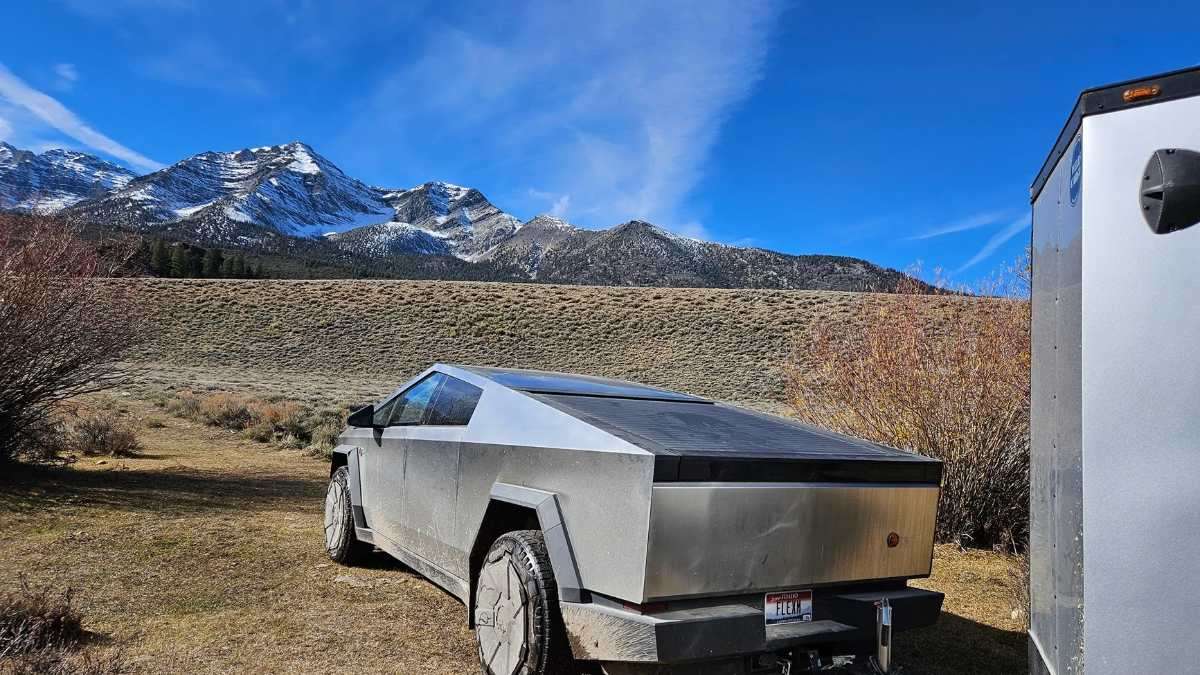

Somewhere in central Idaho, where the mountains lift straight out of the sage, and the roads forget they were ever paved, a stainless triangle is quietly doing what pickup trucks have always done. It hauls gear, tows a homebuilt cargo trailer, sleeps a tired hunter for a cold night, and brings back one deer and two elk from a season that started as an experiment and ended as a case study. The Tesla Cybertruck may have arrived as a rolling argument, but in the hands of Steve from Rigby, Idaho, it has become something more useful than a talking point. It is a tool that has to solve real problems in a real country, not on a whiteboard.
“Well, Fall is now over, and that means my hunting is done for the year. Brought back 1 deer and 2 elk for the season. It made me reflect a bit on the last year with the truck--and using it for hunting specifically.
Overall, it worked. But just barely. I've been trying to think of ways to make this truck work for hunting in my spot for years as I waited. I imagined all the same power stations and solar combos that many others have. But they are a ton of money and take up lots of space. Here are my thoughts after a hunting season under my belt with it.
My problem is that I hunt central Idaho--near Mt Borah and Arco, Idaho. I also have a cargo trailer I've built out to camp in. My 300-mile range gets cut to about 120 miles while pulling the trailer and gaining elevation like that. There is a hokey charging station about 85 miles into the trip. It's only a 125kw charger, but it's all there is in the middle of nowhere, and one of only a few that the government put in with all that money for charging infrastructure. So.....super happy it exists at all. But we have to stop and charge there for 60-75 minutes to get 100% before continuing on. We go another 50 miles and turn off the paved roads, and then it's 1-2 hours on slow, rocky, nasty roads. Range anxiety might not be too bad on well-used highways, but for us hunters and explorers, it's very real.
Instead of expensive solar setups, I took my 4750 Harbor Freight inverter/generator on each of the 3 hunts. With its 30-amp output (only 23 or so usable without tripping the charger), I can get 5-6 miles per hour running. So in the evenings, I'd run it for a couple of hours. Kind of obnoxious (quiet solar would be better). The cold nights would sap away 15 miles by morning, but at least I was keeping up with the drain. Then, before leaving, we ran it for 3-4 hours as we packed up and relaxed a bit. It worked, but just barely enough to get us back to that same charger with 10-15 miles to spare.
Thoughts after nearly 1 year plus 3 hunting trips.
Love driving it. Mostly a commuter.
People mostly accept it now.
Tech is great. Systems & Software are amazing.
Space was good. Love having the higher bed panels, which allow you to cram more in the bed and still keep it covered.
Advertising
On one trip (September), I even spent 1 night in bed with the cover cracked open. It was definitely cold at night, but turning sideways a little was doable in a pinch.
Loved the air suspension and being able to raise when needed.
Glass roof, I would sacrifice for $$$. I thought it would be cool in the mountains. But it mostly didn't help the view. Only saw a reflection of what is inside the truck. If that adds $1000 or 2000. It's easy to take that money instead. My son-in-law nearly cracked it accidentally, getting in the truck, and hitting the barrel of the gun on the ceiling.
4-wheel steering is great, but I wish they hadn't done it. Nice and nimble, but my F150 was fine without it. If it's another thousand or two, I would have taken that off the price gladly as well. Plus, more expensive parts to going bad and worry about messing up.
A spare tire is a pain. Have to take up most of the bad with it, plus a beefy floor jack, tire iron, and inflator. If Rivian could find a way to package one in a smaller truck, I think Tesla could have if they had wanted to.
The truck performed well over the nasty terrain. Was able to digitally "disconnect" trailer so I could raise the suspension even with the trailer on to avoid some dips and spots where I would have drug my tongue.
Sure wish we could connect the truck to satellites for way off-grid trails.
Another problem with the glass roof is no grab handles. From my older mom that I take around sometimes, to just getting in easier and taking weight off the seat edges, to off-roading, i t's just unimaginable that a truck doesn't have handles. If an updated truck came out today with no other feature besides that, I would seriously consider it for that one thing alone. When you're on a rocky trail, the driver is fine with the wheel, but anybody riding is just sloshed all over the place. It's terrible.
Still happy I have it, but if there is a re-design with a larger battery or some correction to some of these things, I'd be open to a trade-up. I'll attach a few pics of the hunt for those that appreciate that kind of thing.”
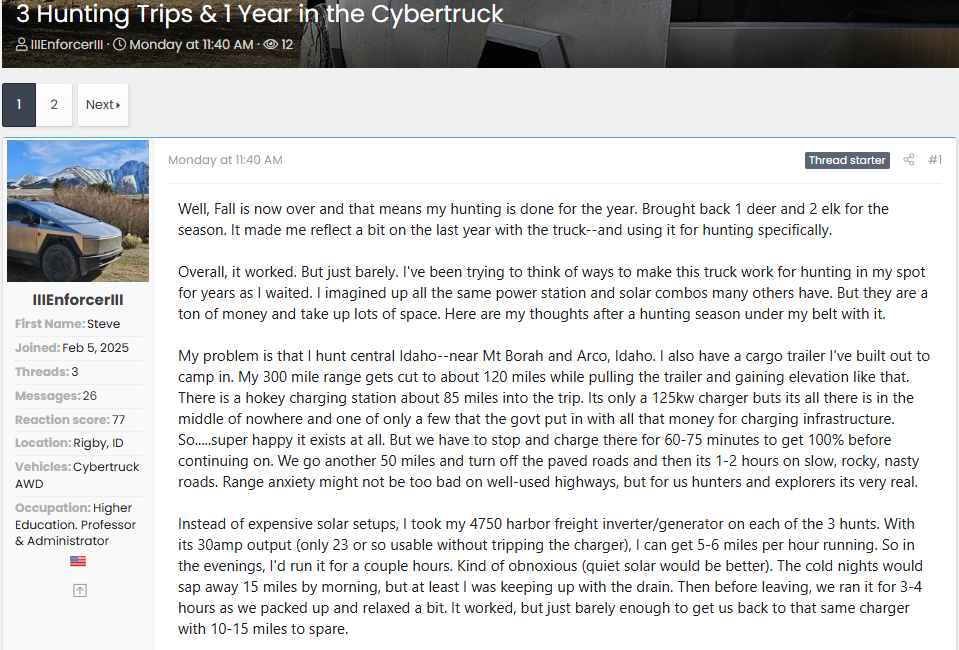
It is what happens when a three-hundred-mile-rated Tesla Cybertruck pickup meets elevation gain, a loaded cargo trailer, and the long empty spaces between Arco and the shadow of Mt. Borah. On paper, 300 miles suggests comfort. In practice, the combination of weight, grade, cold, and slow, rocky access roads cuts that figure to about 120 usable miles while towing. That is enough, but only if every leg of the journey is treated like a problem set. Eighty-five miles to a lonely 125 kW charger that exists by the grace of government infrastructure money, an hour or more to top up, another fifty on pavement, then one to two hours crawling on rock. Range anxiety on an interstate is a matter of convenience. Out where the lights stop, it becomes trip planning in its purest form.
Tesla Cybertruck: Tire Size & More
- The Cybertruck is built around an exoskeleton-style stainless-steel body, giving it a futuristic look and significant rigidity compared to traditional body-on-frame trucks, a design choice that’s as much about durability as it is about identity.
- From the factory, Cybertrucks come with massive 35-inch all-terrain tires (typically around 285/65R20, depending on configuration). Tesla chose this size to deliver off-road capability, ground clearance, and a planted stance without resorting to oversized fender modifications.
- Tesla does not include a spare tire primarily to maximize cargo bed space, maintain aerodynamic efficiency, and keep total vehicle weight under control. On an EV truck, extra weight directly reduces range, so deleting the spare is a meaningful engineering trade-off.
- Instead, drivers rely on tire repair kits, roadside assistance, or optional aftermarket spare-tire carriers, a setup that aligns with Tesla’s general philosophy of reducing onboard redundancy and trusting software+support systems to fill the gap.
Instead of turning to a high-dollar solar array, Steve turned to something almost endearingly simple: a 4,750-watt Harbor Freight inverter generator. With about 23 amps of usable output before tripping the Cybertruck’s onboard charger, it feeds an extra 5 to 6 miles of range for every hour it runs. Evenings in camp become a ritual of electrons and elk, a couple of hours of generator time to keep the cold from eating too deeply into the battery, followed by another three or four hours of charging while camp is broken in the morning. The result is just enough energy to limp back to that solitary charger with ten to fifteen miles in hand. It is not elegant, and the owner freely admits the generator is obnoxious compared to silent solar, but it is practical, affordable, and, crucially, it works.
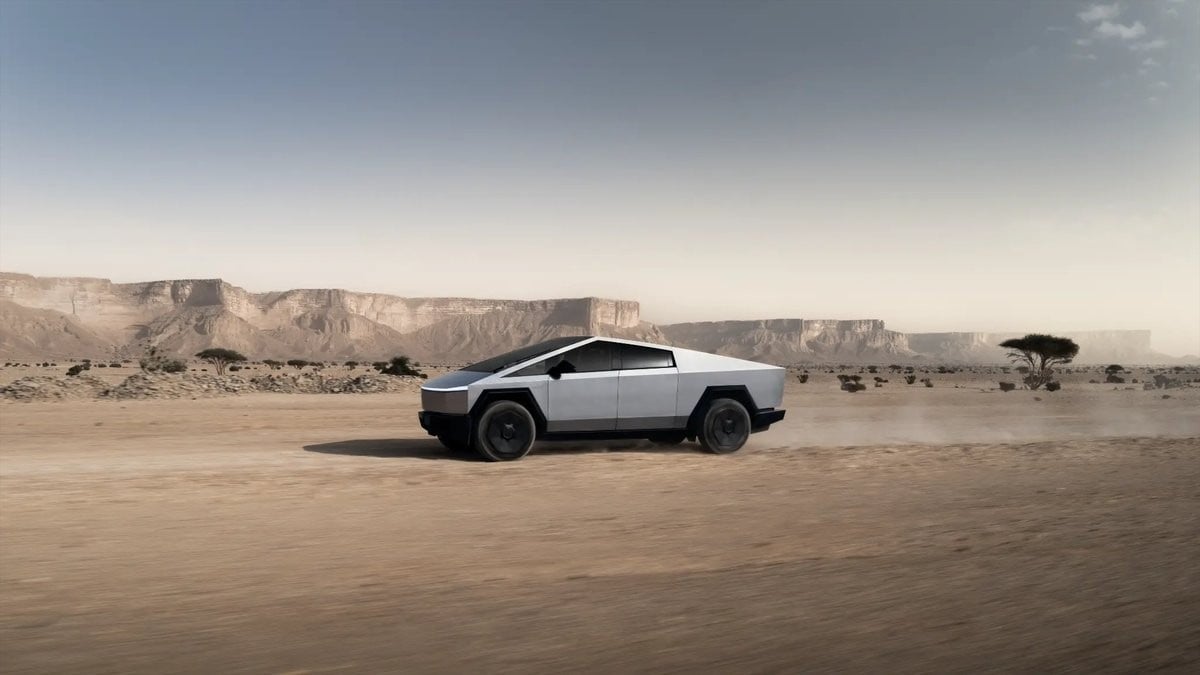
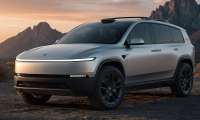
Strip away the online noise, and what remains is a truck used very much like any hardworking pickup. For most of the year, Steve’s Cybertruck is a commuter that has gradually gone from curiosity to accepted presence in town. Out in the hills, it becomes a gear shed on four motors. The high bed walls raise the volume under the tonnea, so more equipment is covered and secure. The air suspension earns real respect, lifting the truck and trailer over ruts and washouts that would have a conventional hitch grinding its tongue in the dirt. One early-season night, when circumstances dictated, the owner simply slept in the bed with the cover cracked, lying sideways to make it work. It was cold, but the fact that it was possible at all speaks to a certain quiet versatility.
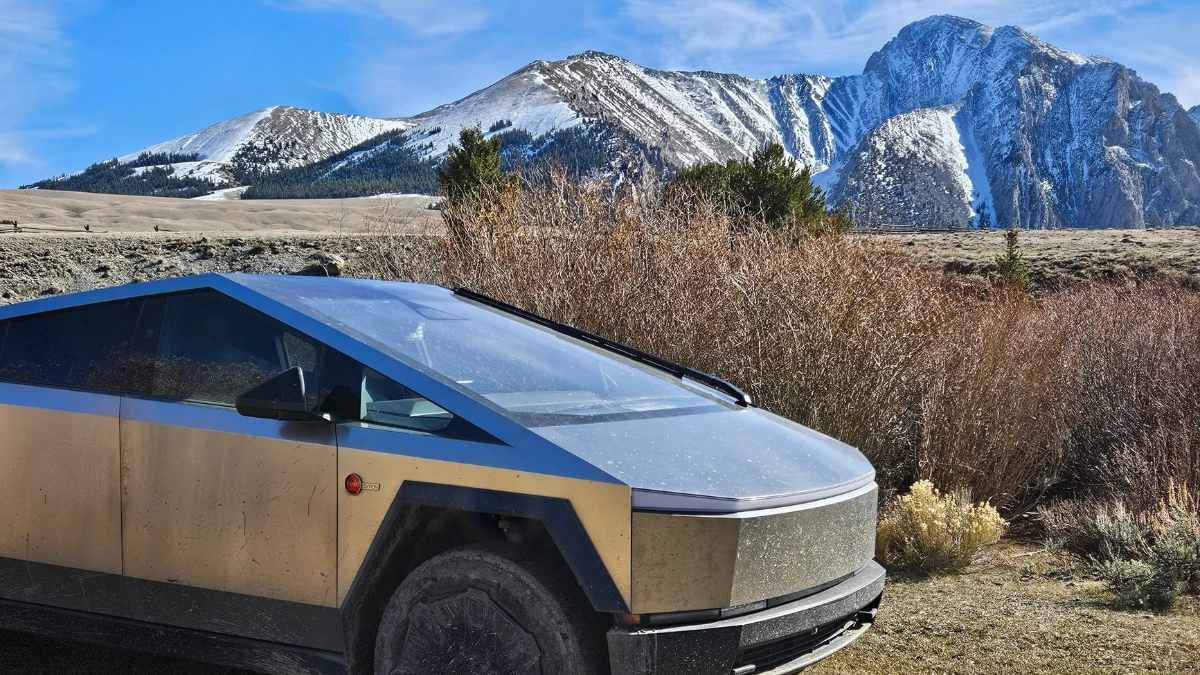
The design choices that thrill in brochures can look different on a loose shale two-track. The panoramic glass roof, for example, turned out to be more reflective than vista in the mountains, and a potential liability when a son-in-law nearly tagged it with a gun barrel. The lack of grab handles, a stylistic side effect of that glass, is more than an annoyance when older passengers are climbing in or when occupants are being tossed around on rocky trails with nothing to brace against. The spare tire solution consumes much of the bed once the jack, iron, and inflator are included, leading the owner to point out that if a smaller electric truck can hide a spare more gracefully, this one should be able to as well. These are not emotional complaints. They are the sort that only appear after repeated trips over the same battered road.
The forum crowd filled in the picture around those notes. One owner from British Columbia applauded the hunting success while admitting he is more of a hiker who happens to carry a rifle. He was quick to credit the Cybertruck’s four-wheel steering and camera suite for helping him thread his own way out of tight mountain turnarounds, the kind of slow-motion three-point shuffles where a mistake means bodywork. Another long-time poster, who keeps both a Cybertruck and an old Toyota FJ in his stable, agreed with Steve’s verdict on range in blunt terms. For him, using current electric trucks for serious off-grid work within even a hundred-mile radius feels like the early laptop era. You can do it, he argued, but you never forget how close the battery gauge is getting.
Connectivity is part of that puzzle as well. When Steve mentioned wishing he could tie the truck into satellites for off-grid navigation, another member answered with a solution that feels almost inevitable in hindsight. A compact Starlink Mini unit, roof-mounted and connected to the truck’s Wi-Fi, can keep maps and messages flowing far beyond cellular coverage while sipping relatively little power. In that configuration, the Cybertruck becomes a roving camp hub, a stainless steel command post with hot coffee in the cab, a freezer in the trailer, and an Internet connection that reaches over the next ridge.
Step back, and the picture is not one of failure or of effortless triumph. It is a portrait of a first-generation electric pickup doing legitimate work in a demanding environment, and doing it with enough competence that its owner is both satisfied today and eager for a future revision with more range and a few hard learned ergonomic improvements. The truck is still controversial in city parking lots and on social media, where lines and opinions are both sharp. In central Idaho, its value is measured in whether it can claw its way back out of the mountains with game in the bed and a few miles to spare. By that standard, “it worked, but just barely” is not a complaint. It is a clear-eyed verdict on the current state of electric trucks at the edge of the map, and an indication that plenty of people love them enough to work around the limits.
Image Sources: Tesla Media Center
Noah Washington is an automotive journalist based in Atlanta, Georgia. He enjoys covering the latest news in the automotive industry and conducting reviews on the latest cars. He has been in the automotive industry since 15 years old and has been featured in prominent automotive news sites. You can reach him on X and LinkedIn for tips and to follow his automotive coverage.
Set Torque News as Preferred Source on Google
Follow us today...





Comments
He's carrying fuel and a…
Permalink
He's carrying fuel and a generator rather than a panel and a converter; which can be quite small and light if they are a mechanically linked vfd.
If the spare was useful in another way that would help, too. Like if it also was a pushbar/cattlebar type mount to the front and not a full size width.
Plus, spare tires could be power storage, as can air pressure in the tires can be emergency "fuel" for a kinetic vfd. Then... Of course; much tech is in progress which uses bumpy roads to supply power directly through several conversion methods; many similar to those developing for hydro/tidal/wave/wind applications...
So in a few years at best bumpy roads should mean unlimited range.
Which will be scaled to offramps at interstates so charging is as simple as picking the alternate lanes for a few miles.
Good work keep it up.
Baj 11 plus a host of "impressive" cv junk and a degree in anthro. Plus i sold parts and worked in aftermarket chemicals (i worked for/with the inventor of block seal by k&w and for autoworks: a hahn division, and i have aerospace/defense and dhs ties. Ive done a lot.
Yep, nothing screams, I'm…
Permalink
Yep, nothing screams, I'm here to hunt!, like a Tesla "truck". Did you have the self shooting gun too where you line the cross hairs up on the target on the computer and then click the button??
Why would anyone think they…
Permalink
Why would anyone think they could tow a trailer with an electric pickup and not lose range???????? This is the number 1 reason people who tow long distances don't even consider electric vehicles. First dumb move was buying a cyber truck. Second dumb move is towing with it.
Looking to score the dumbass…
Permalink
Looking to score the dumbass trio, that is;
I got the whimpy truck- dork
Got the faggy man denial of suedo hunting- dick.
Now for the perfect score - get in a wreck on the way home driving cyberjunk thru the snow- dipshit.
Still mad Kamala didn't win?…
Permalink
In reply to Looking to score the dumbass… by John L (not verified)
Still mad Kamala didn't win? And, what do you drive, a Prius?