
Is autonomous driving ready for prime time? Autonomous driving, or “full self-driving” (FSD) as Tesla calls it, has been a major push in the automotive industry. Although it has improved massively since the disastrous 2004 Darpa Grand Challenge which was a competition with a $1 million prize for the first fully autonomous vehicle to complete the 142-mile off-road course in the Mojave Desert. It was nicknamed the “Debacle in the Desert" because not even one of the 15 autonomous vehicles entered in the race managed to complete the course. The best-performing vehicle, Carnegie Mellon's Humvee named "Sandstorm," only made it a little over seven miles before crashing into a ditch.
Fast forward to today and Waymo has logged over 100 million fully autonomous miles, while Tesla has accumulated over 3 billion miles using its driver-assisted Autopilot feature. Despite these advances, we still see numerous social media posts about autonomous driving features supposedly causing accidents or confusing drivers. Here’s a recent post by Alex Pidilla from the Facebook Tesla Model Y group.
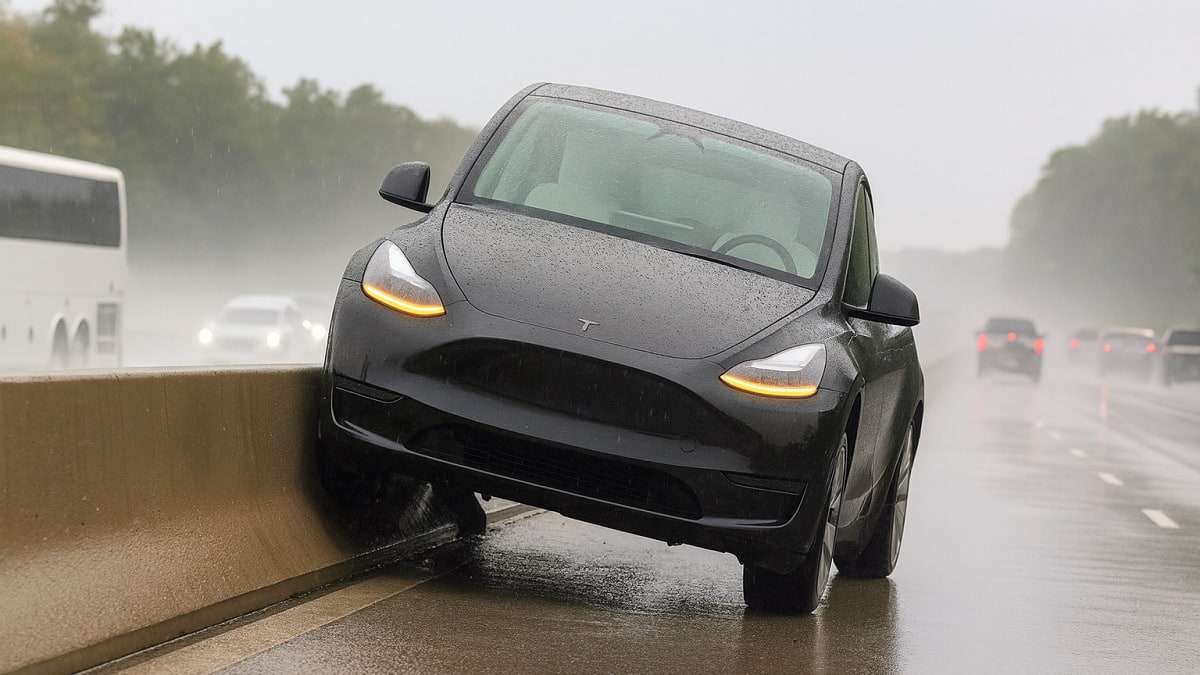
Alex was driving on a highway in the rain. Because of the conditions, he mentions that he drove at a reduced speed to prioritize safety, and stated, “I was also cautious due to the presence of multiple semi-trucks, that often drive recklessly in the rain.” During his drive, he stated, “I believe it was the Lane Assist that made my steering wheel make a hard jolt that caused me to do a full 360 spin on the highway, and crash backwards into the center divider wall.”
Fortunately, nobody was hurt, and Alex noted, “I was very fortunate to not have sustained any injuries.”
When trying to diagnose what happened, Alex thought back to earlier in the day, and stated, “The crazy part is that it had happened earlier that morning and I had no idea that it would happen again, because I thought it was some type of oily spot on the road that I had driven over.”
Given this experience, Alex doesn’t think that he caused the accident and stated, “I am fully convinced that I am not at fault. I was not on Traffic Aware Cruise Control or Full Self Driving.”
On Alex’s Facebook post, Alexa Norris commented:
“I had the lane assist and turned it off. I believe is “aggressive” when it thinks you are coming off the lane and has scared me a couple of times.”
Joe Eschmann commented about how Tesla’s can respond unpredictably:
“Others will just say it’s your fault and it is BUT, Tesla’s at Times have a mind of their own and it’s scary. I’ve been driving a Tesla for 9+ years.”
Kyle Mentink got into the philosophy of autonomous assist and who is ultimately responsible:
“Not to be a jerk, but it is your fault. You trust the car to drive itself, but ultimately you are still responsible for the car and what it does.”
How The Brands Rank in Driver Assist Accidents
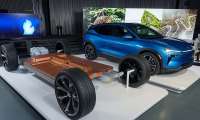
According to 2025 reports, Tesla vehicles are most frequently involved in crashes where Advanced Driver-Assistance Systems (ADAS) are engaged, followed by Honda and Subaru. These statistics are based on mandatory reporting to the National Highway Traffic Safety Administration (NHTSA) and reflect the high number of Tesla vehicles on the road. To be clear, the reports regard crashes where ADAS were in use, but do not always specify if the ADAS was the direct cause of the crash.
Why Is ADAS Important
Research shows that most accidents happen because of human error, while a small portion comes from environmental factors or mechanical failures. This pattern is why Advanced Driver Assistance Systems, known as ADAS, were created. These systems are designed to make driving safer and more manageable by supporting drivers when conditions become unpredictable or stressful.
How ADAS Senses the Environment
The foundation of ADAS is a network of sensors placed around the vehicle. These sensors work together to understand what is happening on the road. Radar uses radio waves to detect objects and measure distance and speed. Lidar creates a detailed three dimensional map of the vehicle’s surroundings. Ultrasonic sensors help detect objects close to the vehicle, which makes them ideal for parking situations. Cameras capture images of lane markings, traffic signs, pedestrians, and vehicles, providing valuable visual data that the system can interpret.
How ADAS Makes Decisions
All the information collected by the sensors flows into the control unit, which acts as the brain of the system. The control unit compares this data to programmed rules and algorithms. This process helps the system identify risks, predict what might happen next, and take appropriate actions when needed. These actions may include sending alerts to the driver or adjusting the vehicle’s movement to avoid danger.
Tesla has relied heavily on machine learning and artificial intelligence to improve its ADAS features by teaching its systems to recognize real world driving patterns with greater accuracy. The company collects data from millions of miles driven by customers, which helps its algorithms learn how to handle a wide range of situations. This approach lets Tesla refine lane keeping, object detection, and decision making over time through frequent software updates. The result is a system that becomes smarter and more capable as more vehicles gather real world experience.
Levels of Automation: Level 0 and Level 1
ADAS is organized into levels that describe how much automation a vehicle can provide. Level 0 has no automation, leaving the driver fully responsible for all driving tasks. Level 1 offers limited assistance in specific situations while still requiring full driver engagement. Examples include adaptive cruise control, lane departure warning, parking assist, and traffic sign recognition. These features help with narrow tasks such as maintaining speed, monitoring lane position, improving parking visibility, and identifying road signs.
Examples of Level 1 ADAS are Tesla’s Lane Assist which provides steering support to help keep the vehicle centered, and Traffic Aware Cruise Control (TACC) which controls acceleration and braking to maintain speed and following distance, but it does not control steering, so it is categorized as Level 1.
Level 2: Partial Automation
Level 2 marks a major step forward because it can manage multiple driving tasks at the same time. Lane keeping assist can provide ongoing steering adjustments to keep the vehicle centered. Traffic jam assist can control acceleration, braking, and steering during slow or stop and go conditions, which reduces driver fatigue. Automated emergency braking can detect an imminent collision and apply the brakes when the driver does not react in time. These systems still require the driver to remain alert and ready to intervene.
Examples of level 2 ADAS are Tesla’s Autopilot which is a combination of Traffic-Aware Cruise Control and Autosteer. Tesla Full Self-Driving (FSD) Supervised is also Level 2 because it can handle more complex driving tasks such as city streets, turns, and lane changes, yet the driver must maintain attention and be ready to take control at any moment. Because the driver remains responsible, it is still Level 2, not Level 3 or above.
Level 3: Conditional Automation
Level 3 allows the vehicle to handle certain driving tasks under specific conditions. Features such as traffic jam pilots and highway pilots can take over speed control, steering, and lane changes in defined areas like highways. These systems rely on high-definition maps and geofencing to determine where they can operate safely. Although the system can manage much of the driving, the driver must be able to take control when the vehicle requests it.
Level 4: High Automation
Level 4 can perform most driving tasks without driver involvement in certain environments. An urban pilot can guide the vehicle through intersections, traffic lights, and pedestrian areas. Self-parking features allow the vehicle to find a parking spot and park on its own. These abilities make level four a significant milestone in autonomous technology, although the vehicle still depends on specific conditions and mapped areas.
Level 5: Full Automation
Level five represents complete autonomy. A level five vehicle does not require a steering wheel, pedals, or any other traditional controls. It can operate in any environment and handle every driving scenario without human input. The onboard artificial intelligence manages route planning, decision making, and movement through complex road situations. This level remains a future goal as the technology continues to evolve.
Bottom Line
ADAS is reshaping modern transportation by reducing errors, improving awareness, and easing the workload on drivers. It is important for drivers to understand what level of automation their vehicle offers because ADAS is meant to support rather than replace them. Staying attentive and following manufacturer guidelines ensures that these systems can be used safely. The progress made so far shows how close the industry is moving toward fully autonomous vehicles, although widespread level five automation will take time to become reality.
The Tesla Model Y
The Tesla Model Y is a compact electric crossover SUV that blends practicality, strong performance, and modern technology in a way that appeals to a wide range of drivers. It was introduced in 2019 with deliveries beginning in 2020, and it quickly became Tesla’s most popular model because of its roomy interior, smooth ride, and impressive electric range. The Model Y stands out through its efficient design, quick acceleration, and access to Tesla’s extensive Supercharger network, which makes long trips easier and more convenient. Its simple cabin layout, large touchscreen, and frequent software updates give it a futuristic feel that many shoppers find refreshing. The combination of space, efficiency, and cutting-edge features makes it a favorite in the growing EV market.
What Do You Think?
Have you ever had your Tesla Model Y or another EV make a sudden steering correction that didn’t feel right?
Do you keep Lane Assist and similar safety features turned on, or have you disabled them because of how they behave?
Chris Johnston is the author of SAE’s comprehensive book on electric vehicles, "The Arrival of The Electric Car." His coverage on Torque News focuses on electric vehicles. Chris has decades of product management experience in telematics, mobile computing, and wireless communications. Chris has a B.S. in electrical engineering from Purdue University and an MBA. He lives in Seattle. When not working, Chris enjoys restoring classic wooden boats, open water swimming, cycling and flying (as a private pilot). You can connect with Chris on LinkedIn and follow his work on X at ChrisJohnstonEV.
Photo credit: Provided by author
Set Torque News as Preferred Source on Google
Follow us today...