
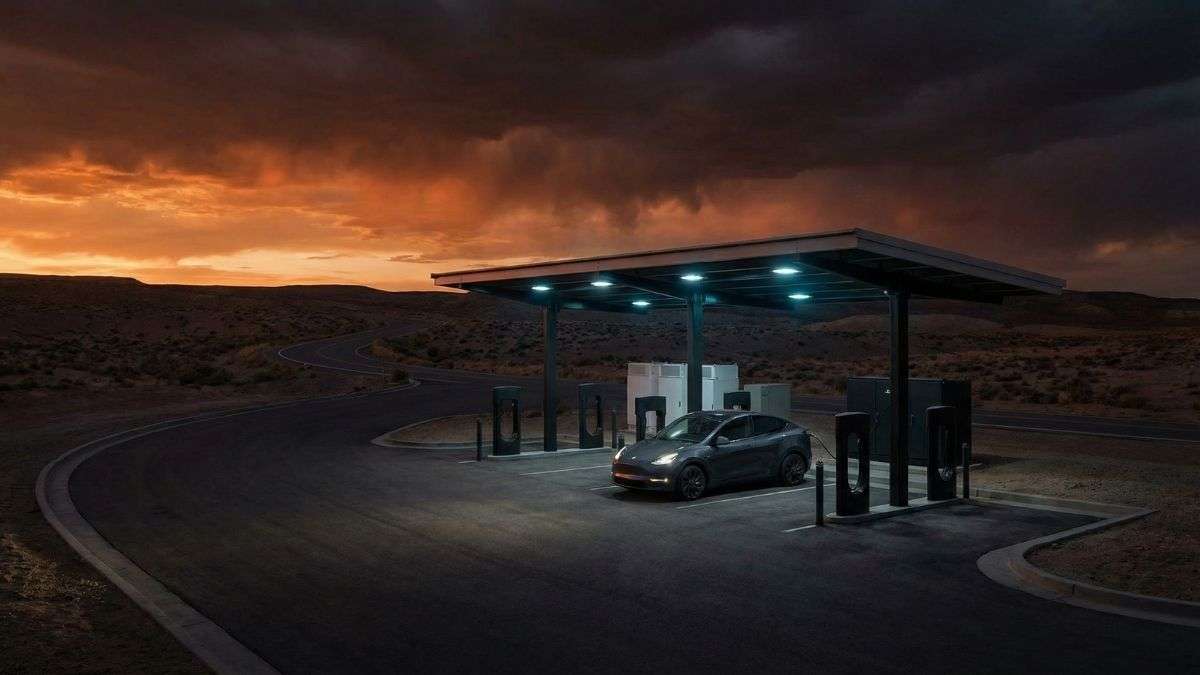

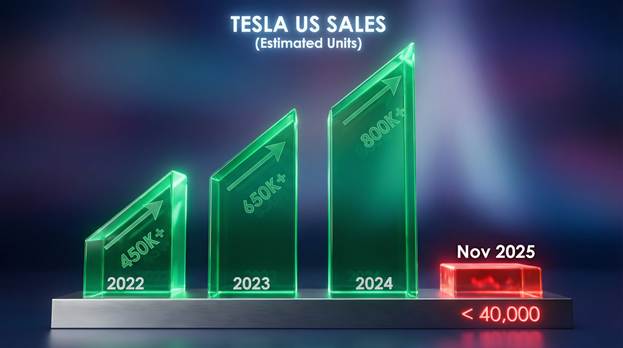
For years, the narrative around Tesla was one of unstoppable momentum. Even when quarters were tough, the trendline pointed up. But the data from November 2025 has delivered a stark reality check: Tesla’s US monthly sales have dropped below the psychological floor of 40,000 units.
According to the latest industry estimates, Tesla moved approximately 39,800 vehicles in the US last month—a figure we haven't seen since the supply-constrained days of January 2022. This represents a stinging 23% year-over-year decline and a massive deceleration from the frantic pace of the third quarter.
This isn’t just a blip; it is the culmination of a "perfect storm" involving policy shifts, an aging product lineup, and a brand identity crisis that centers squarely on its CEO. Here is a deep dive into why the EV king is losing its crown in its home market and what it will take to stop the bleeding.
The Tax Credit Hangover and the "Standard" Misstep
The immediate catalyst for this drop is clear: economics. The expiration of the $7,500 federal EV tax credit at the end of September 2025 created a massive demand vacuum. We saw a "pull-forward" effect in Q3, where buyers rushed to lock in deals, leaving the Q4 cupboard bare.
Tesla anticipated this. In October, they launched new "Standard" range variants of the Model 3 and Model Y, priced roughly $5,000 lower to bridge the gap left by Uncle Sam. On paper, it was a logical move. In practice, it has backfired.
Early data suggests these cheaper variants aren't bringing in new buyers; they are simply cannibalizing sales of the higher-margin Premium trims. As Electrek reported this morning, the demand for these stripped-down models is tepid at best. Buyers are looking at the value proposition—a lower-range, de-contented Tesla without a tax credit versus a flood of feature-rich competitors—and walking away.
The "Musk Penalty": When the Brand Becomes Baggage
We cannot discuss Tesla’s 2025 slump without addressing the elephant in the room: Elon Musk.
For a decade, Musk was Tesla’s greatest marketing asset. Today, he is arguably its biggest liability in the US and Europe. His deep involvement in polarizing political campaigns throughout 2024 and 2025, specifically his leadership role in the "Department of Government Efficiency" (DOGE) and vocal support for far-right figures, has alienated a significant portion of the EV-buying demographic.
The data supports this "reputational fatigue." Surveys from Forrester and other firms have noted that the "sheen" has worn off the brand. Liberal and centrist buyers, who once viewed owning a Tesla as a badge of environmental honor, now increasingly view it as a political endorsement they aren't willing to make.
Even Musk seems to recognize this strategic error. In a candid moment recently cited by InsideEVs, Musk admitted regrets regarding his political entanglements, noting that the backlash has had tangible effects on the company. When the CEO’s personal brand actively repels 50% of the market, sales slumps are inevitable.
An Aging Fleet in a Fresh Market
Beyond politics and tax credits, there is a fundamental automotive problem: The cars are getting old.
The Model Y is the best-selling car in the world, but it is no longer the newest or most exciting. The Model 3 received a refresh (Highland) back in 2024, but the core platform is aging. Meanwhile, the Cybertruck remains a polarizing, high-priced niche product that has not ramped up to the mass-market volumes needed to offset declines in the sedan and SUV segments.
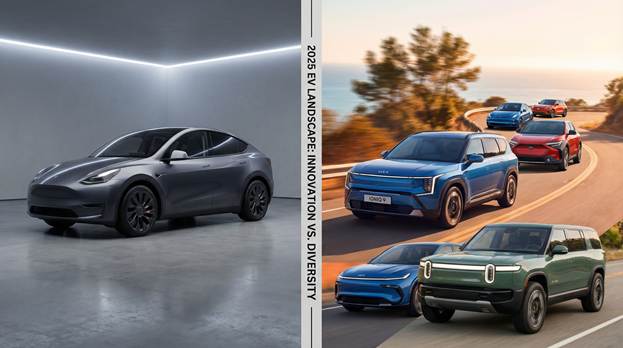
Contrast this with the competition. Hyundai and Kia have released a blitz of varied, stylish, and high-performing EVs. The US legacy automakers are finally finding their footing with reliable electric trucks and SUVs. Customers walking into showrooms today have choices that didn't exist three years ago. Tesla’s "minimalist" interior and tech-first approach are no longer unique selling points; they are just one option among many.
Global Pressure: The Walls Are Closing In
The US sales drop is mirrored by struggles abroad. In Europe, Tesla’s market share is under siege from both Volkswagen Group and Chinese entrants. In China, BYD continues to be the juggernaut.
While Tesla still holds its own in profit margins, its volume growth—the engine of its stock valuation—has stalled. Reports indicate that while global EV sales are up 21% in 2025 driven by Europe and China, the US is stalling, and Tesla is losing its grip on the narrative of being the "only game in town." The Chinese OEMs are moving faster, iterating software quicker, and offering luxury interiors at price points Tesla has refused to match.
What Tesla Needs to Do to Turn Around
Is this the end of Tesla? Absolutely not. But it is a severe pivot point. To reverse this slide and climb back above the 50k monthly sales mark in the US, three things need to happen immediately:
- Launch the "Model 2" (Next-Gen Platform): The time for rumors is over. Tesla needs a true mass-market vehicle priced under $30,000 before incentives. The "Standard" Model 3 cuts aren't enough. The market needs a compact, affordable Tesla to compete with the incoming wave of cheap Chinese EVs and affordable options from Kia/Hyundai.
- Decouple the Brand from the Man: Tesla needs a stronger, independent marketing voice. The company has historically spent $0 on advertising, relying on Musk’s X (Twitter) account. That strategy is now broken. Tesla needs traditional, high-quality brand advertising that reminds people why the cars are good—safety, Supercharging network, and software—without the political baggage of its CEO.
- Refocus on Core Auto Execution: While Robotaxi and Optimus robots are exciting for the stock price long-term, they don't sell cars today. Buyers are frustrated with "FSD" promises that haven't fully materialized. Tesla needs to improve service center availability, build quality, and customer support to win back the trust of the "normie" car buyer who just wants a reliable vehicle, not a science experiment.
Wrapping Up
November’s drop below 40,000 units is a wake-up call that cannot be ignored. It signals that the era of easy growth for Tesla is officially over. The company is no longer fighting against gas cars; it is fighting against its own aging lineup, a polarized brand image, and a hungry field of competitors.
Tesla has the engineering talent and the cash reserves to fix this. The question is whether leadership is willing to put aside the political distractions and the "robotaxi or bust" mentality to do the hard work of being a car company again.
Disclosure: Images rendered by Artlist.io
Rob Enderle is a technology analyst at Torque News who covers automotive technology and battery developments. You can learn more about Rob on Wikipedia and follow his articles on Forbes, X, and LinkedIn.
Set Torque News as Preferred Source on Google
Follow us today...





Comments
The Tesla fad was fun while…
Permalink
The Tesla fad was fun while it lasted. But all fads eventually fade. Tesla needs to come up with something cute...AND QUICK! Cute is what's selling today.
Sad, Cute?! I’m on my third…
Permalink
In reply to The Tesla fad was fun while… by Buzz Wired (not verified)
Sad, Cute?! I’m on my third Flawless Tesla ,,, 3, Y, ‘26 Juniper … we’ve had EV’s for over 11 years now. We’ve been able to rent EV’s on trips a couple of fimes. The Teslas keep getting Better. Their True One Pedal driving, now with Auto Reverse/Drive selection is simple The Best Driving Experience! But NOW their FSD is simply Wonderful. One very quickly realizes, what is the Point of Driving Oneself?! Imagine if all of the Hot Rodding Boys and drivers distracted by their phones were replaced by Self Driving Teslas?! They are getting very close to removing the “Supervised” part of the equation. The monthly over the air software updates keep making ones car a better product. Tesla is Very Engaged! Meanwhile the GM garage mechanics tell my wife her Volt needs an oil change even though her Oil Life gauge shows 85% Life Remaining! They are pathetic and desperate …