
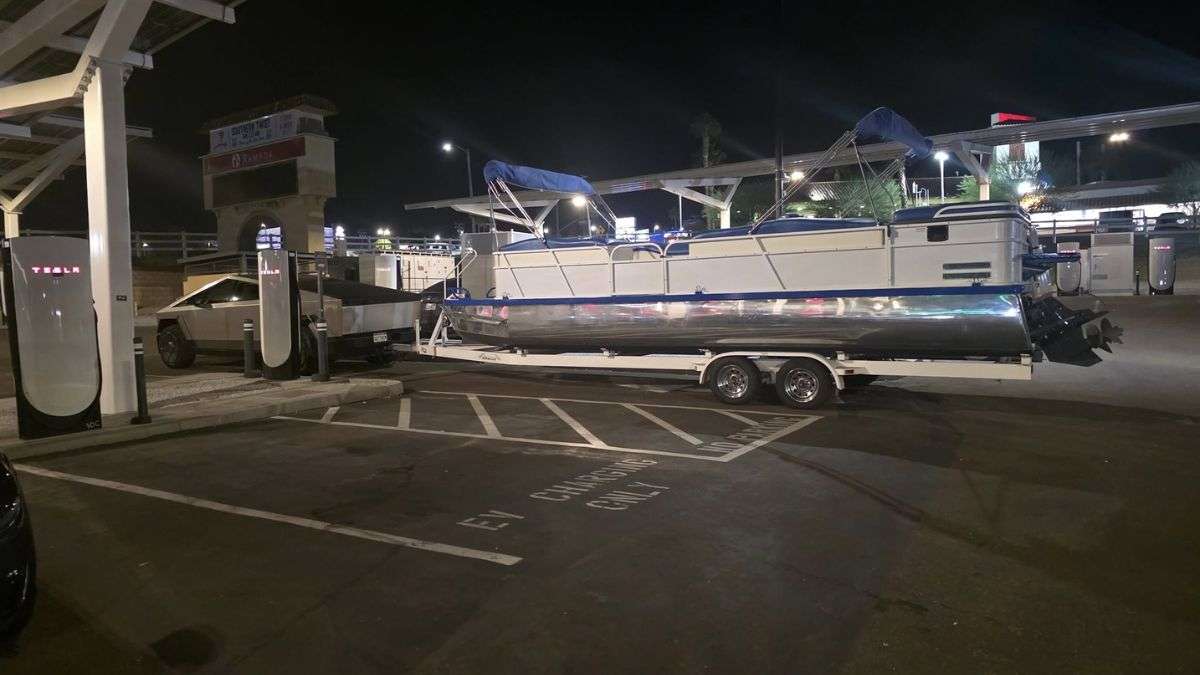

Many believe that towing with an electric truck will be difficult, hard to predict, and simply not worth the time. Some of this is due to how little time has passed since electric trucks were first introduced, and as such how few owners have been able to see the capability of their truck outside of marketing materials. That’s why when I saw a post by Johnny Meguerditchian in "Cybertruck Owners Only” Facebook group, it could not illustrate the difference between perception and reality any better. Johnny towed his brand-new boat for 350 miles from Los Angeles to Lake Havasu, and the calm, almost nonchalant manner in which he described the experience stood out from most others who describe towing as though it is hard work. He made it sound like a drive with nothing unusual happening at all.
Here's how he put it: "Hello everyone! I am towing my new boat 350 miles from Los Angeles to Lake Havasu. I feel very little pull from the 7,800 pounds back there."
Hearing someone say they barely felt nearly four tons behind a truck is surprising on its own, but hearing it from a Tesla Cybertruck owner is even more interesting. The Cybertruck’s design has generated quite a bit of debate, and many are still underestimating what electric torque feels like when towing a large load.
Countering the Myths
Skeptics of electric vehicles are often critical of truck performance based upon "towing." The idea being that EV truck battery ranges will decrease significantly, EV truck batteries will be overly stressed by towing, and the overall towing experience for EV trucks will be less desirable than towing with gasoline engines. However, examples such as Johnny's provide a counterpoint to this skepticism and illustrate how well-planted and solid the Cybertruck is when hauling heavy weights, and how much stability there is in the vehicle. That’s even though range definitely takes a hit when it comes to EV towing.
And it’s not the first time Cybertruck owners have come forward with positive real‑world experiences. Many early adopters who previously owned multiple trucks have reported that their Cybertruck is the most enjoyable car yet, as real‑world owner testimony praising the Cybertruck’s driving experience across several different trucks they have owned. These kinds of stories matter because they create a pattern rather than an isolated result.
The Second Half of the Experience
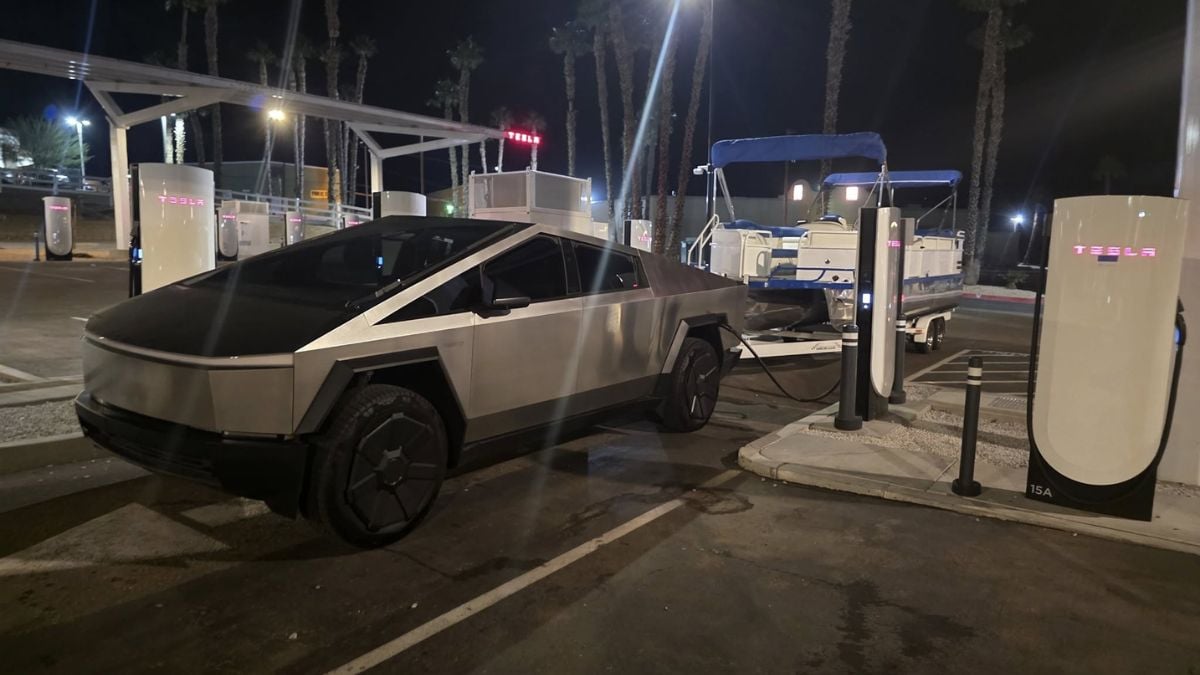
Johnny went back to the post and told more stories about the experience he had on his trip. The second part of Johnny's experience was the actual towability of an electric vehicle (EV) over a long distance. He said, “I’m getting about 120 miles per charge cruising at 55–60 mph. We hit a snafu though. I made it 100 miles with 10%. We did not have a CCS connector for the Electrify America charger, so I had to drop the boat at Goffs Road and milked it to Needles. Went back to get the boat and back to Needles. Now we're at the Airbnb using my makeshift 220V adapter from the dryer to the mobile connector."
This is where the Cybertruck’s towing story becomes more nuanced. The truck has the ability to tow 8,000 pounds as well as having the stability for towing. However, Johnny's experience demonstrates how important it is to plan your charging strategy for towing over a long distance. If you do not have a CCS adapter to fall back on in case something happens to your main charger for example, the trip will be more difficult than it needs to be.
Other Owners Stepped In With Their Experiences
One thing I really enjoy about these owner groups is how fast other Cybertruck drivers jump in to share their own results. The comments help build a clearer, more complete picture of what towing an EV actually feels like in the real world.
Gene Besne shared a story that adds altitude into the conversation:
“It’s wonderful isn’t it. I towed our 21‑foot Bayliner from Fallbrook to Big Bear, CA (sea level to 7,000 ft) without any effort.”
That climb is no joke. Anyone who regularly drives into Big Bear knows the elevation gain alone can turn an easy tow into a stressful one. Gene’s comment reinforces the pattern forming around Cybertruck towing: it’s remarkably stable, smooth, and predictable even on steep grades.
This stability becomes especially relevant when you look at how some Cybertruck owners respond to concerns about long‑term value or durability. Many have highlighted that Tesla’s service support, even for unusual issues like rail recall defects, has been addressed before, as seen in reports detailing owners receiving support and credit after rail recalls and quotes for repair work. When you combine growing service experience with strong towing performance, the bigger picture becomes far more compelling.
But then came the last comment, one that added just a touch of sarcasm.
Matthew Anderson wrote:
“It’s all fun and games for the first couple of long-distance drives, but if you do it enough, you’ll go back to ICE.”
Matthew’s comment is important because it brings us to the heart of the conversation: towing range. He isn’t wrong that EVs require more planning, especially for long‑distance towing. But whether that means someone will run back to gas depends entirely on how often they tow long distances, how predictable their routes are, and how comfortable they are with charging management.
What Makes EV Towing Feel So Stable?
Electric trucks change the towing experience in ways that people don’t fully appreciate until they try it. Instant torque eliminates the lag you feel in traditional trucks, and the weight distribution of a floor‑mounted battery lowers the center of gravity, reducing sway. Regen braking also gives drivers more control when descending hills, especially when loaded.
These advantages become even more noticeable when towing something as heavy as a boat. And Johnny’s claim that he “hardly felt the 7,800 pounds” is consistent with other owners who compared towing with the Cybertruck directly against ICE trucks. We saw a similar insight when a boat owner described how they compared their Ram 1500 and Cybertruck while towing, and they ultimately chose the Cybertruck after experiencing the difference in real‑world performance.
The Range Reality While Towing
Now we get into the part of EV towing that deserves honest discussion. Johnny reported around 120 miles per charge while towing at moderate speeds. That number isn’t surprising, but it does highlight what EV towing really looks like today. A 7,800‑pound load will cut range significantly. But the key factor isn’t just the battery, it’s the spacing of chargers, the presence of CCS adapters, and how comfortable the owner is navigating a mixed charging environment.
Most EV drivers who tow frequently eventually get into a rhythm. They know where the reliable stations are, they plan their stops around natural rest breaks, and they adapt to their towing speeds. But as Matthew hinted, towing cross‑country every week might not be ideal for an EV today. Still, towing stories like Johnny’s show that the truck itself is not the issue. It’s the charging infrastructure around it. And as that continues to expand, the ratio of hassle to convenience can tip in EV driver’s favor.
A Quick Look at Social Misconceptions
EV truck owners often face reactions that have nothing to do with performance. Some drivers even get comments about “American‑made” loyalty, which I recently covered in an article discussing how Cybertruck drivers are sometimes criticized simply because their American‑built EV doesn’t fit someone else’s idea of patriotism These cultural perceptions shape the towing conversation more than people realize.
But towing performance doesn’t care about opinions. Johnny’s story shows that all the noise disappears the moment the truck is hooked to a 7,800‑pound trailer. I think what really stands out to me in stories like this is how differently people would view EV trucks if they actually spent time using them in real towing environments. Numbers on a spec sheet don’t capture what it feels like to tow with instant torque or descend a hill with regenerative braking doing most of the work.
But that doesn’t mean EVs are for everyone. Some people will never get behind them and that’s ok. For heavier work or certain long‑distance needs, diesel is still on top of the game for a reason. Instead of debating from the sidelines, real‑world experiences like Johnny’s reveal that EV trucks are already capable where it matters, even if the supporting infrastructure still has room to grow.
Key Takeaways
- EV trucks can tow loads with surprising stability, often smoother and more confidently than traditional trucks.
- Range is the primary challenge, not towing power, which means planning and proper charging equipment are essential.
- Charging infrastructure is improving, and owners who tow occasionally are finding the tradeoffs manageable.
- Real‑world stories matter more than assumptions, especially as more owners share genuine experiences instead of speculation.
- Towing with a Cybertruck is entirely realistic for many drivers, especially those who understand their routes and energy needs.
Now It's Your Turn to Share
Have you ever towed a heavy load with an EV? How did the experience compare to what you expected?
And if you haven’t tried EV towing yet, what part of the experience would deter you from trying one?
I'd love to hear your thoughts in our comments below.
Aram Krajekian is a young automotive journalist bringing a fresh perspective to his coverage of the evolving automotive landscape. Follow Aram on X and LinkedIn for daily news coverage about cars.
Image Sources: The “Cybertruck Owners Only” public Facebook group.
Set Torque News as Preferred Source on Google
Follow us today...







Comments
But, you have to stop every…
Permalink
But, you have to stop every 100-120 miles to recharge. Think I’ll stick was ICE, and avoid the every one hundred miles pit stops. (Or, making my route longer so I can find a charger every 100 miles in the SE)
That's not how the verb …
Permalink
That's not how the verb "towed" works.
I would rather stop every…
Permalink
In reply to That's not how the verb … by Larry casio (not verified)
I would rather stop every 400 miles for diesel fuel and be able to tow 20,000lbs with my Ford F250 6.7 power stroke
Um no that pontoon is no…
Permalink
Um no that pontoon is no place close to 7500 lbs unless the trailer and tubes are made of lead
4k max but doubtful not even a tri toon
Prob closer to 3200
Finally someone said it. Its…
Permalink
In reply to Um no that pontoon is no… by Exta (not verified)
Finally someone said it. Its pontoon boat, an f150 wouldnt have trouble towing that. I cant imagine having to stop every 1.5 to 2 hours. When my family is on road trips we dont stop until the tank is low...about 500 miles
He wasn’t towing his truck…
Permalink
He wasn’t towing his truck you imbecile. He was towing the heaviest pontoon boat in the world. Ridiculous article, what are you, 8?
Again, just trying to…
Permalink
Again, just trying to justify major shortcomings of ev towing. Stopping every 100 miles to wait 45 min to an hour to charge up and go another 100 miles, that's stupid. I'll stick to my Ram 3500, goes 300 miles while towing my 10k pound trailer and I don't know it's back there either.
The Cybertruck is a biggest…
Permalink
The Cybertruck is a biggest unpracticle POS on the planet. Less we forget the the infamous pictures of the tow hitch not being attached to the frame and the bummer falls off. LMFAO!!! Also my time is worth money. I am NOT stopping every 100 miles to charge
that EV POS. ICE wins everytime.