
Modern road warriors no longer thumb through atlases or rely on half-remembered interstate geometry. They consult battery screens and diagnostic apps that promise to reveal hidden truths about their machines. Sometimes those apps reveal more than the driver expects. That was the case for a Cybertruck owner who recently took his question to Facebook and Reddit after discovering that two popular EV apps could not agree on his truck’s estimated range. It began as a harmless bit of early morning curiosity following a modest hotel charge. It soon became a full-scale data investigation.
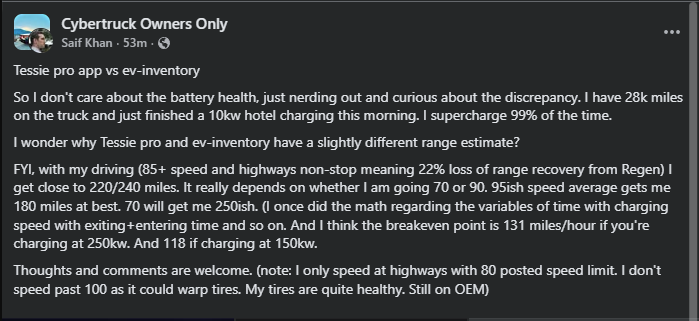
“Tessie pro app vs ev-inventory
So I don't care about the battery health, just nerding out and curious about the discrepancy. I have 28k miles on the truck and just finished a 10kw hotel charging this morning. I supercharge 99% of the time.
I wonder why Tessie pro and ev-inventory have a slightly different range estimate?
FYI, with my driving (85+ speed and highways non-stop, meaning 22% loss of range recovery from Regen), I get close to 220/240 miles. It really depends on whether I am going 70 or 90A. A 95ish speed average gets me 180 miles at best. 70 will get me 250ish. (I once did the math regarding the variables of time with charging speed, with exiting+entering time, and so on. And I think the breakeven point is 131 miles/hour if you're charging at 250kw. And 118 if charging at 150kw.
Thoughts and comments are welcome. (Note: I only speed on highways with an 80 posted speed limit. I don't speed past 100 as it could warp tires. My tires are quite healthy. Still on OEM”
The owner’s screenshots painted a clear picture. Tessie showed a 100 percent charge with an indicated capacity reading of 123 kilowatt hours and a projected 298 miles of rated range. The temperature readings sat in the mid to high seventies, and the voltage approached 814 volts. The battery health section displayed a reading of 100 percent with zero degradation recorded, and the app suggested a total pack value of about 126 kilowatt hours when compared against fleet data. EV-Inventory, meanwhile, produced a different interpretation of the same truck, citing a calculated real-world range of roughly 244 miles and deriving an estimated usable capacity of 121.4 kilowatt hours after 28,275 miles. It noted that similar vehicles in the database averaged 120.63 kilowatt hours, placing his truck slightly above the curve.
What To Expect When You Own a Tesla Cybertruck
- Early owners commonly talk about the truck’s attention-grabbing presence, saying it gets more questions and reactions than any vehicle they’ve ever owned.
- Many Cybertruck drivers highlight the instant power and sharp handling, claiming it feels more like a performance EV than a conventional pickup.
- Testimonials often praise the real-world Supercharging convenience, especially the ability to charge fast on long road trips without planning stress.
- Owners repeatedly mention the durability of the stainless-steel exterior, describing it as resistant to door dings, scratches, and everyday wear.
What made the post resonate with so many readers was the owner’s honesty about how he actually uses the truck. His driving habits are not theoretical or curated for efficiency. He spends most of his time at 85 to 95 miles per hour on wide, posted 80 mph highways, where regenerative braking offers little to no meaningful contribution.
That admission, a reported 22 percent loss in regen recovery, is a reminder that speed is the greatest enemy of range. The numbers he shared match the aerodynamic drag reality that every EV faces at high speeds. A 95 mph average yielding roughly 180 miles of range makes sense for a vehicle with the frontal area and weight of the Cybertruck. Cruising at 70 mph, stretching the figure to the mid-200s is equally consistent with known efficiency curves.
The reactions in the Facebook comments helped deepen the discussion. Mirek Kloucek observed that the 4680 cylindrical cells appear capable of handling higher DC charging rates than Tesla’s older 2170 cells. The owner replied that he suspected the Cybertrucks received packs larger than the commonly referenced 123-kilowatt-hour figure. These comments highlight how rapidly battery technology is evolving and how difficult it can be for third-party apps to fully incorporate the nuances of pack generation, usable capacity buffers, charging profiles, and battery management software updates.
What the screenshots also revealed is how two apps can disagree while still describing the same underlying system. Tessie Pro appears to focus closely on BMS-reported capacity and fleet averages, while EV-Inventory uses a calculated method based on observed charging efficiency and energy added per mile gained. When a driver spends most of their time above 85 mph, that difference in methodology becomes magnified. The truck itself remains consistent, but the interpretive tools do not. It is a reminder that these apps are companions rather than ultimate authorities, each with its own measurement philosophy.
The owner’s willingness to publicly compare the apps and explain his driving behavior shows something important about today’s EV community. In earlier eras, a driver trying to understand unusual fuel numbers might consult a mechanic or rely on instinct. Now owners share images of voltage, amperage, pack temperature, and charge rate across platforms, building a collective understanding of how their vehicles behave in the real world. Sometimes alternative apps reveal more than we want, not because the information is bad but because the picture becomes more complex with every data layer added. The result is a more informed, more empowered ownership experience, even when the numbers do not align perfectly.
The broader takeaway from this 28,000-mile report is simple. Real range depends on real driving. Pushing a large, stainless steel pickup through the air at 95 mph will always exact a toll, whether powered by gasoline or electrons. Yet the owner did not lament the numbers or blame the Cybertruck. He shared his findings with clarity and invited others into the conversation. In doing so, he provided a detailed snapshot of life with one of the most scrutinized vehicles on American roads today. The apps may disagree, the speeds may invite debate, and the calculations may require a second look, but the story remains grounded in experience. It reflects the evolving relationship between drivers, their machines, and the digital tools that interpret every mile.
Image Sources: Tesla Media Center
Noah Washington is an automotive journalist based in Atlanta, Georgia. He enjoys covering the latest news in the automotive industry and conducting reviews on the latest cars. He has been in the automotive industry since 15 years old and has been featured in prominent automotive news sites. You can reach him on X and LinkedIn for tips and to follow his automotive coverage.
Set Torque News as Preferred Source on Google
Follow us today...