

In the world of technology, we often mistake "new" for "better." For the last decade, the automotive industry—led by Tesla and followed by almost every aspiring EV maker—has been obsessed with the "flush" or "hidden" door handle. It looks cool, it shaves a fraction off the drag coefficient, and it makes your car look like a prop from a sci-fi movie. But as I’ve often said, when you trade a 100-year-old mechanical certainty for a complex electronic variable, you aren’t just innovating; you’re gambling with lives.
China’s safety regulators have finally seen enough. Starting January 1, 2027, the Chinese Ministry of Industry and Information Technology (MIIT) will ban fully hidden electronic door handles. Every car sold in the world’s largest auto market must feature a mechanical release accessible from both the inside and the outside.
When "Sleek" Becomes a Death Trap
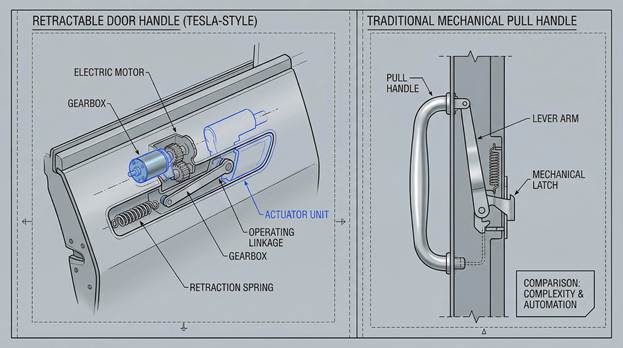
The logic behind the hidden handle is simple: aerodynamics and aesthetics. By smoothing out the side of the car, manufacturers can claim a slight increase in range. However, the cost of that extra mile is a massive increase in complexity. Traditional handles are simple levers. Electronic handles rely on sensors, motors, and the car’s 12V battery system to "present" themselves.
The problem occurs when things go wrong—and in an accident, things always go wrong. When a car’s battery is compromised or the electrical system is severed during a crash, these handles often stay retracted. We have seen horrific examples of this. In 2024, a fatal crash in Toronto involving a Tesla Model Y saw the electronic doors fail, trapping four occupants inside a burning vehicle. A passerby managed to save one person only by breaking a window, but the others were not so lucky.
In China, a similar tragedy involving a Xiaomi SU7 sedan recently acted as the tipping point for regulators. Bystanders watched helplessly as they were unable to open the doors of a crashed vehicle to rescue the driver. When seconds determine the difference between life and death, "figuring out" how to pop a handle shouldn't be part of the equation.
The Global Domino Effect
While China is the first to codify this into a national ban, they aren’t the only ones looking at the data. The U.S. National Highway Traffic Safety Administration (NHTSA) has opened investigations into Tesla’s door handle failures. Meanwhile, Euro NCAP—the gold standard for European safety ratings—is moving toward requiring physical controls for essential functions by 2026.
Why hasn't a ban like this happened sooner? In the U.S. and Europe, regulations tend to be reactive and slow. We wait for a "body count" before we mandate a change. China, however, is increasingly moving from a "rule-taker" to a "rule-setter." Because they are the largest market for EVs, their local mandates often become global standards. No manufacturer wants to build two different door assemblies for the same car; it’s more cost-effective to just make the "safe" version the global version.
The Next Tech on the Chopping Block
Hidden handles are just the tip of the iceberg. As we look into the next five years, several other "innovations" are likely to face the regulatory guillotine:
- Yoke Steering Wheels: They look great in a cockpit, but they are a nightmare for hand-over-hand emergency maneuvers. Expect regulators to mandate a full circular rim for safety.
- Touchscreen-Only Shifters: Placing the "Drive" and "Reverse" functions inside a screen sub-menu is a recipe for disaster in high-stress situations (like a 3-point turn on a train track). Physical shifters are likely to make a comeback by mandate.
- Camera-Only Blind Spot Monitoring: While mirrors can break, they don't have "software glitches." We may see a pushback against replacing physical mirrors with screens until the redundancy systems are bulletproof.
The Designer’s Revenge: Finding the Middle Ground
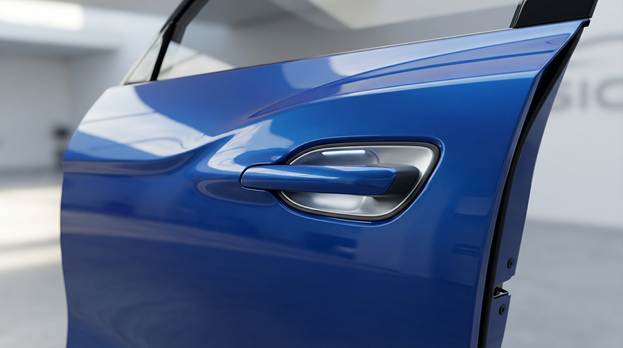
Car companies aren't going to give up on drag reduction easily. We are already seeing the "workaround" in the form of semi-hidden handles. These are handles that sit flush with the body but have a physical cavity—a "pocket"—that allows a hand to reach in and pull a mechanical lever.
China's new law actually accounts for this, requiring a minimum hand-operation space (specifically 60mm x 20mm x 25mm). This allows for "aero-efficient" designs that still offer a mechanical failsafe. We will likely see a return to the "flap" style handles seen on 90s sports cars—sleek, but fundamentally mechanical.
Wrapping Up
The era of the "magic" popping door handle is coming to an end, and frankly, it’s about time. While technology should push boundaries, it should never compromise the basic ability to exit a vehicle in an emergency. China’s move is a win for common sense over vanity. For the rest of the world, it serves as a reminder that "minimalism" shouldn't mean "minimal safety."
If you’re a car buyer today, my advice is simple: look for the mechanical release. If you can’t find it in five seconds without a manual, neither can a first responder.
Disclosure: Images rendered by Artlist.io
Rob Enderle is a technology analyst at Torque News who covers automotive technology and battery developments. You can learn more about Rob on Wikipedia and follow his articles on Forbes, X, and LinkedIn.
Set Torque News as Preferred Source on Google
Follow us today...