
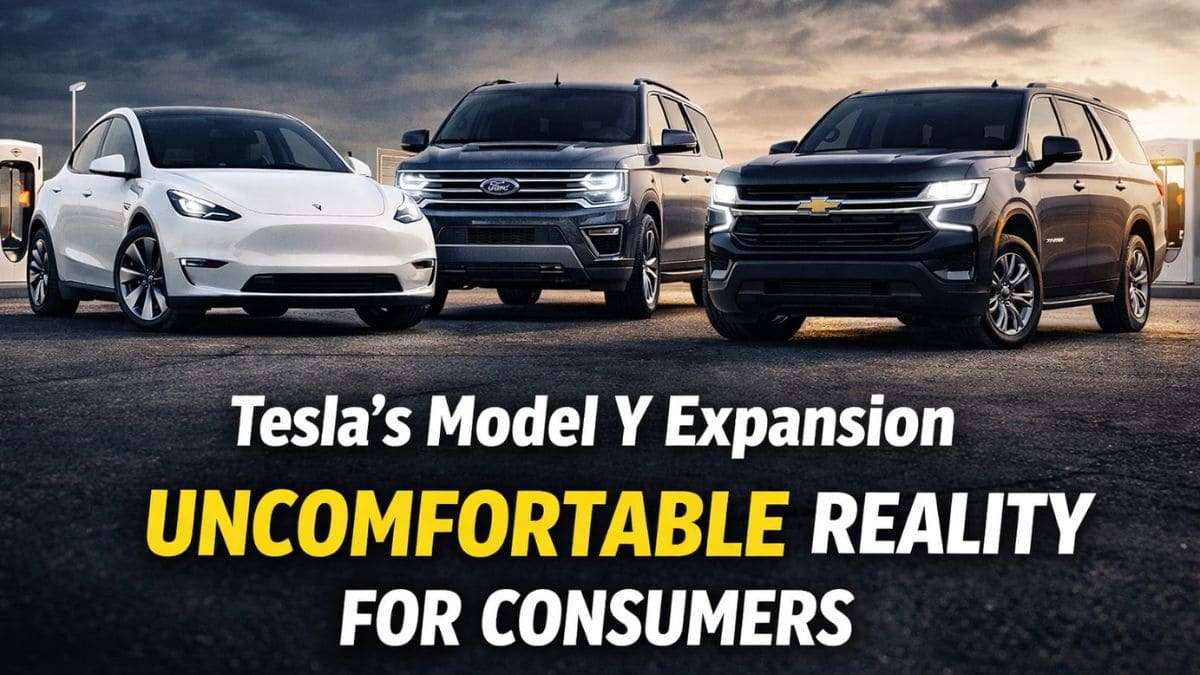

Every time Tesla expands the Model Y lineup instead of unveiling a large, full-size electric SUV, a familiar criticism resurfaces. The argument goes like this: Americans want bigger vehicles, families need more space, and Tesla is out of touch with consumer demand. It sounds reasonable on the surface. But once you look at how people actually buy cars, not how they talk about them online, the narrative starts to fall apart.
The uncomfortable reality may not be that Tesla refuses to build a big SUV. The uncomfortable reality may be that the Model Y already fits the real needs of far more buyers than critics want to admit.
What Buyers Say vs What Buyers Actually Do
There’s a wide gap between stated preferences and revealed behavior. Many consumers say they want full-size SUVs, but year after year, the sales charts tell a different story. Compact and midsize crossovers dominate global volume, and the Tesla Model Y sits at the very top of that list.
This isn’t limited to the U.S. market. In China, where competition is intense and price sensitivity is even higher, the Model Y continues to sell in massive numbers despite flashy new rivals offering unconventional features. As explained in why Tesla’s safe-choice Model Y still rules China’s 2025 market despite claims its dominance is fading, buyers consistently choose familiarity, reliability, and efficiency over novelty.
That matters, because Tesla doesn’t build vehicles for comment sections. It builds them for volume markets where decisions are made with real money, not theoretical wish lists.
The Third-Row Debate Misses How Families Really Use Their Cars
One of the most common criticisms of the Model Y is its optional third row. Yes, it’s small. And yes, it’s better suited for children than adults. But the bigger question is how often most households actually use a third row.
For many families, a third row is an occasional feature, not a daily necessity. It’s folded down most of the time, used for kids on short trips, or deployed a few times a year for road trips. Tesla appears to have designed the Model Y around that reality rather than around the edge cases.
More importantly, real-world ownership experience shows that capability isn’t defined by size alone. A strong example comes from a 2025 Tesla Model Y owner who says ice hills and deep snow didn’t slow his car down and calls it the best vehicle he has owned. That kind of feedback challenges the assumption that you need a massive SUV to handle difficult conditions.
For many buyers, traction control, software tuning, and drivetrain responsiveness matter more than sheer bulk.
Engineering Focus: Solving Practical Problems at Scale
Another critique aimed at Tesla is that expanding the Model Y lineup is incremental rather than innovative. But that view underestimates how much engineering effort goes into refining a high-volume vehicle.
Tesla’s strategy has consistently favored efficiency, manufacturability, and real-world usability. Rather than chasing size for its own sake, Tesla has focused on extracting more range, better performance, and improved cost efficiency from the same platform. That approach is explored in detail in Tesla’s new Long Range Model Y as a masterpiece of engineering that solves a very specific set of problems.
A true full-size electric SUV would require a much larger battery, higher cost, longer charging times, and reduced efficiency. Those trade-offs may make sense for niche buyers, but they work against Tesla’s core strength: delivering the most miles, usability, and performance per kilowatt-hour at scale.
In other words, Tesla may not be ignoring the idea of a bigger SUV. It may simply be waiting until the economics align with mass adoption.
Why EV Market Share Data Supports Tesla’s Caution
Zooming out, the broader EV market offers another clue. While many automakers rush to create new segments and oversized electric vehicles, market share data suggests that this strategy is risky. Some EV makers are building vehicles that look impressive but struggle to sell in meaningful volume.
This trend is clearly illustrated in two charts showing EV market share by model and signaling major problems for EV makers trying to create the wrong products. The takeaway is simple: consumers gravitate toward practical, proven formats, not experimental or excessively expensive ones.
Tesla’s continued focus on the Model Y aligns closely with this data. Instead of fragmenting its lineup, Tesla is reinforcing the segment that consistently converts interest into sales.
Bigger Isn’t Always Better in the EV Era
It’s easy to assume that building a larger vehicle automatically makes it more desirable. In the EV world, that assumption often breaks down. Bigger vehicles require bigger batteries, which drive up cost and complexity while introducing new compromises.
Tesla’s philosophy has long centered on efficiency and software-driven value. A vehicle that improves over time through updates, delivers strong real-world range, and integrates seamlessly with a reliable charging network can be more valuable to most buyers than one that simply offers more space.
That doesn’t mean there’s no market for larger electric SUVs. It means that market is smaller, more expensive, and harder to scale profitably today.
The Real Question Tesla Is Answering
So the question isn’t whether Tesla could build a full-size electric SUV. It almost certainly could. The question is whether doing so right now would serve the majority of buyers better than continuing to refine the Model Y.
So far, the market’s answer has been clear.
Now I’d like to hear from you. Would you actually choose a full-size Tesla SUV if it cost significantly more, charged slower, and delivered less efficiency? Or does the Model Y already cover how you really use your vehicle day to day?
Please, share your thoughts and your ownership experience. That conversation matters more than any headline.
Armen Hareyan is the founder and Editor-in-Chief of Torque News. He founded TorqueNews.com in 2010, which since then has been publishing expert news and analysis about the automotive industry. He can be reached at Torque News Twitter, Linkedin, and Youtube. He has more than a decade of expertise in the automotive industry with a special interest in Tesla and electric vehicles.
Set Torque News as Preferred Source on Google
Follow us today...




Comments
We also have to keep in mind…
Permalink
We also have to keep in mind that the Tesla fad is deep into fade mode.