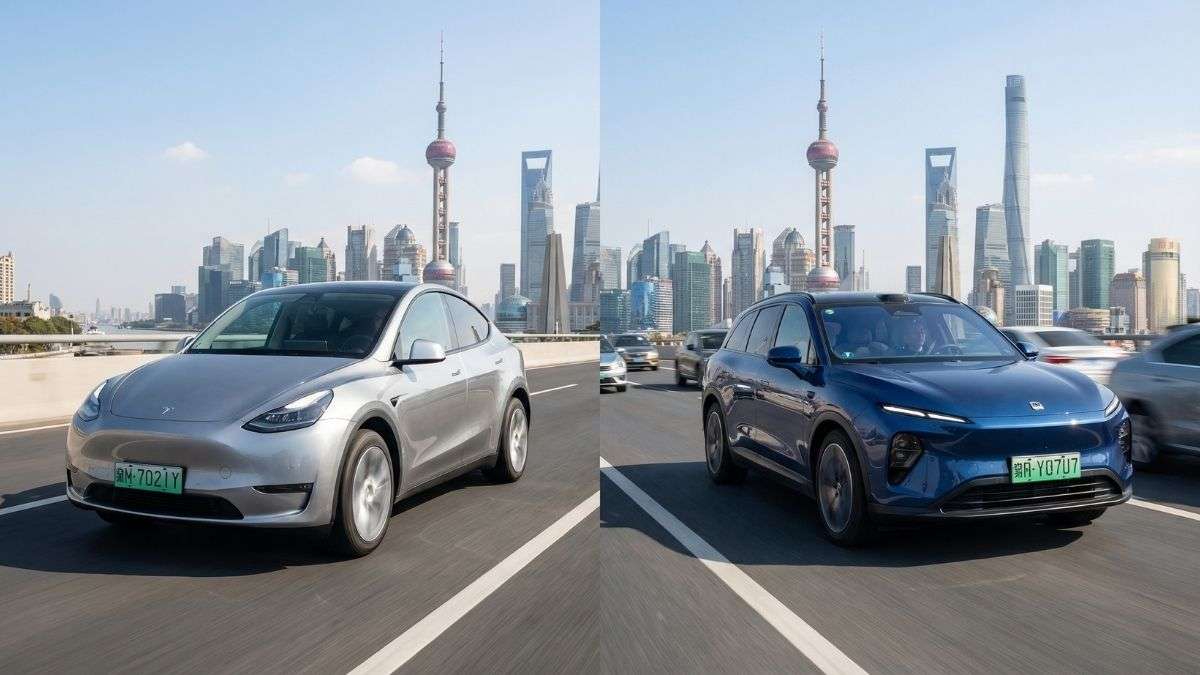

In the hyper-competitive arena of the Chinese automotive market, where a new electric vehicle startup seems to launch every week and legacy giants aggressively pivot to batteries, one fact remains stubbornly consistent: the Tesla Model Y is still the king of the hill.
Data released by the China Passenger Car Association (CPCA) through October 2025 confirms that the Tesla Model Y remains the best-selling premium electric vehicle (priced above RMB 200,000) in China for the year-to-date (YTD). With approximately 312,331 units retail sales from January through October, the Model Y has held off a ferocious siege from domestic rivals that offer arguably better technology, more luxurious interiors, and faster charging speeds.
How is this possible? In a market that fetishizes the "new," how does a platform that has been on Chinese roads for years—even with its early-2025 "Juniper" refresh—maintain its dominance against vehicles that look like they drove out of a sci-fi movie?
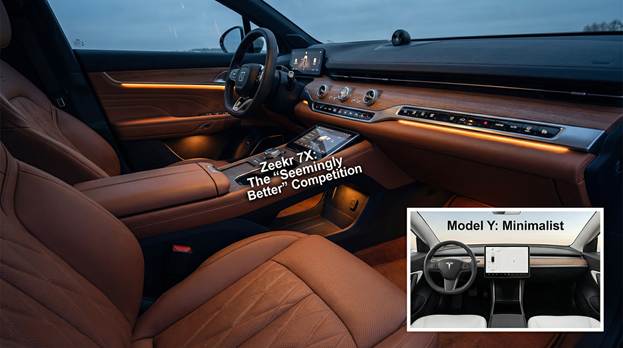
The "Seemingly Better" Competition
To understand the magnitude of Tesla’s achievement, one must first appreciate the quality of the opposition. The narrative that Chinese EVs are "cheap alternatives" is dead. Today, they are often objectively superior on the spec sheet.
Leading the charge is Xiaomi. The consumer electronics giant has stunned the industry with a seamless transition to automotive. Its SU7 sedan is the second-best-selling premium EV this year, moving roughly 234,521 units through October. But the real threat is the newly launched Xiaomi YU7 SUV. Built on an 800V architecture, the YU7 offers blazing-fast charging that makes the Model Y’s 400V system look dated. It features a "fridge, color TV, and sofa" (the colloquial Chinese term for modern luxury EV interiors), seamless integration with Xiaomi phones, and performance specs that rival supercars.
Then there is the Zeekr 7X, a mid-size SUV from Geely’s premium arm. Launched in late 2024, it hits the market with a "Golden Battery" capable of 5.5C charging, allowing drivers to add hundreds of kilometers of range in roughly 10 minutes. Its interior is draped in Nappa leather and features physical buttons—a direct rebuke to Tesla’s minimalism.
Finally, we have NIO’s mass-market sub-brand, Onvo. The Onvo L60, specifically targeted at the Model Y, offers battery swapping capability—eliminating range anxiety entirely—and undercuts the Tesla on price. Just today, December 5, Onvo launched its "Black Knight" edition to inject fresh excitement into the lineup.
These cars are faster charging, more opulent, and often cheaper. Yet, year-to-date, more Chinese buyers still put their money down for a Model Y.
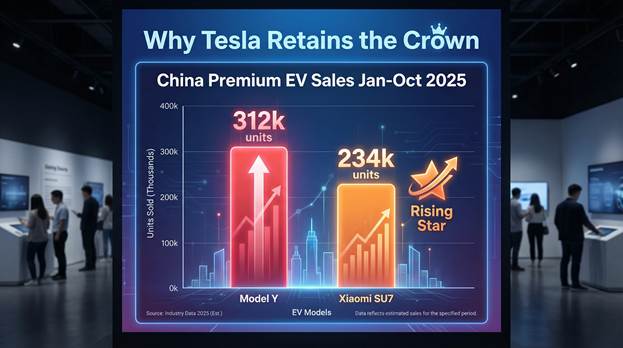
Why Tesla Retains the Crown: The "Safe Choice" Phenomenon
The persistence of the Model Y’s lead comes down to three factors: the "iPhone Effect," the Supercharger moat, and the promise of autonomy.
1. The Default "Safe Choice" In a volatile market where startups can go bankrupt (leaving owners with unsupported software), Tesla represents stability. It is the global standard. Much like the iPhone, it may not always have the absolute newest gimmick, but it works reliably, holds its resale value better than most domestic competitors, and carries a brand cachet that transcends the spec sheet. For the middle-class Chinese consumer spending RMB 250,000+, risk aversion is a powerful motivator.
2. The Supercharger Network While 800V charging is impressive, it requires specific high-power chargers to work. Tesla’s Supercharger network remains the most extensive and reliable proprietary charging infrastructure in China. The "plug and charge" simplicity is a user experience moat that 5.5C charging speeds on paper cannot easily bridge if the chargers aren't available where you need them.
3. The "Juniper" Refresh and FSD Hype The launch of the Model Y "Juniper" refresh in early 2025 provided just enough modernization to keep the car competitive. The updated fascia, ambient lighting, and improved suspension addressed the biggest complaints about the original. Furthermore, the dangling carrot of Full Self-Driving (FSD) has kept buyers loyal. With Elon Musk confirming just last month that full regulatory approval for FSD in China is expected by February or March 2026, many buyers are purchasing the car not for what it does today, but for what it might do three months from now.
The Cracks in the Armor: October’s Warning Sign
However, the "through October" metric masks a critical shift that occurred in October. While Tesla wins on the cumulative yearly scorecard, the monthly battle is telling a different story.
In October 2025, the Xiaomi YU7 SUV reportedly topped the monthly sales charts, delivering 33,662 wholesale units, surpassing the Model Y’s domestic delivery figures, which dipped to approximately 19,488 units (excluding exports). This is the "Dethroning" moment analysts have been warning about.
When a direct competitor outsells the king in a single month, it’s a skirmish. When they do it for a quarter, it’s a regime change. October 2025 might go down in history as the inflection point where the sheer value proposition of domestic EVs finally outweighed the strength of the Tesla brand.
What Chinese Makers Must Do to Dethrone the King Permanently
To turn a monthly victory into a permanent deposition of the Model Y, Chinese automakers need to execute on three fronts:
1. Prove Reliability Over Time Brands like Xiaomi and Onvo are new. Buyers are wary of "version 1.0" products. To win the yearly crown, these cars need to prove they don't have the teething issues—software bugs, phantom braking, or build quality lottery—that often plague new EV launches.
2. Match the Ecosystem NIO has its battery swaps; Xiaomi has its "Human x Car x Home" ecosystem. To kill the Model Y, competitors must make their cars an indispensable part of the user's digital life, something Tesla does well but Xiaomi arguably does better for users of its smartphones.
3. Survive the Price War Tesla has the highest profit margins in the business. It can afford to cut prices to bleed competitors dry. Chinese rivals need to maintain their aggressive pricing without bankrupting themselves before they achieve the scale necessary to survive.
The Most Likely Usurper
If anyone takes the crown in 2026, it will be Xiaomi. The company has the manufacturing prowess, the supply chain mastery, and the fanatical brand following to match Tesla. The YU7 is the right form factor (SUV) at the right price, with tech that appeals to the younger Chinese demographic that views Tesla as slightly "older" tech.
BYD dominates the lower segments, but their direct competitors to the Model Y, such as the Sea Lion 07, have yet to capture the same premium allure as the Xiaomi YU7 or Zeekr 7X.
Can Tesla Maintain the Distinction?
It is unlikely that Tesla will hold the #1 spot for the full calendar year of 2026 without another major intervention. The Model Y, even with the Juniper update, is fighting against rivals that iterate on smartphone timelines.
Tesla is most likely to lose the "Top Selling Premium EV" distinction in Q2 2026. By then, Xiaomi's factory capacity for the YU7 will be fully ramped, and the initial wave of FSD adoption will either succeed (giving Tesla a second wind) or face regulatory/technical hiccups (causing buyers to lose patience).
However, Tesla has one card left to play: FSD V13/V14 Unsupervised. If the approval in early 2026 leads to a truly "driverless" experience that domestic competitors cannot match, the Model Y could surge again. In China, software is the new horsepower. If Tesla becomes the only car that drives itself while you sleep, the spec sheet of the Xiaomi YU7 won't matter.
Wrapping Up
The Tesla Model Y’s performance through October 2025 is a testament to the endurance of a fundamentally great product. Holding off the Xiaomi SU7, YU7, Zeekr 7X, and Onvo L60 is no small feat. But the October monthly numbers suggest the dam is breaking. The "iPhone of Cars" is finally facing its Android competitors who have stopped copying and started innovating. 2026 will not be a battle of batteries or motors; it will be a battle of software ecosystems and brand loyalty. Tesla has the lead today, but in China, yesterday’s leader is often tomorrow’s legacy.
Disclosure: Images rendered by Artlist.io
Rob Enderle is a technology analyst at Torque News who covers automotive technology and battery developments. You can learn more about Rob on Wikipedia and follow his articles on Forbes, X, and LinkedIn.
Set Torque News as Preferred Source on Google
Follow us today...