
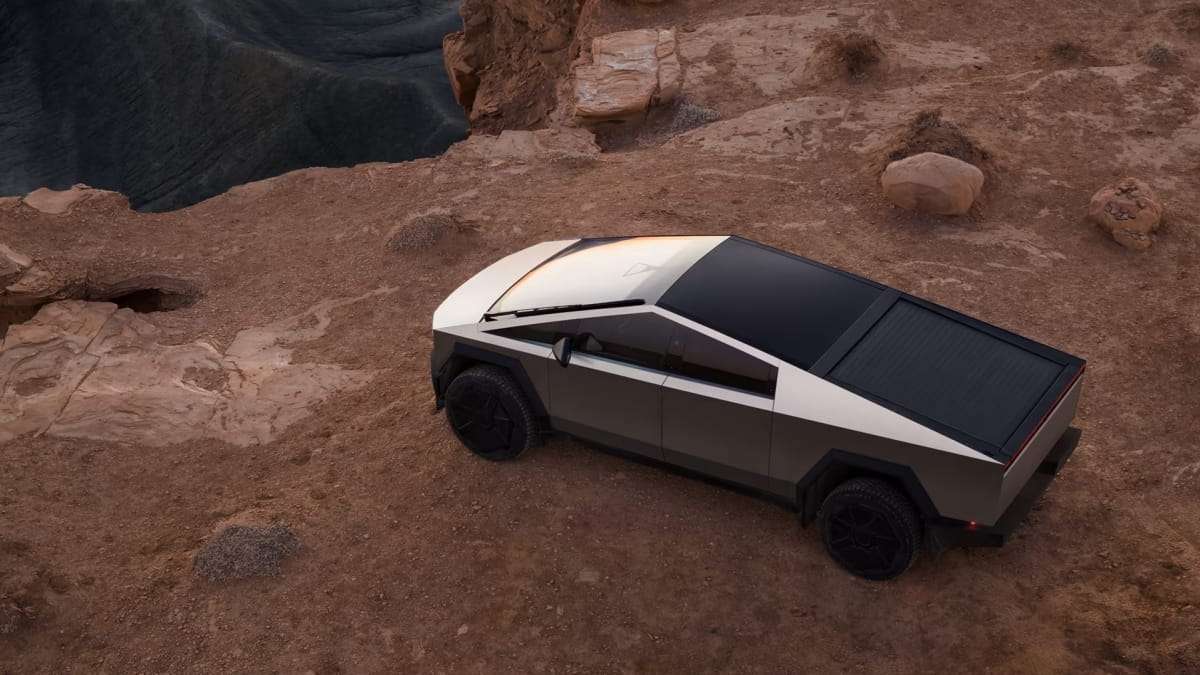

The Tesla Cybertruck is one of the most controversial vehicles to come out in recent times. The angular EV truck arrived on sale in the end of 2023, but hasn’t been the sales hit the company hoped it would be. In fact, Tesla Cybertruck sales continue to free-fall, and after the company’s plans to discontinue its bestselling models - the Model S and Model X - in order to make space for robots, it begs the question: Is Cybertruck next in line to get the axe?
Tesla still sells enough Cybertrucks for drivers to get into trouble.
Tesla’s controversial pickup truck wasn’t always a sales flop. In its first full year - 2024 - the company sold almost 39,000 units. In 2025, however, those numbers were cut almost in half, with some of it coming down to cancelled orders. Still, the Cybertruck has a cult following even abroad, and that leads to some interesting situations.
The Cybertruck isn’t a thing just in North America. Some Europeans (although, granted, not many) want a piece of the EV truck’s quirkiness, despite the American brand having no official dealerships in many European regions.
That said, something peculiar happened to one Tesla Cybertruck owner while he was travelling across Europe with his fully-electric vehicle. He was stopped by the local police after crossing the Romanian border, which resulted in him losing his driver’s license. The reason has to do with the Cybertruck’s weight.
Driving licenses in Europe are classified differently from those in the US
In the US, your Class C license allows you to drive light passenger vehicles, which include trucks and SUVs, regardless of weight. For a large truck - over 26,000 pounds or if transporting hazardous materials/passengers - you need a Commercial Driver’s License (CDL). This means that anything under 26,000 pounds can be driven with a Class C license.
Things in Europe are a bit different. The Tesla Cybertruck is not a lightweight. The sheer physical size of the truck and the fact that it has up to three electric motors (in the range-topping, Cyberbeast variant) mean it weighs almost 7,000 pounds (driver included).
This isn’t a problem in the US, but in Europe, the equivalent of a Class C driver’s license is “Category B”. This allows you to legally drive any vehicle with up to nine seats (including the driver) and a gross weight of 3.5 tons or 7,716 pounds.
Note that we are talking about gross and not curb weight, which is the vehicle’s mass plus the maximum load it can carry. In the case of the Cybertruck, the gross weight is up to 9,916 pounds, exactly 2,200 pounds more than the legal limit. In order for a European citizen to legally be allowed to drive the Cybertruck, they would need to have “Category C”, which is the equivalent of a CDL in the US.
Typically, a vehicle can be registered in your name even if you do not possess a driver’s license, regardless of where in the world you are located, so such legal ambiguities cannot be prevented while the vehicle is undergoing the registration process.
Underlining an issue (both physical and legal) with many EVs
This, however, underlines one major issue with EVs that we have known about. It is the weight. Fully-electric vehicles are up to 30 percent heavier compared to an equivalent vehicle, powered by an internal-combustion engine. This, combined with the current battery technology (which is getting better), is why many EVs still struggle to get a range near that of a conventional vehicle, at least at highway speeds.
The Cybertruck’s 4680 battery, alone, weighs between 1,590 to 2,000 pounds, depending on the truck’s configuration, and things aren’t much better in other EVs, featuring similarly-sized batteries. In the case of the Tesla truck, you are getting a 123-kWh piece, good for up to 340 miles.
This may seem irrelevant at first, but with many US citizens being based across Europe, I feel like it is important to know the technicalities when operating personal vehicles on foreign soil. Have you had any similar experiences while driving abroad? If so, feel free to share your insight in the comment section below.
Image source: Tesla
Dimitar Angelov's automotive interests made him an expert in a wide variety of vehicles. Japanese brands like Toyota and Nissan are closest to his heart, although performance cars in general are his favorite segment, which is why he is constantly on the lookout for the best deals on the market. Dimitar Angelov's car passion and knack for the written word led him to complete a Master of Arts in Media and Communications, and classic car restoration. Dim is happy to get behind the wheel of any car and share his impressions. You can follow Dimitar on X, Linked-in, Instagram, and Facebook.
Set Torque News as Preferred Source on Google
Follow us today...


Comments
The Tesla fad continues to…
Permalink
The Tesla fad continues to fade...