
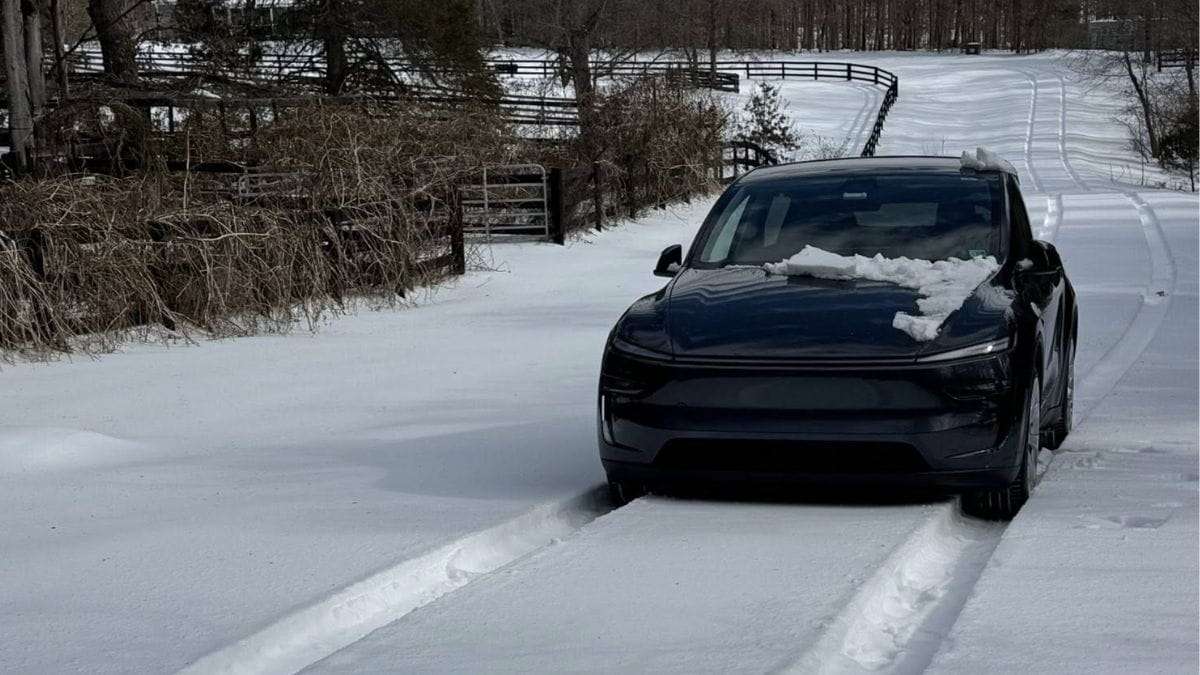

Winter has a way of exposing the truth about any vehicle. Snow-packed driveways, icy grades, and unplowed roads do not care about marketing claims or spec sheets. They care about traction, torque delivery, and how calmly a vehicle behaves when conditions are working against it. For many drivers, this is also where electric vehicles are most questioned, especially when it comes to deep snow and towing in cold weather. That skepticism was put to the test after Joe Nguyen shared his experience in the “Tesla Model Y 2025–2026+ Juniper” Facebook group, describing how his 2025 Tesla Model Y handled a demanding winter scenario at his home.
As Joe explained in his post, “This thing is a snow workhorse. It towed my mower/plow that was stuck, then drove through 8 inches of untouched ice/sheet snow with no problems up and down the hill on my long driveway! Best car ever! It’s the AWD with Off-Road Assist turned on.”
Joe’s situation was not a quick drive on lightly dusted pavement. He was dealing with a long, steep driveway, compacted ice, and the added challenge of towing a piece of equipment that was already stuck. Those conditions tend to highlight weaknesses quickly, yet his experience points to something many Model Y owners are starting to notice once winter truly sets in.
Winter Performance Is Where EVs Are Most Judged
The performance of electric vehicles during cold weather conditions is becoming an increasingly important factor in the buying decisions of many consumers. While the loss of range is typically the focus of discussions regarding the performance of EVs in the cold, the impact that cold weather may have on traction, stability, and driver confidence on slippery roadways is also significant. In order to effectively navigate snowy regions, the vehicle does not simply need to continue moving forward, but it also needs to be able to ascend hills with little difficulty, descend those same hills in a safe manner, and recover from any situation that limits traction.
For Joe, the combination of his AWD system and Tesla's Off-Road Assist appear to be key components of the success he experienced. When navigating deep snow or ridged ice, the Off-Road Assist feature allows for some controlled wheel slip under traction control. This is a critical element for both controlled momentum and safe operation, and it can make a big difference in whether a winter drive is stressful or confident.
Experiences like Joe’s are not happening in isolation. Over time, owners who have lived with the Model Y across multiple seasons tend to point to winter confidence as something that quietly reshapes how they feel about the vehicle long term. That theme has surfaced naturally in broader ownership reflections, including accounts of living with a Tesla Model Y for nearly 19,000 miles in a single year and why the owner still strongly recommends it.
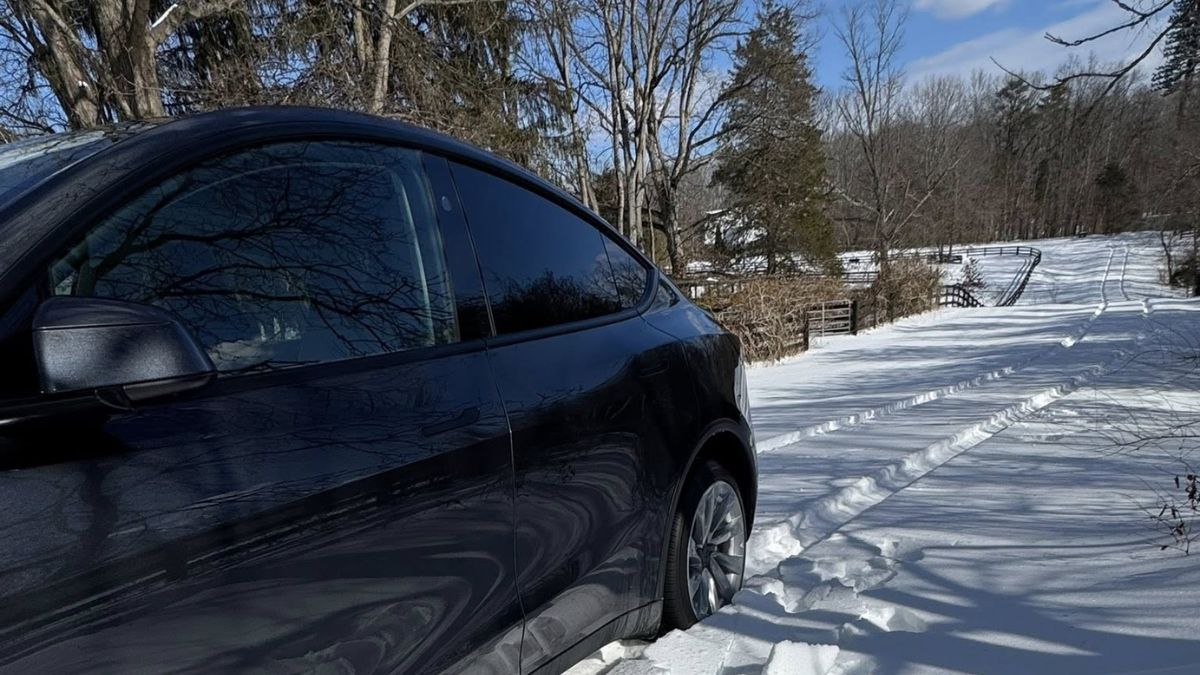
Understanding What Off-Road Assist Actually Does
To some extent, many drivers don't understand, or they overlook, Tesla's Off-Road Assist. Many drivers think that it would be of little use on dirt roads or light trails, but actually, it's at its best on snowy and icy surfaces. Off-Road Assist reduces the traction control limits so the wheels will continue to move forward instead of cutting power as soon as a wheel begins to slip.
This feature has the ability to help a driver navigate steep, slippery driveways (such as Joe's) and prevent them from getting their car stuck part way up the driveway. An additional benefit of an electric motor is that they produce instant torque and deliver power directly to each axle with evenness and precision. This, combined with all-wheel drive, gives the driver the predictability and confidence they need to be able to safely navigate difficult road conditions.
Community Experiences Reinforce the Pattern
Joe’s post quickly sparked responses from other owners who had faced similar winter challenges. Rather than repeating the same story, their comments added useful context about how these systems perform across different regions and snowfall levels.
Natalie Delgado shared a perspective from the Northeast, writing, “We got 2 feet of snow in Massachusetts! Our Tesla got over quite a lot of uncleared snow like a beast. Used off road assist as well!”
Her experience highlights an important point. Deep, uncleared snow presents a different challenge than ice, requiring consistent torque and the ability to maintain momentum without digging in. Natalie’s results suggest that the same software-driven approach that helped Joe on ice also translates well to heavy snowpack.
Another owner, Eric R. Johnson, focused on a specific obstacle many winter drivers recognize immediately. “Chill mode and off-road mode, it took me up over a snow and ice berm easily today.”
A snow and ice berm, typically left behind by plows or repeated traffic, is often denser and harder than surrounding snow. Clearing one without wheel spin or loss of control is a meaningful test of traction management. Eric’s comment reinforces the idea that pairing Chill Mode with Off-Road Assist can create smoother, more controlled power delivery in these situations.
How Winter Capability Fits Into the Bigger Ownership Picture
What makes these winter stories compelling is how they connect to broader ownership experiences. Cold-weather traction is not an isolated feature. It ties into daily usability, long-distance travel, and even towing efficiency. Tesla owners frequently note that while efficiency drops when towing, the power delivery remains predictable and manageable.
That balance was explored in detail in our coverage of how Tesla Model Y efficiency changes when towing, and why its lowest power setting still outperformed what the owner had previously towed. In winter conditions, that same predictability becomes even more valuable when traction is limited.
Confidence in poor weather also tends to change how owners use their vehicles overall. When drivers trust that their car can handle snow, ice, and steep terrain, they are less likely to avoid trips or second-guess routes. That confidence carries over into other areas of ownership, including road trips and advanced driver assistance.
When Expectations Shift After Real-World Testing
I believe that Joe's story has an ability to resonate with readers on a similar level as so many other stories about EVs do, and it does so by challenging some of the common mental images most people have about the type of driving experience they can expect from an electric crossover. As such, the idea that EV crossovers are only suitable for "mild" climates and for daily commutes where you can predict your route and travel time is one that remains a common misconception for many. The fact that winter driving has been a real-world test of this assumption speaks to a much more interesting story than that which we typically see.
One of the things that strikes me most is how consistent the winter driving experiences are that I hear from owners who did not try to set themselves up to make a statement. Rather, they were simply trying to get their car up a driveway, pull something behind them, or simply make it through a snowstorm. And when their vehicle performs beyond their expectations at those times, their reactions feel very authentic rather than scripted.
Key Takeaways for Winter Drivers
- Software matters as much as hardware when it comes to snow and ice performance.
- AWD paired with the right driving modes can dramatically change how a vehicle behaves on steep or slick surfaces.
- Real-world winter use often reshapes owner expectations, especially for drivers new to EVs.
- Confidence in poor conditions tends to influence overall satisfaction more than headline specs.
What About You?
Have you driven your Tesla or another EV through deep snow or icy hills? And did it perform better or worse than you expected?
And if you live in a snowy region, which driving modes or settings have made the biggest difference for you when winter hits hard?
I'd love to hear your thoughts in our comments below.
Aram Krajekian is a young automotive journalist bringing a fresh perspective to his coverage of the evolving automotive landscape. Follow Aram on X and LinkedIn for daily news coverage about cars.
Image Sources: The “Tesla Model Y 2025-2026+ Juniper” Facebook group.
Set Torque News as Preferred Source on Google
Follow us today...


Comments
See, but if it was truly the…
Permalink
See, but if it was truly the best car ever, then Tesla wouldn't be in fade mode, would it?