
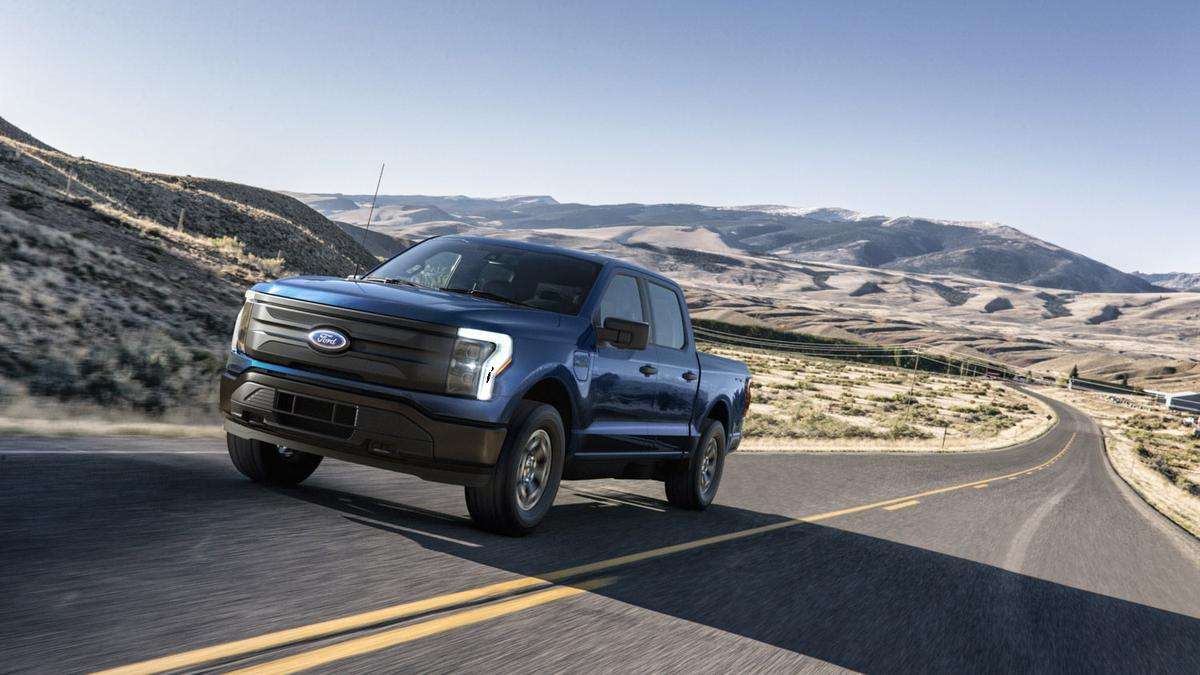

There is a peculiar anxiety that follows every electric vehicle like a shadow at dusk, and it has very little to do with styling, performance, or even price. It is the battery.
Not whether it works today, but whether it will quietly wither tomorrow, losing range and value until the whole enterprise feels like a costly experiment gone wrong.
In the case of Ford’s F-150 Lightning, that concern looms even larger. This is not a commuter hatchback but a full-size pickup, a vehicle Americans expect to rack up miles, haul weight, and remain useful well past the point where the loan is paid off.
Which is why one owner’s blunt, methodical experiment deserves attention.
“I leased an SR Lariat back in late 23. Long story, ended up with an SR, and didn't want to be stuck reselling an SR, so I leased it. Anyway, this thing doesn't have much range, like 200 miles tops, and if you charge to 80%, you can get in trouble, especially when you drive 25k miles a year. So I quickly decided, "screw it, I'm charging to 100%"
Fast forward 26 months, and I've maxed out my range and turned in the lease (and purchased a 2025 Lariat ER at that lovely 0% for 72).
I have an EVIQO charger on a 40-amp circuit, and I've been charging it at 38a to 100% every single night for over two years. And most nights, it hits 100% within a few hours, and then the battery sits at 100% for the remainder of the night. I'm sure there were days when the battery sat at 100% all day, as if I didn't go anywhere. Basically, I ignored all the rules of "don't let it sit at 100% for an extended period of time."
So I turned in the lease and asked to run a diagnostic to check the battery health. I wanted to see how much it had degraded, so I could decide how I wanted to charge my new ER, which I own. I plan to drive this for at least 4 years, 100,000 miles, possibly more, so I don't want to degrade the battery at all.
Advertising
So how much did the battery degrade?
Not one single percentage point
That's right, the battery health is at one hundred percent.”
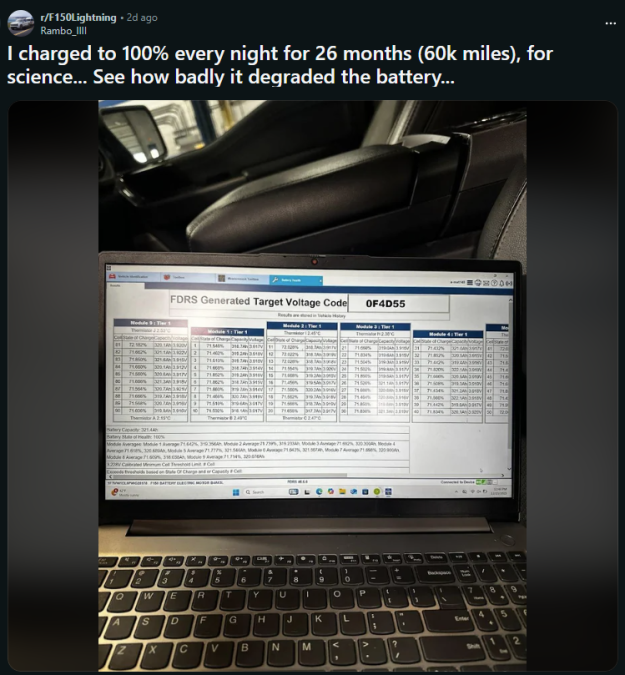
If that reads like heresy to anyone steeped in EV best practices, that is precisely the point. Charging to 100 percent nightly, letting the battery sit full for hours, and repeating the cycle for more than two years is supposed to be the fast track to degradation. Instead, after 60,000 miles of use that would qualify as severe by any reasonable definition, the diagnostic result came back spotless. Not reduced. Not slightly diminished. Perfect.
See Torque News Editor Armen Hareyan pointing out a few things in his analysis of this story on the Torque News Youtube channel below, explaining why the battery may stay intact and without degredation.
Ford F-150 Configurations: Towing Technology, and Trim-Level Variability
- The truck’s wide availability of cab sizes and bed lengths allows it to serve personal, commercial, and fleet roles with minimal compromise.
- Driver-assistance and trailering technologies are deeply integrated, helping manage blind spots, hitch alignment, and load monitoring during towing tasks.
- Interior materials and layout scale significantly by trim level, ranging from utilitarian surfaces to near-luxury finishes, depending on configuration.
- Fuel consumption varies widely across the lineup, highlighting a tradeoff between capability and efficiency that depends heavily on engine choice and usage patterns.
Context matters here. This was a standard-range Lightning, a truck already working with a tighter margin than its extended-range sibling. The owner drove roughly 25,000 miles a year and used the vehicle the way pickups are meant to be used, as daily transportation rather than rolling weekend ornaments. If there were a scenario where battery wear should show itself, this was it. And yet, the data refused to cooperate with the fear.
The comment section reads less like disbelief and more like vindication. One Lightning owner simply noted that the battery is proving to be really good. Another thanked the original poster for running a test that few people are willing to perform on their own lease. Perhaps the most telling response came from the owner himself, wondering aloud how long the Lightning could remain viable, floating figures like a quarter million miles, then observing that there is almost nothing to replace. That last point matters. Electric trucks do not age the same way their combustion counterparts do.
There is also an economic undercurrent here that should not be ignored. The experiment ended with the owner buying a 2025 Lightning Lariat ER at zero percent financing for 72 months, a decision made easier by the confidence earned from lived experience rather than marketing claims. This is how reputations are built in the truck world, not through brochures but through miles, routines, and results that hold up under scrutiny.
Even the limitations are stated plainly rather than defensively. Towing range and long-distance road trips remain the Lightning’s weak spots, and nobody in the discussion pretends otherwise. What stands out is how narrow that list has become. For daily use, work commuting, and the kind of driving that quietly defines ownership over the years, the truck appears to be doing exactly what it promised, with fewer long-term compromises than many expected.
What this owner stumbled into, intentionally or not, is the sort of real-world proof that shifts conversations. It does not argue a theory or cite lab conditions. It simply reports what happened when the rules were ignored, and the miles kept coming. After 26 months and 60,000 miles, the battery did not flinch. For a vehicle class built on durability and trust, that may be the most important data point yet.
Image Sources: Ford Media Center
Noah Washington is an automotive journalist based in Atlanta, Georgia. He enjoys covering the latest news in the automotive industry and conducting reviews on the latest cars. He has been in the automotive industry since 15 years old and has been featured in prominent automotive news sites. You can reach him on X and LinkedIn for tips and to follow his automotive coverage.
Set Torque News as Preferred Source on Google
Follow us today...





Comments
Just a word of warning,…
Permalink
Just a word of warning, there are numerous different chemistries for lithium batteries. Some are better at maintaining stability at a high state of charge. Also different manufacturers and even different models will have various management algorithms for state of charge and such. Most, if not all, batteries will shown 100% but are actually some point below that (perhaps 90-95%) to allow some safety overhead for thermal management or regen braking early into a trip.
This one example did well, as would many batteries, but generally speaking the practice of only charging past 90% when you know you'll need the range the next day goes true to a void excessive degradation.
Also, the Ford system that analyzes battery state of health *may* give a percentage based on expected value at the current mileage. So at 60k miles, if it expects 7% degredation and that's the result, it'll show 100% state of health.
This doesn't sound like he …
Permalink
This doesn't sound like he "broke every rule." The 100% battery charge has more to do with fast charging and also leaving it there for multiple days and even weeks at a time. L2 charging to 100 and then burning off that charge within a day or 2 isn't that big of deal and actually much better than frequently pushing the battery toward 10% or empty. If L2 charging to 100 every night was the only rule he broke it's take many more years to see the impact of that
The SR F150 Lightning has an…
Permalink
In reply to This doesn't sound like he … by Orion (not verified)
The SR F150 Lightning has an LFP battery which can be regularly charged to 100% and many manufacturers actually recommend regular 100% charges for those batteries. The same is NOT true for the Long Range version which has an NMC battery pack.
And yet they still…
Permalink
And yet they still discontinued it lol.
And that remark confirms…
Permalink
In reply to And yet they still… by RONNIE PENNINGTON (not verified)
And that remark confirms that all of this article is complete BS. Thank you for your comment.
I am going on 300k miles on…
Permalink
I am going on 300k miles on my Hemi RAM, tell us when you get there. Still doesn't use a drop of oil, never been touched!
60k miles is absolutely…
Permalink
60k miles is absolutely nothing. My truck at 200k miles still can take me the same range as it had when it was under 60k miles. Will the lightning be able to do the same without having to buy a 20k priced battery.
I’m not absolutely certain…
Permalink
I’m not absolutely certain but would find it incredible if the Ford EV charging system does not include a “shut-off” when the battery is 100% full.
Just like the Prius taxi…
Permalink
Just like the Prius taxi cabs in NYC. Over a million miles on same battery.
Just like the Prius taxi…
Permalink
Just like the Prius taxi cabs in NYC. Over a million miles on same battery.
The 2023 Volkswagen ID 4 pro…
Permalink
The 2023 Volkswagen ID 4 pro s with 115,000 mi.
I drive Uber and I need as many miles as possible every single day so I charge to 100% everyday at home 32 amps . Maybe once a week at the DC charger.
My degradation is 11% after 2 and 1/2 years 115,000 miles. Very happy with that ,degradation is pretty much maxed out now .
You have to know that the reason they suggest 80% is for the battery warranty it's to protect the seller not the buyer. As long as you're charging at home at AC your batteries aren't going to swell or overheat at 32 amps or 40 amps it's just a nice slow charge overnight so charging to 100% should be no issue whatsoever. That said I'm really cold nights when it's below zero here in Minnesota there's times I'll schedule a charge to 90% and then get up in the morning before I leave I'll add that last 10% of the batteries a little under warmer side to start the day
Doubtful. Every battery…
Permalink
Doubtful. Every battery degrades over time, even in the best of circumstances. Sounds like an advertisement, rather than a true testimonial. Buyer beware!
So simply charging the…
Permalink
So simply charging the battery to 100% and keeping it there so you have a full charge is discouraged on a vehicle that only has a pitiful 200 mile range?? LOL and they wonder why they can't sell EVs.
If Ford came out with the…
Permalink
If Ford came out with the extended cab with a 6.5 or 8 foot bed on the EV I'd be interested. Not interested in a 4 door with the little bed.
Perhaps the suggested ways…
Permalink
Perhaps the suggested ways to treat the vehicle were intended to be planned obsolescence. Kudos to you for beating the system, of which I’m sure they would never admit!
The Story, totally glasses…
Permalink
The Story, totally glasses over , how LOW the battery is taken on a daily basis.
Failure to submit all pertinent data, invalidates the paragraphs of boasting. Published range data is one thing, but real world weather, towing, and range daily can greatly effect these results.
I'm not against EVs, I own a hybrid, I just want to know the whole truth !
As a designer myself you…
Permalink
As a designer myself
you should understand
that things are designed
for a certain lifespan
let's say just like doctors
there is no money in The cure
so automobiles and trucks are designed
with a failure rate on certain parts
on many of them actually
they're not built like they used to be
when it started out
they were built to last
now they're built for obsolescence
on a schedule
the only way to keep you people
coming in the door
and spending your money
do you understand ?
It's called planned obsolescence
Bob, doctors are not the…
Permalink
In reply to As a designer myself you… by Bob (not verified)
Bob, doctors are not the ones keeping you sick. I wish people would stop saying that!
People do it all on their own by not exercising and/or doing anything physical and by gaining weight. Then there's good old AGING. Our bodies break down.
Look at the food industry. All the crap produced as "food" yet no nutritional value and tons of sugar. How many people out there drink soda each day?
People are making themselves sick with their poor choices and the food production companies are laughing all the way to the bank.
3 problems with your article…
Permalink
3 problems with your article. 1) you or the owner assumes Ford’s software result is true. (Let’s not forget the department of justice issued massive fines and jail time re the big Volkswagen SOFTWARE LIE, aka fake software results about how clean the emissions were (not). DOJ found the software itself was tweaked to make fake results and VW engineers and officers were party to it.
2) if you understand how modern lithium ion battery chemistry works, it is an electrochemical principal and physically impossible not to degrade at some rate while sitting at any voltage higher than 50% state of charge. Gets exponentially worse the closer to 100% SOC for any length of time. (Let’s not forget the massive lawsuit where Apple caved in and fined millions for hiding battery degradation from customers), Apple using a software curve ball of their own in an attempt at showing limited transparency, but it was still misleading and not true degradation measures,, where and Apple was still found guilty. Finally Apple was forced to adjust their software to reveal true battery degradation on iPhones and MacBooks.
3) weather by accident or by some measure of nefarious purpose like Apple was found guilty of like VW was found guilty of, that kind of battery abuse with very well-known battery chemistry, we’re in the best of the best scientists for Tesla and LG and other top battery makers across the world strive to achieve zero degradation and nobody can even come close, it literally defies the laws of physics to have that battery still have 100%, zero degradation after all that. Your article is either dangerously naïve or dangerously ill informed and now you have caused others to become just as ill informed.
I'm pretty sure this…
Permalink
I'm pretty sure this recommendation comes from folk in the industry that don't really know the differences between rechargeable batteries.
Nickel-Cadmium batteries and Nickel Metal Hydride batteries were notorious for developing what people called a 'memory' or a tendency when charged repeatedly to lose capacity greater than the repeated charge. This led to the rule of thumb always to drain the battery completely before charging it.
Lithium Ion do not perform the same way. The 'memory' that occurred in previous generations of batteries were caused by a chemical development in the battery causing crystals to form on the electrode, reducing surface area and limiting the available charge. This could be 'fixed' by full discharge cycle which breaks down the crystal build up (to a point).
Lithium Ion do not have this issue as the chemistry of operation is different. In fact draining Lithium Ion batteries completely can have more negative effects over time than excessive charging. There are concerns regarding number of charging cycles, but these are in the thousands to hundreds of thousands depending, so the odds of encountering that issue charging once a day is pretty slender. Even if it was 1000 you're talking around 3 years before you reach that number. Charging to 100% every single day. I charge mine to 100% about once a week on average and have had no issues for multiple years. Tesla model 3.
I sold batteries for years, learned quite a bit about how they work and operate over time and I thought it extremely odd that they did not recommend regular charging for EV health. I still may not recommend daily charging unless you genuinely drive that much, but definitely going to encourage people to top off periodically. (The usual reason for charging less than 100% isn't because of the above issues, it's because it takes more energy per watt to charge above a certain point. Charging isn't linear, it's easiest at the lowest value and gets increasingly difficult the closer you get to the top. So the last 10~20% take significantly more energy to fill than the other 80-90%.)
This article is useless…
Permalink
This article is useless cause Ford dropped their Lighting faster than a hot rock. In fact their entire EV program is gone due to over $18 billion in losses. Imagine that.
I have to call BS for two…
Permalink
I have to call BS for two reasons:
No degradation at all is not possible. It breaks the laws of physics
And
The dealer ran the diagnostic who (a) probably dont know much about EV batteries to begin with, and ( b) wanted to sell this guy another one.
If the guy had been knowledgeable, he would have been able to check the HV battery SOH himself by running the BMS stats from the OBD2 port. But he wasnt so you cant trust a dealer claim especially when the customer knows even less than the dealer.
People don't realize the…
Permalink
People don't realize the damage to charge to 100% is caused by DC Fast Charging not by using a level 1/2 charger. Imagine drinking energy drinks everyday for 3 years when you felt tired.... It doesn't give you the rest you need and just drains you more. Same concept for fast charging it's giving a lot of power upfront but will affect the battery life.
but 2 years is only 770…
Permalink
but 2 years is only 770 charge cycles.
I would not expect significant degradation until 2000, so 6 years.
What the author has not…
Permalink
What the author has not mentioned (and I wonder he even knows it) that his Ford with standard range comes with LifePO4 battery, which is very robust and unaffected by 0 to 100 charge. However Ford extended range comes with NMC battery, which is not as good.
This is absolutely incorrect…
Permalink
In reply to What the author has not… by Adnan (not verified)
This is absolutely incorrect. Ford initially planned on using LFP batteries for the Lightning but they NEVER DID. All Lightning vehicles ever made have the same battery chemistry- NMC.
Yet another example of why blindly trusting AI search results is not a great idea.
How much does a gasoline car…
Permalink
How much does a gasoline car degrade filling to 100% for 20 years. None is the point.
Great story. In Dec/25 Ford…
Permalink
Great story. In Dec/25 Ford announced the discontinuation of the Ford F150 Lightning.
Perhaps Ford finally did one…
Permalink
Perhaps Ford finally did one smart thing and designed the battery so it could never be truely completely charged. Not likely, but possible.
100k miles in 4 years is…
Permalink
100k miles in 4 years is insane.