

There is a peculiar anxiety that follows every electric vehicle like a shadow at dusk, and it has very little to do with styling, performance, or even price. It is the battery.
Not whether it works today, but whether it will quietly wither tomorrow, losing range and value until the whole enterprise feels like a costly experiment gone wrong.
In the case of Ford’s F-150 Lightning, that concern looms even larger. This is not a commuter hatchback but a full-size pickup, a vehicle Americans expect to rack up miles, haul weight, and remain useful well past the point where the loan is paid off.
Which is why one owner’s blunt, methodical experiment deserves attention.
“I leased an SR Lariat back in late 23. Long story, ended up with an SR, and didn't want to be stuck reselling an SR, so I leased it. Anyway, this thing doesn't have much range, like 200 miles tops, and if you charge to 80%, you can get in trouble, especially when you drive 25k miles a year. So I quickly decided, "screw it, I'm charging to 100%"
Fast forward 26 months, and I've maxed out my range and turned in the lease (and purchased a 2025 Lariat ER at that lovely 0% for 72).
I have an EVIQO charger on a 40-amp circuit, and I've been charging it at 38a to 100% every single night for over two years. And most nights, it hits 100% within a few hours, and then the battery sits at 100% for the remainder of the night. I'm sure there were days when the battery sat at 100% all day, as if I didn't go anywhere. Basically, I ignored all the rules of "don't let it sit at 100% for an extended period of time."
So I turned in the lease and asked to run a diagnostic to check the battery health. I wanted to see how much it had degraded, so I could decide how I wanted to charge my new ER, which I own. I plan to drive this for at least 4 years, 100,000 miles, possibly more, so I don't want to degrade the battery at all.
Advertising
So how much did the battery degrade?
Not one single percentage point
That's right, the battery health is at one hundred percent.”
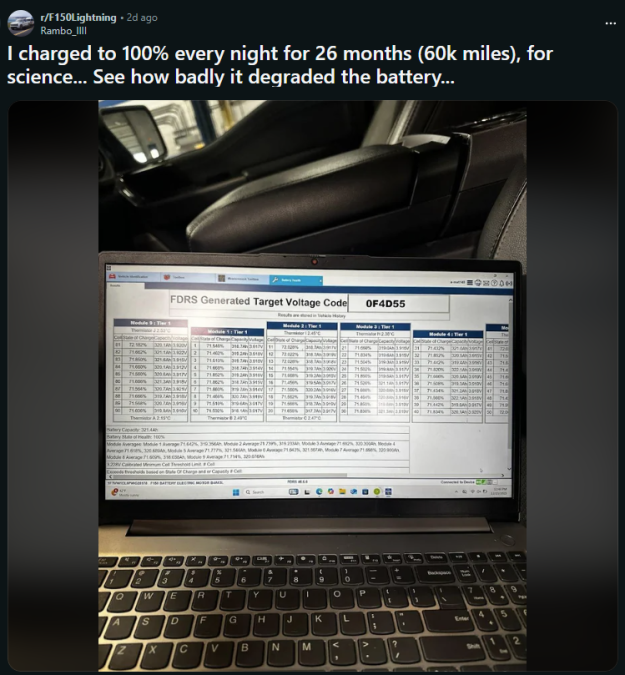
If that reads like heresy to anyone steeped in EV best practices, that is precisely the point. Charging to 100 percent nightly, letting the battery sit full for hours, and repeating the cycle for more than two years is supposed to be the fast track to degradation. Instead, after 60,000 miles of use that would qualify as severe by any reasonable definition, the diagnostic result came back spotless. Not reduced. Not slightly diminished. Perfect.
See Torque News Editor Armen Hareyan pointing out a few things in his analysis of this story on the Torque News Youtube channel below, explaining why the battery may stay intact and without degredation.
Ford F-150 Configurations: Towing Technology, and Trim-Level Variability
- The truck’s wide availability of cab sizes and bed lengths allows it to serve personal, commercial, and fleet roles with minimal compromise.
- Driver-assistance and trailering technologies are deeply integrated, helping manage blind spots, hitch alignment, and load monitoring during towing tasks.
- Interior materials and layout scale significantly by trim level, ranging from utilitarian surfaces to near-luxury finishes, depending on configuration.
- Fuel consumption varies widely across the lineup, highlighting a tradeoff between capability and efficiency that depends heavily on engine choice and usage patterns.
Context matters here. This was a standard-range Lightning, a truck already working with a tighter margin than its extended-range sibling. The owner drove roughly 25,000 miles a year and used the vehicle the way pickups are meant to be used, as daily transportation rather than rolling weekend ornaments. If there were a scenario where battery wear should show itself, this was it. And yet, the data refused to cooperate with the fear.
The comment section reads less like disbelief and more like vindication. One Lightning owner simply noted that the battery is proving to be really good. Another thanked the original poster for running a test that few people are willing to perform on their own lease. Perhaps the most telling response came from the owner himself, wondering aloud how long the Lightning could remain viable, floating figures like a quarter million miles, then observing that there is almost nothing to replace. That last point matters. Electric trucks do not age the same way their combustion counterparts do.
There is also an economic undercurrent here that should not be ignored. The experiment ended with the owner buying a 2025 Lightning Lariat ER at zero percent financing for 72 months, a decision made easier by the confidence earned from lived experience rather than marketing claims. This is how reputations are built in the truck world, not through brochures but through miles, routines, and results that hold up under scrutiny.
Even the limitations are stated plainly rather than defensively. Towing range and long-distance road trips remain the Lightning’s weak spots, and nobody in the discussion pretends otherwise. What stands out is how narrow that list has become. For daily use, work commuting, and the kind of driving that quietly defines ownership over the years, the truck appears to be doing exactly what it promised, with fewer long-term compromises than many expected.
What this owner stumbled into, intentionally or not, is the sort of real-world proof that shifts conversations. It does not argue a theory or cite lab conditions. It simply reports what happened when the rules were ignored, and the miles kept coming. After 26 months and 60,000 miles, the battery did not flinch. For a vehicle class built on durability and trust, that may be the most important data point yet.
Image Sources: Ford Media Center
Noah Washington is an automotive journalist based in Atlanta, Georgia. He enjoys covering the latest news in the automotive industry and conducting reviews on the latest cars. He has been in the automotive industry since 15 years old and has been featured in prominent automotive news sites. You can reach him on X and LinkedIn for tips and to follow his automotive coverage.
Set Torque News as Preferred Source on Google
Follow us today...




Comments
Glad to hear that about the…
Permalink
Glad to hear that about the battery. Did you have any equity in the truck when you turned it in I hear most dealers don’t want to touch them(EV). What was the residual value vs trade in value. 200 miles is pretty light. Does the new one get over 35”?
I had a phone that said it…
Permalink
I had a phone that said it at 100% capacity left right before it died
Honestly, as someone who has…
Permalink
Honestly, as someone who has more than a little knowledge on the subject, both historically and the current attempts at rekindling interest, every article appears as attempts at justification of a failing technology that never really got a foothold. And likely never will with newer technologies coming that will exclipse battery powered cars. Your positions have been oversold and now are seen as talking past closing with the recent scaling back of so many including the cessation of the F-150 battery truck altogether. May be time to rethink into which basket you put your eggs.
Yep, get a Tesla. They are…
Permalink
In reply to Honestly, as someone who has… by Steve Racer (not verified)
Yep, get a Tesla. They are the only company that makes a profit with EVs.
There is no other technology to surpass batteries at this time. Every alternative that works in the lab, fails miserably in the real world.
The problem with legacy auto, is they still think they are just adding batteries and an electric motor to a typical car. They have to think from the ground up. Every aspect of the vehicle needs to be rethought or they will
Never succeed.
This is interesting as I had…
Permalink
This is interesting as I had a ride from a cab at the LA airport around a year ago who had the big Tesla suv with the rear gull wing doors .I asked how he liked it and he said he has to charge it every day while working and uses the quick chargers and his battery has degraded 20%+ and he was getting rid of it asap .
It may not "show" any…
Permalink
In reply to This is interesting as I had… by Bill Thomas (not verified)
It may not "show" any degradation, but it will still suddenly fail. Wait and see.
I have been charging my…
Permalink
I have been charging my truck the same way for almost 3 years, will be 3 yrs in Feb of 26. Mine is a 2023 Lariat. I have 32000 miles on it. I have solar so it starts charging after 9:00pm every night it is plugged in. I use the 40 amp charging option even though I have the 80 amp fast charger. Need to upgrade my sub panel in garage to use 80 amp charger. It is almost always a full charge in morning unless I’m at less than 70-80 of range when I plug in. Since it only charges after 9:00pm. Cheaper elec after 9:00pm till 6:00am. On normal days I start with 330 -332 miles of range. Totally happy with the truck at almost 3 years old. Only issue I’ve ever had is I was surprised I needed new tires at 31000 miles. I bought 10ply replacement tires. Hopefully they will last longer than factory tires. I got 70000 miles on my factory tires on my 2019 Lariat I traded in on my 2023 Lightning. Overall I love this truck.
I can hardly wait till they…
Permalink
I can hardly wait till they make smart phone batteries of the same quality.
This is just one persons…
Permalink
This is just one persons claim I would believe this if it was a few thousand owners. The claim is highly improbable
Hilarious. Seems like a…
Permalink
Hilarious. Seems like a great timed Hallmark-esque puff piece at a time when EVs are being shunned. Sorry, just because a writer with great skills spins a yarn doesn't mean its true. Depreciating like a brick, the zero percent over 72 months won't keep place with the loss of value.
Uh, is this the Ford Motor…
Permalink
Uh, is this the Ford Motor Corp. Lightning Vehicle that Ford just scrubbed from production ?
Bruce
Watch it drop when it’s out…
Permalink
Watch it drop when it’s out of warranty…..oops not covered
It's a miracle - a battery…
Permalink
It's a miracle - a battery that NEVER degrades! The author of this article is an idiot who actually bought an electric F-150 (HINT: discontinued), now he's trying to convince himself he made a good decision by claiming the battery has some kinda special Ford Magic. He's convinced himself that it will never, EVER degrade because he doesn't understand how batteries WORK. Idiot.
💯
Permalink
In reply to It's a miracle - a battery… by Charles Thompson (not verified)
💯
It still has limited tow…
Permalink
It still has limited tow range and requires a dedicated charging spot to avoid hours at public charging but I never had any doubt battery tech is improving
The whole crux of this…
Permalink
The whole crux of this article was that the person OWNED the vehicle and "broke" the cardinal rule about EVS. He DID NOT own the vehicle. He LEASED IT. And like many who LEASE or RENT, he did something that he simply wouldn't do to something he OWNED. Now, go back and see if this guy continued his experiment with the truck he actually just bought. Dollars to donuts, he won't be.
Ford hides about 10% of the…
Permalink
Ford hides about 10% of the battery range, so he wasn't actually charging to 100% of the batteries physical capacity. There was probably some degradation like a couple percentage, which is less than the hidden buffer.
200 mile range is ridiculous…
Permalink
200 mile range is ridiculous. Ford, please fix it.
Bet you won't get that if…
Permalink
Bet you won't get that if you are using it as a truck and not a car. Try hauling some weight in the bed and pulling some loaded down trailers and even both. Bet the results come out different in every way you experimented.
It a vehicle that is useful…
Permalink
It a vehicle that is useful only for Urban Cowboys and the ignorant woke.
It cannot tow or haul anything significant (Boat, Camper, etc.) without recharging every 100 miles. The ICE F-150 blew it away in every single test. The Lightning was never even close.
A couple of my medical collegues have them. But their idea of "roughing it" is staying at Hilton because the Four Seasons is booked up.
They may enjoy a certain niche market, woke city hipsters and stoned surfers, but they are not even close to being a Real Work Vehicle unless all you need to haul is a brief case.
Ford would have been better off releasing "Edsel 2026
The F150 Lightning standard…
Permalink
The F150 Lightning standard range uses LFP batteries which are recommended to be charged to 100% on a regular basis. Those batteries are less energy dense but theoretically last longer and are less prone to fire. The long range version uses Lithium Ion batteries with more energy density but are recommended to be charged to 80% on a regular basis.
This article is misleading. …
Permalink
This article is misleading.
He broke no rules. SR Lightnings come with LFP batteries. You are supposed to charge these to 100% as often as possible.
I have a 2023 Tesla with LFPs. I bought it used but charge it to 100% daily. I have lost 3% with 74,000 miles. This is much more normal than you think.
If he does this with a higher end Lightning with NMC batteries, he will degrade them faster. Ford, like many manufacturers now give you about a 10% buffer on both ends to lessen the effects, but it will still hurt those batteries.
It has been found, by the scientists who invented Lithium batteries, that if you always keep NMC type batteries between 20% and 80%. You will have no real degradation and the batteries will last almost forever.