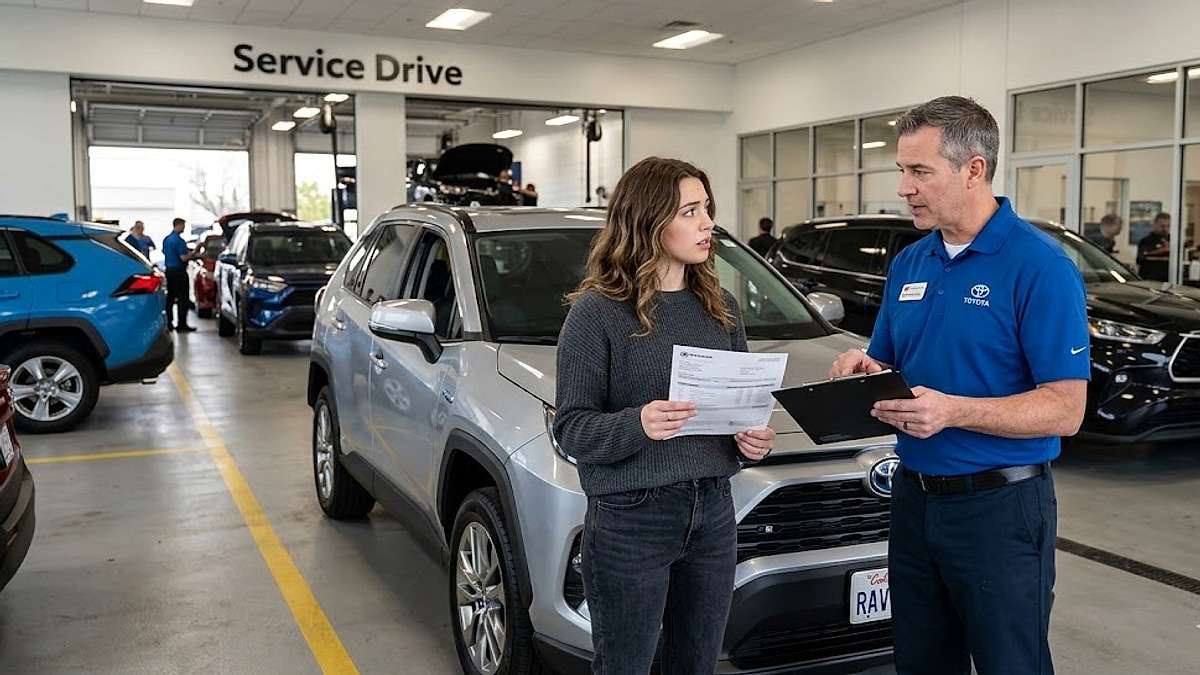

This Torque News investigative report exposes a widening systemic gap between official automotive manufacturer service schedules and dealership service drive sales tactics. By conducting a forensic breakdown of a real-world $2,038.98 service estimate presented to a 2024 Toyota RAV4 owner at the 30,000-mile mark, this piece isolates factory-mandated safety items from independent, high-margin dealer upcharges.
Through engineering analysis, direct comparisons with official corporate documentation, and field data from vehicle-owner communities, we establish that over 80% of the quoted cost is attributable to unnecessary chemical additives, premature fluid flushes, and redundant cleaning procedures. This investigation provides consumers with the technical literacy required to decipher service invoices, challenge localized dealership profit centers, and maintain factory warranty compliance without incurring thousands of dollars in arbitrary maintenance upcharges.
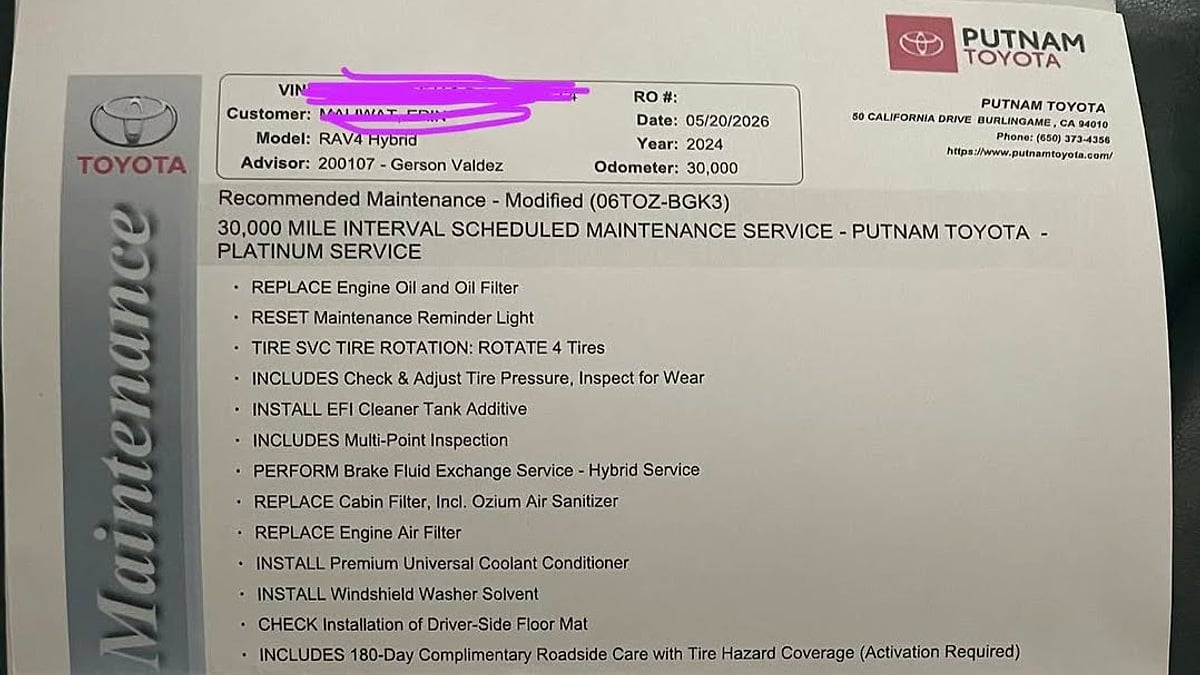
A routine oil change for a 2024 Toyota RAV4 recently turned into a $2,038.98 service-drive standoff, exposing a massive structural rift between what Toyota corporate engineers require and what local dealership service advisors sell. The owner, Erin Nicole Maliwat, shared her itemized invoice on the Toyota RAV4 Discussion Group 2019-2025 Gas Hybrid Prime Facebook page after pulling into her local service lane for a basic express oil change. Upon reaching the 30,000-mile odometer milestone, the service advisor presented a sweeping, multi-page list of recommended operations, leaving the owner questioning whether such an astronomical bill is normal for a modern compact SUV.
According to ongoing Torque News tracking of manufacturing defects and dealership service transparency, this specific scenario highlights a growing consumer advocacy issue across the North American automotive landscape. Investigative market data published by CarEdge reveals that a Toyota RAV4 costs about $5,820 in maintenance and repairs over its first 10 years of service, proving that front-loading a $2,000 bill at just 30,000 miles completely breaks the expected cost curve for this vehicle segment.
The reality is that the official Toyota Warranty and Maintenance Guide mandates only a tiny fraction of these services at 30,000 miles. Senior Reporter Denis Flierl notes that when RAV4 owners hit 30,000 miles, many begin bracing for impact as they hunt down hidden service lane upcharges, making consumer vigilance absolutely vital. The rest of the invoice represents a calculated suite of independent dealer upcharges, proprietary chemical treatments, and premature fluid flushes designed to maximize localized service-drive profitability rather than preserve the vehicle's mechanical integrity.
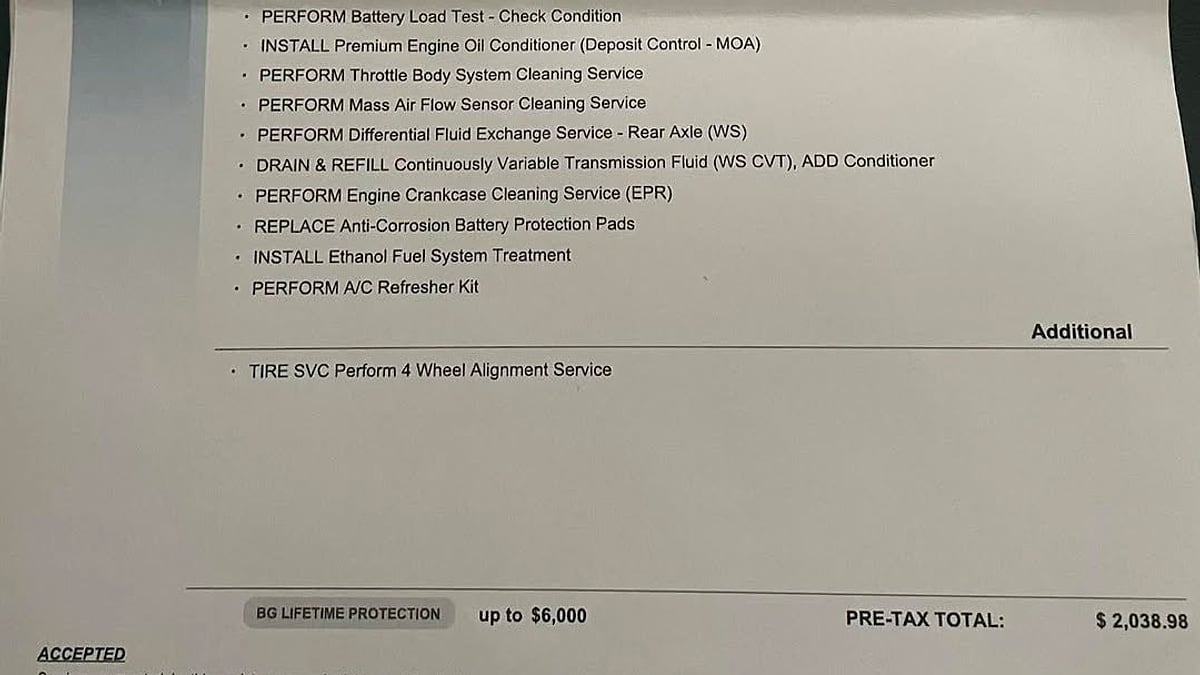
The Itemized $2,038.98 Dealership Service Estimate Breakdown
To understand how a basic maintenance visit escalated past the $2,000 threshold, one must review the exact, verbatim line items presented to the owner during the service consultation:
- Replace engine oil and filter
- Reset maintenance reminder light
- Tire service - rotate 4 tires
- Install EFI cleaner tank additive
- Perform brake fluid exchange service
- Replace the cabin filter
- Replace the engine air filter
- Install premium coolant conditioner
- Install windshield washer solvent
- Check the installation of the driver’s side mat
- Perform battery load test
- Install premium engine oil conditioner (BG MOA)
- Perform throttle body system cleaning service
- Perform mass air sensor cleaning service
- Perform differential fluid exchange service
- Drain & fill CVT transmission fluid & add conditioner
- Perform engine crankcase cleaning service
- Replace anti-corrosion battery protection pads
- Install the ethanol fuel system treatment
- Perform A/C refresher kit
The grand total for these compiled line items reached exactly $2,038.98. For an owner of a vehicle less than two years old, this expansive billing strategy blurs the line between preventive care and aggressive financial upselling.
Technical Analysis of Factory Specifications Versus Service Drive Upsells
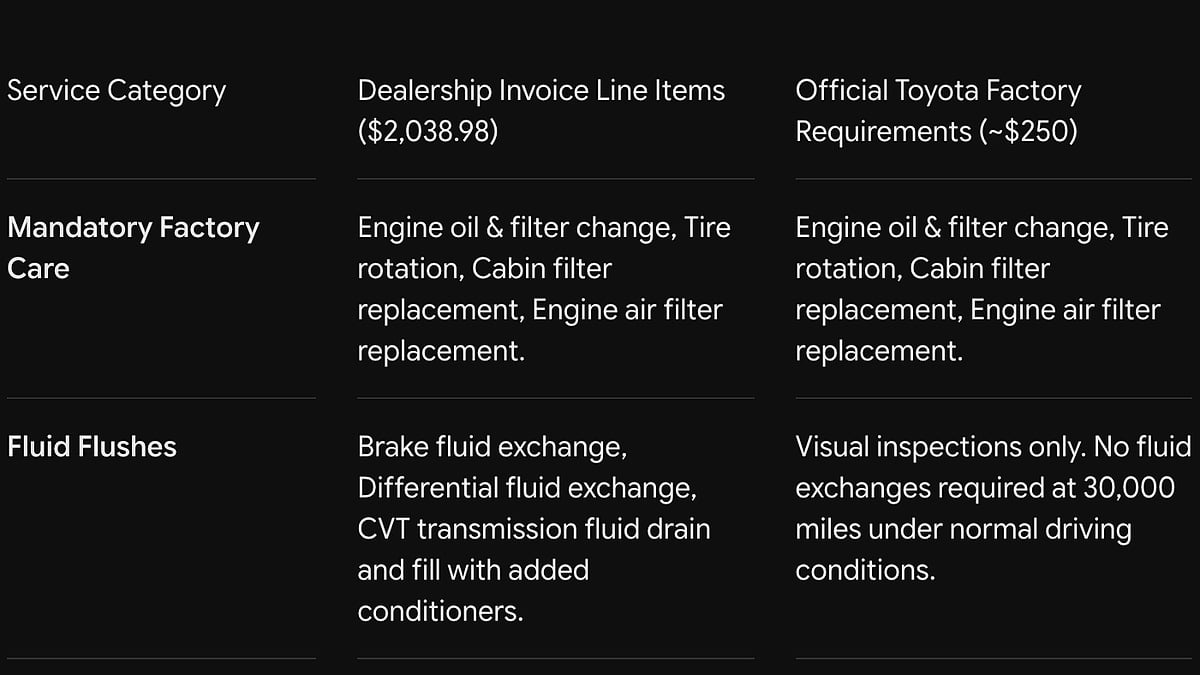
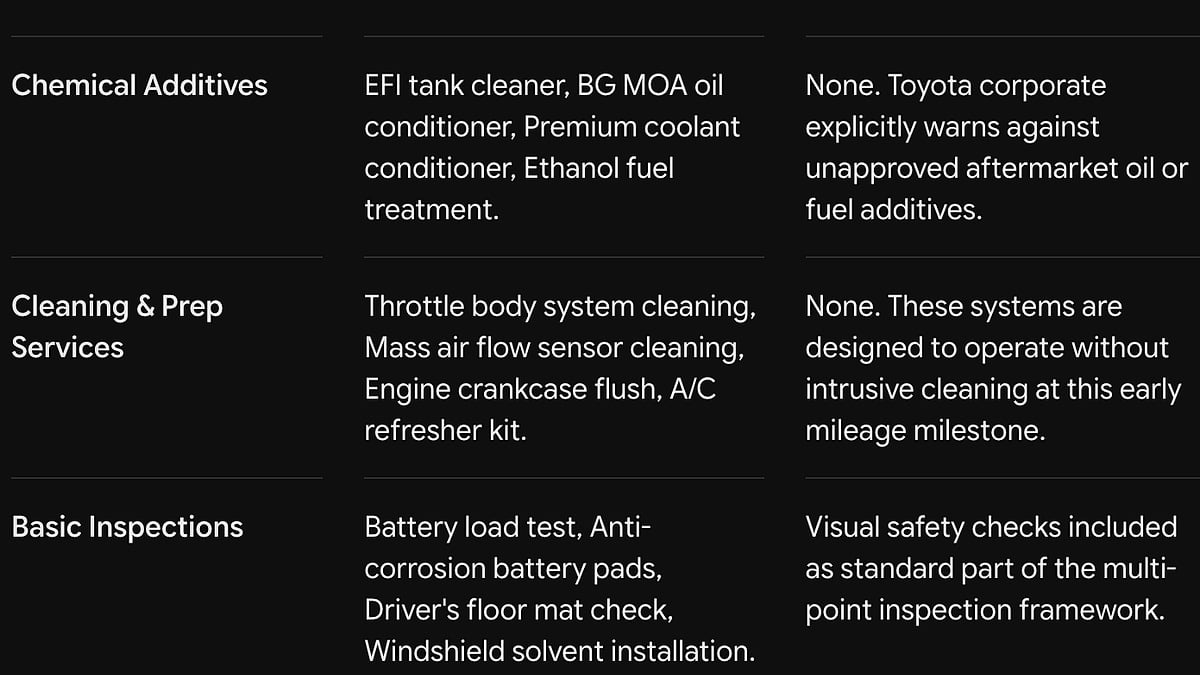
Torque News technical analysis reveals a critical gap between explicit factory engineering requirements and predatory service drive-up sales. At the 30,000-mile or 36-month interval for a fifth-generation Toyota RAV4, corporate engineers specify only replacing the engine oil and filter, rotating tires, replacing the cabin and engine air filters, and conducting visual inspections of brakes, steering, drive shafts, and fluid levels.
This official manufacturer maintenance schedule costs between $200 and $350, depending on regional labor rates, yet dealerships pack invoices with unnecessary fluid flushes and chemical add-ons completely absent from the Toyota factory manual. Furthermore, independent technical organizations at Edmunds have validated that these extra fuel system services are redundant because modern top-tier fuels already contain robust detergent packages that prevent carbon buildup under normal operating conditions.
The Engineering Fallacy of Premature Fluid Exchanges
Including a CVT fluid drain and fill, differential fluid exchange, and throttle body or mass airflow sensor cleaning at 30,000 miles departs markedly from factory guidelines, offering no preventive value and introducing significant mechanical risks. Toyota classifies transmission and differential fluids as lifetime inspection items under normal operating conditions, requiring replacement only at 60,000 or 90,000 miles under severe conditions such as continuous heavy towing or driving on dusty roads.
Dealerships exploit consumer fear by misinterpreting "severe service" and inventing terminology; for example, Denis Flierl reported that a Toyota dealer quoted a RAV4 Hybrid owner $1,500 to "refresh the hybrid system" during past investigations. Unless a vehicle displays a check engine light or exhibits rough idling with a documented diagnostic trouble code, spraying harsh solvents onto delicate intake components can prematurely degrade their factory protective coatings, while introducing aftermarket fluid conditioners into a precision-engineered Toyota CVT can dangerously alter critical friction coefficients.
Insights into the Profit Mechanics of the Service Drive
To understand why a local dealer would recommend over $1,700 in unneeded maintenance, one must look at the structural economics of modern automotive retail operations. New-vehicle sales margins have been under downward pressure for more than a decade. Consequently, franchise dealerships rely heavily on their parts and service departments, often referred to as fixed operations, to generate the vast majority of the store's net operating profit.

Service advisors are rarely straight-salaried employees. They operate primarily on a commission-based pay structure, earning a direct percentage of the parts and labor hours they successfully sell during each customer interaction. This structural incentive model naturally encourages advisors to recommend menu-priced maintenance packages that bundle high-profit chemical flushes with simple, low-cost maintenance items such as an oil change or a tire rotation.
Chemical lines, such as the BG products listed on the RAV4 invoice, represent an exceptionally high-margin segment for the service drive. Dealerships purchase these additive kits at low wholesale prices and retail them with significant labor markups, often backing them with third-party secondary warranties to convince consumers of their necessity.
Field Observations from Owner Communities
Automotive community platforms validate that modern service drives aggressively utilize pre-printed menu pricing to overwhelm consumers and meet high fixed-operations revenue targets, creating a massive disconnect between factory documentation and dealership recommendations.
On forums like r/ToyotaHighlander and Car Talk, owners note that dealerships routinely quote $700 to $800 for a 30,000-mile service, adding unnecessary packages and charging high prices for basic fluid checks once initial factory care expires. Because consumers naturally mistake these localized, arbitrary shop menus for non-negotiable corporate engineering directives designed to maximize billed labor hours, owners must protect themselves by checking vehicle documentation, cross-referencing factory specifications, and explicitly demanding an itemized invoice estimate to question and eliminate any service item not explicitly recommended in the official owner's manual.
Key Takeaways for Protecting Your Wallet
- Verify the official manufacturer warranty and maintenance guide stored in your glovebox before agreeing to any multi-item service menu package.
- Decline generic aftermarket chemical additives, crankcase flushes, and fluid conditioners, as Toyota corporate engineers do not mandate them for vehicle longevity.
- Request an itemized a la carte estimate for only the specific oil change and air filter replacements required by the factory at your current mileage interval.
- Understand that your factory powertrain warranty remains fully intact as long as you perform the core factory-mandated services, regardless of whether you purchase optional dealer upsells.
Will Declining These Dealer Recommendations Void My Warranty?
Declining a dealer's recommended maintenance will not void your factory powertrain warranty. Under the federal Magnuson-Moss Warranty Act, automotive manufacturers cannot void coverage because an owner declines optional, non-factory services suggested by a dealership franchise. To maintain your warranty, you are only legally obligated to perform the services explicitly detailed in your official vehicle maintenance guide, and you are free to perform these core services yourself or at an independent repair shop. If you choose to do so, you must retain accurate, dated parts receipts and a clear mileage log, as a dealership cannot legally deny a future powertrain warranty claim unless it can definitively prove that a total lack of basic, factory-required maintenance directly caused that specific failure.
Anticipating the Next Phase of Vehicle Ownership
A critical element that compact SUV owners must consider when cross-shopping long-term operational costs is how different brands handle everyday cabin ergonomics and ride refinement over extended ownership cycles. Senior Reporter Denis Flierl investigated this dynamic during a comparative long-term vehicle evaluation, observing how individual design philosophies affect owner satisfaction over time. In his analysis, Denis Flierl explains why a buyer walked away from a long-awaited model upgrade, noting that the competitive landscape forces distinct packaging tradeoffs between utility and comfort.
How About You?
Have you ever pulled into a local dealership for a simple, low-cost oil change only to walk out of the service lane facing a massive, multi-page maintenance estimate? How does your local service advisor handle the 30,000-mile or 60,000-mile service intervals, and have you ever felt pressured into purchasing optional fluid flushes or chemical additives to preserve your factory warranty protection? Let us know about your personal experiences with automotive dealership service transparency, and share your perspective on fixed-operations upselling tactics. Please leave a comment in the red "Add new comment" link below to join the discussion.
What Is Next for This RAV4 Investigation?
In our upcoming second report, we will pivot from the service drive to the mechanical bay, conducting an analysis of the five most common high-mileage mechanical failures currently tracking across fifth-generation RAV4 platforms. The next article, titled "The High-Mileage Toyota RAV4 Survival Guide: Top 5 Mechanical Weak Points After 100,000 Miles," will break down real-world component wear, including cooling system bypass valve failures, cable corrosion issues in hybrid variants, and rear differential clutch pack degradation. This follow-up piece will equip owners with the exact diagnostic trouble codes and technical service bulletins needed to identify emerging mechanical faults before their factory warranty coverage expires.
Check out Denis Flierl’s third report in this series. The RAV4 Lifecycle Blueprint: Balancing Factory Maintenance Realities Against Costly Dealership Upsells and Long-Term Mechanical Vulnerabilities. Go here for the full report.
About The Author
Denis Flierl is a 14-year Senior Reporter at Torque News and a member of the Rocky Mountain Automotive Press (RMAP) with 30+ years of industry experience. Explore his full investigative reporting archives and technical guides at DenisFlierl.com. Based in Parker, Colorado, Denis leverages the Rockies' high-altitude terrain as a rigorous testing ground to provide "boots-on-the-ground" analysis for readers across the Rocky Mountain region, California EV corridors, the Northeast, Texas truck markets, and Midwest agricultural zones. A former professional test driver and consultant for Ford, GM, Ram, Toyota, and Tesla, he delivers data-backed insights on reliability and market shifts. Denis cuts through the noise to provide national audiences with the real-world reporting today’s landscape demands. Connect with Denis: Find him on LinkedIn, X @DenisFlierl, @WorldsCoolestRides, Facebook, and Instagram.
Photo credit: Denis Flierl via Erin Nicole Maliwat
Set Torque News as Preferred Source on Google
Follow us today...