
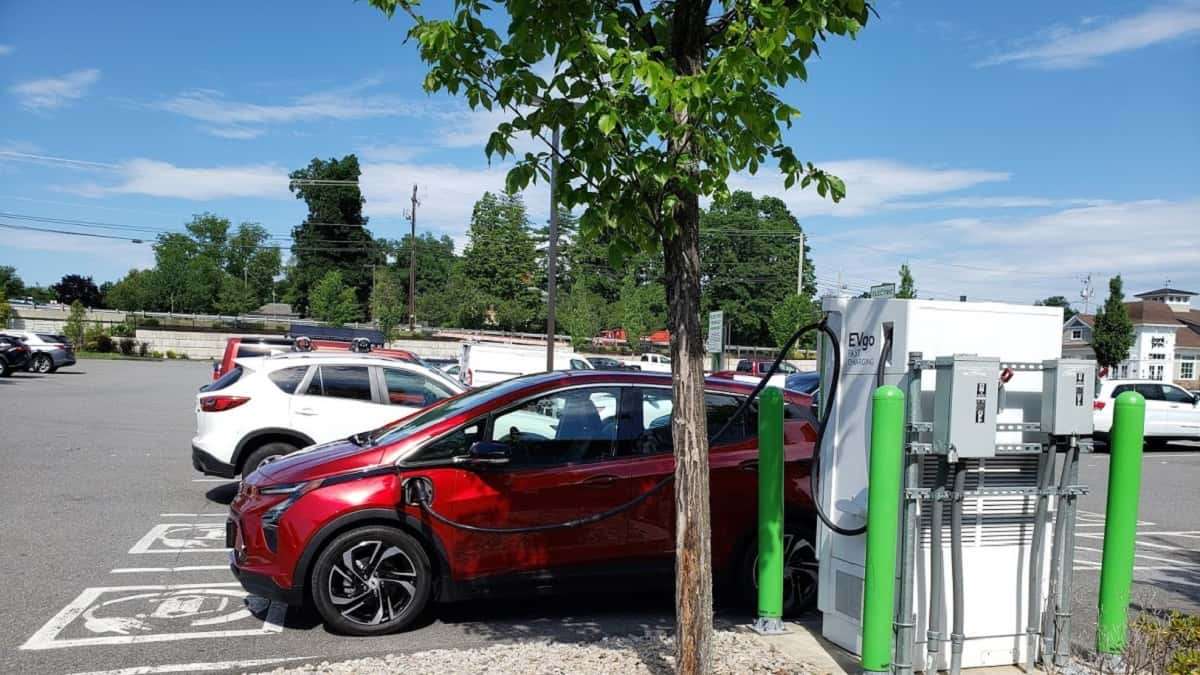

Charging an electric vehicle in public can range in price from free to very expensive. When we recently charged a new 2022 Chevrolet Bolt at an EVgo DC fast charger (DCFC) in Bedford, NH, we discover the pricey end of the spectrum can be more than it would cost to fuel a "gas-guzzling" V8-powered muscle car.
Related Stories:
Big Mistakes To Avoid When Charging an EV In Public
Many Public DC Fast Chargers For Electric Vehicles Are Slower Than You’d Think
Quick Stops At Level 2 Public Electric Vehicle Chargers Are Worthless
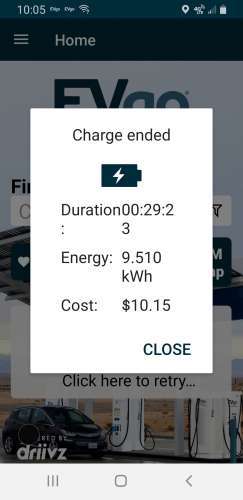
$10.15 To Add 34 Miles of EV Range
We charged up a Chevy Bolt using the EVgo DC fast charger, and the bill was $10.15. That amount of money added 34 miles of range to the Bolt. So, the cost per mile of energy was 30 cents per mile. Let’s compare that to a 2021 Dodge performance car we tested the prior week.
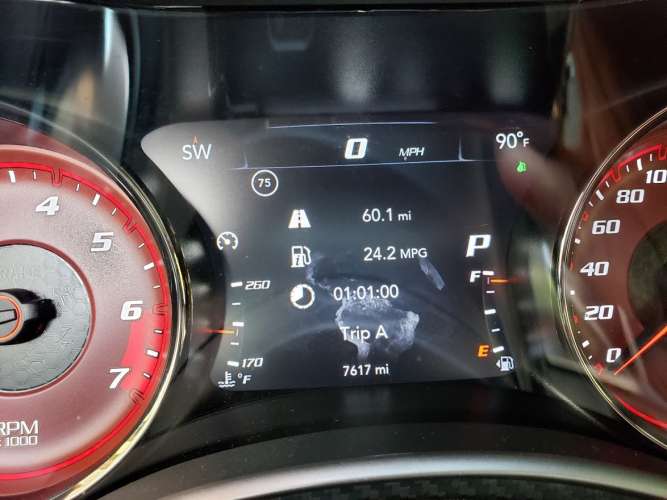
The Dodge had 797 hp, and it returned a combined fuel mileage of 24 MPG in our use on the same route we tested the Bolt. We paid $2.90 per gallon for the gasoline it uses. Doing some “goes in’tahs,” the cost per mile for energy in the muscle car turns out to be 12 cents. Thus, the cost per mile to energize the Bolt was roughly triple what the V8 gas-powered car cost us.
Charging Etiquette
When charging in public one is supposed to quit charging when one’s EV reaches 80% state of charge. The reasons for this are two-fold. First, the rate at which charge can be added to an EV battery is more rapid below 80% and much more time-consuming as the battery reaches full. Second, EV chargers are in very short supply. We need to ration them.
On my route from the metro Boston area to the lakes region of New Hampshire, there are exactly zero public DC fast chargers. In order to charge at a DCFC, I took a slightly longer by time route to swing by one of only two DCFC charging spots in that area. Google “Henniker NH DC Fast Chargers” if you want to see what I mean about no chargers. I needed to top-off in order to complete the 200+-mile route I was making. So, I broke charger etiquette, and I charged to full.
I also charged at the DCFC because I wanted to test my EVgo membership RFID card and account and see how long the DCFC took to add back miles. Both were successful tests.
Charging For Free
Coincidental to my test, GM was running a free-to-charge promotion day during the week I had the Bolt. I think free anything is great, but I always wonder, what’s the hidden agenda? If charging up an EV is very affordable anyway, why does there need to be a promotion to make it “free?” If Dodge offered free gas to muscle car owners, I suppose folks would jump at the chance for a free fillup. But why make EV charging free?
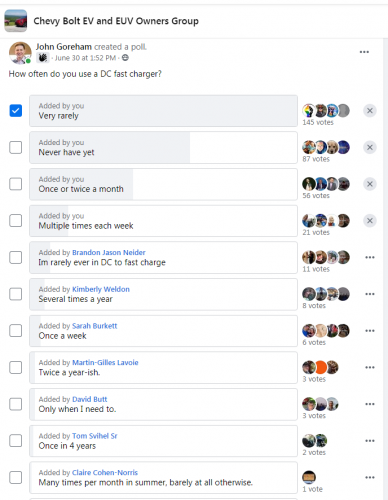
The answer is to get EV owners to the chargers and have them try out the experience. You see, when we poll owners of EVs, most report that they only charge at home, and almost none report using DC fast chargers.
When I plugged into the EVgo DC fast charger, I hadn’t thought about the cost. After all, we constantly hear how affordable EVs are to power up. I have done the math at my own home, and I know that the cost is typically about five to seven cents per mile of range I add back on my home charger using my relatively pricey Boston-area electricity. $10.15 for just 34 miles was a “shock.” Get it, shock. Bet you never heard that in an EV story before.
Related Story: New Hampshire Innkeepers Demonstrate EV-Driving Guest Best Practices
Feel free to tell us in the comments below what you typically pay to charge in public at a DC fast charger and how that cost compares to your cost at home.
John Goreham is a long-time New England Motor Press Association member and recovering engineer. John's interest in EVs goes back to 1990 when he designed the thermal control system for an EV battery as part of an academic team. After earning his mechanical engineering degree, John completed a marketing program at Northeastern University and worked with automotive component manufacturers, in the semiconductor industry, and in biotech. In addition to Torque News, John's work has appeared in print in dozens of American newspapers and he provides reviews to many vehicle shopping sites. You can follow John on TikTok @ToknCars, on Twitter, and view his credentials at Linkedin
Set Torque News as Preferred Source on Google
Follow us today...



Comments
Honestly? The carbon
Permalink
In reply to The article and replies I by Sean (not verified)
Honestly? The carbon footprint is comparable. Tesla is worse with their lithium batteries, don't even get me started on the environmental impacts of lithium mining. But to produce the electricity to power that bolt, or Tesla, or any other fully electric vehicle, carbon is produced in much higher quantities to create electricity at coal burning plants. Over 60% of American electricity is still powered by carbon-emitting methods. You aren't really helping the environment wirh an electric car, it just makes the buyer unable to personally see the carbon being produced and therefore feels more efficient without doing much. Hybrids are the best blend of carbon-reducing technology on cars in my opinion, at least until we look more into hydrogen powered cars. Toyota and I believe 2 other companies have hydrogen powered cars which don't use gas or electricity. I'm a gas junkie but I still think we could clean up our emissions, for sure. However, electric cars aren't at all where people seem to think they are on emissions. Accoesinf to a study, it takes a Tesla 17 years to outweigh the carbon produced just to make the car. Again, lithium mining is horrible. I forget the name of the study and it very well could be wrong, but something to think about.
No hate in any of this, I just wanted to throw it out there as another opinion, maybe even spark some interest in yet another alternative energy source. Nuclear would be cool but people don't seem to trust it, despite the intense modern safety regulations. Oh well.
Hey dummy, like many other
Permalink
In reply to The article and replies I by Sean (not verified)
Hey dummy, like many other batteries, the lithium-ion cells that power most electric vehicles rely on raw materials — like cobalt, lithium and rare earth elements — that have been linked to grave environmental and human rights concerns. Cobalt has been especially problematic. Making matters worse your crooked racist bumbling prez Biden who no doubt is your hero is Banning coal plants in USA where we just happen to have the best technology to produce Clean Coal.. mean while China is building coal plants every day as we speak so take your head out of your ass and stop getting brainwashed dummy!!!
Clean coal is a bigly lie. It
Permalink
In reply to Hey dummy, like many other by Nick (not verified)
Clean coal is a bigly lie. It's filthy and the fly ash is a radioactive disposal problem.
You paid roughly $1 per kW ($
Permalink
In reply to This is definitely a hidden by DeanMcManis (not verified)
You paid roughly $1 per kW ($ per mile is irrelevant and varies by car and driving style) which is insane. You got robbed. At home is about $0.11 per kW and the most expensive Tesla Superchargers are about $0.30. There must be something wrong with that charge.
Yes, he used one of the
Permalink
In reply to You paid roughly $1 per kW ($ by scap (not verified)
Yes, he used one of the slowest to charge evs (we have one), and charged to 100% at a pet minute charger. This is pretty much a what not to do with an ev article.
Dan, exactly right. As the
Permalink
In reply to Yes, he used one of the by Dan Letsch (not verified)
Dan, exactly right. As the first line of the story states, EV charging in public ranges in price from free to expensive. This is a story highlighting the expensive end of the curve, which the story states in the opening paragraph. I'm glad somebody read that far in ;)
Exactly. This is effectively
Permalink
In reply to Yes, he used one of the by Dan Letsch (not verified)
Exactly. This is effectively the same as filling up with gas when the meddle moves just off full. Most people don't do that (unless returning a rental car). Repeat the test with a charger from 20 to 80% and then see how it compares.
Correct. I also mostly charge
Permalink
In reply to You paid roughly $1 per kW ($ by scap (not verified)
Correct. I also mostly charge my Model3 at home which averages 12¢ per kwh. But when I charged it outside in Tesla's public charging station couple of days ago, I was was charged 25¢ per kwh. $1 per kwh is too high, there's something wrong. May be they parked it there for a longer period even after charging was complete. So they might have charged penalty/fees for blocking the chaging space.
$/mile is the only way to
Permalink
In reply to You paid roughly $1 per kW ($ by scap (not verified)
$/mile is the only way to compare ICE v. EV costs, so it's hardly irrelevant.
There is, it's called very
Permalink
In reply to You paid roughly $1 per kW ($ by scap (not verified)
There is, it's called very misleading charges. There's a service charge just to use it. So the more you charge the lower your average per kw is going to be. Nobody is stopping and only charging 10kw.
I agree that is a very high
Permalink
In reply to You paid roughly $1 per kW ($ by scap (not verified)
I agree that is a very high price, not normal. It may be set high because, as the author noted, there are few if any chargers in that area, so they figured they could gouge people. I am also very confused how they charged for 30 minutes, yet only got 30 miles of range...that is not a DC Fast charger, that is only slightly better miles/minute than I get with my home charger. When I charge at a DC Fast charger I get over 150 miles in that time.
Well said, Scap. It is insane
Permalink
In reply to You paid roughly $1 per kW ($ by scap (not verified)
Well said, Scap. It is insane, and it does seem like robbery. I did the best I could right from the first sentence to point out that charging can be free. The Supercharger example is moot. Not a public charging network. For sure the charge had something wrong. Charged past 80%, and a very high cost per charge conspired to ake it so expensive. As others have said, not a single example.
Use PlugShare to pre-evaluate
Permalink
In reply to This is definitely a hidden by DeanMcManis (not verified)
Use PlugShare to pre-evaluate where to charge and get a better EV than an old Chevy Bolt, like a Nissan LEAF Orca Tesla.
Great advice Jan. Thanks for
Permalink
In reply to Use PlugShare to pre-evaluate by Jan Galkowski (not verified)
Great advice Jan. Thanks for commenting.
This article is written by
Permalink
In reply to This is definitely a hidden by DeanMcManis (not verified)
This article is written by someone that has no idea of what they are talking about. I took a trip that was roughly 700 miles and paid $26.00 to charge using EV quick charge stations. The cars slow the charge rate down as they near being full. So he probably did pay that. But it was also unnecessary to charge when he did. He should do some research before he writes an uninformed article.
This post greatly show the
Permalink
In reply to This is definitely a hidden by DeanMcManis (not verified)
This post greatly show the ignorance of the driver. He seems to be charging at a charger, that charges you per minute, and is charging the car to full. If he would have added the came amount of range from a mostly empti battery, it would have cost him only 4-5$
So by your math, I could have
Permalink
In reply to This post greatly show the by Anže Košir (not verified)
So by your math, I could have added 35 miles and paid $5.00? That is still more than the cost to fuel a gas guzzler. Gas here is about $3.25/gal today.
I looked up the numbers for
Permalink
In reply to So by your math, I could have by John Goreham
I looked up the numbers for the charging costs of the charging network they used, and from what it seems, they charge 2$ starting fee, and then either roughly 30c per kWh or 30c mer minute of charging. In his case, it only makes sense that he was charged by the minute. And his 10$, would be 2$ + 27 min* 30c.
According to Chevy, bolt can charge for 100mi in 30 min, so for the same price, he could have gotten 3 times the charge, if he would have charged at the the middle of the trip, when the battery state of charge would be lower. Also, because the charging is paid by the minute, the faster the car charges, the cheaper it is, and bolt is not a fast charging car.
Also, don't get me wrong, that is still pretty expensive, and you aren't saving much in comparison to gas. But if you charge at home, you can easily get prices lower than third ok that.
I hope that my explanation of that situation helps, and if you have any other questions, I'll be happy to try and answer you.
Well said, Anze, you seem
Permalink
In reply to I looked up the numbers for by Anže Košir (not verified)
Well said, Anze, you seem correct on all points. However, charging in rural New Hampshire during the middle of the trip is not an option. Only a pair of DCFCs in the entire region and time is valuable. Elon Musk had a calculator on the Tesla website that values one hour at $100 almost a decade ago. With inflation, how much is time worth today? Spot on about charging at home. Hence the poll related to that.
I'll be the one to make the
Permalink
I'll be the one to make the obligatory Tesla comment. If you have any intention of doing road trips your only choice is a Tesla now. I went to lake Sunapee NH on Saturday. It was less than 200 miles roundtrip so I didn't to charge but if I did there are Superchargers at the rest stop at Hooksett NH which is right on the way and also at Lebanon NH which is nearby. The cost would have been 7 cents per mile. Next Saturday well going to Warren Vt, that's a 450 mile roundtrip so I'll need a couple of charging stops. I'll top it up to 75 or 80% in Lebanon on the way up and then stop in Lebanon or Hooksett on the way back. ABRP says 19 minutes total but I'll probably do a bit more because I'm very conservative. Because there are a lot of Superchargers it's seldom necessary to go beyond 80% even for trips like this one. The CCS network simply isn't good enough in New England yet to consider a non-Tesla yet. My guess is that it will be two years before CCS gets to the point where you can do these trips painlessly. It might be a little sooner, EA has plans for Lebanon NH which is a good start
Sorry, but a Tesla is not
Permalink
In reply to I'll be the one to make the by B Joshia Rosen (not verified)
Sorry, but a Tesla is not even close to the only choice. While there is a lot of room for improvement in the charging area, it is not an issue to take our Bolt all through this area. This article was nothing but a set up as they used a charger that charges by the minute while the car was over 80% to inflate the cost.
B Joshia, I'm thrilled you
Permalink
In reply to I'll be the one to make the by B Joshia Rosen (not verified)
B Joshia, I'm thrilled you commented. I visit the Common Man Joe coffee shop in Hookset at the highway plaza many times each month. I openly admit to a latte addiction. While there, I often take pictures of the long rows of superchargers (on both the North and South sides of the highway). I have some fun images of Prius cars parked in the spots and trucks ICEing them all out. Normally, there are many available, and Tesla owners grab a charge while enjoying a bathroom break. I've even seen Tesla owners park on the grass behind the Northbound chargers and pull the cable over the guard rail so they don't have to pay the Hookset highway toll I guess. Metro Boston has a fairly good infrastructure for the relatively few BEVs in the region, but I agree, it is too soon for a non-Tesla BEV if you live in NH, particularly outside Metro Manchester, Concord, Salem, or Nashua (which are all de facto Boston suburbs now). I have a friend in Hillsboro who commutes to Metro Boston every day, if you can believe it. He owns a used Ford Fiesta just for that commute. I'll look for you at the plaza!
It’s a very bad idea to
Permalink
It’s a very bad idea to charge past 80% at a charger that goes by time instead of total power. Typical super chargers near me are $.25-.30 per kWh
EVGO charge by the minute, if
Permalink
EVGO charge by the minute, if you already had over 80% charge you should have used the level 2 charger. Or better yet use Plugshare to find a free charger at Colby Hill Inn, Henniker, NH.
I love that Inn, and I've
Permalink
In reply to EVGO charge by the minute, if by Chris Wilson (not verified)
I love that Inn, and I've stayed there in the past. I may be mistaken, but if I remember correctly, the charger there is L2 not DCFC. (I think there were two a Tesla destination charger and another brand )Time is money and my final destination is not Henniker, but a town West of that point. Most of the Inns I have stayed at in NH (for example Inn at Pleasant Lake) do not offer free charging for all takers. Rather, for guests. I've done a number of stories highlighting NH destinations with free charging. How would you feel if you were a guest arriving at an inn with charging for guests only to find folks local to the area and passing through were using that charger but not staying at the inn?
I own a Tesla. The majority
Permalink
I own a Tesla. The majority of the time I charge at home during the night while rates are low. When I’m on the road for a long distance trip I charge for free at Tesla’s high speed chargers. I do have to charge over the recommended 89% to ensure making it to the next charger.
With my tesla, I haven’t been
Permalink
With my tesla, I haven’t been charged more than $.25 per minute. When traveling I typically charge to gain 100 miles of range or so and usually pay under $5 (typically around $3). With my commute to work (50 miles a day x 5 days) it cost me $5/week charging from home with a rate of around $.13 kw/h. I am in a smaller town in indiana too, but the rates which you mention are astronomical.
Good share. I appreciate the
Permalink
Good share. I appreciate the comparison against the gas powered vehicle. I started driving my Tesla Model 3 since end of March and always enjoy reading these experiences. One reason why the bill you got may have been so high was your beginning state of charge. It seems like every EV battery has a different charge curve, with it charging super fast from about 5-50% then it tapers off. Even in the Tesla, to get from 90-100% often takes an estimated 15-20minutes. When you’re paying per minute (as opposed to per unit energy) that cost can skyrocket. I’d love to see a side by side drive (EV vs a gas car -trying to get my girlfriend to agree but she doesn’t seem to be that into it).
The comparison here is
Permalink
In reply to Good share. I appreciate the by Richard Kistnen (not verified)
The comparison here is totally dishonest. As you pointed out they likely started with a high state of charge making the comparison invalid. With our Bolt a 20% to 80% charge averages about 40kW while this charge was under 20kW, so no sane person would do what they did here until they were fishing for a high price to whine about.
Thanks, Kurt. If you were
Permalink
In reply to The comparison here is by Kurt Hammons (not verified)
Thanks, Kurt. If you were planning a drive of around 300 total miles departing Metro Boston and heading into the New Hampshire area around Washington or Lempster, where would you charge, and why in the world would you start off with a low rate of charge? Maybe I missed a way to do the journey. The story has a whole paragraph on the 80% state of charge issue. I did actually go fishing while I was there BTW.