
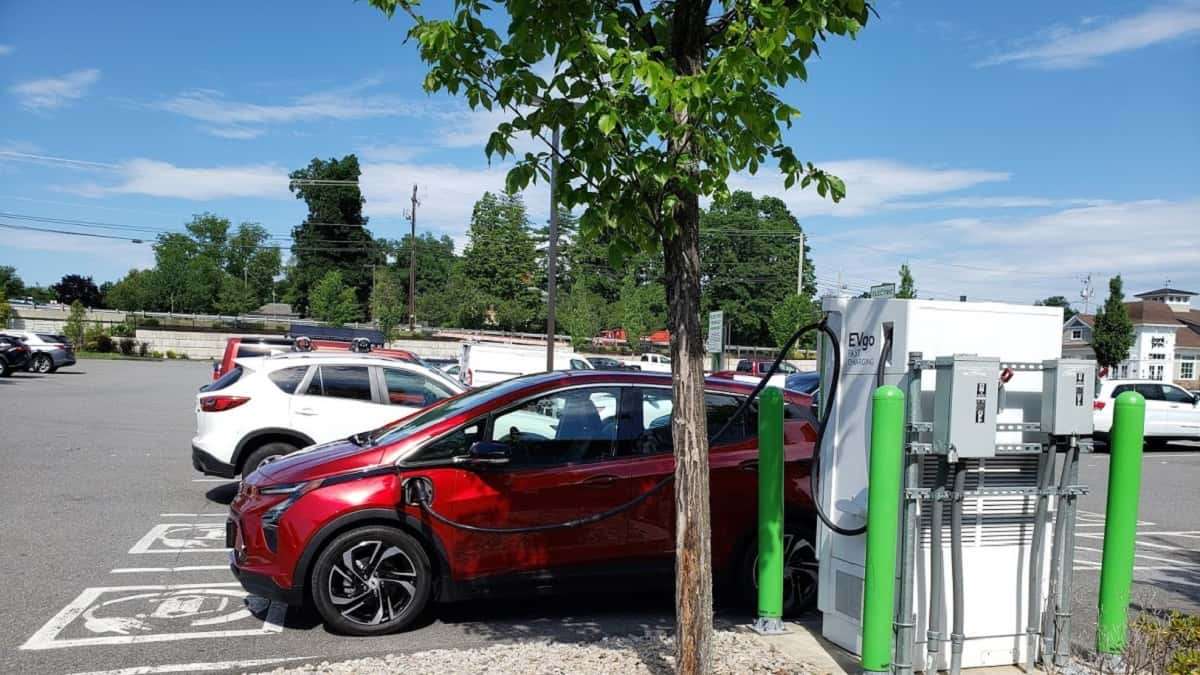

Charging an electric vehicle in public can range in price from free to very expensive. When we recently charged a new 2022 Chevrolet Bolt at an EVgo DC fast charger (DCFC) in Bedford, NH, we discover the pricey end of the spectrum can be more than it would cost to fuel a "gas-guzzling" V8-powered muscle car.
Related Stories:
Big Mistakes To Avoid When Charging an EV In Public
Many Public DC Fast Chargers For Electric Vehicles Are Slower Than You’d Think
Quick Stops At Level 2 Public Electric Vehicle Chargers Are Worthless
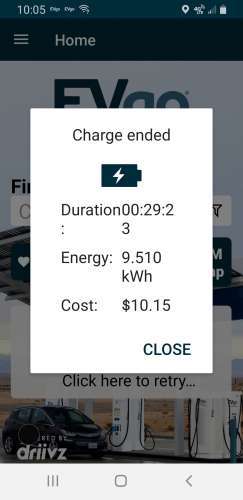
$10.15 To Add 34 Miles of EV Range
We charged up a Chevy Bolt using the EVgo DC fast charger, and the bill was $10.15. That amount of money added 34 miles of range to the Bolt. So, the cost per mile of energy was 30 cents per mile. Let’s compare that to a 2021 Dodge performance car we tested the prior week.
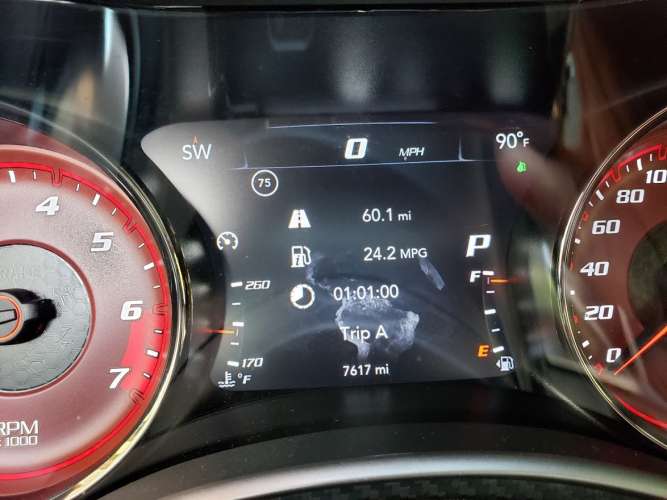
The Dodge had 797 hp, and it returned a combined fuel mileage of 24 MPG in our use on the same route we tested the Bolt. We paid $2.90 per gallon for the gasoline it uses. Doing some “goes in’tahs,” the cost per mile for energy in the muscle car turns out to be 12 cents. Thus, the cost per mile to energize the Bolt was roughly triple what the V8 gas-powered car cost us.
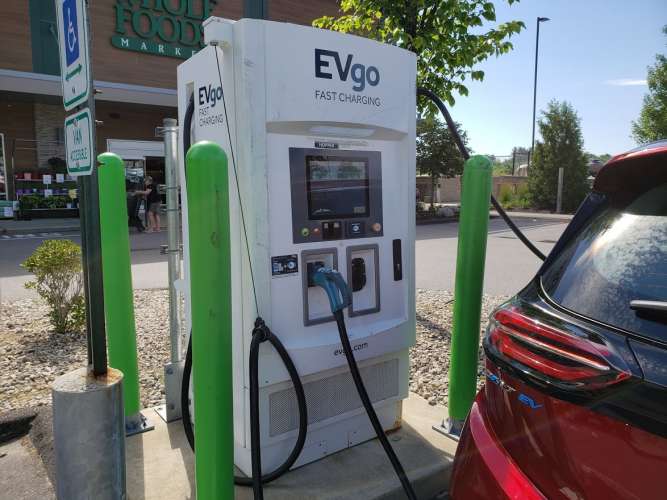
Charging Etiquette
When charging in public one is supposed to quit charging when one’s EV reaches 80% state of charge. The reasons for this are two-fold. First, the rate at which charge can be added to an EV battery is more rapid below 80% and much more time-consuming as the battery reaches full. Second, EV chargers are in very short supply. We need to ration them.
On my route from the metro Boston area to the lakes region of New Hampshire, there are exactly zero public DC fast chargers. In order to charge at a DCFC, I took a slightly longer by time route to swing by one of only two DCFC charging spots in that area. Google “Henniker NH DC Fast Chargers” if you want to see what I mean about no chargers. I needed to top-off in order to complete the 200+-mile route I was making. So, I broke charger etiquette, and I charged to full.
I also charged at the DCFC because I wanted to test my EVgo membership RFID card and account and see how long the DCFC took to add back miles. Both were successful tests.
Charging For Free
Coincidental to my test, GM was running a free-to-charge promotion day during the week I had the Bolt. I think free anything is great, but I always wonder, what’s the hidden agenda? If charging up an EV is very affordable anyway, why does there need to be a promotion to make it “free?” If Dodge offered free gas to muscle car owners, I suppose folks would jump at the chance for a free fillup. But why make EV charging free?
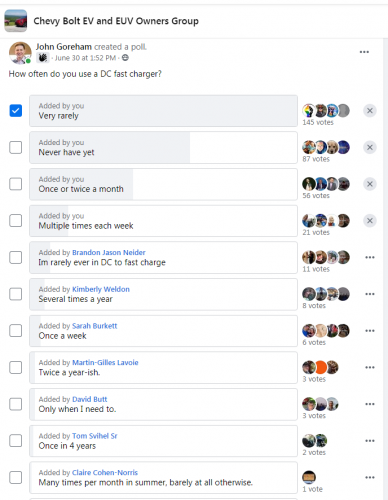
The answer is to get EV owners to the chargers and have them try out the experience. You see, when we poll owners of EVs, most report that they only charge at home, and almost none report using DC fast chargers.
When I plugged into the EVgo DC fast charger, I hadn’t thought about the cost. After all, we constantly hear how affordable EVs are to power up. I have done the math at my own home, and I know that the cost is typically about five to seven cents per mile of range I add back on my home charger using my relatively pricey Boston-area electricity. $10.15 for just 34 miles was a “shock.” Get it, shock. Bet you never heard that in an EV story before.
Related Story: New Hampshire Innkeepers Demonstrate EV-Driving Guest Best Practices
Feel free to tell us in the comments below what you typically pay to charge in public at a DC fast charger and how that cost compares to your cost at home.
John Goreham is a long-time New England Motor Press Association member and recovering engineer. John's interest in EVs goes back to 1990 when he designed the thermal control system for an EV battery as part of an academic team. After earning his mechanical engineering degree, John completed a marketing program at Northeastern University and worked with automotive component manufacturers, in the semiconductor industry, and in biotech. In addition to Torque News, John's work has appeared in print in dozens of American newspapers and he provides reviews to many vehicle shopping sites. You can follow John on TikTok @ToknCars, on Twitter, and view his credentials at Linkedin
Set Torque News as Preferred Source on Google
Follow us today...






Comments
You are full of shet.
Permalink
In reply to Since you're focusing on by Joe M (not verified)
Refineries use oil to heat the systems up, not electricity.
This percentage very much
Permalink
In reply to One problem with your logic by Arlo (not verified)
This percentage very much depends on where you live. The province of Canada where I live for example generates 99.8% of all electricity using renewable sources, and produces basically zero carbon emissions. The next province over, which is the only other one I travel to regularly, generates over 91% of its electricity from renewable sources or nuclear, and also produces basically no CO2 emissions.
Both provinces combined generate about 1% of their total electric output using coal, natural gas, or diesel. That is not the case for the western provinces however, and Alberta for example, generates about 90% of its electricity from coal, gas, oil, and bitumen, and consequently has CO2 emissions from electricity about 100 times as high as Ontario and Quebec combined.
While wind turbines can't be
Permalink
In reply to One problem with your logic by Arlo (not verified)
While wind turbines can't be easily integrated into cities, solar panels and battery backups can. If we incentivise projects on already developed land over projects on undeveloped land, we can boost our renewable capacity significantly with the only downside being the energy and resources needed to create those renewables, and hopefully at least the energy can be offset easily and the materials, being mainly silicon, shouldn't be too destructive to obtain.
I also think there is a good opportunity for vertical windmills in cities and even perhaps rain based hydro-electric, as well as better reclamation of hydrocarbons, that could significantly improve our local energy in and near cities.
I also think that criticism of this article over focusing on the price instead of the benefit of reduced carbon emissions completely misses the point. Some people aren't selfish and really will spend more for the common good or are sufficiently motivated by the social status assigned to something like certain EV's that the price per mile doesn't matter. For others (especially for professional use) the price per mile has to figure into the decision. The point isn't "EV's aren't a good investment" but rather "we need to take a serious look at EV charging prices if we want this whole thing to work", because altruism just doesn't work for everyone.
@ Phyzzy What??? Who gets
Permalink
In reply to While wind turbines can't be by Phyzzi (not verified)
@ Phyzzy What??? Who gets social status from owning an ev??? All I ever saw were jokes and general mockery of my S. I even started calling it my toy car. Was what everybody at my job called it. Having a hard time Tom? Had to settle for a tesla instead of a real car? Often received gifts of AA batteries, extension cords etc. as gags from others. Oh hey you were complaining you needed to charge here pop some of these in it, or here ya go bud plug it in here at work since you cant afford gas etc.. Even at its price point the S was below the average price point much cheaper than other cars I considered buying. You find out why too with their lack of quality fit and finish compared to luxury brands. Took 3 months complaining before it was properly fixed... well mostly fixed. The b Pilar would still pop off if you hit a bump right or drove overly aggressive. Was one of the crappiest cars in that regard I owned since I was poor in My 20's.
And how fast is the use of
Permalink
In reply to One problem with your logic by Arlo (not verified)
And how fast is the use of renewable energy rising? Most charging is done at home and our solar handles that well.
If you are going to spout
Permalink
In reply to One problem with your logic by Arlo (not verified)
If you are going to spout this nonsense, at least have the decency to provide all the relevant information. You are not taking into account the emissions and energy used to extract, refine, and transport the fossil fuels burned by a gasoline engine. Should there be more energy produced by renewable sources, absolutely. Overall, to get the fuel you burn in a ICE vehicle to your tank, there are FAR more emissions produced than to produce the electricity to charge an EV, regardless of the type of generation used.
So... If you don't mind me
Permalink
In reply to If you are going to spout by Matt (not verified)
So... If you don't mind me asking... How do you suppose all the components on your ev are produced and delivered around the world? If you're going to count the environmental cost of a fossil fuel powered vehicle, then you should also count the environmental and human cost involved in making the "fuel" for an ev. (Edited for content. Point made)
One can also argue that
Permalink
In reply to So... If you don't mind me by Lonnie (not verified)
One can also argue that America is the most "nefarious" country in the world. (Edited for content. Profanity removed. The commenter's point is that America has done bad things).
Really, THE most nefarious?
Permalink
In reply to One can also argue that by Stooch (not verified)
Really, THE most nefarious? More than China, Russia, and India? More nefarious than Mexico, Columbia, Venezuela, South Africa? You can always move to another nation if you don't like it here.
If you think the only carbon
Permalink
In reply to The article and replies I by Sean (not verified)
If you think the only carbon emissions cost comes from driving these you are sadly mistaken. If we start to consider the big picture ie the carbon cost associated with manufacturing and disposal things start to look a little more even. If we truly want to be environmentally conscious then study after study have shown no matter what u chooses to drive if far better for the planet to buy it and run it for 15-20 years bot throw it away and buy new every 2
We shouldn't be throwing out
Permalink
In reply to If you think the only carbon by Chris (not verified)
We shouldn't be throwing out nearly as much, obviously, but there are plenty of people happy to give your jalopy an extended life until it rusts to the point of unusable or is so out of date that the insurance and inefficiency outweighs a reduced "used" price, which is often 30 or more years if no owners do the disservice of significantly and rapidly altering the structure of the vehicle. Frankly, if you have the resources for a new vehicle, you should be buying electric and trading in the old unless it honestly won't work for you, because your vehicle WILL find a second life with someone else, and if you buy electric you at least begin the transition.
Also, by the way, every serious study puts the lifetime carbon emissions of an electric vehicle in all but the very worst cases as well below the lifetime emissions of even the best ICE vehicles. That's counting manufacturing. So unless you are looking for something to wrap around a tree, the investment in an EV is an investment in combatting climate change.
And if you just really hate the idea of a new car, there is a healthy market for used EV's that may not have the range but certainly have some spunk. So if you are part of the vast majority of drivers who could probably bike commute but have some excuse not to, a used EV should be fine for most or even all trips.
Thank you, Sean. As you say,
Permalink
In reply to The article and replies I by Sean (not verified)
Thank you, Sean. As you say, the comparison is ridiculous and just helps to highlight the issue of how EV charging is not a no-brainer. We need to plan and think in order to do it sensibly and affordably. And the fraction of Americans with 800 hp vehicles is minuscule. A rounding error when it comes to the vehicles in service today.
Let's not pretend the EVs
Permalink
In reply to The article and replies I by Sean (not verified)
Let's not pretend the EVs aren't without thier own moral dilemmas. I'm all for green energy, but the stories from African mining operations are discouraging. Our hunger for modern batteries comes with it's own price in blood.
Not just African mining.
Permalink
In reply to Let's not pretend the EVs by Eric Hippler (not verified)
Not just African mining. When it comes to mass production of hybrid and electric vehicles, the main problem has been a shortage of batteries. (Edited for content. Point is there is a coast to manufacturing batteries)
Lithium is the 33rd most abundant element, however, it does not naturally occur in its pure form due to its high reactivity. Lithium metal, due to its alkaline properties, is corrosive and reacts with water. Breathing lithium dust or alkaline lithium compounds irritates respiratory tracts. Prolonged exposure to lithium can cause fluid to build-up in the lungs, leading to pulmonary edema. The metal itself is a handling hazard because of the caustic hydroxide produced when it is in contact with water causing an explosion.
Lithium mining carries high environmental costs. Mining companies prospecting lithium in northern Tibet, salt plains of South America, and Chile as well as lithium at Bolivia's Salar De Uyuni require extensive extraction operations and water in a dry land.
You did not compare to oil.
Permalink
In reply to Not just African mining. by Ken Flook (not verified)
You did not compare to oil. Toxins and cancer risk. Oil wants the myth of peak to ease prices. Lithium is a minor issue compared to oil.
This is quite the sob story
Permalink
In reply to Let's not pretend the EVs by Eric Hippler (not verified)
This is quite the sob story until you compare it to the history of the fossil fuel industry. I'm not excusing it, but as a reason to buy gas instead of electric, it's lacking.
But the cobalt used in them
Permalink
In reply to Let's not pretend the EVs by Eric Hippler (not verified)
But the cobalt used in them has virtually eliminated unemployment among Congolese five year olds.
This might sound bad, I
Permalink
In reply to Let's not pretend the EVs by Eric Hippler (not verified)
This might sound bad, I honestly don't even care about blood coming from people and their questionable mining operations as long as the Earth doesn't cook me or my kin alive. I think we're at a crisis and there will be much more blood in the future. The root of the issue is consumption.
and yet the following is not
Permalink
In reply to The article and replies I by Sean (not verified)
and yet the following is not topic of discussion in rebuttal.
When it comes to mass production of hybrid and electric vehicles, the main problem has been a shortage of batteries. And the main material in growing demand is lithium. An element found in abundance in South America, where the cheapest extraction method by evaporating salt brines in the solar ponds deploys usage of cheap and toxic PVC; and in lithium-rich regions of Chile where extracting the metal uses two-thirds of the area’s fresh drinking water.
Lithium is the 33rd most abundant element, however, it does not naturally occur in its pure form due to its high reactivity. Lithium metal, due to its alkaline properties, is corrosive and reacts with water. Breathing lithium dust or alkaline lithium compounds irritates respiratory tracts. Prolonged exposure to lithium can cause fluid to build-up in the lungs, leading to pulmonary edema. The metal itself is a handling hazard because of the caustic hydroxide produced when it is in contact with water causing an explosion.
Lithium mining carries high environmental costs. Mining companies prospecting lithium in northern Tibet, salt plains of South America, and Chile as well as lithium at Bolivia's Salar De Uyuni require extensive extraction operations and water in a dry land.
What about how the
Permalink
In reply to The article and replies I by Sean (not verified)
What about how the electricity is produced to charge those vehicles. Or if you say solar panels which I'm sure doesn't provide 100% of the electricity what about the manufacturing of those. People buy electric cars to try and feel good about themselves but fail to realize how much damage they will do when the batteries are time to be replaced. Or how the power is being generated in the first place.
What about how the
Permalink
In reply to The article and replies I by Sean (not verified)
What about how the electricity is produced to charge those vehicles. Or if you say solar panels which I'm sure doesn't provide 100% of the electricity what about the manufacturing of those. People buy electric cars to try and feel good about themselves but fail to realize how much damage they will do when the batteries are time to be replaced. Or how the power is being generated in the first place.
Are we going to ignore the
Permalink
In reply to The article and replies I by Sean (not verified)
Are we going to ignore the immisions when making these things. Or the fact that Boone is willing to fix ev so any environmental impact saved is lost 1000 times over when someone that needs an 800$ charge port changed is told it's going to cost them 16000$to repair there car and to just buy a new one this is what happens when you break anything on an ev right now and with right to repair in jeopardy even if someone wants to fix them they may not be aloud to or the parts will not be made available.
My electricity comes from a
Permalink
In reply to The article and replies I by Sean (not verified)
My electricity comes from a coal plant. Riding a bike is probably the only way to travel carbon neutral
Just don't eat beans....
Permalink
In reply to My electricity comes from a by [email protected] (not verified)
Just don't eat beans....
My electricity comes from a
Permalink
In reply to The article and replies I by Sean (not verified)
My electricity comes from a coal plant. Riding a bike is probably the only way to travel carbon neutral
Climate change is a hoax. I
Permalink
In reply to The article and replies I by Sean (not verified)
Climate change is a hoax. I'll take my fossil fuel vehicle any day. You will never stop using fossil fuels. Everything you own is possible because of fossil fuels, even aspirin. I'll also take fuel sourced in the US by grown men to batteries whose materials are mined by child slave labor in countries that hate us. What could possibly go wrong?
Another fool. Just because
Permalink
In reply to The article and replies I by Sean (not verified)
Another fool. Just because the emissions do not come out of the tailpipe doesn't mean 400 miles away the power plant isn't spewing out carbon. Your scope is so small and lacking any intelligence.
I'm sorry but this big myth
Permalink
In reply to The article and replies I by Sean (not verified)
I'm sorry but this big myth that oil controls politics is bonkers. It is cost that has kept adaptation of electric. As costs went down, so did the ownership in electric increase. Not everyone finds a Prius the right vehicle for them. Can't haul much or tow. Can't carpool with the soccer team either. If your single or have a small family, the Prius is great. Can we get back to facts instead of spreading quantifiable false information that big oil has kept electric at bay? Utter nonsense. That Honda Insight with 2 seats got MPG in the 60s but with only 2 seats. Not many would think a 2 seat automobile is right for them. The first Tesla was a 2 seater as well based in a Lotus sports car.
I always find this argument
Permalink
In reply to The article and replies I by Sean (not verified)
I always find this argument interesting. We really need to look at the whole package for vehicles. From mining the raw materials, shipping, refining, part creation, assembly, vehicle shipping, lifespan, power source used to charge, and ultimately recycling the vehicle.
The numbers when you take the full lifespan of the vehicle into account, I haven’t seen any numbers showing that EVs produce any less greenhouse gasses.
On top of that, EV companies sell their carbon credits to other companies, which negatively impacts overall carbon production numbers too.
EVs are a scam.
I believe you are keeping
Permalink
In reply to The article and replies I by Sean (not verified)
I believe you are keeping blinders on when it comes to emissions. Currently it takes about 12 years to break even with electric vehicles on emissions.