

There is a lingering anxiety that still follows electric vehicles even as they become more common on American roads. Ask almost any EV skeptic what worries them most, and battery degradation usually comes up within seconds. People imagine steep capacity loss, expensive repairs, and a car that feels worn out long before it should. That concern has shaped countless buying decisions and has slowed adoption for drivers who otherwise like the idea of going electric.
That’s why a post shared in the “Chevy Bolt Owner Issues” Facebook group stood out to me today. Perry Hall wasn’t reporting a failure, a warning light, or a service nightmare. Instead, Perry shared a snapshot of long-term ownership that directly challenges many of those assumptions.
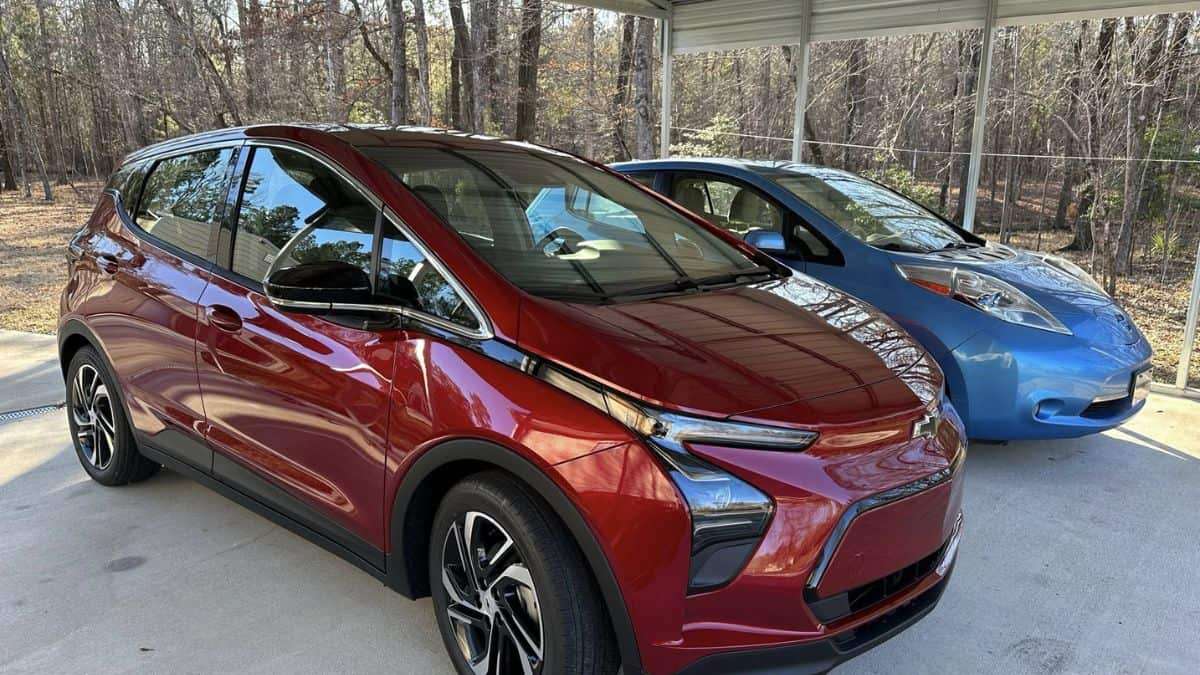
As Perry explained it: “Our 2023 Chevrolet Bolt EV is almost three years old and already has over 91,000 miles. Yesterday, I checked the battery degradation using the infotainment system and it has only lost about 2–3% of its original capacity. That’s incredible. Nothing has broken and we’ve had zero issues. We love this car.”
Ninety-one thousand miles in under three years is not light use. That’s the kind of mileage many vehicles do not reach until well into their second ownership cycle. Seeing that level of use paired with minimal battery degradation and zero repairs is exactly the type of real-world data shoppers say they want but rarely get.
Battery Degradation Matters More Than Mileage
When gas-powered cars rack up miles, most people think in terms of wearing items like engines, transmissions, belts, and gaskets. With EVs, the battery replaces all of that as the central concern. Mileage still matters, but capacity loss tells a deeper story. A battery that holds most of its original range after years of use suggests good thermal management, consistent charging behavior, and stable chemistry.
The Chevrolet Bolt EV has never been positioned as a luxury electric vehicle or a technology showcase. It is, at its core, a practical commuter car. Yet stories like Perry’s echo what other owners have already shared, including one long-term experience detailing how a 2023 Chevy Bolt EUV remained fantastic after 59,000 miles of daily use, reinforcing the idea that the platform holds up better than many expect.
What makes the 2–3% figure particularly noteworthy is how normal Perry’s ownership sounds otherwise. No mention of special care, no extreme babying, and no caveats about reduced performance. It is simply a car that has been driven a lot and continues to work as intended.

Zero Issues Is the Real Headline
Battery health may grab attention, but the phrase that truly changes the tone of this story is “nothing has broken.” Modern vehicles are complex, and electric cars are no exception. Between software updates, charging hardware, sensors, and infotainment systems, even small glitches can pile up over time.
Yet Perry’s experience mirrors what many Bolt owners quietly report. Reliability does not always mean perfection, but it often means predictability. Oil changes disappear, scheduled maintenance shrinks, and ownership becomes refreshingly uneventful. That kind of experience has pushed some owners to rethink what they expect from a daily driver, much like one owner who explained why their 2017 Chevrolet Bolt EV Premier became one of the best purchases they ever made even years into ownership. For drivers who simply want to get in the car and go, uneventful ownership is not boring. It's freeing.
What Other Owners Are Saying Adds Context
Perry’s post sparked a wave of responses, and taken together, they help frame this experience as part of a broader pattern rather than a one-off success story.
Daryl Yager chimed in with a short but telling comment: “I have the same year. 92k miles trouble and stress free. Life’s good so far!”
That kind of consistency matters. When multiple owners independently report similar results at similar mileages, it strengthens confidence that the experience is repeatable.
Neal Peters offered a more nuanced perspective that adds realism without undermining the overall message. He wrote, “Outside of the steering rack and pinion assembly, which I've replaced once already at 50,000 miles and I'm replacing it again at 155,000 next week, these cars are rock solid. The air conditioning is a little glitchy in super hot weather.”
Neal’s comment reminds readers that no car is perfect as mileage climbs. But still, even his list of issues feels manageable when viewed against six-figure mileage.
Then there is Tyler Reece’s experience, which pushes the Bolt EV’s credibility even further:
“Ours has just under 200,000 miles on it. We have driven it on several road trips from Tennessee to Oregon using just CCS stations with several other trips along the way. It has seen both the Atlantic and Pacific Oceans. It has issues, but it's also a 200,000 mile car.
- There's a short in the front dome light that sometimes only one of them works.
- The headlight on the right side is starting to go out at 193k miles.
- The front shocks had to be replaced.
- I replaced the small 12v in it for a little under $300 dollars total.
- And I've had a lot of tires over 200,000 miles. As bad as that sounds, it's an older car and it's STILL going on road trips. We now live in Gold Beach and often drive it up the 101 to Portland and down to Eureka. It was worth every penny.”
What stands out in Tyler’s story is not the list of issues, but the context around them. At nearly 200,000 miles, items like shocks, tires, headlights, and even a 12‑volt battery fall firmly into the category of expected wear and not failure. More importantly, the Bolt EV is still trusted for long-distance travel, relied on for daily life, and viewed by its owner as a worthwhile purchase. That reframes what long-term reliability really looks like. At this stage, the car is not breaking down, but simply aging.
Range Anxiety Fades With Experience
Another takeaway from these comments is how little anxiety remains once owners build experience. Tyler’s cross-country trips relying on CCS fast charging show how confidence grows over time. Early EV ownership is often defined by planning and caution. Later ownership tends to look more like habit and trust.
That transition mirrors what many first-time EV buyers describe, including one owner who admitted they knew after buying a 2020 Chevy Bolt that they would never go back to gas, a realization shaped not by marketing claims but by lived experience. The Bolt EV may not charge the fastest or boast the longest range in its class, but reliability and predictability often matter more than peak specifications once the novelty wears off.
That's why looking at Perry’s post and the responses underneath it, what stands out to me most is how unremarkable the story feels in the best possible way. There is no drama here, no crisis moment, and no viral failure clip. Instead, there is a car doing its job for nearly 100,000 miles and asking for very little in return.
I think that matters more than we often admit. I see a growing disconnect between how vehicles are discussed online and how they are actually lived with. The loudest stories tend to be the worst ones, while thousands of uneventful ownership experiences go largely unmentioned. Posts like Perry’s help rebalance that narrative. They remind us that progress in the automotive world is not always flashy. Sometimes it looks like a commuter car aging gracefully, racking up miles, and staying out of the shop.
Key Takeaways for EV Shoppers and Owners
- Battery degradation fears are often overstated: Real-world data shows modern EV batteries can retain most of their capacity even with heavy use.
- High mileage does not automatically mean high maintenance: Many long-term Bolt EV owners report minimal repairs beyond normal wear items.
- Ownership experience evolves over time: Early concerns about range and charging often fade as drivers build confidence.
- Quiet reliability deserves attention: Boring, trouble-free miles are often the strongest endorsement a vehicle can earn.
Let’s Hear From You
If you own a Bolt EV or another electric car, how has your battery held up as the miles added up?
And for those still on the fence about going electric, do long-term stories like Perry’s change how you think about EV reliability and ownership?
Don't hesitate to share your thoughts with us in the comments below.
Aram Krajekian is a young automotive journalist bringing a fresh perspective to his coverage of the evolving automotive landscape. Follow Aram on X and LinkedIn for daily news coverage about cars.
Image Sources: The “Chevy Bolt Owner issues” public Facebook group.
Set Torque News as Preferred Source on Google
Follow us today...







Comments
It's really good to hear…
Permalink
It's really good to hear that the Chevy Bol's battery holds so well after so many miles.
It's all part of EVs being…
Permalink
It's all part of EVs being new.
Problem with the bodywork ? It's just a car. Brakes, suspension, air conditioning? Just like any other car.
A combustion car, you don't replace the drive train because a part failed, you fix a pump, or the ignition or the exhaust or the clutch.
EVs for many people are a bunch of what ifs.
Battery packs are a huge part of the cost, what-if the battery goes? First off it's very low probability.
Yes-but-what-if mine is one of the the few? The first 8 years are covered by warranty (required by law in the UK and EU) it gets swapped for free
Yes-but-what-if I have the car after the end of the warranty? It's usually a component not a whole pack replacement, but you might swap your pack for a reconditioned one and yours is fixed and goes to the next person.
Yes-but-what-if .... etc.
I tell people they expect their phone battery to last 1000 charge cycles minimum, phones with 2000 cycles - 5-6 years old aren't remarkable. 250 miles per cycle x1000 cycles is a point where everything else is worn out. Most EV batteries will outlast the rest of the car.
The problem is swapping a risk of we think we understand in ICE cars for one we know we don't understand yet with EVs.
After buying a Tesla Model 3…
Permalink
After buying a Tesla Model 3 twenty months ago, they provided a lot of information on optimizing battery life, all basically centered around the rate that the battery charges and discharges. Because I’m retired, I don’t drive more than 50 miles a day on average, so 95+ % of the time, I plug the car into a standard 110 volt outlet in my garage. If I was still working and had 2+ of commuting back and forth to work each day, I might consider installing a 220 volt charger for faster charging. I’ve only needed Super Charging use for about 8,000 miles of Interstate Highway travel on 4 separate trips. Tesla also encourages drivers to keep the battery level between 20% and 80% of full capacity, unless more is needed for safety reasons. With 325 mile full capacity, this is easy to do.
The biggest hurdle for EVs…
Permalink
The biggest hurdle for EVs is that we live in a world where the average consumer won’t even follow through on maintenance and oil changes so expecting them to follow through steps to increase the likelihood of battery success is a path to failure.
I own a 2018 Bolt EV. I…
Permalink
I own a 2018 Bolt EV. I bought it in 2020. Battery was recalled and replaced in 2021. I have had zero issues with it.
Sounds like my Saab cars…
Permalink
Sounds like my Saab cars. Basically change the oil and drive. Why make a big deal out of periodic fluid changes? Other than that, the EV has ALL the other maintenance items--tires, brakes, shocks, light bulbs, wiper blades, etc. Oh, and let us not forget the battery cooling system with coolant, hoses, radiator, and pump. At the end of the day,
Based upon thousands of…
Permalink
Based upon thousands of owner feedback surveys, Consumer Reports magazine rates the 2018 Bolt as having better-than-average reliability. The 2019 -2022 Bolts are rated as having worse than or much worse than average reliability. Their EV batteries were big problem areas.
By contrast, the Toyota Camry and Corolla hybrids consistently have had better than or much better than average reliability ratings over a much larger user base.
I don’t understand why GM…
Permalink
I don’t understand why GM canceled the Bolt . Lower cost dependable EV ‘s are the way to go. At some point oil and gas prices will increase again and people will look to EV . Too bad that a lot of good incentives are being cancelled.
Battery degradation is more…
Permalink
Battery degradation is more tied to time than miles.
2017 Bolt owner, California,…
Permalink
2017 Bolt owner, California, 101k miles. full charge GOM consistently ~200 miles. We only home-charge w hill top reserve, this model prior to user defined limts. Best desision we ever made after our 2015 Spark EV thats still going strong.
I have a spark EV a little…
Permalink
I have a spark EV a little under 95k miles. I just get in and drive. Original battery, windshield wipers amd brakes. I'll always own an ev of some sort.
My son and I both have the…
Permalink
My son and I both have the 2023 Bolt, his is the EUV, mine, EV... We absolutely love our Bolt EV 's!! Mine has I believe 29,000, mi and his maybe 11,000 mi. We don't drive a whole lot, best purchase ever!! Will never go back to a gas-powered car. If for some reason I had one as a backup or to go on longer drives, that's fine, but I'm definitely not in the market for a gas-powered car. These are too amazing and I sure don't miss going to the gas station!! The savings is incredible ...They have been completely trouble free! So smart with the regenerative breaking, with the car braking for you, you rarely have to ever press the brake pedal.. but so many things are so well thought out with this vehicle. It's just simply amazing! Best car ever!!