
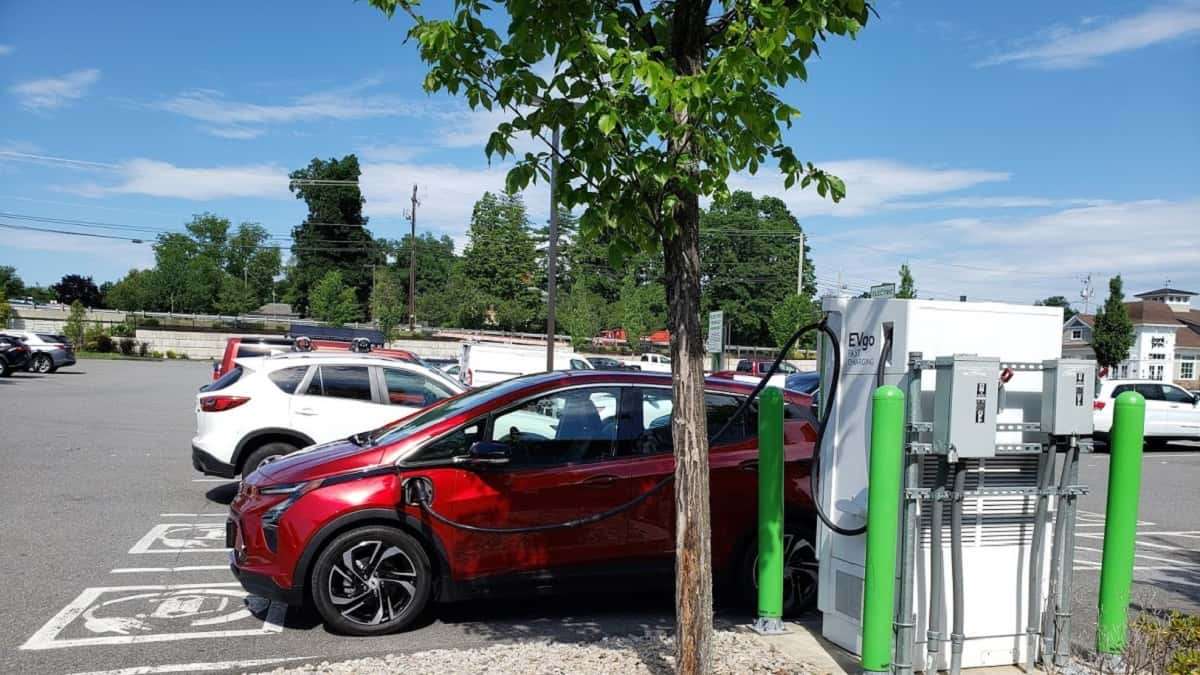

Charging an electric vehicle in public can range in price from free to very expensive. When we recently charged a new 2022 Chevrolet Bolt at an EVgo DC fast charger (DCFC) in Bedford, NH, we discover the pricey end of the spectrum can be more than it would cost to fuel a "gas-guzzling" V8-powered muscle car.
Related Stories:
Big Mistakes To Avoid When Charging an EV In Public
Many Public DC Fast Chargers For Electric Vehicles Are Slower Than You’d Think
Quick Stops At Level 2 Public Electric Vehicle Chargers Are Worthless
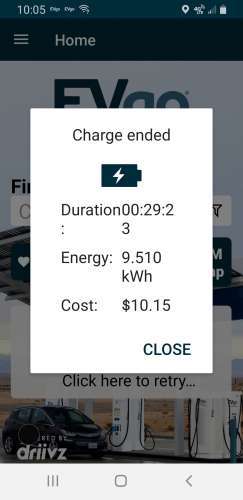
$10.15 To Add 34 Miles of EV Range
We charged up a Chevy Bolt using the EVgo DC fast charger, and the bill was $10.15. That amount of money added 34 miles of range to the Bolt. So, the cost per mile of energy was 30 cents per mile. Let’s compare that to a 2021 Dodge performance car we tested the prior week.
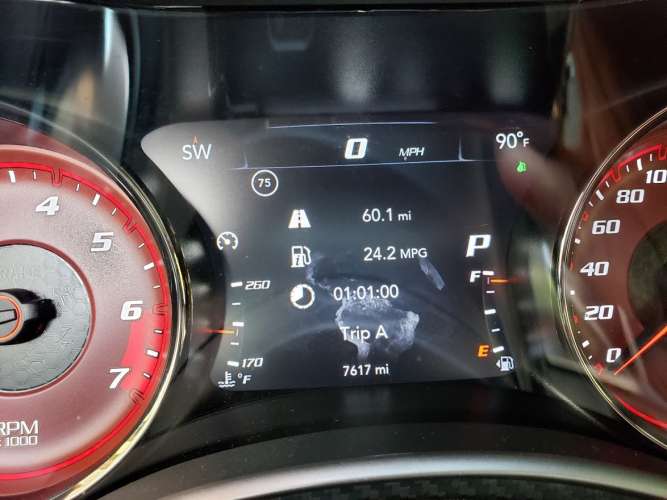
The Dodge had 797 hp, and it returned a combined fuel mileage of 24 MPG in our use on the same route we tested the Bolt. We paid $2.90 per gallon for the gasoline it uses. Doing some “goes in’tahs,” the cost per mile for energy in the muscle car turns out to be 12 cents. Thus, the cost per mile to energize the Bolt was roughly triple what the V8 gas-powered car cost us.
Charging Etiquette
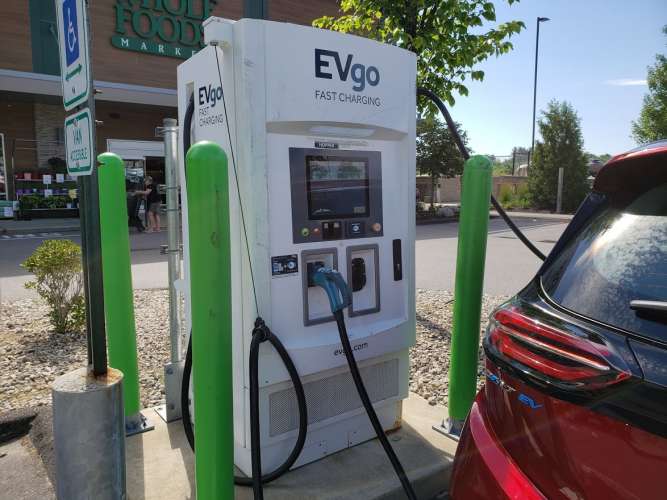
When charging in public one is supposed to quit charging when one’s EV reaches 80% state of charge. The reasons for this are two-fold. First, the rate at which charge can be added to an EV battery is more rapid below 80% and much more time-consuming as the battery reaches full. Second, EV chargers are in very short supply. We need to ration them.
On my route from the metro Boston area to the lakes region of New Hampshire, there are exactly zero public DC fast chargers. In order to charge at a DCFC, I took a slightly longer by time route to swing by one of only two DCFC charging spots in that area. Google “Henniker NH DC Fast Chargers” if you want to see what I mean about no chargers. I needed to top-off in order to complete the 200+-mile route I was making. So, I broke charger etiquette, and I charged to full.
I also charged at the DCFC because I wanted to test my EVgo membership RFID card and account and see how long the DCFC took to add back miles. Both were successful tests.
Charging For Free
Coincidental to my test, GM was running a free-to-charge promotion day during the week I had the Bolt. I think free anything is great, but I always wonder, what’s the hidden agenda? If charging up an EV is very affordable anyway, why does there need to be a promotion to make it “free?” If Dodge offered free gas to muscle car owners, I suppose folks would jump at the chance for a free fillup. But why make EV charging free?
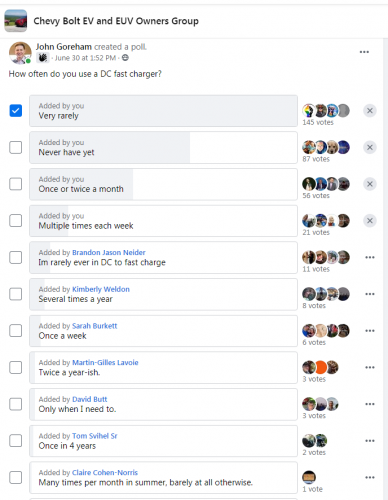
The answer is to get EV owners to the chargers and have them try out the experience. You see, when we poll owners of EVs, most report that they only charge at home, and almost none report using DC fast chargers.
When I plugged into the EVgo DC fast charger, I hadn’t thought about the cost. After all, we constantly hear how affordable EVs are to power up. I have done the math at my own home, and I know that the cost is typically about five to seven cents per mile of range I add back on my home charger using my relatively pricey Boston-area electricity. $10.15 for just 34 miles was a “shock.” Get it, shock. Bet you never heard that in an EV story before.
Related Story: New Hampshire Innkeepers Demonstrate EV-Driving Guest Best Practices
Feel free to tell us in the comments below what you typically pay to charge in public at a DC fast charger and how that cost compares to your cost at home.
John Goreham is a long-time New England Motor Press Association member and recovering engineer. John's interest in EVs goes back to 1990 when he designed the thermal control system for an EV battery as part of an academic team. After earning his mechanical engineering degree, John completed a marketing program at Northeastern University and worked with automotive component manufacturers, in the semiconductor industry, and in biotech. In addition to Torque News, John's work has appeared in print in dozens of American newspapers and he provides reviews to many vehicle shopping sites. You can follow John on TikTok @ToknCars, on Twitter, and view his credentials at Linkedin
Set Torque News as Preferred Source on Google
Follow us today...




Comments
True that! We definitely need
Permalink
In reply to Government subsidies don't by Joe suche (not verified)
True that! We definitely need to stop propping up the oil and gas industries.
Oil & gas companies pay MORE
Permalink
In reply to True that! We definitely need by JanetR (not verified)
Oil & gas companies pay MORE taxes than any others. While green companies thrive off taxpayer subsidies, small oil and gas companies went bankrupt when prices drop as they always have. Go research taxes paid by gas companies.
Electricity doesn't just
Permalink
In reply to True that! We definitely need by JanetR (not verified)
Electricity doesn't just magically appear. There are thousands of items that need oil.
Spot on. I love how some
Permalink
In reply to True that! We definitely need by JanetR (not verified)
Spot on. I love how some people mistakenly believe that the government doesn't prop up entire industries in this country - like FARMING.
You do realize that the
Permalink
In reply to Government subsidies don't by Joe suche (not verified)
You do realize that the government subsidizes large parts of our farming community, right?
It's good government if it's something you approve of and communism if it's something you don't like.
I hope you like eating as
Permalink
In reply to You do realize that the by Brian Sinclair (not verified)
I hope you like eating as good as you like your Telsa. Farmers get screwed left and right. But they keep putting food on your table. When you start charging your EV's from your windmill or solar panel then you can talk your Ev trash. But in the mean time lay off the oil industry that makes it possible to charge your EV., just saying.
Tesla no longer offers free
Permalink
In reply to That's why I wouldn't own a by Stephen Rideout (not verified)
Tesla no longer offers free charging and Kia's EVs actually get better miles per kW charge than any Tesla (search YouTube for 'we drove EVs until they died').
Stephen, you're comment is
Permalink
In reply to That's why I wouldn't own a by Stephen Rideout (not verified)
Stephen, you're comment is incorrect. Tesla doesn't have more advanced charging technology, nor are their chargers free. In fact, since their charging network is closed to other brands, they're able to significantly simplify their design . It's a boon to Tesla and allows them to put on it loads of cheap charging infrastructure quickly, but it does nothing for the plethora of other electric cars out there.
Now I'm not saying public chargers should be tripping people off like this, but they are more complex designs so they can provide service to all customers, and more expensive to build, to install, and maintain.
That said, Tesla's near monopolization in the US with their closed network and the cast majority of long range BEVs being Tesla is causing huge problems in getting public network the funding they need to upgrade and expand. Tesla is the enemy of public charging infrastructure, and while it may be great for Tesla, it's a headache for the US.
But yet.. they can charge
Permalink
In reply to Stephen, you're comment is by upl8n8 (not verified)
But yet.. they can charge anything and will very soon in the states. They are also cheaper in price per KW than any other charger. When it happens they will be the only charger, that can charge anything.
Not only does Tesla have
Permalink
In reply to That's why I wouldn't own a by Stephen Rideout (not verified)
Not only does Tesla have superchargers everywhere, but the cost of charging to 80% for an average range of 270 miles (85mph) was on average less than $14.00 also, Tesla only charges the utility rate and doesn’t make a profit from chargers.
It's only free if your car
Permalink
In reply to That's why I wouldn't own a by Stephen Rideout (not verified)
It's only free if your car was made before 2017
Sorry. No free charging for
Permalink
In reply to That's why I wouldn't own a by Stephen Rideout (not verified)
Sorry. No free charging for Tesla anymore unless you have model S from 2017 or so
Tesla does not have free
Permalink
In reply to That's why I wouldn't own a by Stephen Rideout (not verified)
Tesla does not have free charging. You pay to use a supercharger. The free charging ended years ago and the referral codes just earlier this year.
Tesla hadn't had free
Permalink
In reply to That's why I wouldn't own a by Stephen Rideout (not verified)
Tesla hadn't had free charging for awhile now
Tesla no longer has free
Permalink
In reply to That's why I wouldn't own a by Stephen Rideout (not verified)
Tesla no longer has free charging for new vehicles. That ended with the 2017 model year. Further, they're no longer the most advanced BEVs on the road.
Mercedes EQS has the longest
Permalink
In reply to That's why I wouldn't own a by Stephen Rideout (not verified)
Mercedes EQS has the longest range.
Tesla charging isn't free and
Permalink
In reply to That's why I wouldn't own a by Stephen Rideout (not verified)
Tesla charging isn't free and hasn't been free for multiple years. It was only free on early Model S, and maybe X. It's still a fraction of the price of gas per mile.
And let's completely ignore th maintenance cost of the "dodge muscle car"
I agree. Who stops to charge
Permalink
In reply to That's why I wouldn't own a by Stephen Rideout (not verified)
I agree. Who stops to charge up for only 34 charger miles anyway. I have a tesla and it costs me about $11 to top off when I'm on the highway.
I bought a Dodge Durango RT
Permalink
In reply to "The Dodge had 797 hp, and it by Mark Day (not verified)
I bought a Dodge Durango RT and I get amazing mileage with it. It’s only the 5.7L HEMI but man, fast as you’ll ever need it, but when you drive nicely, you get excellent gas mileage. I had a 2017 Ram with the same engine and I was getting on average, 700km per tank. Not many cars can do that. I think that’s roughly 14-16mpg?
Your ram has a 26 gallon tank
Permalink
In reply to I bought a Dodge Durango RT by Wayne (not verified)
Your ram has a 26 gallon tank. Every single car in the world can do 700km on a 26 gallon tank, don't misunderstand this as economical or comparable.
14-16 mpg is not good, it's
Permalink
In reply to I bought a Dodge Durango RT by Wayne (not verified)
14-16 mpg is not good, it's appallingly bad
It's 16.7 .
Permalink
In reply to I bought a Dodge Durango RT by Wayne (not verified)
It's 16.7 .
How big is your tank? :)
Permalink
In reply to I bought a Dodge Durango RT by Wayne (not verified)
How big is your tank? :)
How many liters/gallons were
Permalink
In reply to I bought a Dodge Durango RT by Wayne (not verified)
How many liters/gallons were in the tank of your Ram? Also, what's the mileage on your Durango?
I own a 2018 Chevy Equinox 1
Permalink
In reply to I bought a Dodge Durango RT by Wayne (not verified)
I own a 2018 Chevy Equinox 1.8L T. When traveling at 80 mph on the highway I get roughly 28-32 mpg, when I lower that speed to 70, I increase to 41 mpg. During my last trip across the country, at night going through texas on i-10, I was able to achieve 55.4mpg at 63 mph. This was on a night with very cold, dense air, and a very smooth brand new section of highway, as well as no head wind. Obviously I will not maintain 50+ mpg consistently, but averaging over 40 seems to be common with my equinox. With a 12 gallon tank, I come right in under at 450m between fill ups when traveling across the country. So, no, the 700km/tank 14-16mpg is extremely low.
Yes but you have to drive an
Permalink
In reply to I own a 2018 Chevy Equinox 1 by John Harpster (not verified)
Yes but you have to drive an Equinox
Please, can do 800km easy in
Permalink
In reply to I bought a Dodge Durango RT by Wayne (not verified)
Please, can do 800km easy in a 2020 kia hybrid with 12 gal tank and 480 to 800km in a 2nd gen civic hybrid
No one in their right mind
Permalink
In reply to I bought a Dodge Durango RT by Wayne (not verified)
No one in their right mind would say 14-16 mpg is excellent mileage in this era, maybe back in the 1950s. Also, how much is your fill-up? $100? And your hemi is only fast against slow cars. Even the slowest Tesla's 0-60 acceleration is around 5 seconds, most 5.7L hemis take 7 seconds.
My Corvette did even better
Permalink
In reply to "The Dodge had 797 hp, and it by Mark Day (not verified)
My Corvette did even better than the referenced Dodge on the highway! This is no surprise to anyone in the know.
And way behind the whole time
Permalink
In reply to My Corvette did even better by Gcrosby (not verified)
And way behind the whole time lol!