
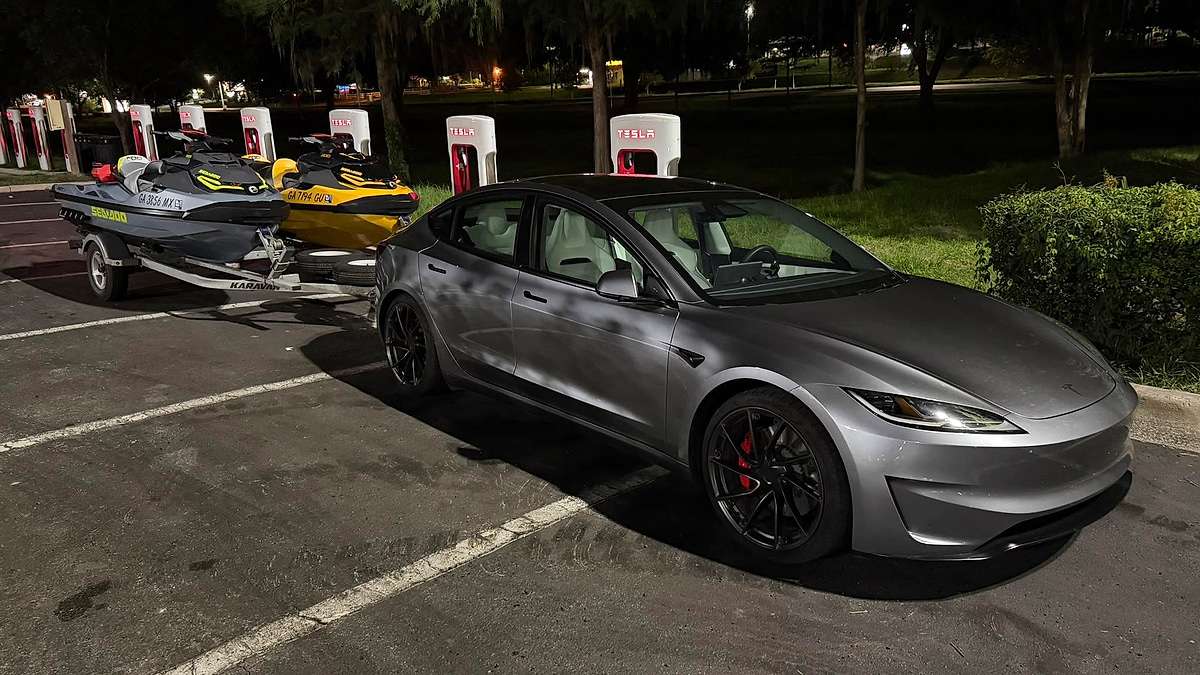

Chris Golden did something most Tesla Model 3 Performance owners only joke about.
He put the car to work.
Golden towed from the Cordele, Georgia area to Salt Springs Recreation Area in Florida, pulling what he estimated as a roughly 3,000-pound load: two large three-seat personal watercraft with full fuel, two extra 5-gallon fuel jugs, and about 200 pounds of luggage, firewood, and fuel tanks in the trunk. The route covered right around 250 miles. He left with 80% charge, stopped twice, and arrived at the campground with 23% remaining. The car handled it well, according to Golden on Facebook. But the battery noticed.
His first leg was 86 miles. The second was 89. The last was 70. He arrived at each Supercharger at around 15% and watched his energy use over the previous 10 miles to decide how much margin he needed. On the interstate, he used Autopilot behind semi trucks at 65 to 70 mph. On backroads, he used FSD in Sloth mode around 55 mph. He said the car towed great.
Then came the numbers.
Running 70 mph without a semi breaking the air, he saw as much as 700 Wh/mile. Tucked behind a truck at the same speed, he saw 500 to 525 Wh/mile. At 55 mph on backroads, he saw about 500 Wh/mile.
The Model 3 Performance had plenty of power. No surprise there. A dual-motor Tesla with Performance tuning does not struggle to move a couple of jet skis. The hard part was not torque. The hard part was air.
The Load Was Heavy, But The Shape Was Worse
A lot of people will stare at the 3,000-pound estimate first.
That is understandable. Tesla’s own Model 3 tow package is rated at 2,200 pounds with trailer brakes, and Golden’s estimated load sits well above that. He acknowledged this was a one-off experiment and said he also owns a Ram truck. That context helps, because this is not the setup I would tell someone to copy as a normal weekend habit. Still, the weight is only half the problem.
Two large three-seat jet skis on a trailer are a nasty aerodynamic load behind a sedan. They sit wide. They sit exposed. They have hulls, handlebars, mirrors, seats, trailer fenders, winch hardware, and tie-down points sticking into the air. Golden even said the skis stick out considerably on the sides of the car.
That line explains the whole trip.
A Model 3 is shaped like a bar of soap for a reason. Hook a wide, blunt, irregular load behind it, and the car loses one of its strongest advantages. The battery is no longer pushing only a sleek sedan through the air. It is dragging a pair of plastic water missiles across the interstate.
At 70 mph, that gets expensive.
The Drafting Number Is Huge, And I Would Not Build A Trip Around It
Golden’s most useful observation was the difference behind a semi.
At 70 mph without a truck ahead, he saw up to 700 Wh/mile. Behind a semi, he saw 500 to 525 Wh/mile at the same speed. That is a massive swing. Take 700 down to 525, and you are looking at roughly a 25% reduction in energy use. Take 700 down to 500, and the drop is closer to 29%.
Physics explains it cleanly. The semi punches a hole in the air. The Tesla and trailer sit in less hostile airflow. The energy screen rewards the driver immediately.
I still would not make that the plan.
Drafting behind a semi while towing is the exact kind of thing that looks brilliant on an energy graph and ugly in a braking event. Tesla’s own towing guidance tells drivers to increase following distance and remember that stopping distance changes with a trailer. Add night driving, trailer mass, jet skis, and a sedan hitch setup, and I want margin more than I want another few percentage points of efficiency.
Use the lesson, not the habit.
The lesson is that air dominates the trip. Slow down before you start hunting for a semi. A steady 55 to 60 mph with good spacing is a cleaner strategy than relying on the turbulence behind a truck at 70.
500 Wh/Mile Is The Number I Trust Most
The 700 Wh/mile figure grabs attention. The 500 Wh/mile figure teaches more.
Golden saw about 500 Wh/mile at 55 mph on backroads. He also saw 500 to 525 Wh/mile at 70 mph when tucked behind a semi. That tells me the rig’s natural energy demand, under favorable airflow or lower speed, lived around that 500 Wh/mile zone. For a Model 3 Performance towing wide jet skis, that is believable.
- Tesla's factory Model 3 tow package includes Trailer Mode, which adjusts stability-control behavior when a trailer is connected and is designed for a maximum tongue weight of 200 pounds.
- Aerodynamics usually hurt EV towing range more than weight. A low, enclosed trailer can sometimes consume less energy than a much lighter but taller load because wind resistance rises dramatically with speed.
- The 2025 Model 3 Performance uses an approximately 75 kWh usable battery pack. At 500 Wh/mile, that translates to roughly 150 miles of theoretical range from 100% to 0%; at 700 Wh/mile, the same battery would theoretically cover only about 107 miles.
At 500 Wh/mile, every 10 kWh buys about 20 miles. At 700 Wh/mile, the same 10 kWh buys about 14 miles. That difference changes how often you stop, how much buffer you need, and how relaxed the driver feels at night when the next charger is still 40 miles away.
Golden handled it the right way by watching recent consumption, not some fantasy range estimate. A Tesla’s displayed range can get silly when a trailer changes the energy picture. The past 10 miles may be a better truth-teller than the big battery number if the terrain, speed, and wind stay similar.
That is the skill EV towing teaches quickly.
Ignore the dream range. Watch the recent burn rate.
The Charging Stops Were Planned Like A Pilot Would Plan Fuel
The charging pattern was more disciplined than the tow setup.
- Leg one: 86 miles.
- Leg two: 89 miles.
- Final leg: 70 miles.
He left with 80%, hit chargers at roughly 15%, and arrived at the campground with 23%. That is smart EV towing behavior. He did not try to run the pack into the floor for bragging rights. He kept enough margin to account for wind, missed exits, traffic, charger issues, and the fact that a trailer can turn a small routing mistake into a larger problem.
The 23% arrival number is especially good.
Campground charging changes the trip. If he can plug in at Salt Springs, then arriving with 23% is comfortable. Arriving with 3% would make a better internet story and a worse travel habit. With a trailer, I want the boring arrival.
Boring is underrated.
The sideways Supercharger detail is useful too. Golden said he had no problem fitting in sideways because he was driving late at night. That is a big qualifier. A sedan towing a trailer at a Supercharger can work when the site is quiet. During a busy daytime rush, sideways charging can block stalls and make everyone hate you before the plug even clicks.
This is where EV towing still feels immature.
The car can do the job. The charging sites are not always built around the job.
The Wheel Covers Detail Is Small, Then It Isn’t
Golden said he does not run the wheel covers.
On a normal drive, that may cost a little efficiency. Towing a wide jet-ski trailer, the penalty gets buried under a much larger aerodynamic problem. Still, details stack. Wheel covers, tire pressure, speed, trailer bearing drag, trailer tire pressure, trailer alignment, and load placement all nibble at the same battery.
People love debating the big number: 3,000 pounds.
I keep looking at the little stuff.
Were the trailer tires properly inflated? Were the hubs cool after a highway run? Was the load balanced with safe tongue weight? Did the jet skis sit as low as possible? Were loose items kept out of the airflow? Did the fuel jugs add tongue load or sit behind the axle? Were the trailer lights wired into Tesla’s Tow Mode properly? Were the trailer brakes present and working?
Those questions matter more than another comment about torque.
Power was never the scarce resource here. Stability, braking, aero, and range were.
Lessons From A Real-World Tesla Towing Run
- 700 Wh/mile at 70 mph without a semi ahead shows how punishing a wide trailer can be.
- 500 to 525 Wh/mile behind a semi at 70 mph shows how much airflow changes the result.
- 23% arrival charge after roughly 250 miles and two charging stops shows the trip was workable with conservative planning.
The Autopilot And FSD Part Needs A Hard Look
Golden used a combination of Autopilot and FSD depending on the situation.
I get why. Long highway stretches get tiring, especially late at night, and Tesla’s driver-assistance systems can reduce workload when used properly. On empty roads with clear lane markings, the temptation is obvious.
Towing changes the equation.
Tesla’s manual says Trailer Mode must be active while towing. It also says some self-driving features may be unavailable or behave differently when Trailer Mode is enabled. Traffic-Aware Cruise Control increases following distance. Side-collision warnings remain active, while automatic steering interventions can be disabled. Automatic Emergency Braking may provide limited braking force.
That should make every towing driver slow down and think.
I am not saying Golden did anything malicious. I am saying the driver-assistance part of this trip should not become the headline people copy without reading the manual. Towing a wide load behind a Model 3 Performance is already asking the car to operate outside the usual daily-driver envelope. Add FSD or Autopilot, and the driver needs to know exactly what Trailer Mode is doing, what the system will and will not do, and whether the trailer setup is fully detected.
The human still owns the rig.
Especially with jet skis hanging wider than the car.
The Real Surprise Is How Normal The Car Felt
Golden said the Model 3 Performance towed great.
That does not shock me.
EVs are excellent at the part of towing most drivers feel first: getting the load moving. Instant torque, no gear hunting, low center of gravity, strong regen, and smooth power delivery make even a sedan feel more confident than the spec sheet suggests. A Model 3 Performance has enough motor to make 3,000 pounds feel lighter than it is.
The danger is that smoothness can flatter the driver.
A heavy load that accelerates easily still has to stop. A trailer that feels calm at 55 may start moving around in crosswinds at 70. A sedan that can pull hard up a grade may still have tire, tongue weight, hitch, and cooling limits set by the manufacturer for reasons that do not care how quick the car feels.
That is why I separate drivability from advisability.
The car may feel wonderful. The setup can still exceed the rating.
The 2,200-Pound Rating Is The Wall Buyers Should Respect
Tesla rates the Model 3 tow package at up to 2,200 pounds with trailer brakes.
Golden estimated his load around 3,000 pounds. That means this trip sat roughly 800 pounds over the official braked limit before getting into the uncertainty of trailer weight, fuel weight, tongue weight, trunk cargo, and accessories. He also carried about 200 pounds in the trunk, which counts against vehicle loading and can affect how much tongue load the car can safely handle.
I would not build a habit around that.
A lighter utility trailer, a Gheenoe, or one small personal watercraft sits in a very different risk category. Golden mentioned future lighter towing, and that sounds like the sane path. The Model 3 can be a useful tow vehicle when the load fits the rating, and the driver plans around range. It should not be treated like a pickup because it has pickup-grade acceleration.
That is the trap with electric cars.
They make hard work feel easy until physics sends the invoice.
The Better Use Case Is A Lighter Trailer And A Smarter Speed
Golden’s experiment still gave Model 3 owners valuable data.
A 2025 Model 3 Performance can pull a wide, heavy recreational load a meaningful distance if the driver plans carefully, charges conservatively, and accepts a serious energy penalty. The car’s powertrain was not the limiting factor. The wide jet skis and highway air were the limiting factors.
For future trips, I would change three things before chasing any software trick.
Run slower. Keep it closer to 55 to 60 mph when practical.
Lighten the trailer package. One smaller boat or a lighter utility trailer fits the Model 3’s personality much better.
Respect the official tow rating and tongue limit. That keeps the experiment from becoming a repair bill or a claims argument.
I would also put the wheel covers back on for a repeat test, if they fit the wheel setup. The gains may be modest, but this is exactly the kind of trip where small aero savings can stack into fewer minutes at the charger.
This Is Why Owner Data Beats Forum Theory
The comment section did what comment sections do.
Some people cheered him for putting the Tesla to work. One warned that the Model 3’s official towing capacity is 2,200 pounds. Golden replied that he also owns a Ram and that this was more of a one-off experiment. Another commenter asked about the hitch. Golden said he used a Stealth hitch, with a removable ball and cover plate so the car looks stock when the trailer is gone.
That is the useful mix: enthusiasm, caution, hardware detail, and real energy numbers.
Without the trip data, the argument stays dumb. Someone says a Model 3 can tow. Someone else says it can’t. The truth sits in the middle with a spreadsheet and a sweaty driver at a Supercharger.
Golden gave us the numbers.
They say the car can move the load. They also say the wind gets expensive, drafting changes everything, speed discipline is non-negotiable, and two charging stops for 250 miles is the kind of reality a heavy, wide trailer creates.
That is more helpful than another theoretical towing debate.
What I Would Do If I Owned This Setup
If this were my 2025 Model 3 Performance, I would treat the jet-ski run as a successful experiment and then retire the 3,000-pound version.
For lighter trailers, I would keep the hitch. I would use Trailer Mode every time. I would verify tire pressures cold. I would keep tongue weight measured, not guessed. I would avoid relying on semi drafting. I would plan charger stops around recent Wh/mile, the way Golden did. I would look for Supercharger sites with room to pull through or charge without blocking stalls. I would avoid arriving below 15% with a trailer unless the site had a backup nearby.
The Model 3 Performance is a shockingly capable machine.
It is still a sedan.
That is the line this trip draws better than any spec sheet. The car had the muscle. The route worked. The owner arrived with battery to spare. The energy screen also reminded everyone that towing is not a horsepower contest. It is a fight with air, load ratings, charger layout, and judgment.
Golden won this round because he planned, watched the numbers, and had a campground plug waiting.
For the next one, I would bring the lighter trailer.
Would You Tow With A Model 3 Performance?
If you tow with a Tesla Model 3, what are you pulling, what does the loaded trailer actually weigh, what Wh/mile are you seeing at 55, 65, and 70 mph, and how often do you have to charge sideways at Superchargers?
Come back tomorrow, or check our Torque News Home Page for more interesting automotive news articles.
One image by Chris Golden
About The Author
Noah Washington is an automotive journalist based in Atlanta, Georgia, covering sports cars, luxury vehicles, and performance culture. His reporting focuses on explaining the engineering, design philosophy, and real-world ownership experience behind modern vehicles.
Noah has been immersed in the automotive world since his early teens, attending industry events and following the enthusiast communities that shape how cars are built and driven today. His work blends industry insight with enthusiastic storytelling, helping readers understand not just what a car is, but why it matters.
Noah is also a member of the Southeast Automotive Media Association (SAMA), a professional organization for automotive journalists and industry media in the Southeast.
His coverage regularly explores sports cars, luxury vehicles, and performance-driven segments of the automotive industry, including the evolving culture surrounding Formula Drift and enthusiast builds.
Read more of Noah's work on his author profile page.
You can also follow Noah here:
Set Torque News as Preferred Source on Google
Follow us today...


Comments
I have a 2024 Model 3…
Permalink
I have a 2024 Model 3 Performance and there is no tow mode or a place to mount a hitch.
Interesting
Permalink
Interesting
Article after article I read…
Permalink
Article after article I read on Tesla's has misinformation . Good article, except the 220lbs weight limit is wrong. The M3P is not, at least based on my rechecking today, offered in the United States to do Towing. And in countries where it can tell, it's a 500 kg, or approximately 1,100 weight limit. The non-performance Editions are allowed to tow in both markets at 2200 lb. Now it's possible the guy bought an aftermarket Towing kit, especially if the tow option remains officially unavailable for the performance Edition in this market, but that doesn't change the towing capacity weight limit recommendation.
Tesla Genie (find my YouTube channel for accurate Tesla Information)
Interesting.
Permalink
In reply to Article after article I read… by Tesla Genie (not verified)
Interesting.
Seems pointless, my 02 ALH…
Permalink
In reply to Interesting. by Noah Washington
Seems pointless, my 02 ALH tdi can tow that and still get 32 mpg with 330k miles on the engine. I would make the trip there and back on one full tank at 70-90 bucks to fill with diesel. Cant tell me those supercharger are any cheaper even with free charging my car can be bought for 2-4k verse a new vehicle at 38k+.....
These EV's are pointless (until battery tech is better) diesel hybrids are and have been the most viable option.
Why people buy new vehicles ICE or EV and dont force these companies to make smart changes by boycotting new vehicles has led to us being in the predicament we are.
There's people swapping vw diesels into honda insights getting 70mpg, theres people hypermilling mk4 tdi's for 60mpg ....so why are we supporting these grossly inefficient government subsidized companies that are detrimental to any progress... end of rant but maybe some of you will open your eyes.
Here's my data in return for…
Permalink
In reply to Seems pointless, my 02 ALH… by Jb (not verified)
Here is some first-hand data from someone who has owned both combustion and electric vehicles. While I agree that a diesel is tough to beat for long-haul towing convenience, the math changes completely depending on how a person actually uses their truck.
For daily commuting and local hauling under 160 miles, the savings on home charging are hard to ignore. Here is how the numbers break down based on my Ford F-150 Lightning (98 kWh usable battery) towing a 3,000-pound aerodynamic trailer at 70 mph, compared to a diesel truck for a 160 mile trip:
EV (Off-Peak Home Charging) efficiency: 1.6 miles/kWh
rate: $0.08 / kWh
Total Cost: $8.00
Your '02 ALH TDI (Claimed towing efficiency or normal efficiency? still an apples to orange comparison here since I'm talking trucks and towing) efficiency:32 mpg
rate:$5.35 / gal
Total Cost: $26.75
Average Diesel Truck (Towing)
efficiency: 15 mpg
rate: $5.35 / gal
cost: $57.07
EV (Public Fast Charging)
efficiency: 1.6 miles/kWh
rate: $0.51 / kWh
Total Cost $51.00
The takeaway:
The '02 TDI: At $26.75 per trip, it's still cheaper than public fast charging ($51), which supports your point that your car seems highly economical for long hauls if your towing efficiency is accurate.
The Average Diesel: At $57.07 per trip, a typical diesel truck is actually more expensive to fuel than a public fast charger ($51). This one surprised me, but I still hold the view that the experience of fast charging an EV makes the additional cost for Diesel trips worth it to rent a diesel or something for long trips and just keep my EV for local driving and work but this depends on your desired stop frequency and tolerance levels. Some might opt to haul with the EV anyway.
My Savings: Over 300,000 miles of local driving (comparing my $8.00 home charge to the average diesel truck's $57.07), you would save $92,000 in fuel alone if all of my driving was towing which more than justifies replacing my vehicle with another EV the next go around with or without incentives. The thing pays for itself in my case. Especially since I use my truck as a daily driver as well. I'd probably save even more if I opted for a more efficient EV sedan and rented a truck on days that I needed one since I don't have the need to tow all that often.