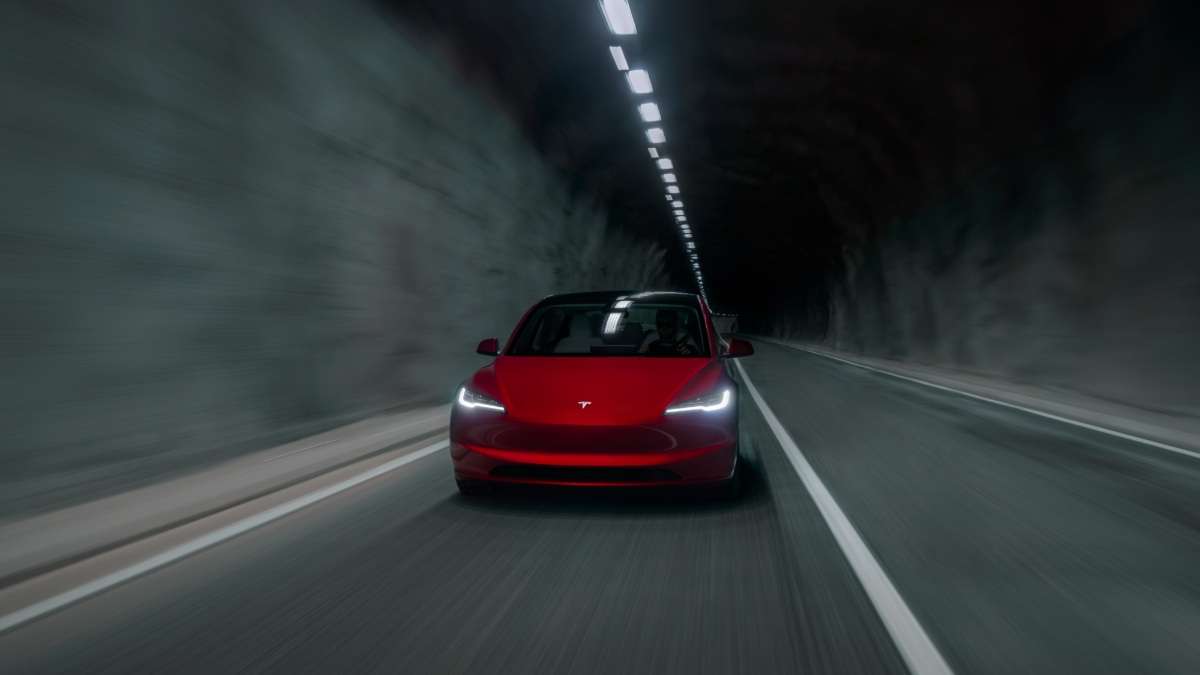

Some of the most honest car reviews are not filmed on mountain roads or written from airport hotel bars. They are typed out late at night by people who have to live with their cars every day. That is exactly what happened when a Reddit user named SmokeySFW left behind a decade of living with a modified, 6-speed Ford Focus ST and bought a 2025 Tesla Model 3 RWD. One month into ownership, he went to r/TeslaModel3 and wrote the sort of long, unvarnished report that tells you far more about a car than any glossy brochure ever will.
“I know a lot of these get posted here, but when I was waiting on delivery for mine, I really enjoyed reading them, so I'll go ahead and post mine. I have the non-performance non-AWD stock version. I drove a 6-speed manual modded Ford Focus ST for the 10ish years.
Things I LOVE:
I love the acceleration at the low end and especially at the top end when I want to pass on the highway. Even for the "slowest" version of the M3, it's very impressive.
The air conditioning and ventilated seats are really nice.
Autopilot is nice. After trying FSD and autopilot, I don't feel any real urge to pay for FSD. I love being able to get into a middle lane, start autopilot, and go hands-free (mostly) for my ~1hr evening commute with lots of stop-and-go traffic.
I bought an air+foam mattress for the back with the seats down, and even though I'm sure a Model Y would be a lot more comfy, it's still totally doable in my Model 3. I slept a night in it, and it went great. I made a driver profile that has the front seats moved forward to the right depth so that the rear seats can fold down freely. I do wish the Model 3 had a 12V power port in the trunk area.
The driver's seat is very comfortable to me.
I installed a Level 2 home charger in my garage, and I LOVE how smooth plugging it in feels; it's satisfying for some reason. I love being at exactly 80% every morning and arriving back home at roughly 50% for my typical commute. I forgot to plug it in once and still got through my normal day easily. I still haven't had a reason to use a public charger.
I put a 20% tint all the way around the car (none on the windshield), and it looks great and feels great inside.
Advertising
Kind of a weird one, but the car is really easy to wash myself. The panels are all so flat and sleek; there are very few crevasses to clean out with the flat front, where an ICE car would have the inlet for the radiator.
Things I am not a fan of:
I don't like the button turn signals. I want stalks back. I don't mind shifting with the screen at all, but hitting the blinker buttons while I'm already turning is bad. Getting onto a main road from my house involves a left turn onto a 2-way 5 lane road with a median lane, so often I'll be taking the left directly into the median lane and wanting to give a right-hand blinker immediately after my left-hand turn; awful. It's not even resistance to change; blinker stalks don't move, you don't have to aim for them, and you don't have to track them down. Also, the buttons just don't press sometimes if you aren't in exactly the right spot, especially the right-hand blinker button.
I don't like the way the navigation doesn't present route options, especially concerning tolls. My city has a lot of toll roads; they are very expensive, but sometimes I'll opt for them anyway if the time savings justify the cost. Having to go in and change the "avoid tolls" setting on and off is just a significantly worse experience than Google Maps and/or Waze. Just show me both routes and give me enough time to select which one I want to use, and if I don't pick one, then you can default to one of them.
I really don't like all the beeps and alarms going off all the time when I'm pulling into a tight parking spot or trying to reverse through tight gaps and stuff like that. It's incredibly distracting and not helpful at all because the alarms go off when you're still several feet away from things, so it just becomes useless noise. They go off every time I pull into a parking spot to a proper depth. It'll scream at me like I'm slamming into a wall, and I'm still easily 2 feet away from a parking block that the front end would clear anyway.
In my old car, when the car was off, the media would keep playing until I opened the door. In my M3, when I open the door, the media just gets softer and keeps playing, requiring me to actively pause what I'm listening to every time I get out of my car; otherwise, I miss stuff (audiobooks are where this is most frustrating).
The wireless charging spots for phones barely trickle a charge in, by far slower than any other wireless charging I've ever used.”
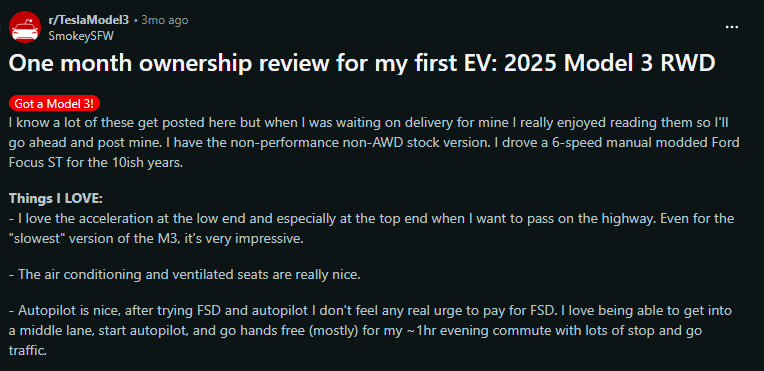
In his post, he explains that he chose the non-performance, non-AWD Tesla Model 3, the so-called slow one in the lineup, after ten years of rowing his own gears. What surprised him first was not that this car was different, but how easily it replaced the old habits he had built with the Focus.
He talks about loving the way the car launches away from the lights and how much punch it still has when he pulls out to pass on the highway. For a base model, he calls the acceleration very impressive. He praises the strong air conditioning, the ventilated seats that take the sting out of a long commute, and the basic Autopilot that handles his roughly one-hour evening crawl in stop-and-go traffic well enough that he never feels tempted to pay extra for the full self-driving package.
Tesla Model 3: Minimalist Interior
- Reviewers consistently point to the Model 3’s responsiveness as one of its standout traits; the car reacts instantly to throttle input, giving even the base model a sense of energy usually reserved for performance sedans.
- The minimalist interior remains a topic of debate among journalists, with many acknowledging that the clean layout and single-screen approach simplify the driving environment in a way few competitors have been willing to attempt.
- Road testers often praise the Model 3’s efficiency, noting that its real-world range and low energy consumption allow it to punch well above its price point in long-distance capability.
- Handling impressions are consistently positive: its low center of gravity, planted stance, and balanced chassis give the Model 3 a level of agility that feels more like a sport compact than an electric four-door.
The domestic side of the car earns just as much admiration. He installed a Level 2 charger in his garage and has fallen for the simple ritual of plugging in at night and waking up to a battery set to 80 percent every morning, then getting home with about 50 percent remaining after his routine drives. He forgot to plug in once and still made it through the next day without any drama, which quietly undercuts a lot of range anxiety. He added 20 percent window tint all around, likes how it looks, likes how it feels, and even compliments how easy the car is to wash because of its clean surfaces and lack of tricky crevices. He has already spent a night camping in it on an air plus foam mattress, with a dedicated driver profile that slides the front seats to just the right place so the rear can fold flat. It is an owner making the car fit his life, not the other way around.
The real friction begins when his fingers reach for controls that no longer exist. Tesla’s decision to replace traditional turn signal stalks with steering wheel buttons is where his patience runs thin. His daily route includes a left turn from his neighborhood onto a two-way, five-lane road with a center median, followed immediately by a lane change that requires a right signal. In his description, that is where the capacitive buttons show their weakness. A stalk lives in one place. It does not move, you do not have to aim for it, and muscle memory does the rest. A small button on the wheel, especially one that sometimes fails to register a press if you are not in exactly the right spot, becomes a distraction at the precise moment when a driver most needs simplicity.
Parking assist moves from help to hindrance in a similar way. In tight spaces, the car fills the cabin with beeps and alarms even when he is still a couple of feet away from a parking block that he knows the front bumper will clear. After a while, the constant warnings begin to feel less like safety and more like noise. One commenter, jxdigital, chimed in from Europe to say that he eventually turned the parking alert sounds off entirely on his own Model 3, complaining that the bells and chimes sounded through every maneuver and speculating that the system might be tuned for very large American parking spaces rather than the narrower slots common in the EU. When systems cry wolf every time you nose into a normal space, drivers start to tune them out.
Navigation, in theory, the great advantage of a software-driven car, becomes another point of contention in a city laced with toll roads. The car offers a simple avoid tolls toggle. In practice, that means if the setting is off, the system will sometimes route him on an eight-dollar toll road to save two minutes on a forty-minute trip. Turn the setting on, and now he cannot even see the potentially faster toll route when it might save fifteen or twenty minutes. A commenter named VictorianAuthor noted that you can pick a route in Google Maps and send it to the car, which gives more control over toll choices, but that solution depends on the driver knowing the trick in the first place. For someone who just wants the car to show a couple of clear options and let him choose, the current setup feels like a step behind the smartphone apps he was already using.
The noise problem turns out to have a software answer hiding in a menu. Several Reddit users, including reneofficial and SnortingElk, asked if he had turned on something called Joe Mode. He had not even heard of it. Joe Mode is a setting that lowers the volume of chimes and alerts so the car stops shouting every time it senses a potential issue. Once it is explained, it seems obvious, but it raises a simple point about cars that function more like rolling computers. Features that could solve an annoyance can sit unused if owners either do not know they exist or cannot easily find them. The same theme appears in his notes about the media system, which keeps playing quietly when he opens the door, forcing him to pause audiobooks manually, and the wireless phone chargers that supply less power than other wireless pads he has used.
Taken together, his account paints a balanced picture of a very capable car that sometimes gets in its own way. The core is strong. The powertrain delivers quiet, effortless speed. The cabin keeps him cool, comfortable, and willing to take the long way home. The ability to camp in the back on a mattress and wake up with a full battery from a home charger has a certain practical romance to it. At the same time, he cannot shake the feeling that trading simple mechanical stalks for steering wheel buttons and replacing clear driver judgment with a chorus of alarms is a poor bargain. In his eyes, those are the real tradeoffs of this modern design language, not the move from gasoline to electrons.
That is what makes his month-long review so useful for anyone thinking about a similar jump from a manual hot hatch to an entry-level EV sedan. It is not a complaint about the idea of electric cars or a broadside at the manufacturer. It is a report from daily life that talks about specific left turns, specific parking situations, specific commute patterns, and charging habits. For shoppers, those details matter more than any headline number. This is how a 2025 Model 3 RWD actually behaves once the showroom glow fades, the new car smell blends with your coffee, and all that is left is you, the road, and a car that is brilliant in many ways yet still asking a serious question: how many beeps, menus, and buttons on the wheel are worth the rush of that silent surge when you pull out to pass?
Image Sources: Tesla Media Center
Noah Washington is an automotive journalist based in Atlanta, Georgia. He enjoys covering the latest news in the automotive industry and conducting reviews on the latest cars. He has been in the automotive industry since 15 years old and has been featured in prominent automotive news sites. You can reach him on X and LinkedIn for tips and to follow his automotive coverage.
Set Torque News as Preferred Source on Google
Follow us today...