
Automotive ownership has always been a quiet pact between driver and machine. You put down real money, sign a stack of papers, and trust that what you are getting in return is competence on four wheels. When that machine is a Mercedes-Benz G-63 that stickers around a quarter of a million dollars, the pact is more than trust. It is an expectation, almost a certainty, that the truck will shrug off anything the road can throw at it. That is why the email that recently landed in my inbox from a Colorado G-Class owner felt less like a complaint and more like someone calmly describing a near miss. The central emotion was not frustration. It was fear. At the time of the most serious incidents he describes, the G-63 had fewer than 2,000 miles on the odometer. The first double left-turn incident happened within the first few hundred miles of driving the vehicle.
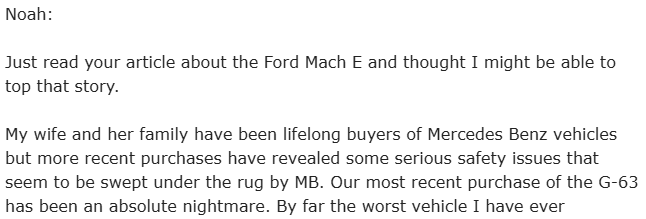
Here is his complete email, exactly as he wrote it:
“Just read your article about the Ford Mach E and thought I might be able to top that story.My wife and her family have been lifelong buyers of Mercedes-Benz vehicles, but more recent purchases have revealed some serious safety issues that seem to be swept under the rug by MB. Our most recent purchase of the G-63 has been an absolute nightmare. By far the worst vehicle I have ever encountered. The electronics system is a disaster. I have attached a photo of the dashboard warning that overrides and disables any driver input without any prior notice or warnings. It literally slows the vehicle to an instant crawl (note the turtle mode) regardless of what the current driving circumstances are. This is one of many serious issues and faults we have had with this vehicle. The car also has a difficult time navigating a double left-turn lane and immediately stops the car at its own discretion in the middle of the intersection, again disabling any input from the driver. The fix? Turn off the car and restart it. Apparently, Mercedes is trying hard to bury these ongoing issues with this model. After this incident, we had it towed to Mercedes. Their answer: no fault found.
My wife bought it new from Littleton, CO, Mercedes, and literally out of the box, it has been a nightmare. The most serious incident happened on I-70 in Colorado on the downside mountain pass, exiting the Eisenhower tunnel, when the vehicle essentially locked up on its own from 70mph to 5mph and went into "turtle mode" due to some unknown mechanical issue. She had no control over the speed of the car. It did this with no advance warning, with Semi trucks having to swerve around her, horns and all, with the children in the car, certainly about the most unsafe time to enact this driver override.
We took it again to the dealership, which had had it for a month but provided little detail other than an issue with the turbos. But they admitted they were even unsure. They were focused on a sensor on the turbos, which they replaced. This override was apparently to protect the engine. (never mind the passengers!) The manager actually suggested that we reach out to Mercedes-Benz of America to see if they would do a buyback. My wife tried, but MB America shunned her with little feedback. Needless to say, my wife is terrified of the car and is driven only short distances.
My research suggests that this car is on the brink of being a Lemon Law car.
Advertising
My wife avoids driving it in Lieu of our more reliable Subaru. This morning, however, she decided to take our daughter to school in it, and as she was backing out of the garage, this same warning went off (see picture). Needless to say, she parked it. This is the same disabling mode that occurred on the I-70 mountain pass.
This brand-new $250K vehicle is junk, and my research suggests we are not alone. We are seeking a Colorado lawyer who can provide some assistance in Lemon Law issues. Any feedback or thoughts you can provide would be appreciated. Thank you.”
Strip this story down to its core, and it becomes a simple, unsettling picture. According to the owner, a family is exiting the Eisenhower Tunnel on I-70, traffic is heavy, semis are around them, and their G-63 allegedly decides to protect itself by dropping from around 70 miles per hour to about 5, entering what the owner calls “turtle mode” with little or no warning. Modern performance engines do use limp home strategies and torque reduction to protect themselves when sensors detect potentially damaging conditions, an approach that is common across high-performance brands (source: NHTSA, technical summary on limp home systems). On paper, that is a safety feature for the engine. In practice, timing is everything, and a sudden loss of speed in fast traffic on a downhill pass is exactly the scenario drivers hope never to experience.
2025 Mercedes-Benz G63 AMG: What Drivers Say
- Critics frequently point out that the G-Wagon’s unmistakable boxy silhouette isn’t just a nod to heritage; it shapes the entire driving experience, giving the SUV a commanding presence that feels closer to a military vehicle than a luxury cruiser.
- Despite its rugged roots, reviewers note that the latest G-Wagon delivers a surprisingly polished ride thanks to updated suspension geometry, smoothing out imperfections without dulling its authentic, old-school character.
- The cabin earns praise for blending tradition with technology; its upright windows, exposed door hinges, and iconic grab handle coexist with high-resolution screens and modern connectivity features, offering an unusual mix of nostalgia and sophistication.
- Test drivers often highlight the engine’s effortless power delivery, describing the acceleration as almost surreal for a vehicle shaped like a brick and weighing as much as a small truck.
The same pattern reportedly shows up again in slower, more mundane settings. The owner describes episodes where the G-Class, under computer control, allegedly intervenes in a double left turn lane and brings itself to a halt in the middle of the intersection, or triggers the same warning simply backing out of a garage on a school run. In each case, the workaround is classic consumer electronics logic: turn it off, then turn it back on. That kind of reset behavior is typical of complex control systems across the industry, not unique to any brand, and it underlines how much modern vehicles now rely on overlapping networks of sensors and modules rather than single mechanical linkages.
The dealer portion of the story also mirrors what many owners of sophisticated vehicles describe when they encounter intermittent faults. According to the email, the G-63 spent about a month at the selling dealership in Littleton, Colorado. The service team focused on turbocharger-related sensors, replaced components, and apparently acknowledged they were not completely certain that the fix addressed the root cause. When a vehicle behaves normally on the rack and the fault is sporadic, technicians often have to work from stored codes, pattern recognition, and experience. That is not an indictment of any individual shop. It is simply the reality of diagnosing issues in vehicles that, in the case of the G-63, pack a hand-built V8 and an extensive suite of electronic safety and performance systems into a single package.

What moves this from the realm of the technical puzzle to something more serious is the emotional shift inside the household. The writer describes a family with a long history of Mercedes-Benz ownership, people who clearly know what they expect from the brand. He now says his wife is “terrified” of the G-Class and defaults to their Subaru for daily use. That is not about badges or image. That is about trust. When a driver begins to wonder whether their vehicle might intervene at the wrong moment, even a single unsettling incident can overshadow years of positive experience. Once that confidence is shaken, leather quality and horsepower figures become secondary.
The email also mentions that a dealership manager suggested the family contact Mercedes-Benz of America to explore a possible buyback, and that the owner now believes the G-63 is close to qualifying as a lemon law case in Colorado. By statute, lemon laws typically look at whether a substantial defect impairs the use, value, or safety of a vehicle, and whether the manufacturer has been given a reasonable number of attempts to repair it before buyback or replacement obligations are triggered (source: Colorado Attorney General, consumer protection guidance). Whether this particular SUV meets that legal threshold is a matter for attorneys and formal documentation, not opinion. From an observer’s perspective, what is clear is that the owner feels those boxes are being checked.
If I found myself in this situation, I would approach it methodically. I would maintain a detailed log of every incident, including dates, mileage, conditions, and what warning messages appeared. I would keep copies of all repair orders, technician notes, and any written communication with the dealer and with the manufacturer. I would probably seek out a second authorized Mercedes-Benz service center for an independent look, simply because a fresh diagnostic approach can sometimes pick up what the first set of eyes missed. I would also consult a local attorney who focuses on automotive consumer issues to understand, in concrete terms, how the law applies to the documented facts. That is not legal advice, just a straightforward description of how I personally would respond to a vehicle that behaved in ways I considered unsafe.
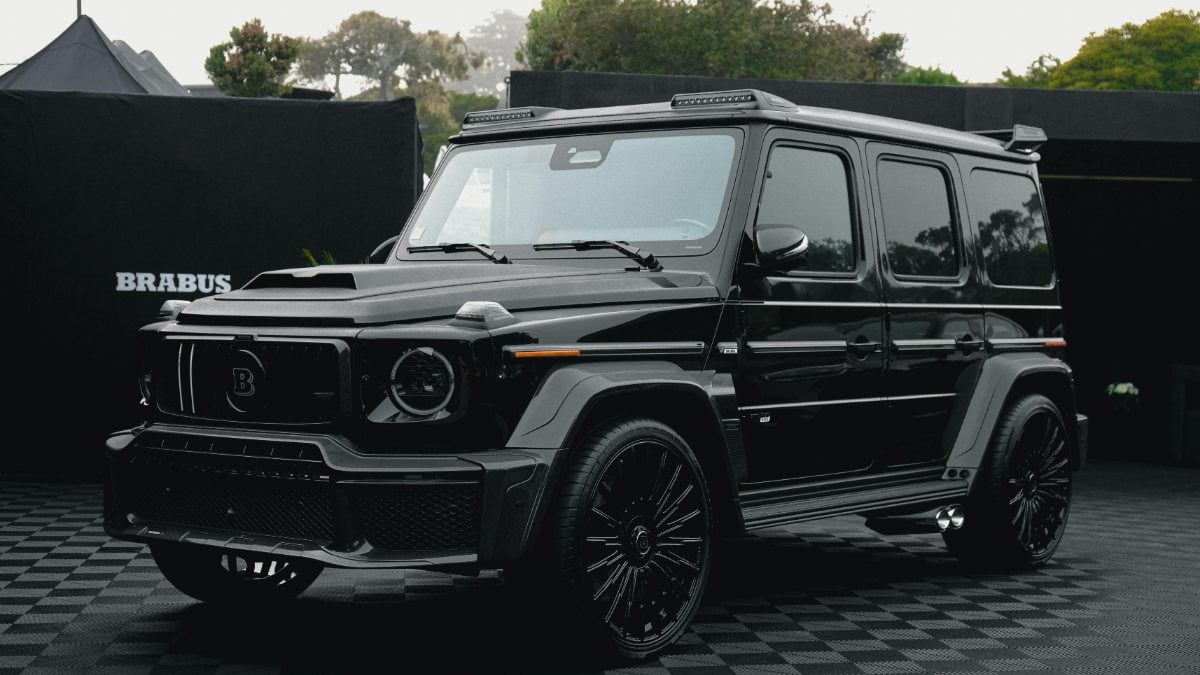
The broader lesson is less about one G-63 and more about the era we are driving into. High-performance luxury vehicles are now as much software as steel. That reality brings incredible capability, from advanced stability systems to powertrains that produce enormous output while still meeting emissions and efficiency requirements. It also means that when something goes wrong, it may present as a sequence of sudden electronic interventions that are difficult to reproduce and even harder to explain. Most examples of a given model will perform exactly as intended for years. Occasionally, as stories like this suggest, one will not. When that happens with a vehicle that costs as much as a house, owners quite reasonably expect clear answers, a thorough fix, or a transparent path to resolution.
Image Sources: Mercedes Media Center
Noah Washington is an automotive journalist based in Atlanta, Georgia. He enjoys covering the latest news in the automotive industry and conducting reviews on the latest cars. He has been in the automotive industry since 15 years old and has been featured in prominent automotive news sites. You can reach him on X and LinkedIn for tips and to follow his automotive coverage.
Set Torque News as Preferred Source on Google
Follow us today...