
The future has a habit of showing up without warning, and sometimes it rolls to a halt in the most inconvenient places. Tampa saw a vivid example last week when a Cybertruck owner found himself in the center of an intersection, caught between what the road required and what modern software interpreted.
The promise of automated driving continues to advance, yet each new feature brings along the responsibility of understanding how these systems behave when the road markings that guide them fall short of perfection. This particular episode serves as a reminder that progress, no matter how polished, still relies on real-world conditions that do not always meet the textbook definition.
“So FSD was driving me home and came to an intersection with a 4-way light. Red light came for my lane, and CT slowed for a brake, but to the other side of the intersection. It seems FSD gauges where to stop by the white line, and that intersection did not have white lines bordering each lane. It did have a crosswalk white line beyond the intersection, so it decided it was going to chill in front of that. I had to gun it to get out of the middle of the intersection. Other drivers must either be shaking their heads and/or cursing Tesla, and sorry, folks, I didn’t mean to give them more reason to hate us.
Unfortunately, I forgot to honk the horn and save the recent event. When I got home, it’s no longer in the RecentClips folder.”
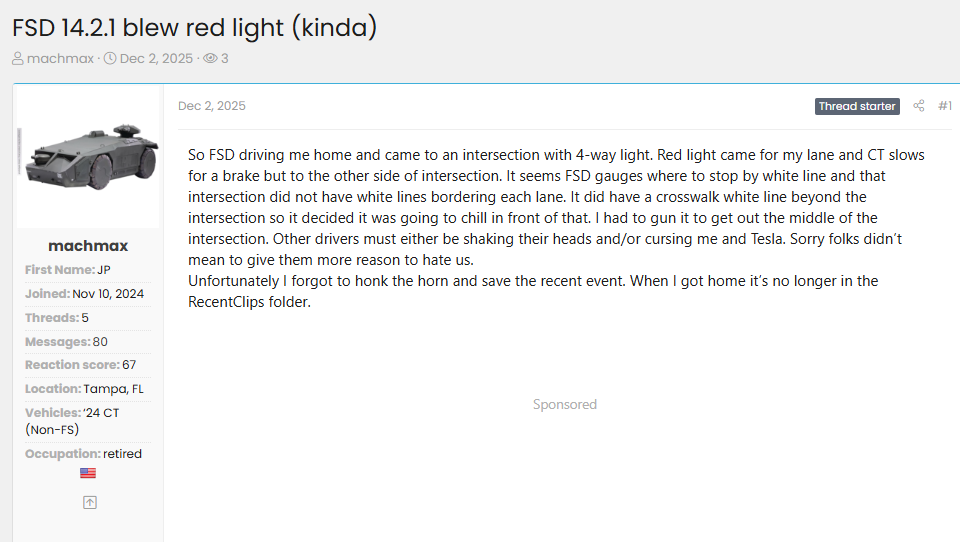
Reactions on the Tesla Cybertruck Forum began almost instantly. One member, ABILISK, tried to parse the event with a simple question that reflected the puzzle of the situation. He asked if the truck had stopped too far forward on a red and required the driver to force it through. The discussion clarified how easily a conflict can arise when digital logic meets an intersection that lacks the traditional markings the system expects. With no stop bar in sight, the truck behaved according to its best interpretation of the environment, guided by geometry and code rather than the subtle instincts that come from experience.
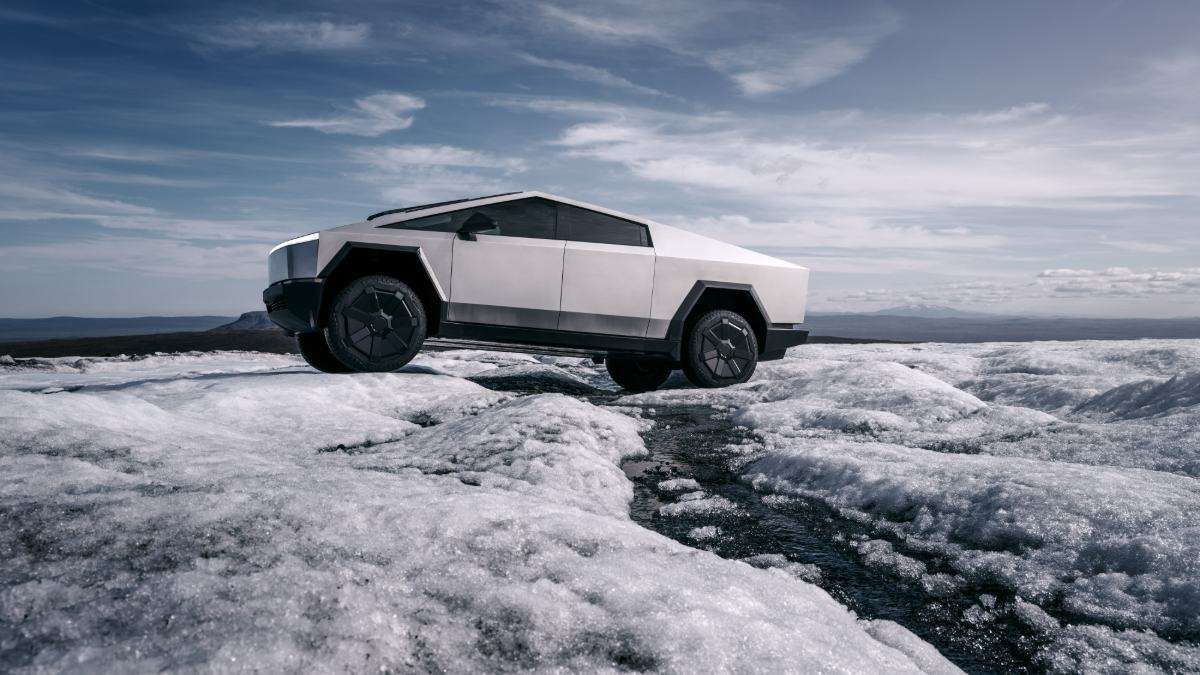
Tesla Cybertruck: What It’s Like To Drive
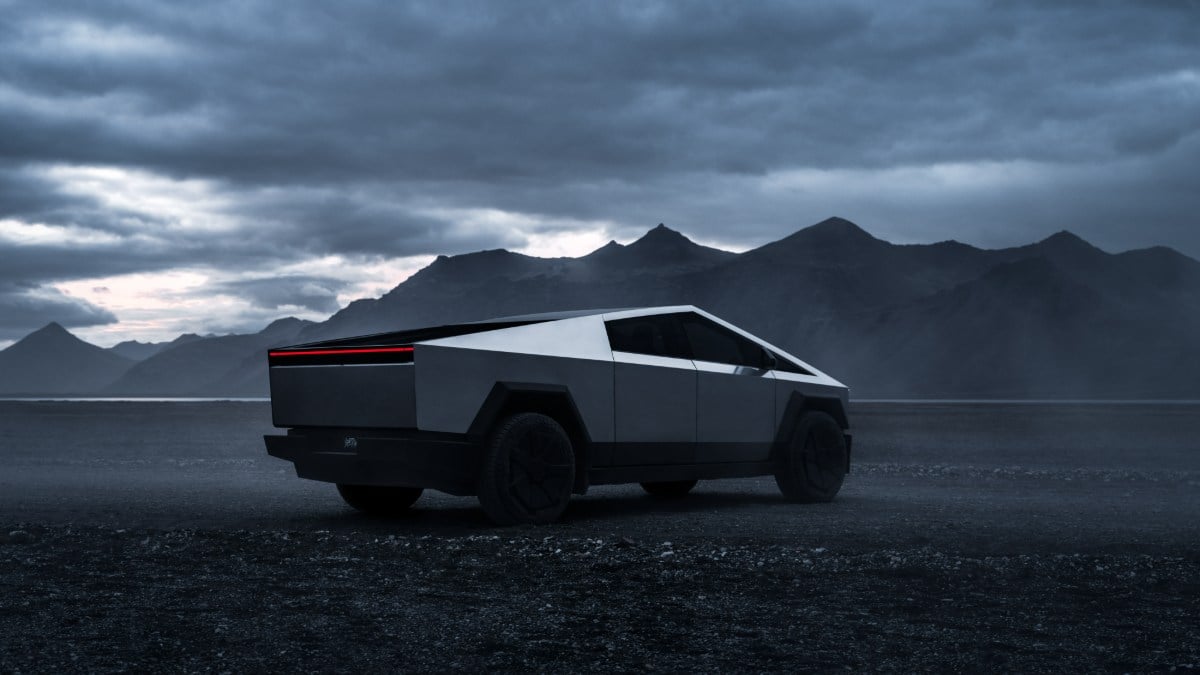
- The stainless steel exterior gives the Cybertruck a bold and durable identity, although the rigid surface can make minor dents and scratches more visible than on painted body panels.
- Rear-wheel steering provides impressive maneuverability for a vehicle of this size, yet the truck’s sharp angles and wide stance still require extra attention in tight urban environments.
- The minimalist cabin promotes a clean, open atmosphere, but the sparse layout may feel unfamiliar to drivers who prefer more traditional controls and tactile buttons.
- Strong electric torque allows the Cybertruck to build speed with little effort, though the truck’s substantial weight can become more noticeable during quick directional changes or uneven road surfaces.
The owner later explained that the Cybertruck was not acting unpredictably. It was being precise in the only way it knew how. The crosswalk striping on the far side of the intersection became its reference point, creating a moment where the truck prepared to stop in a place that would have left it squarely in the middle of cross traffic. ABILISK questioned whether the Cybertruck had nearly cleared the intersection before deciding to brake, and the answer confirmed the issue. The automated system was following the rules as it understood them, even if the asphalt did not provide the expected cues.
Throughout the discussion, the owner did not attempt to place blame. He simply described an occurrence where the vehicle acted on incomplete visual information and required immediate intervention. The phrase he used, that he would have ended up stuck in the intersection without taking control, captured the tension of relying on emerging technology that continues to learn from countless unique situations. It illustrated how impressive these systems can be while also acknowledging that their interpretation of the world can occasionally be just a degree off.
ABILISK responded once more, this time urging the owner to document the moment for the sake of improvement. He pointed out that a voice message or a manual dashcam save could have provided valuable data. That suggestion captured the evolving role of FSD operators. They are not only navigating with assistance. They are contributing to an ongoing engineering process that depends on field reports, subtle anomalies, and small corrections that gradually refine what the system understands. A missed horn save became more than an anecdote. It represented a lost opportunity to strengthen the technology.
Navigating today’s roads with tomorrow’s tools is both a privilege and a responsibility. The capabilities of modern driver assistance can feel extraordinary, but each feature is shaped by infrastructure that varies from town to town. A faded line or absent marking may seem trivial to the everyday driver, yet for a vision-based system, it becomes the difference between a confident stop and an unexpected pause in traffic. These systems do not simply follow directions. They interpret surroundings, identify boundaries, and make decisions based on rules that remain in constant development.
This is why the account shared on the Cybertruck forum holds value. It underscores the reality that technology progresses through experiences that are not always clean or comfortable. Each encounter becomes part of a larger story that charts the evolution of automated driving, shaped by thousands of observations like this one. Nothing failed dramatically. Instead, an owner intervened, adjusted course, and later provided insight for others. The road to tomorrow is built on such moments, and every imperfect intersection helps write the manual for the systems that will guide the vehicles of the future.
Image Sources: Tesla Media Center
Noah Washington is an automotive journalist based in Atlanta, Georgia. He enjoys covering the latest news in the automotive industry and conducting reviews on the latest cars. He has been in the automotive industry since 15 years old and has been featured in prominent automotive news sites. You can reach him on X and LinkedIn for tips and to follow his automotive coverage.
Set Torque News as Preferred Source on Google
Follow us today...