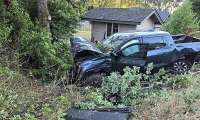

Was this Cybertruck owner's Full Self-Driving suspended because he was driving dangerously, or because he was relying on it too much?
Michael Fox on the Cybertruck Owners Only Facebook page says,
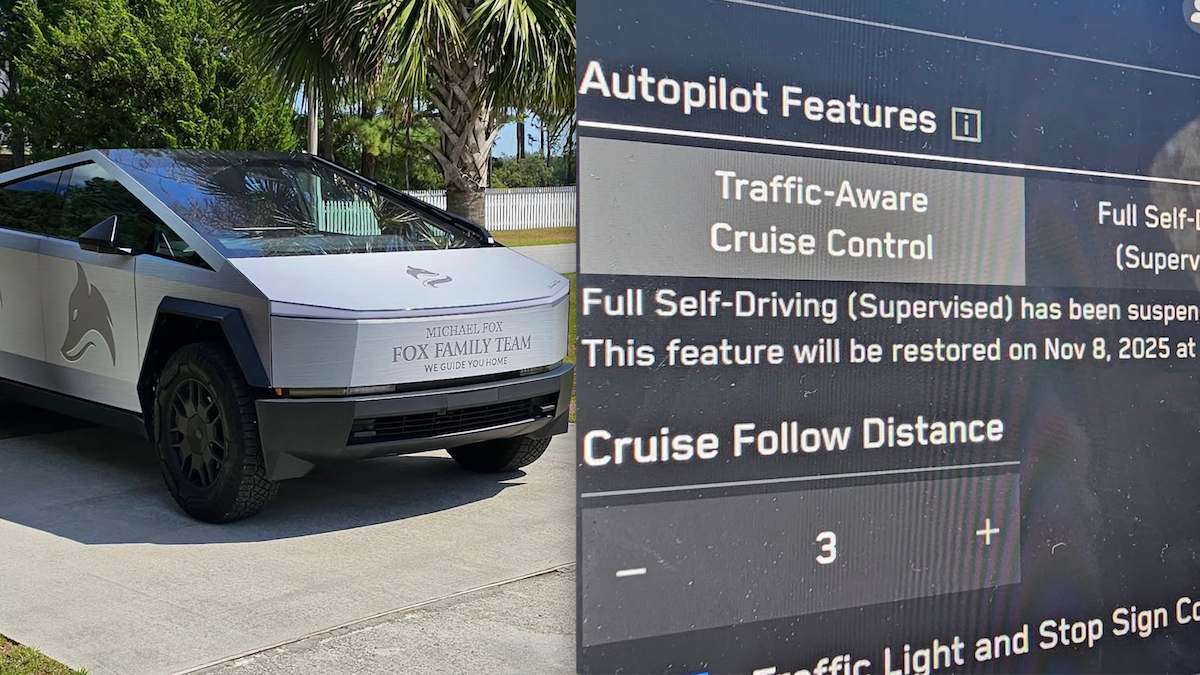
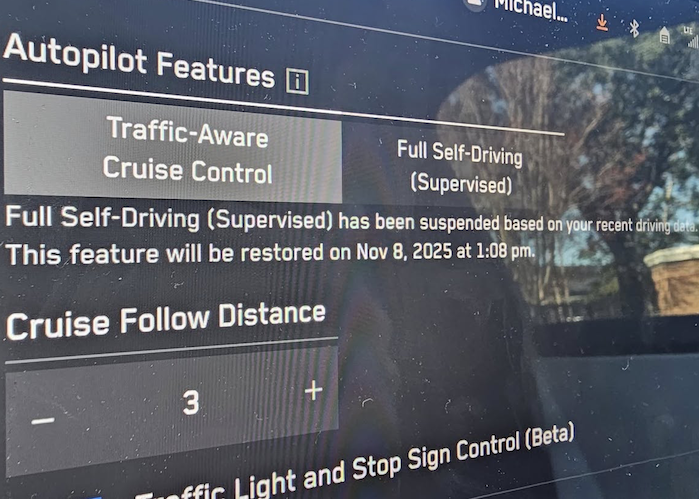
"Tesla just suspended my Cybertruck FSD because of my recent driving data. The screen data says, "Full Self-Driving has been suspended based on your recent driving data. Cruise Follow Distance: 3. And then it says Traffic Light and Stop Sign Control."
"It's literally like my truck is broken. I hate this so much! It's just terrible to drive without FSD once you're used to it. As for doing other things while driving, maybe they should make it optional on the driving test. If you can pass while eating a sandwich, then you get a sticker on your license that says you're good to go! I feel like I was driving safely, and I am for sure much safer with the FSD helping."
Why Did Tesla Suspend Michael's Full Self-Driving and How to Get It Back
Michael's feeling that his futuristic Cybertruck suddenly feels "broken" and "terrible to drive"—is a widely shared experience among dedicated FSD users. He's not alone. When you've adapted your daily driving to rely on supervised autonomy, reverting to manual control feels like taking a step back a decade.
The message he received—"Full Self-Driving has been suspended based on your recent driving data. Cruise Follow Distance: 3. And then it says Traffic Light and Stop Sign Control"—is not a vague warning; it's a technical receipt itemizing his driving transgressions.
Michael likely isn't an unsafe driver; it's about failing to meet the hyper-specific criteria of Tesla's machine vision and data-driven Safety Score model. Let's break down exactly what Cruise Follow Distance 3 means for Tesla FSD suspension.
The Critical Error: Cruise Follow Distance: 3
The FSD monitoring system evaluates several key factors, but few are as critical—or as misunderstood—as follow distance.
Tesla's Traffic-Aware Cruise Control (TACC) allows the driver to select a following distance setting from 1 (closest) to 7 (farthest). This distance is measured in car lengths or, more accurately, in time headway (seconds). When the system reports "Cruise Follow Distance: 3," it means that while you were actively using TACC or FSD, the system detected a pattern of driving where your chosen setting of '3' was utilized in a manner that the underlying Safety Score algorithm deemed too aggressive or risky based on the conditions.
Here's the rub: The suspension is almost certainly not because Michael set the distance to 3. The suspension occurred because he likely forced a manual takeover (disengagement) while the follow distance was set to 3, or because the FSD system itself had a late brake event while operating at that distance.
Why is distance '3' a problem? In most highway scenarios, a setting of 3 translates to approximately a 1.8 to 2.0-second gap behind the car ahead. While this is acceptable on open, clear highways, the Safety Score system penalizes drivers whose intervention is required when following too closely, particularly at higher speeds or during changing traffic conditions.
This is why Tesla FSD Cruise Follow Distance is the biggest safety score killer. Tesla's algorithm aggressively penalizes any disengagement that occurs under conditions it deems high-risk, and tailgating (which a '3' setting can sometimes mimic in heavy traffic) significantly increases the probability of requiring a critical human intervention. This single metric often causes a ripple effect, leading to other penalties.
The Double Whammy: Traffic Control Intervention
The second suspension criterion, "Traffic Light and Stop Sign Control," points to two specific manual interventions you made during FSD use:
- Running a Red/Stop Sign: The most obvious cause is that he failed to take over, and the FSD system either approached a red light too quickly or failed to creep forward correctly, prompting the vehicle to throw up a warning that required you to hit the brake or manually steer to avoid a violation or collision.
- Aggressive Takeover at the Green: The more insidious cause is avoiding full self-driving disengagements at traffic lights and stop signs by manually pressing the accelerator or steering just as the light turns green. If the FSD system is still processing the turn and you aggressively take over to accelerate, the system logs this as a critical disengagement due to "driver intervention at a controlled intersection." Tesla wants FSD to initiate the move on its own when the system feels comfortable.
How Do You Regain Tesla Full Self-Driving Beta Access After a Suspension?
FSD suspension is typically temporary (1-2 weeks), and your re-eligibility depends on demonstrating perfect manual driving immediately. Access is usually suspended after five critical disengagements (strikes) in a rolling seven-day period.
Here are the recommendations to reset your profile and get back in the game:
1. Drive "Boring" for Seven Days
The suspension is a monitored cooling-off period where you must demonstrate perfect manual driving behavior:
- Traffic-Aware Cruise Control (TACC): If you use TACC, set the follow distance to 5 or higher (e.g., 5, 6, or 7) to create a clear margin of safety and prevent warnings.
- Smooth Movements: Avoid aggressive acceleration, hard braking (deceleration exceeding 0.1g), and sharp turns (lateral acceleration exceeding 0.4g). Drive extremely smoothly.
2. Manage Intersections Manually
Intersections are a common failure point that leads to strikes:
- Anticipate Disengagement: When approaching complex intersections or lights where FSD struggles, manually disengage FSD early (about 100 feet before the decision point) by tapping the brake or stalk. This logs a controlled takeover, not a critical strike.
- Avoid the "Green Light Creep": Do not impatiently hit the accelerator at a green light. Allow the car to start moving on its own, then gently apply pressure.
Key Takeaway: The Five Strike Rule
The suspension happens after five critical disengagements in a rolling seven-day period. The common critical strikes that trigger a warning include Follow Distance and Traffic Control failures, which indicate a lack of supervision or high-risk driving before the human takeover.
As I've written before in the context of FSD behavior (My 2024 Tesla Model 3 FSD Turned Right At a Stop Light and Ignored the No Turn on Red Sign, Why Is My FSD Making Ridiculous Traffic Violations?), the system is capable, but it's still supervised.
As you can see in my report, the system still has some glitches: My Tesla Model 3 Passed a Slower Car, Pulled In Front of It, and Slowed Down. The Car Passed Me and Gave Me the Finger. Now, I'm Ready to Cancel FSD
The suspension is Tesla's way of aggressively enforcing the "supervised" part of the agreement. They are not judging you as a driver; they are judging you as a supervisor of their technology. They want you to take over well before the system is forced into a critical situation.
My Final Takeaway
Tesla owners need to treat FSD's re-engagement criteria like a high-stakes, real-time driving exam. You need to focus on smooth, predictable inputs and proactively disengage FSD in complex areas where its performance is historically inconsistent. Michael should use the next week to recalibrate your driving style to an ultra-conservative, defensive approach.
Now, for Tesla owners, I want to hear your perspective.
This situation highlights a fundamental conflict: Tesla monitors driving aggressively for safety, but this monitoring punishes the driver for reacting to the system's own imperfections.
Do you believe that Tesla should differentiate between a 'bailout disengagement' (where the driver corrects a bad FSD move) and a 'high-risk disengagement' (where the driver was truly negligent), or is a critical disengagement always the supervisor's fault? Click the red Add New Comment link below and let us know.
I'm Denis Flierl, a Senior Torque News Reporter since 2012, bringing over 30 years of automotive expertise to every story. My career began with a consulting role for every major car brand, followed by years as a freelance journalist test-driving new vehicles—equipping me with a wealth of insider knowledge. I specialize in delivering the latest auto news, sharing compelling owner stories, and providing expert, up-to-date analysis to keep you fully informed.
Follow me on X @DenisFlierl, @WorldsCoolestRides, Facebook, and Instagram
Photo credit: Denis Flierl via Michael Fox
Set Torque News as Preferred Source on Google
Follow us today...