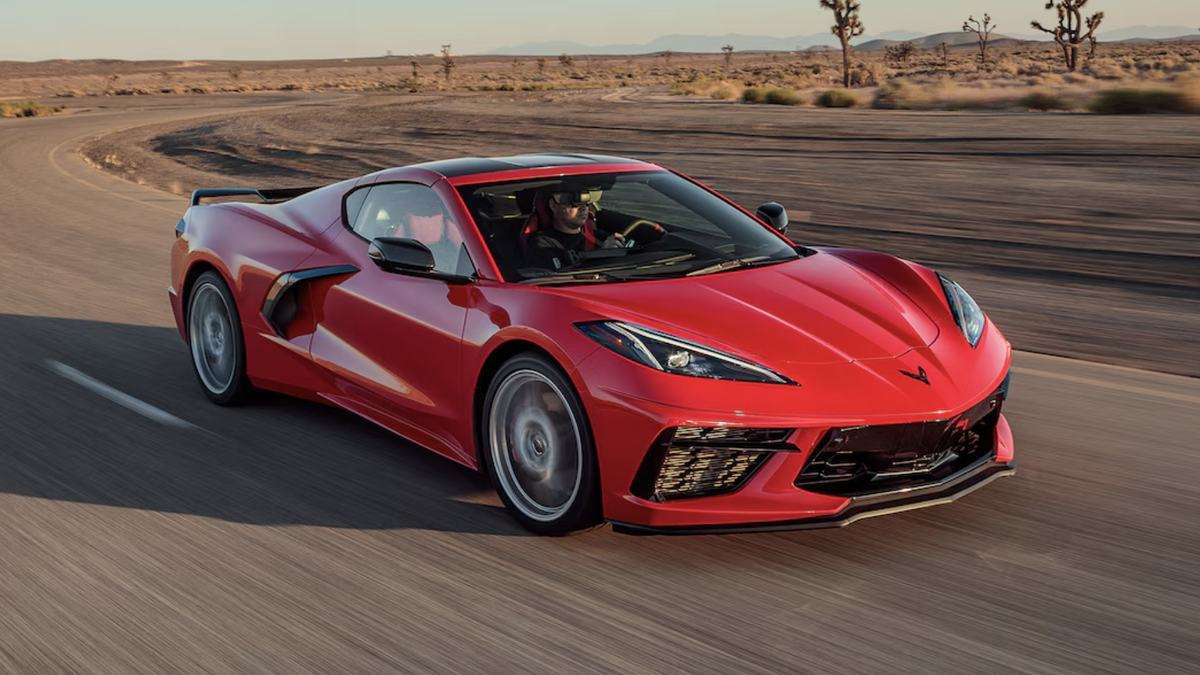

Modern sports cars like the C8 Corvette promise spectacle without sacrifice. They offer dramatic styling, mid-engine balance, and the ability to live a normal life between spirited drives. That is what makes stories like Jeff Wieringa’s worth attention. They are not about breakdowns or warning lights, but about small, persistent irritations that quietly undermine the expectation that everything should work seamlessly in a car this advanced.
Wieringa shared his experience with fellow owners in the C8 Corvette Owners group on Facebook after months of noticing the same pattern. After starting his 2023 Corvette C8 hardtop convertible in the garage and driving with the roof up, his eyes began to burn and water mildly about three miles into the drive. There is no obvious smell, no visible smoke, and nothing to suggest a mechanical failure. The issue appears only after cold starts and disappears entirely once the car has been driven, shut off briefly, and restarted warm.
“I love my 2023 C8 HTC. Interesting situation. I park my Vette in my garage. After raising the door and starting it up with the top up, after about 3 miles, my eyes start burning and watering mildly. No unusual smell in the car. It's been happening for months. Today...I tried something different. Just seconds after I started the car, I turned off the ECS system and drove for about 5 miles, opened the rear window, and turned the ECS on HI for several minutes. So what? I'm suspecting that when the engine is cold after starting it, backing up for a T-turn out of the driveway, the ECS is sucking in some exhaust fumes. After a short drive to the store, and a quick stop, when I start and drive home, no issues. Does anyone else have this?”
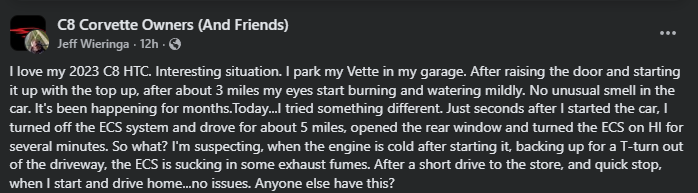
Rather than dismissing it as a coincidence, Wieringa approached the situation methodically. On one drive, he shut off the climate system seconds after startup, drove several miles, then opened the rear window and ran the system on high. The result reinforced his suspicion that the problem was tied to the first moments after ignition. His working theory was simple and logical: during cold starts, particularly while backing out of the driveway, the ventilation system may be drawing in exhaust fumes before the car has fully stabilized.
Chevrolet C8 Corvette: Mid-Engine Performance Reframed
- The C8 Corvette’s mid-engine layout fundamentally changes how the car behaves, delivering improved balance and a more composed feel during spirited driving.
- Acceleration builds quickly and consistently, supported by a dual-clutch transmission that keeps power delivery uninterrupted.
- Steering response feels deliberate and precise, allowing the driver to place the car confidently through corners at speed.
- Despite its performance credentials, the C8 retains a degree of daily usability, with a ride that remains manageable on regular roads.
Another owner, Andrew Nelson, provided useful technical context that helped frame the discussion. He explained that during cold starts, the C8 employs a fuel injection strategy designed to heat the catalytic converters as quickly as possible. That process can produce higher levels of unburned hydrocarbons in the exhaust, sometimes visible as light smoke. If the car is reversing and the ventilation system is pulling in outside air rather than recirculating cabin air, those fumes could be drawn into the interior.
The C8’s mid-engine layout changes airflow behavior compared to earlier Corvettes, and cold start strategies are more aggressive than they were in the past. Combine a closed garage, a rich-running engine, and a ventilation system set to fresh air, and the result may be an uncomfortable but temporary exposure rather than a defect.
Not all owners were convinced the car itself was responsible. Some commented that they had never experienced anything similar, even over longer drives. Others suggested environmental factors or personal sensitivity as possible explanations. One pointed out that three miles is a relatively long distance for cold start effects to persist. These responses highlight the challenge of separating a repeatable mechanical interaction from individual circumstances.
Still, the consistency of Wieringa’s experience, and the way it disappears once the engine is warm, keeps attention focused on the cold start phase. His background in aviation shows in the way he frames the problem, observing conditions, adjusting variables, and drawing conclusions based on outcomes rather than assumptions. This is not speculation fueled by frustration, but careful observation informed by technical thinking.
The C8 Corvette is a fundamentally different machine from its predecessors, and with that difference comes a learning curve that extends beyond driving dynamics. Owner communities play an important role in identifying these edge cases, comparing experiences, and distinguishing quirks from genuine concerns. Sometimes the most revealing stories are not about what breaks, but about how complex systems interact in everyday use, reminding us that even the most sophisticated performance cars are still subject to the realities of air, fuel, and human senses.
Image Sources: Chevrolet Media Center
Noah Washington is an automotive journalist based in Atlanta, Georgia. He enjoys covering the latest news in the automotive industry and conducting reviews on the latest cars. He has been in the automotive industry since 15 years old and has been featured in prominent automotive news sites. You can reach him on X and LinkedIn for tips and to follow his automotive coverage.
Set Torque News as Preferred Source on Google
Follow us today...