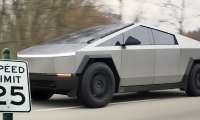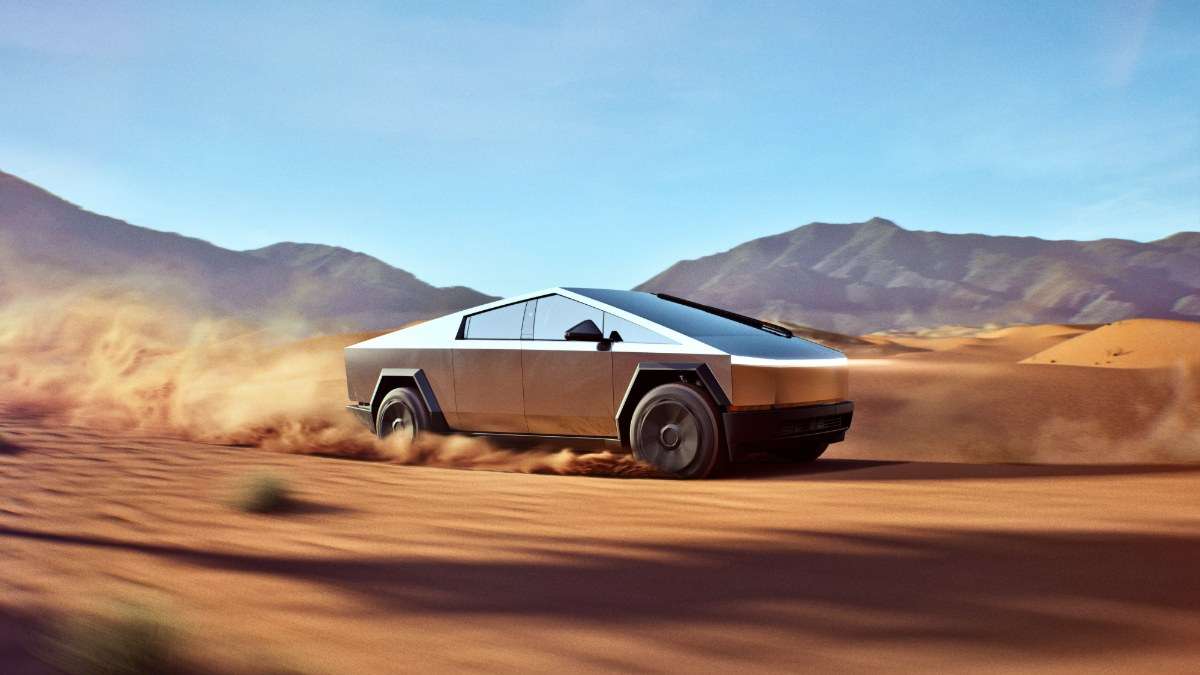

If you have spent enough years listening to engines howl across American highways, you learn to keep a healthy reserve of skepticism for any system that promises to do the driving for you. Yet every so often, someone steps up with a real-world report that demands attention. That person this week was Jerry Balester, a Florida Cybertruck owner who treated Tesla’s latest Full Self Driving update to a rigorous, sun-soaked, four-day trial across the heart of the state. What he found was not a fragile experiment begging for human rescue but a surprisingly competent partner, one that handled the strange and the sudden with a cool hand.
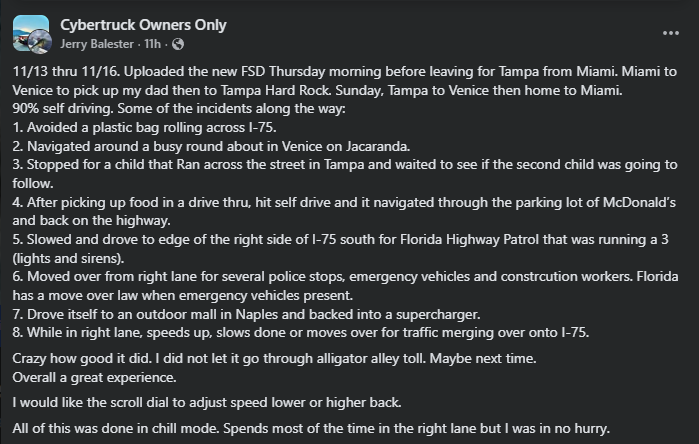
“11/13 thru 11/16. Uploaded the new FSD on Thursday morning before leaving for Tampa from Miami. Miami to Venice to pick up my dad, then to Tampa Hard Rock. Sunday, Tampa to Venice, then home to Miami.
90% self-driving. Some of the incidents along the way:
1. Avoided a plastic bag rolling across I-75.
2. Navigated around a busy roundabout in Venice on Jacaranda.
3. Stopped for a child who ran across the street in Tampa and waited to see if the second child was going to follow.
4. After picking up food in a drive-thru, hit self-drive, and it navigated through the parking lot of McDonald’s and back on the highway.
5. Slowed and drove to the edge of the right side of I-75 south for the Florida Highway Patrol that was running a 3 (lights and sirens).
6. Moved over from the right lane for several police stops, emergency vehicles, and construction workers. Florida has a move-over law when emergency vehicles are present.
Advertising
7. Drove itself to an outdoor mall in Naples and backed into a supercharger.
8. While in the right lane, speeds up, slows down, or moves over for traffic merging onto I-75.
Crazy how good it did. I did not let it go through alligator alley toll. Maybe next time.
Overall, a great experience.
I would like the scroll dial to adjust the speed lower or higher.
All of this was done in chill mode. Spends most of the time in the right lane, but I was in no hurry.”
Balester’s journey covered the kind of miles that separate brochure promises from actual capability. Miami to Venice to Tampa and back is no scenic Sunday cruise. Interstate 75 in Florida is a shifting battleground of tourists, commuters, weather changes, and construction pinch points. For decades, this has been the sort of road where the only reliable constant is unpredictability. To have a vehicle manage ninety percent of the workload on such terrain is notable. To have it handle random events like children darting across a street or emergency vehicles threading through traffic without prompting is something worth examining closely.
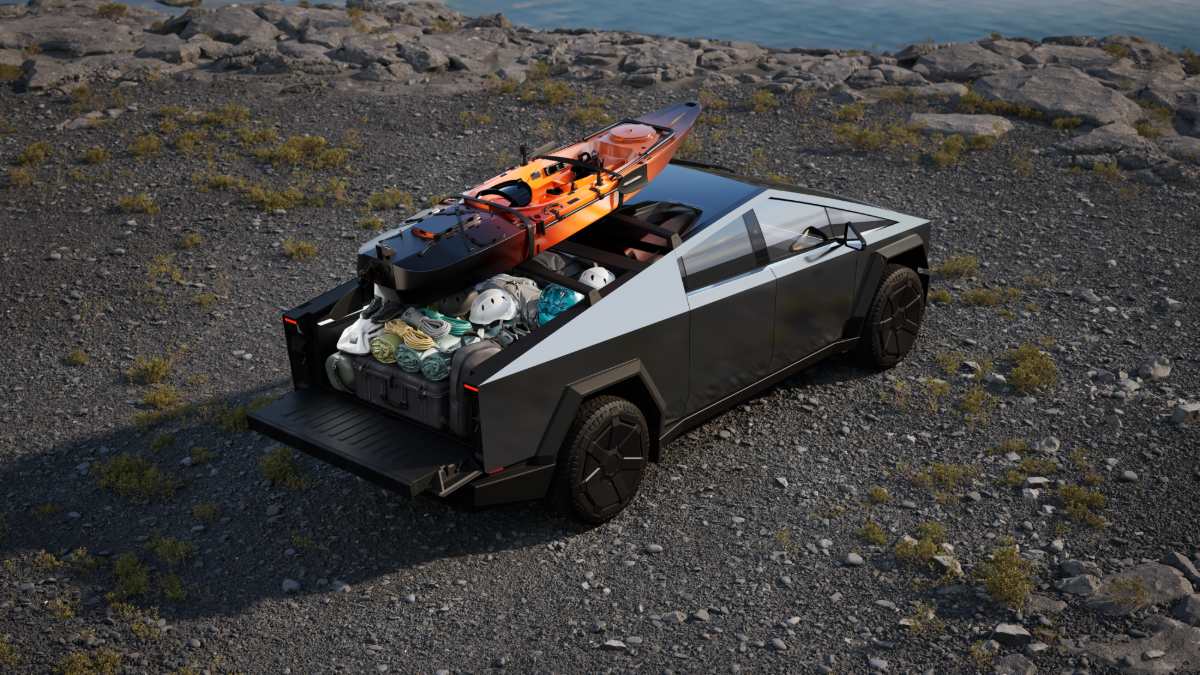
Tesla Cybertruck: Design Philosophy
- Designed around an exoskeleton-first philosophy, the Cybertruck uses ultra-hard stainless steel as a structural element, flipping the traditional “frame then skin” workflow on its head.
- The body panels are so rigid that they limit traditional stamping, forcing Tesla to rely on origami-style bends and laser trimming instead of complex shaping.
- Gigapress die-casting forms huge structural sections, reducing part count dramatically and helping achieve Tesla’s goal of robot-heavy assembly with fewer human-touch steps.
- The design prioritizes aerodynamics through hidden features, like the retractable tonneau cover and angled roofline, making its polygonal look functional, not decorative.
Reactions on Facebook reflected the same mixture of surprise and curiosity that long-time road testers often feel when technology jumps forward. One commenter praised the responsibility of the system in handling dynamic situations. Another admitted their own Tesla still hesitated in tight turns and tipped their hat to Balester for letting FSD navigate a chaotic McDonald’s lot. These comments mattered because they framed Balester’s report not as brand promotion but as shared evidence of progress that owners watch with a close and personal interest.
The McDonald's parking lot episode deserves particular attention. Anyone who has ever spent time in one knows these places rely more on improvisation than rulebooks. Cars angle themselves wherever they fit. Pedestrians wander through without patterns. Deliveries block lanes. It is the kind of environment that exposes the limits of most automated systems that expect order and lane discipline. Balester’s Cybertruck moving through this clutter and then finding its path back to the highway speaks to meaningful refinement in Tesla’s low-speed navigation and situational awareness.

Balester confirmed he stayed ready to intervene, which is what Tesla instructs, and that reinforces the role of FSD as advanced assistance rather than a replacement. Yet the Cybertruck responding correctly to Florida’s Move Over Law during encounters with police, construction workers, and emergency vehicles showed it was not simply tracking objects but interpreting context. This is the kind of difference that takes autonomy from theoretical promise to genuine usefulness. Even the humble plastic bag on I-75 illustrated this. Light debris can confuse sensors because they move irregularly, yet the system reacted with the sort of instinct drivers gain only through years of seat time.
There were limits. Balester chose not to let FSD handle the Alligator Alley toll, which shows practical judgment that makes his entire account more credible. His only complaint was the absence of the scroll dial for adjusting speed. That kind of usability critique is exactly what manufacturers need to hear because it comes from genuine daily use rather than technical oversight committees. It is an owner identifying the details that separate smooth operation from mild frustration.
The fact that the Cybertruck backed itself into a Supercharger in Naples seemed almost like a victory lap to Balester. Maneuvering into tight spaces with accuracy remains one of the benchmarks for well-tuned automated control, and the truck performed the job quietly and efficiently. By that point in the journey, the tone of Balester’s story had shifted from cautious exploration to a growing confidence in the system’s ability to handle the rough edges of the real world. What stayed with him was not the novelty but the consistency.
A real driver taking a real trip and asking a new piece of technology to prove itself against the messiness of American roads. Nothing sterilized, nothing staged, just life unfolding in fast food lots, toll plazas, residential streets, and long interstate stretches where attention tends to waver. The story works because the machine rose to meet the task with unexpected competence, and the driver remained honest about what worked and what did not. For a technology that is constantly under scrutiny, these miles across Florida stand as evidence that the future is arriving one responsible update at a time.
Image Sources: Tesla Media Center
Noah Washington is an automotive journalist based in Atlanta, Georgia. He enjoys covering the latest news in the automotive industry and conducting reviews on the latest cars. He has been in the automotive industry since 15 years old and has been featured in prominent automotive news sites. You can reach him on X and LinkedIn for tips and to follow his automotive coverage.
Set Torque News as Preferred Source on Google
Follow us today...