
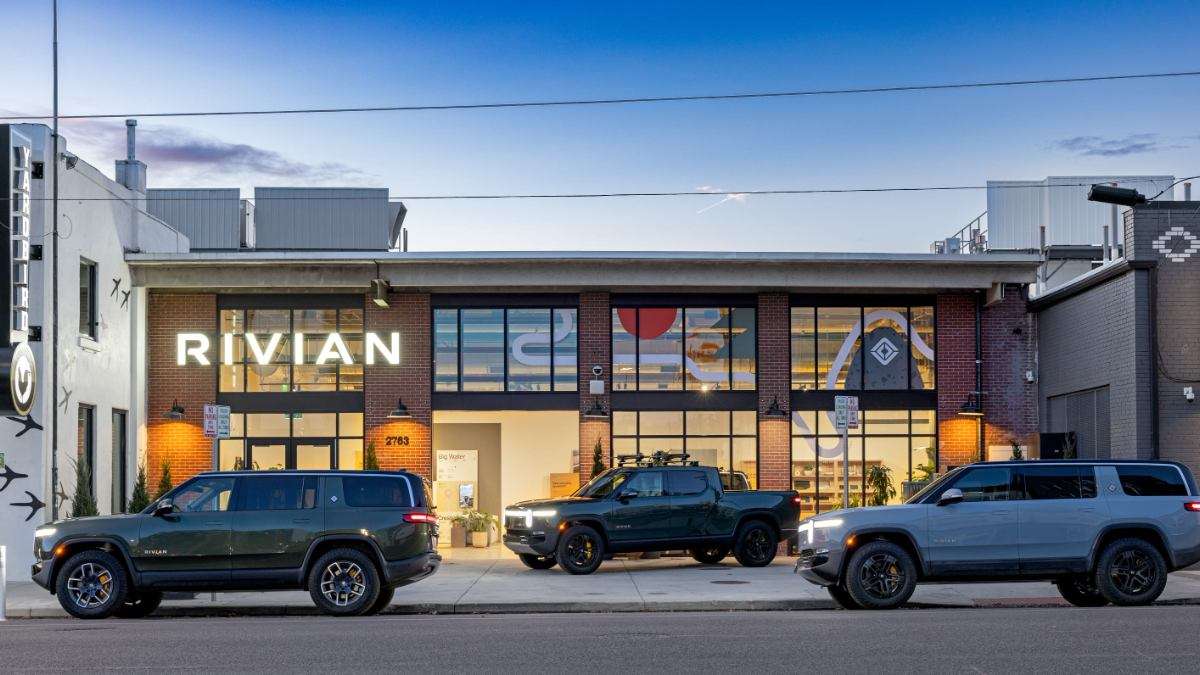

Modern vehicles are increasingly defined not by their hardware, but by the logic that governs it. Motors, heaters, sensors, and elements can all be present and fully functional, yet still fall short if the software choreography is off by a step. Few vehicles illustrate this reality better than the Rivian R1T, a truck that is impressively engineered, deeply capable, and occasionally undermined by the smallest decisions hiding in its menus and automation layers.
One R1T Quad Motor owner recently turned to the r/Rivian subreddit to clear up what he described as persistent myths surrounding the truck’s heated windshield wipers.
“I think we need Rivian to tie the elements to rear defrost or give a separate button to enable. There are many times when blasting the front defrost makes the cabin too hot. Meanwhile, the wipers outside the car are icing up.
This is tested on my Gen1 R1T quad.”
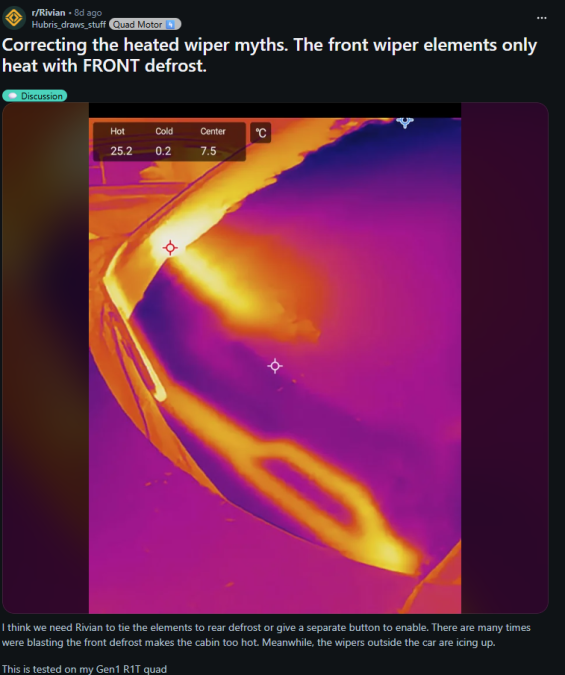
After testing on his Gen1 R1T, he found that the heating elements embedded in the front wipers activate only when the front defrost is engaged. Rear defrost does nothing for them, and there is no independent control. The result is a system that technically works, but only under conditions that can make the cabin uncomfortably warm while still leaving the driver fighting ice buildup outside.
Rivian R1T: Design Focus
- The R1T blends pickup proportions with a relatively compact footprint, making it easier to maneuver than full-size trucks while still supporting meaningful payload and off-road capability.
- Its quad- or dual-motor configurations deliver controlled, evenly distributed power, contributing to confident traction on loose surfaces and predictable behavior in varied driving conditions.
- Interior design focuses on clean materials and intuitive layout, combining physical controls with touchscreen functions to reduce reliance on menus for everyday tasks.
- Utility features such as the gear tunnel and powered frunk expand storage options, though their usefulness depends on how well they fit individual hauling and access needs.
This is not a complaint about capability so much as coordination. Heated wipers are a genuinely useful feature in cold, wet climates, particularly where freezing rain and slush conspire to refreeze blades mid-drive. The frustration arises when activating that feature requires blasting heat onto the windshield, driving cabin temperatures upward, and consuming far more energy than necessary. For an electric truck whose appeal rests partly on efficiency and thoughtful design, that tradeoff feels unnecessary.
The comments quickly filled in the broader picture. One owner noted that wipers tend to refreeze as soon as conditions worsen, wishing the system could simply be left on continuously. The original poster agreed, suggesting either a dedicated button or tying the feature to the rear defrost instead. Both solutions would allow drivers to manage exterior conditions without turning the interior into what he aptly described as a sauna.
Other owners questioned whether this behavior was limited to first-generation trucks or specific software versions. The answer, according to the original poster, was not encouraging. Running software version 2025.38.0, he reported that the behavior has remained unchanged for two winters, suggesting a long-standing design choice rather than a temporary oversight. That longevity makes the issue feel less like a bug and more like an unresolved philosophy.
More pointed criticism came from drivers in wet, cold regions where defrost performance is not a convenience but a necessity. One Pacific Northwest owner described Rivian’s front defrost and defog behavior as dramatically less effective than that of traditional internal-combustion vehicles, arguing that the limitation is not mechanical but purely software-driven. The hardware can do the job. It is simply not being allowed to do so in a sensible way.
This is where the R1T’s ambition becomes both its strength and its vulnerability. Rivian has built a truck that invites continuous improvement through updates, promising evolution rather than stagnation. That promise cuts both ways. When something as basic as windshield management feels constrained by logic rather than physics, it stands out precisely because the rest of the vehicle is so thoughtfully executed.
A single software toggle could resolve most of these concerns, improving comfort, efficiency, and winter usability overnight. The Rivian R1T remains a compelling and innovative truck, but moments like this serve as reminders that progress is not only about adding features. Sometimes it is about letting existing ones work on the driver’s terms, especially when the weather refuses to cooperate.
Image Sources: Rivian Media Center
Noah Washington is an automotive journalist based in Atlanta, Georgia. He enjoys covering the latest news in the automotive industry and conducting reviews on the latest cars. He has been in the automotive industry since 15 years old and has been featured in prominent automotive news sites. You can reach him on X and LinkedIn for tips and to follow his automotive coverage.
Set Torque News as Preferred Source on Google
Follow us today...




Comments
Just drive with the windows…
Permalink
Just drive with the windows open.
And Rivian wonder why people…
Permalink
And Rivian wonder why people bypass its software all the time
Rivian is a joke. Only…
Permalink
Rivian is a joke. Only reason they are still in business is that Amazon threw them a lifeline.
At one point they had sold less trucks in a five year period than Ford does in two weeks.
There are far better EV trucks out there at a lower cost.
You sure know absolutely…
Permalink
In reply to Rivian is a joke. Only… by Bill C (not verified)
You sure know absolutely nothing about what you speak about Rivian.
Not only are there no better EV trucks out there than Rivian, there’s no better trucks period out there than Rivian. Rivian can outperform any piece of shit Ford, Chevy or ram, literally any size of their trucks. .