
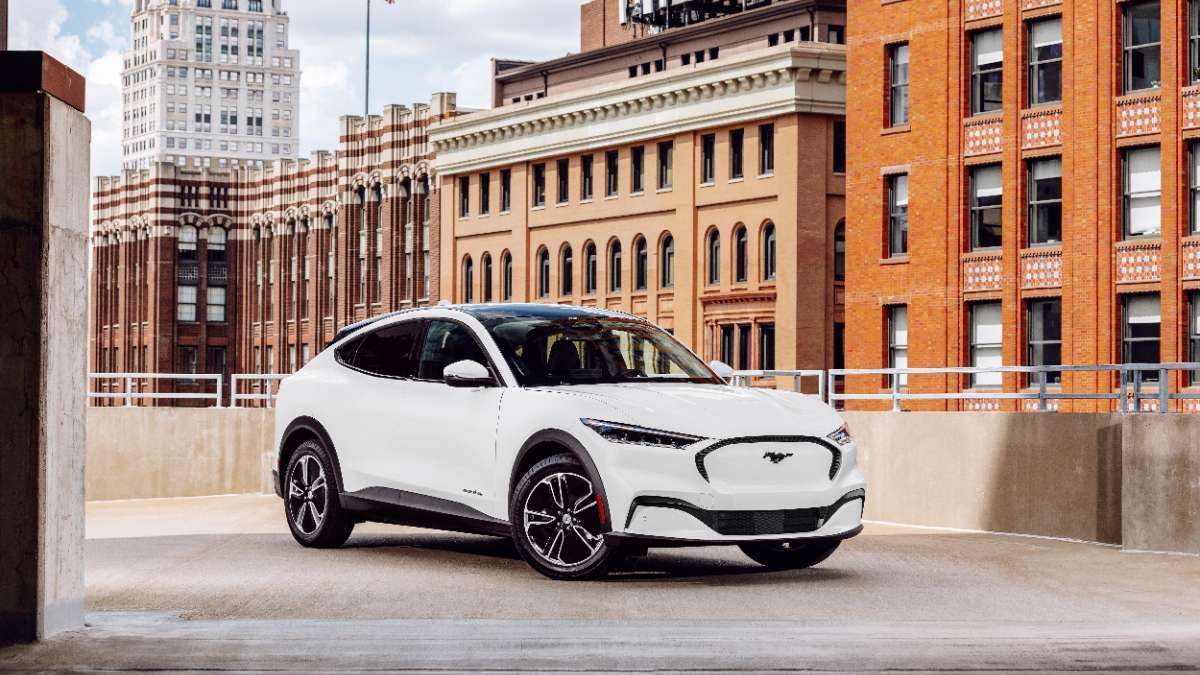

By the time you’ve stopped for your second $0.50/kWh top-off at a rest stop flanked by Chick-fil-A and a broken Electrify America terminal, something clicks in your mind, maybe this EV road trip thing isn't as futuristic as the brochure implied. But it can be, if you plan like Eisenhower on D-Day and trust a Tesla Supercharger map more than your car’s native nav. This isn’t a crisis of propulsion or battery tech; it’s a crisis of infrastructure, planning, and basic economic arithmetic.
“I just completed my first real road trip. I have a 23 rwd extended range premium. Purchased a used one about 3 months ago. We drove from Raleigh to Asheville (NC) this weekend. Here are some thoughts;
Range: impressed with the overall range. We could have made it to Asheville (249 miles all freeway) nonstop but would have arrived with a very low state of charge. Started with 100%SOC
Driving: comfortable ride and great handling. One-pedal driving in the mountains is a true joy.
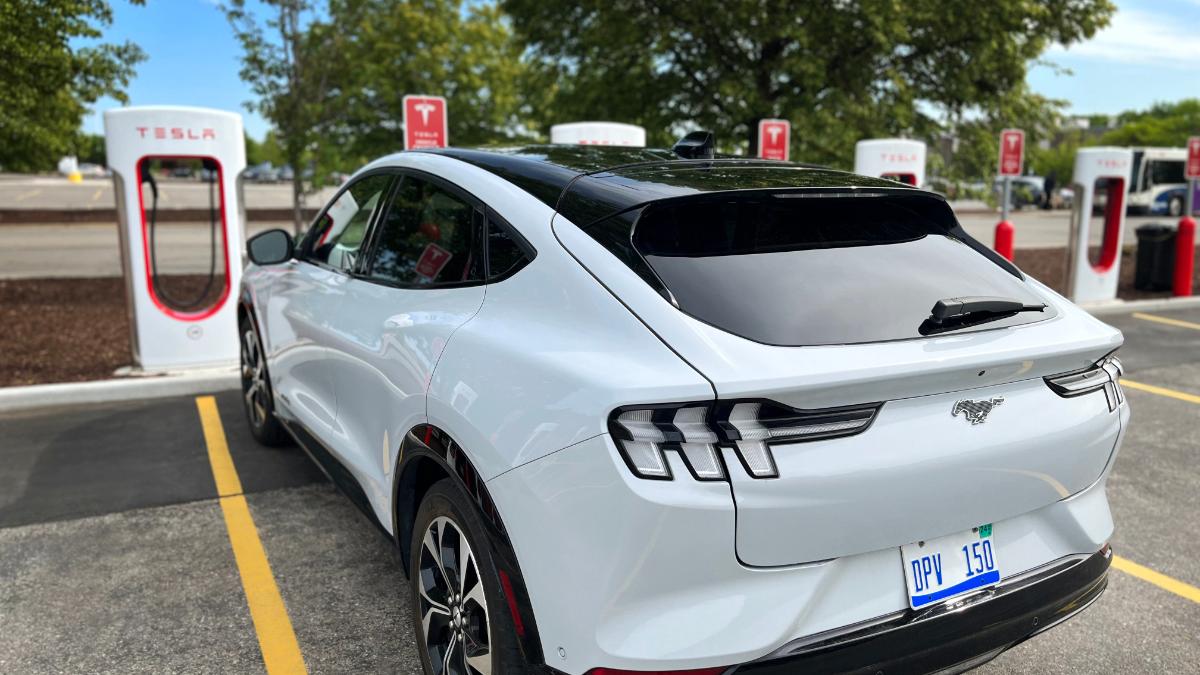
Charging: I’m not sure I could have made this trip without Tesla superchargers. We tried two different chargers found through the Ford Pass app, but neither worked. (At least one was functional for another driver but wouldn't activate through the Ford pass) Thankfully the superchargers worked perfectly. Built-in navigation does not show Tesla chargers
Charging cost: DC fast charging is more expensive than gas. $.50 / KWH @ 3.7 miles/KWH =$.14 / mile $3.00/gallon @ 30 mpg =&.10/mile. The alternate vehicle is a Ford Maverick. Not all of the trip is fast charging but the cost per Mile is higher than gas for fast charging
CarPlay: Apple Maps has amazing integration with the Mach E. Better than Google Maps, and maybe a better range estimate than the built-in navigation. However, the car play connection is inconsistent and can be frustrating.
Blue Cruise: convenient. Performed well with easy transition to manual takeover when necessary. Not worth the price. Feels like it should just be included with the hardware or the navigation subscription.
Efficiency: averaged 3.7 for the whole trip. Trip 1 shows the whole trip. Trip 2 is the return only.
Advertising
Taking all of this into consideration my next trip to the mountains will most likely be in the Maverick. Charging on the highway was slow, inconvenient, and expensive.
Feel free to ask questions/comment.”
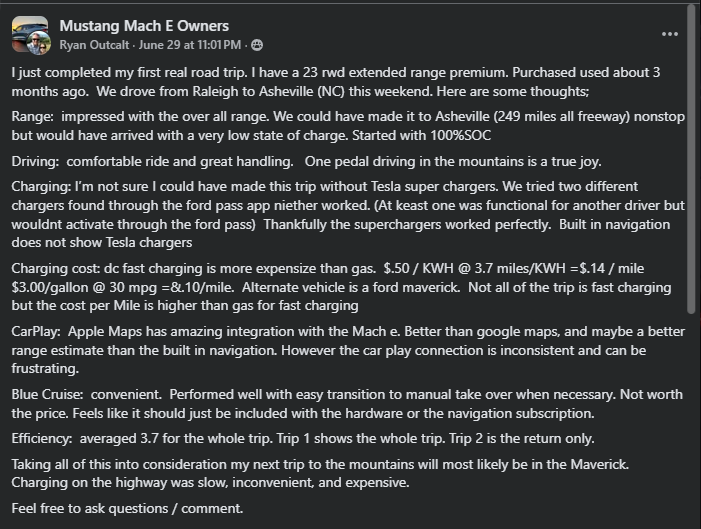
Ryan Outcalt’s candid field report from the driver’s seat of his 2023 Mustang Mach-E RWD Extended Range is the kind of data that never makes it into glossy dealership brochures. It’s a story told in real-world metrics, cents per mile, failed charging attempts, and the sheer satisfaction of one-pedal mountain descent. It also confirms what seasoned road-trippers are beginning to accept: electric road travel isn’t broken, but it’s not seamless either. The Mach-E got him there, sure. But the mental bandwidth needed to avoid stranded anxiety could be better spent admiring the Blue Ridge Parkway.
Charging Time For Ford Mustang Mach-E
- Expect around 11 hours for a full charge from empty, adding roughly 25 mi (≈40 km) of range per hour
- At 150 kW stations, the battery typically charges from 20 % to 80 % in 30 minutes; even 50 kW chargers can achieve that range in about an hour
- An extended‑range Mach‑E often hits 20–80 % in ≈30 minutes on a 150 kW charger, depending on battery temperature and state
- Users report ~7 hours from 15–100 % on a 7.4 kW AC charger, though this may vary; level and battery health influence results
To be fair, this isn’t an indictment of the Mustang Mach-E. If anything, Outcalt praises its dynamics: smooth ride, sharp handling, and the addictive novelty of regenerative braking in downhill twisties. No, the real battle lies outside the cabin, between charging stations that sometimes ghost you like a bad Tinder date and apps that don’t communicate with your car. “Any trip with more than two charging stops causes me to take a gasser,” one Mach-E owner commented after opting for a 2025 CR-V Hybrid over his GT on a 2,200-mile family vacation. Not because he wanted to. Because he had to.
Here’s where the numbers start to matter. Outcalt’s Mach-E averaged 3.7 mi/kWh on the highway. At $0.50 per kWh via DC fast charging, that’s 14 cents per mile.
His Ford Maverick, hardly a paragon of frugality, manages the same trip at about 10 cents per mile on $3/gallon gas. Over the span of a 1,000-mile road trip, that’s a $40 difference. Not a dealbreaker, but when road travel is already a series of small economic and time trade-offs, it's enough to shift decisions. “I own a Mach-E,” another driver noted,
“But I only Level 2 charge at home for $0.02 per kWh… unless I factor in depreciation, quirks, and the fact it might be worth zip at 150,000 miles.”
Where The Mach-E Shines
That 2-cent Level 2 home charge is where the Mach-E shines. Charging overnight on the cheap flips the math in favor of electrons over petroleum. That’s half a penny per mile, a rounding error so tiny it’s almost comedic. For the local commuter or suburban runabout, there’s no contest. Superchargers may change the game. With Tesla’s network opening up and Ford drivers now able to tap into its reliability via adapters and integration, the calculus is evolving. One owner documented a 4,410-mile cross-country journey with 31 Supercharger sessions, proclaiming near-zero issues and fast, consistent service. “We swore off all non-Tesla fast charging stations,” they wrote. Instant start times, high charging rates, plentiful stalls. For EVs to truly win the road trip war, this is the standard. And it’s finally within reach for non-Tesla drivers.
Ford Mustang Mach-E Recalls
- Ford has recalled ~197,432 Mach‑E SUVs (model years 2021–2025) because a low 12‑volt battery may prevent rear door latches from unlocking, risking entrapment, especially concerning children in hot conditions. Remedy: a software update due by late September 2025
- Sales of new Mach‑E units are paused while the fix is implemented; about 317,000 models worldwide are affected
- Some 2021–2022 Mach‑E units with extended‑range or GT battery packs are being recalled due to overheating high‑voltage contactors, potentially causing a loss of drive power. Dealers will replace or update these systems
- Other past recalls include windshield wiper motor failures, improperly secured axles, panoramic roof detachment risk, unintended acceleration/deceleration, and seat-belt faults, all addressed by dealers free of charge
Of course, trip efficiency depends as much on behavior as it does on kilowatt-hours. A Las Vegas-based Mach-E owner admitted averaging 85–90 mph on clear roads and acknowledged that smarter charge planning via the A Better Route Planner app could’ve cut their stop time in half. No matter the powertrain, the right foot still writes checks the battery or fuel tank, and has to cash. Add in the reality that charging from 80% to 100% can take an extra two hours, and it becomes clear: road trip strategy with an EV is half logistics, half discipline.
The verdict is pragmatic, not passionate. The Mach-E is a brilliant piece of engineering wrapped in a badge with real heritage. But when dollars and minutes matter, and charging infrastructure still has too many potholes, the Maverick wins the long-haul decision. Local driving? The Mach-E makes more sense. It’s cheaper, quieter, and more sophisticated in daily use. But for the open road, the numbers, and the current state of infrastructure, don’t lie. As EV networks expand and charging gets cheaper and faster, this equation will flip. Until then, road trippers like Ryan Outcalt are making the smart call: drive electric in the city, and gas it when the road calls your name.
Image Sources: Ford Media Center
Noah Washington is an automotive journalist based in Atlanta, Georgia. He enjoys covering the latest news in the automotive industry and conducting reviews on the latest cars. He has been in the automotive industry since 15 years old and has been featured in prominent automotive news sites. You can reach him on X and LinkedIn for tips and to follow his automotive coverage.
Set Torque News as Preferred Source on Google
Follow us today...




Comments
Sorry, but you were on a…
Permalink
Sorry, but you were on a road trip. Unless you spend your entire life driving long distances, you entire article is pointless to the typical motorist. Everyone who knows anything about EVs knows that high power rapid DC charging is much more expensive than charging it at home - where (if you have any brains at all) you could be doing it for free if you have PV and (and ideally a battery). Even on a basic domestic electricity tariff, home charging would make the cost of powering your electric car at least half that of a petrol one. Here in Europe it is more like 1/5th and if you can find a really cheap tarif (like I have) it's 1/10th the cost of driving an ICEV.
I own a '24 MME 4x Premium…
Permalink
I own a '24 MME 4x Premium and it's a great province car. Not just city, but across the province. In Ontario (which could hold three Texas sized states) we can drive from Toronto to Ottawa on one charge. Toronto to Montreal with a 20 minute top up (in Kingston) and Toronto to London and back on one charge. Even Manitoulin is double with two charges.
So, no I wouldn't say a gas car is better. I think you have to consider the 2000km plus trips are very rare. The 1500km and under is where this car shines. And frankly, that's 90%+ of anyone's driving.
I tend to agree. I've…
Permalink
I tend to agree. I've driven electric for almost ten years now, and it's ridiculously cheaper when used from home, but even with free supercharging, intend to rent a car for long trips so that I don't have to worry about charging infrastructure.
One day it'll be great, but not yet. It's not about the time to charge, because it's done charging before I can get my wife and kid back in the car, and it's not even cost, because the Maverick they compared it to here is a statistical anomaly as far as the cost to operate because it's based on a small SUV.
But even though I've taken a couple of long trips in an EV now without any real problems, it still requires more thinking than I want to do on a long trip.
For longer trips the math…
Permalink
For longer trips the math makes sense but for the trip he took he should have driven all the way there without charging and charged overnight. Would use the math/ cost of home charging for the first half and the cost of the supercharger for the return and averaged it out.
But for longer trips and trips that require multiple charging stops his math and decision can make sense. Especially for a person with multiple cars and options.
As soon as public charging…
Permalink
As soon as public charging needed, an EV is not worth the hassle. I have no problem keeping 1 or 2 in the family fleet, but for the time being we always need ICE vehicles in the stable as well. EVs suck for road trips. The added time and cost over your average ICE vehicle for long trips is real. Heck the added time alone is deal breaker for me. I would rather drive a big slob V8 truck than an EV on a long trip.
This article makes the case…
Permalink
This article makes the case that EVs are practically city cars. One cannot always depend on Tesla Superchargers being available, particularly off major highways. Based on 10 cents per mile energy cost, the Maverick must have been a non-hybrid model. I’d like to see the comparison against the hybrid model.
Please include the excessive…
Permalink
Please include the excessive insurance costs as well as rapid depreciation and double the tire replacement cost to the actual cost of an electric vehicle that other people had to subsidize so EVers could somehow feel better about themselves To casually think that the taxpayers should pay for more remote chargers shows how ignorant some people are. EVs are a failed policy brought to you by failed politicians that cost our country trillions of dollars by the time they are all bought and paid for. Having the ability to to not have to dig into the taxpayers pocket Hybrids are a good environmental compromise as well as a good economic value. Our country can put those trillions to better use for our environment. We shouldn't have to subsidize car purchases for misinformed people that can afford to buy a hybrid vehicle themselves.
What a hassle! Why do people…
Permalink
What a hassle! Why do people endure this needlessly. This is precisely why EVs are not for me. At least not yet. And all those Ford recalls? We sold our previous Ford last year. Won't go near them now. Sad.
You are comparing to road…
Permalink
You are comparing to road trips and not actual daily drives. Yes gas is cheaper. Over all, electric is cheaper, I pay 30 bucks flat fee. Your not charging outside of your house that often. On road trips and if you forgot to charge and going long distant that day you may need to. Between both cars I pay 30 bucks per 700 miles driven. With has I was paying 600 a month. Electric hand down is cheaper
He's also comparing two very…
Permalink
In reply to You are comparing to road… by Christopher McIntyre (not verified)
He's also comparing two very different vehicles. The MME has a much quieter and comfortable ride than the Maverick - which is a big deal when you're spending several days on the road. The MME seats are more comfortable - and lets not expect adults to sit in the back seat of the Maverick all day. Sorry your luggage got rained on in the back of the Maverick by the way. Considering costs of the road trip - you probably want to add in the cost of an oil change to the Maverick. I have 58,000 miles on my 2021 MME GT and I've only replaced the 12v battery and the tires. My other vehicle is a v8 F150 4x Crew Cab . It's never cheaper to take the truck - but it is better at things. The article was written by the typical newbie, whining about things they aren't good at yet - and giving a Chicken Little report. It mentions not all recharges cost at $.50 Kwh - but doesn't mention what his average was (some superchargers are as little as $.17 a Kwh. He mentions how slow the supplied Ford travel charger is - but forgot to mention that's when on a plain 15A 110v outlet - or that the charger will also work on a 30A 220v. Learn to actually use the product before you review it. I wouldn't use an MME to drive on the beach - but I stay at hotels on the beach that let me charge it overnight for free.
It is simply amazing how…
Permalink
It is simply amazing how people who own electric vehicles don’t even know what they are they are paying. No one is paying $0.02/kwh. The fact you published this shows how little you know. There is a generation fee and a delivery fee. Con Ed is the cheapest at $0.0249 from midnight to 8am. But that’s only delivery. You still have to add on generation. Just fake news. There isn’t a word of anything factual any more.
Unfortunately most of my…
Permalink
Unfortunately most of my driving isn't road trips. So not an issue for me.
I purchased 2 Mach e that I…
Permalink
I purchased 2 Mach e that I charge at home with solar. The system is already paid (2017 with a 5 year payout). My daughter charges the Chevy bolt for free at her apartment parking or at her office
Yes, if you make up numbers,…
Permalink
Yes, if you make up numbers, one is better than the other. 3 dollr a gallon gas? Right. And what about oil and brake wear? Two years ago, I drove from Portland to Las Vegas in my M3, $9.48 total cost in electricity, one way. That 1000 miles and over mountains. And why do you care who owns whatever charger you use. Do you whine and blame the vehicle if there are no shell gas stations and only Arco?
Yup, public charging damages…
Permalink
Yup, public charging damages the cost per mile advantage (before the comparison of amortized maintenance cost per mile). The only solution is to charge mostly at home and recognize that road trips cut into the very real cost advantage.
I am an EV early adopter of…
Permalink
I am an EV early adopter of a 2019 Chevy Bolt EV. I have had my car for 5.5 years.
Electricity in Seattle costs ~ $ 0.13 per KWh. To operate this car costs $ 0.03 for electricity and $ 0.03 for tire wear. I charge at Level 2 (220 volt AC). There is very little maintenance that is done except rotate tires and a carefully under chair rage inspection every 7500 miles. This is my cost structure for local driving and shorter road trips.
When I travel cross country it is more expensive, but typically my travels about 35% on the gasoline dollar. As more EVs take the road, and more faster DC chargers are installed. Battery charging times are improving with higher powered chargers and Nextel generation battery technology. The Hyundai Iconic 6 charges to 80% SOC in 18 minutes. Faster charging for EVs increases the net charging work and improves existing charger access.
It is unfair to judge charging on a single trip as compared to an ICE car.
My EV is remarkably reliable. The performance of the motor is consistent and no decrease in performance is detected.
Range anxiety only ocurres on road trips. Start with a full charge, plan your trips, consider staying at a EV Hotel which have level 2 and level 3 chargers. Wake up with a full charge.
Woke
Permalink
Woke
Nobody I know pays 2 c a KWH…
Permalink
Nobody I know pays 2 c a KWH for home charging … it’s 12 c off peak at home in Houston , 25 c off peak in Los Angeles per KWh
That, or get a Tesla where…
Permalink
That, or get a Tesla where all this stuff is built in properly
Are you kidding me? Apples…
Permalink
Are you kidding me? Apples to oranges as the trucks are in two completely different markets. Making an argument solely based on long road trips? Sell Fuller brushes I guess. Where I live we’ve $5 gallon gas and 6.3 pennies/kwh. Our MME gets 3.7 miles/kWh and the Lightning 2.4. I commute 100 miles a day and the only way a Maverick competes is on initial cost/depreciation. On strict “mileage” the Lightning buries it at 80 mpge. And heat destroys ICE engines and a hybrid is like owning two powertrains.
My wife's Mach E is $0.00/mi…
Permalink
My wife's Mach E is $0.00/mi because we have solar that covers our house use and 2 EVs.
It came with a level 2 home charger, but we already had one, so $500 off! Pretty sure it used to be more, but Trumpifs.
What's ironic is that a Mustang is her commuter because it's more efficient than my Solterra, the family car.
I'll save $40k/decade.
Your Maverick do that;)?
This is a single case…
Permalink
This is a single case scenario. I've just completed my first year of BEV ownership and I'm only buying an ICE vehicle, in the future, for nostalgia.
I live in Detroit MI. I'm a 50 yr old male and I love cars. I currently have 2 Ford trucks, a Tundra crew cab, a Lincoln Continental Town Car coupe 74 and sedan 73. And I've owned several American, Japanese, S. Korean and German sedans in the past. And I've never bought a new car, always used. I understand maintenance, trust me.
Last year in May I sold my AWD MKZ and Hyundai Equus both '14 MY. After months of research I flew to Atlanta and bought a '22 MY Mercedes EQS 450+ rwd. On that drive back to Michigan we stopped at 2 Walmarts and a VW factory to charge. Each time for about 40 minutes for a 90% or higher charge. Not what I expected but it got better.
Since then we've driven to Maryland twice and Miami for a Christmas, New Year trip. Now we only charge to 80% to get to the next station. From less than 10% to 80% takes 20 minutes. I drive 70-80 on the highway. And now I can charge at most Flying Js because of their GM collaboration. I was even lucky enough to get free charging on my Florida trip, thanks EA. The most I have ever paid to charge was $55 and that was when I used to charge above 80%. Road trips feel so much more relaxing without stopping at the pump rushing, trying to imitate a pit crew.
Find yourself a good used EV and pay for the digital extras and you won't regret the smoothest ride (1 speed trans) instant torque and money saved.
His Maverick is not going to…
Permalink
His Maverick is not going to get 30mpg on a mountain road. Average price per kW in NC is $.33c. Most of his trip was powered by his house electrical rate.
I know EVs aren't the "free" ride we've been promised, but I'm tired of these bad examples. Add in all the expenses that come with ice vehicles and that cost per mi climb quickly. Engine Oil is at least $.01/mile. Not to mention diff & transmission changes/repairs. Air filters. Plugs or Def fluid. Belts. Cat convertors... Add up all the ICE specific maintenance and divine my the mi you drive that vehicle and in the end you'll add probably $.05 mi over a ev
Sorry Torque, but the math…
Permalink
Sorry Torque, but the math doesn't work. More than half his trip was done with low-cost energy, since he started at 100% with home energy.
Superchargers are just less expensive than 50¢/kWh. I completed a 1400 mile round trip, and no Supercharger session cost more than 38¢/kWh, one was as low as 19¢/kWh. So I'm not sure where he's getting 50¢. I also charged and left to return home at 100% for 0¢/kWh at my AirBnB, meaning it was even cheaper, as I arrived at my rental at 3% SoC, and had a full charge by the next morning.
This is the real EV math that is missing. When you have a gas car, and you want to save money, you just don't stop at the most expensive station. You use a tool like Gas Buddy or Waze to find the cheapest gas/gallon (or litre). Same with an EV: you use a tool like ABRP or Plugshare to find the cheapest energy/kWh.
Once you get subsidies…
Permalink
Once you get subsidies removed from both, recalculate. Gas remains more convenient, but that comes at a cost of... foreign entanglements.
Twgile this is informative…
Permalink
Twgile this is informative. It doesn't take into concern that most trups/travel are withing 100 miles of home and most charging is performed at home. With the likes of FPL and their off-peek at home charging plan EVlution which is a flat $38/m there is no way yo compair Gas to Electric. As gas would take 4 or more fillups per month (likely closer to 6-8 per month) at lets say 38 each where all of those would be included in the one time charge for the EV. A substantial savings...
You might have a point if…
Permalink
You might have a point if most of your miles are for long road trips in areas with cheap gas...but if you're mostly charging at home for $0.12/kwh, you're paying $0.04/mile for the Mach-E. And if your gas is $4.50 instead of $3 per gallon, your Maverick costs $0.15/mile. In this scenario, instead of being 29% less, the Maverick is almost 275% more! And that's even before factoring in the cost of maintenance, which is vanishingly small on an electric.
If you want an even more fair comparison, then factor in other costs, like depreciation and insurance. There's a lot more than just fuel costs that make up the total cost of a vehicle.
Your mistake was picking a…
Permalink
Your mistake was picking a Ford instead of a Tesla. The experience would have been very different
But if you charge it at home…
Permalink
But if you charge it at home before you leave, the cost goes way down. And some hotels gives you a free unlimited charges.
My wife and I just drove…
Permalink
My wife and I just drove from Okeechobee Florida to Covington georgia, exactly 500 miles each way. Our charge at home is somewhere between free, we have solar system, and 7 cents per kilowatt hour. When we know we're going to make a long trip or two in one month we pay the $13 for the Tesla membership which drops the per kilowatt hour price about 30 cents. And then of course the advantage of making a long trip on interstate and other divided highways is that the car is a lot of the work for you. I set the cruise control and then I occasionally touch the directional stalk to change lanes. The slightly longer stops to charge along the way really aren't much of a problem because we either have to walk the dog or we have to use the bathroom my cells and we try to coordinate with lunch and dinner stops. Sometimes the car is ready to go before we are. You rarely get out of Buckee's any faster.