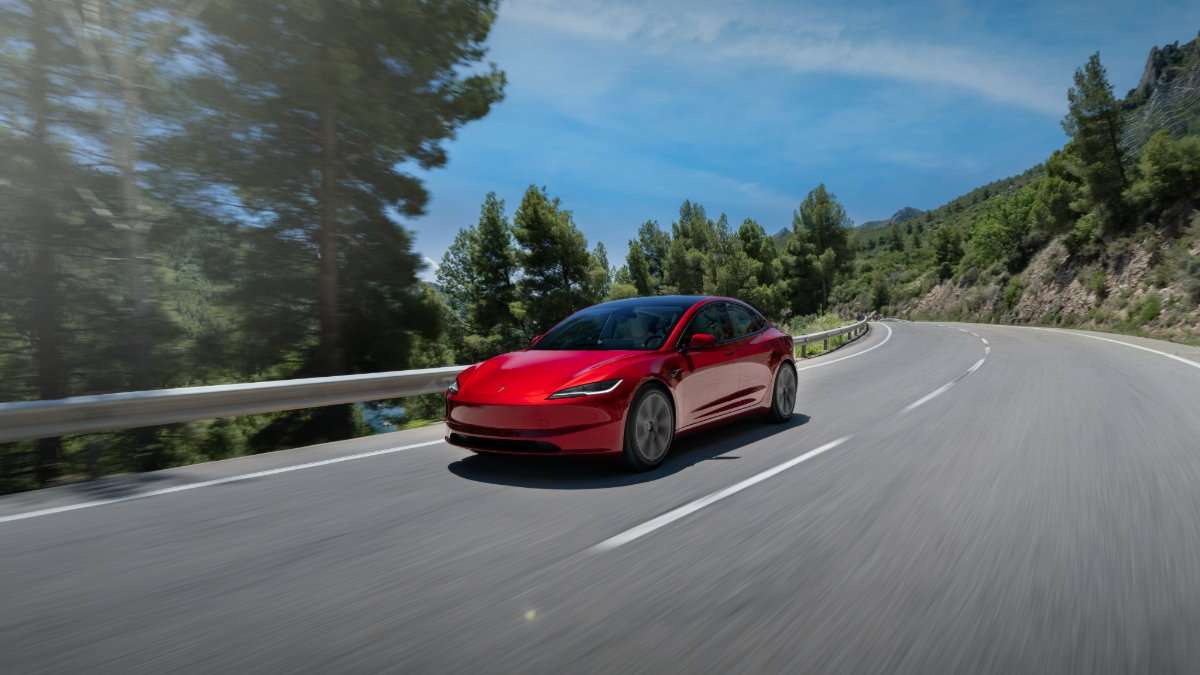

What began as a simple hike ended with a locked door, a dead phone, and a very modern kind of stranded. Not a technological failure, not a design flaw, just a misstep in an age when our cars and our phones share the same heartbeat.
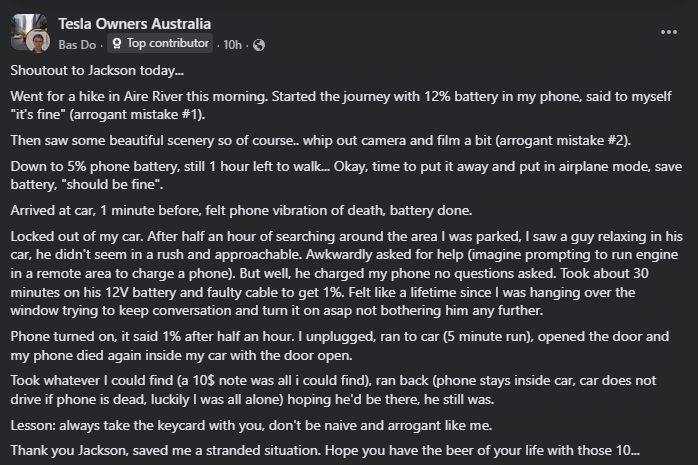
“Shoutout to Jackson today...
Went for a hike in the Aire River this morning. Started the journey with a 12% battery in my phone, said to myself, "it's fine" (arrogant mistake #1).
Then saw some beautiful scenery, so of course,.. whip out the camera and film a bit (arrogant mistake #2).
Down to 5% phone battery, still 1 hour left to walk... Okay, time to put it away and put it in airplane mode, save battery, "should be fine".
Arrived at the car, 1 minute before, felt phone vibration of death, battery done.
Locked out of my car. After half an hour of searching around the area I was parked, I saw a guy relaxing in his car, he didn't seem in a rush and was approachable. Awkwardly asked for help (imagine prompting to run the engine in a remote area to charge a phone). But, well, he charged my phone, no questions asked. Took about 30 minutes on his 12V battery and a faulty cable to get 1%. Felt like a lifetime since I was hanging over the window trying to keep the conversation and turn it on asap, not bothering him any further.
Phone turned on, it said 1% after half an hour. I unplugged, ran to the car (5-minute run), opened the door, and my phone died again inside my car with the door open.
Advertising
Took whatever I could find (a 10$ note was all I could find), ran back (phone stays inside car, car does not drive if phone is dead, luckily I was all alone), hoping he'd be there, he still was.
Lesson: always take the keycard with you, don't be naive and arrogant like me.
Thank you, Jackson, for saving me from a stranded situation. Hope you have the beer of your life with those 10...”
Now, first things first: the Tesla Model 3 is a brilliant piece of engineering. Let’s give credit where it’s due. It’s quick, intuitive, elegantly designed, and quietly reshaping what we expect from personal transportation. But as this story reminds us, brilliance comes with a quiet dependency. The Model 3’s key is not a piece of metal or plastic; it’s an app. It’s a Bluetooth handshake between man and machine, and when that connection dies, so does your access. It’s a new kind of vulnerability, one we’ve invited in willingly for the sake of progress.
The irony is almost cinematic. Here’s a car that can out-drag some performance coupes and beam over-the-air updates across continents, reduced to an inert sculpture because the driver took too many videos of waterfalls. To his credit, the owner, Bas Do, didn’t lash out. As one commenter, Jeremiah Yaoenberg, put it best, “At least you’re taking accountability. Not too long ago, people would do this, have a tantrum, and write articles about the evils of electric vehicles.” This wasn’t one of those moments. It was humility wrapped in technology, a reminder that the weakest link in the chain is often human, not silicon.
Tesla Model 3: Engineering Challenges
- Designing the Model 3’s battery pack required balancing high energy density with cost and safety. Engineers had to innovate cooling and packaging systems to maintain efficiency without overheating or adding excess weight.
- The car’s minimalist interior posed manufacturing difficulties, as integrating all vehicle controls into a single touchscreen demanded new software and hardware coordination. This required rigorous testing to ensure usability and reliability under various conditions.
- Tesla’s shift toward extensive automation in production lines initially caused major bottlenecks. Over-reliance on robots led to slowdowns, forcing engineers to reintroduce human flexibility into certain assembly stages.
- Achieving structural rigidity while reducing material costs drove Tesla to use a mix of aluminum and high-strength steel. The hybrid frame design required precise joining methods to maintain crash safety and performance standards.
Tesla’s system, to its credit, isn’t without backup. Each car comes with a slim keycard that uses RFID to unlock the vehicle and start it. There’s even a key fob and a growing cottage industry of accessories, from Bluetooth rings to bracelets that act as digital keys. Commenter Jeremy Smith mentioned wearing his for surfing, a kind of wearable insurance policy against dead-phone syndrome. The problem isn’t the design. The problem is that we’re so accustomed to technology’s reliability that we forget it occasionally needs a little help, or, in this case, a spare.
The real hero here, though, wasn’t an app or a feature. It was Jackson, the stranger who sat patiently in his own car, lending power, time, and good humor to a fellow traveler in need. It took thirty minutes of trickle-charging from a 12-volt socket and a worn cable to give Bas’s phone enough life to wake up the Tesla. Then came the mad dash across the lot, the brief victory of an unlocked door, and the second death of the phone before the car could drive. One $10 note later, Jackson was found again, still there, still helping, still proving that human kindness hasn’t yet been automated out of the system.
The story has the shape of a parable. A high-tech car in a low-tech predicament. A machine that could drive itself but couldn’t be entered without a charge. The Model 3 wasn’t at fault; it did what it was programmed to do. But moments like this expose the edges of modernity. They remind us that the more integrated our devices become, the more brittle our independence can feel. Convenience is a wonderful thing, until it fails you 200 kilometers from home with 1% on the screen.
Bas’s post found resonance across the Tesla community, not because it mocked the technology, but because it acknowledged the humanity behind it. His closing line, “Always take the keycard with you”, feels almost old-fashioned in its simplicity. It’s the same lesson your grandfather might have offered if he saw you heading off with a half-charged phone and no backup plan. For all of Tesla’s digital brilliance, that advice still holds true.
The Tesla Model 3 remains one of the finest cars ever to wear an electric badge, a vehicle that has redefined what it means to drive in the digital age. But progress is not without its hiccups. As we race forward into a world of software on wheels, it’s worth remembering that some lessons are timeless: keep a backup, trust a stranger, and never underestimate the power of 1% battery and a good Samaritan named Jackson.
Image Sources: Tesla Media Center
Noah Washington is an automotive journalist based in Atlanta, Georgia. He enjoys covering the latest news in the automotive industry and conducting reviews on the latest cars. He has been in the automotive industry since 15 years old and has been featured in prominent automotive news sites. You can reach him on X and LinkedIn for tips and to follow his automotive coverage.
Set Torque News as Preferred Source on Google
Follow us today...