

Software has a way of turning minor service visits into existential moments, especially when it intervenes uninvited.
That tension sits at the center of a recent r/TeslaSupport post from a 2021 Model 3 Performance owner who brought their car in for a simple suspension fix and left with a cascading failure that now threatens to cost more than $2,600 to resolve.
The mechanical issue was trivial. The digital aftermath was anything but.
According to the owner, the original visit was straightforward. A suspension bolt was not fully tightened, Tesla corrected it quickly, and the car should have been on its way.
Instead, while the vehicle was in Tesla’s possession, a technician initiated a “courtesy” software update because the car was several versions behind.
The owner says they did not request or authorize this update. Service logs later confirmed that the update failed mid-process and was aborted by the technician, a detail that was not disclosed when the car was returned.
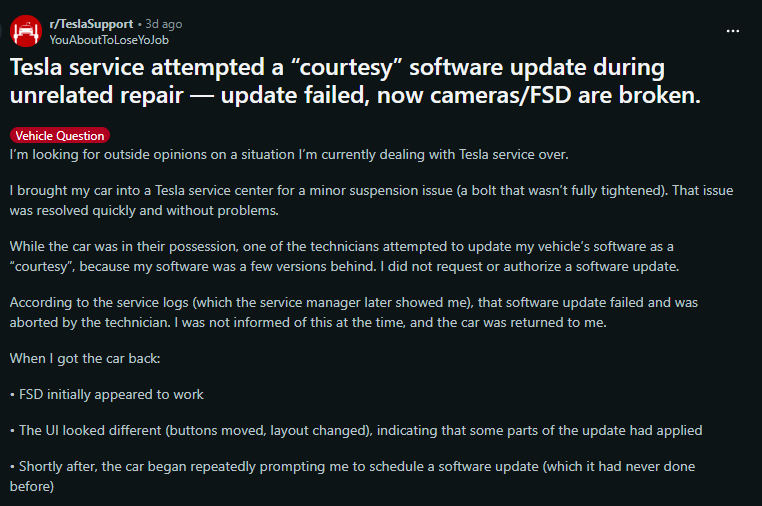
“I’m looking for outside opinions on a situation I’m currently dealing with, Tesla service over.
I brought my car into a Tesla service center for a minor suspension issue (a bolt that wasn’t fully tightened). That issue was resolved quickly and without problems.
While the car was in their possession, one of the technicians attempted to update my vehicle’s software as a “courtesy” because my software was a few versions behind. I did not request or authorize a software update.
According to the service logs (which the service manager later showed me), that software update failed and was aborted by the technician. I was not informed of this at the time, and the car was returned to me.
When I got the car back:
FSD initially appeared to work
The UI looked different (buttons moved, layout changed), indicating that some parts of the update had applied
Shortly after, the car began repeatedly prompting me to schedule a software update (which it had never done before)
Assuming Tesla had already updated the car as part of service, I later allowed the update to proceed. After that point, major issues started:
All cameras stopped working
FSD became unavailable
Software update attempts now fail
Tesla reports a firmware mismatch between computers
I met with the service center manager, and while reviewing the logs together, he pointed out:
Advertising
A communication failure between the main vehicle computer and the FSD/navigation computer during updates
Historical logs showing a thermal/heating-related event on one of the computers at some point in the past
The FSD computer is water-cooled on a shared loop, so diagnosing this would require opening things up and further evaluation
I fully understand that hardware can fail, and I’m not disputing that possibility. However, my concern is that:
The car was functioning normally (including cameras and FSD) before I brought it in
A Tesla technician initiated and aborted a software update without my request
The vehicle was returned to me in a partially updated state
The software-related failures began after that service visit
I’m scheduled to bring the car back in next week for a full diagnostic. In the best case, they can manually reflash the computers and resolve the mismatch. Worst case, they determine a hardware issue exists.
My question to the community:
If a Tesla-initiated update attempt exposes or triggers a deeper issue, does Tesla generally take responsibility for resolving it?
Has anyone experienced a similar situation where a service-initiated update led to firmware mismatch or camera/FSD failures?
Is there anything specific I should be mindful of when going into this diagnostic appointment?
I’m not trying to assign blame unfairly, I just want to understand what’s reasonable to expect here, since the software issue originated while the vehicle was in Tesla’s possession.
Thanks in advance for any insight.
Additional details that may be relevant:
- The vehicle is a 2021 Model 3 Performance
- One of the recurring alerts states that **Adaptive Headlights are not functioning**
To my knowledge, the **2021 Model 3 Performance does not have adaptive headlights**, which makes this alert especially concerning.
Advertising
From my understanding, this suggests a software or configuration mismatch, where the vehicle believes it has hardware that it physically does not.
This alert only appeared after the failed service-initiated software update and subsequent update attempts.
Update:
They just sent my estimate, $2,599.92.”
At first, the car appeared mostly normal. Full Self-Driving initially worked, though the user interface looked different, suggesting that parts of the update had partially applied. Soon after, the vehicle began repeatedly prompting the owner to schedule a software update, a behavior it had never exhibited before. Believing Tesla had already updated the vehicle during service, the owner allowed the update to proceed. That decision marked the turning point.
Tesla Model 3: Floor-Mounted Battery & Acceleration
- The Model 3’s low-slung sedan profile and floor-mounted battery give it a planted feel on the road, contributing to confident cornering despite its relatively simple suspension layout.
- Acceleration is immediate and smooth across trims, shaping a driving experience that feels responsive in everyday traffic without requiring aggressive throttle input.
- Interior design minimizes physical controls in favor of a single central display, creating a clean cabin while shifting routine interactions like climate and wipers into software menus.
- Efficiency remains a defining strength, with aerodynamic shape and relatively low weight helping deliver strong real-world range per kilowatt-hour.
Afterward, multiple core systems failed. All cameras stopped working. FSD became unavailable. Software update attempts now consistently fail. Tesla diagnostics reportedly show a firmware mismatch between the main vehicle computer and the FSD or navigation computer. The car effectively believes it is something it is not, a state that modern vehicles tolerate poorly.
A meeting with the service center manager added more complexity rather than clarity. Reviewing the logs together, they identified communication failures between computers during update attempts and historical records of a thermal or heating-related event affecting one of the computers at some point in the past. Because the FSD computer is water-cooled on a shared loop, proper diagnosis would require deeper disassembly and evaluation. None of this had manifested as a user-facing problem before the service visit.
What troubles the owner is not the possibility of hardware failure in isolation. It is the sequence. The vehicle’s cameras and FSD worked before service. A Tesla technician initiated and aborted a software update without authorization. The car was returned in a partially updated state. Only after that did the failures begin. From the owner’s perspective, the causal chain matters, especially when the proposed solution now carries a four-figure price tag.
One detail underscores the software mismatch concern. The car now throws an alert stating that adaptive headlights are not functioning. The 2021 Model 3 Performance does not have adaptive headlights. That kind of error strongly suggests a configuration or firmware profile that no longer matches the physical hardware, a problem far more consistent with a botched update than with random component failure.
Community responses reflect the fault lines of modern Tesla ownership. Some argue that the responsibility is straightforward: the car should be returned to the same level of function it had before entering the shop, regardless of how that is achieved. Others question why the owner delayed software updates in the first place. The owner’s answer is pragmatic rather than ideological. On HW3 hardware, newer software versions did not meaningfully improve FSD performance, and like many cautious users, they prefer not to update functioning systems simply for novelty.
The real anxiety arrives with the estimate. Tesla has now quoted $2,599.92. That number crystallizes the owner’s concern that the diagnostic will end with a declaration of hardware failure and a bill for new computers, even though the trigger for the issue occurred while the vehicle was under Tesla’s control. It is the classic modern dilemma: when software exposes a latent hardware weakness, who owns the outcome?
This case highlights a broader reality of software-defined vehicles. Updates are no longer benign background processes. They are invasive procedures that can alter system states, dependencies, and hardware interactions. When performed without consent and aborted midstream, they blur the line between maintenance and modification. For owners, the takeaway is sobering. Convenience features like “courtesy updates” carry real risk. For manufacturers, the obligation is clearer. If a car enters service functioning and leaves digitally compromised, restoring it should not be optional or billable.
Whether Tesla ultimately absorbs the cost remains to be seen. But the story illustrates how trust in modern vehicles is built not just on innovation, but on restraint. Sometimes the most valuable update is the one that never happens.
That tension, between what the car is on paper and what it becomes in practice, hangs over the Model 3’s current moment. Tesla is still selling the same essential idea it has for years: an efficient, quick, minimal sedan whose value is as much firmware as it is aluminum and glass. But the closer you look, the more the ownership experience is defined by a series of trade-offs that don’t always show up on the spec sheet, and don’t always feel optional once the car is in your driveway.
The biggest news for the Model 3 in the U.S. over the last few months is the quiet addition of the 2026 Model 3 Standard trim to the U.S. configurator. It effectively brings the Highland-refresh car into the mid-$30k bracket on headline price, at about 36,990 dollars before destination and order fees, roughly 38.6k all-in.
Are you happy with the direction Tesla is going? Let us know in the comments below.
Image Sources: Tesla Media Center
Noah Washington is an automotive journalist based in Atlanta, Georgia. He enjoys covering the latest news in the automotive industry and conducting reviews on the latest cars. He has been in the automotive industry since 15 years old and has been featured in prominent automotive news sites. You can reach him on X and LinkedIn for tips and to follow his automotive coverage.
Set Torque News as Preferred Source on Google
Follow us today...


Comments
Part of the Tesla ownership…
Permalink
Part of the Tesla ownership experience?