

For decades, buying a full-size pickup truck has been understood to include one important caveat: you pay higher prices for fuel in order to have greater capability, more convenient use, and greater versatility. Whether that means hauling your gear, using your truck to commute, or whether you need to get out to your weekend project, you just expect to spend money on gasoline/diesel. The vast majority of people who buy trucks don't bother to calculate what that cost is going to add up to at the end of each year because they already know it's not going to be good.
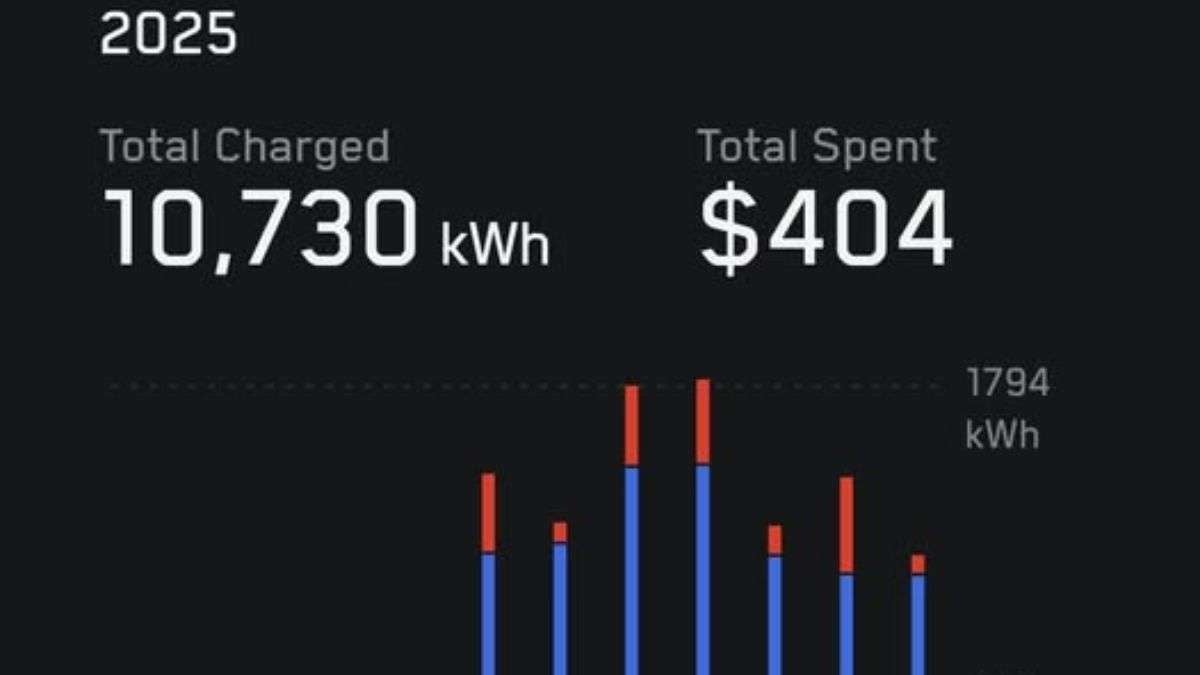
That long-standing assumption starts to feel less solid when real ownership data challenges it, though. Last evening, I was scrolling through the “Cybertruck Owners Only” group on Facebook and came across a post by Ty Alexander. Ty shared a screenshot from the Tesla app showing that after charging more than 10,700 kWh over the past year, the total electricity cost came out to just $404, with the app estimating over $4,000 in fuel savings compared to a gas or diesel truck.
As Ty put it plainly, “It’s going to be hard to go back to a gas or diesel truck.”
A Full Year of Numbers Changes the Conversation
It's the time frame, as much as the actual dollar amount, that makes Ty's post so notable. It's not a 1-month test nor a week-long road trip. This is 12 months of real-world ownership boiled down to a single screenshot. Over that span, the Tesla App estimated that a comparable gas/diesel truck would consume over $4,400 in fuel to travel the exact same miles, while the Cybertruck used slightly more than $400 in electricity.
This type of gap changes the way we think about electric trucks. We're no longer projecting an abstract idea about electric trucks, nor making overly optimistic assumptions. Ty has shown us what happens when you actually own one for a long enough period of time to allow the savings to build up quietly in the background. The cost difference is now impossible to ignore because it is no longer hypothetical.

Home Charging Is the Quiet Advantage
Digging a bit deeper into the data reveals another important detail. Nearly all of Ty's charges came from his home, and only a small amount was done via Supercharger. The fact that nearly all of Ty's charges were from home is important as this represents how most people will live their daily life with an electric vehicle. Home plug-ins make energy costs a predictable one. They help make energy costs almost invisible versus being an ongoing source of annoyance for someone who has to go to a public charging station and spend more money.
This pattern mirrors what many owners have described when talking about how the Cybertruck fits into daily life, including one owner who said it became the most enjoyable vehicle they have owned after years of driving different cars and pickups across a wide range of real-world ownership experiences.
A Truck Story, Not Just an EV Story
It's also worth emphasizing that this is not a compact sedan or a lightweight crossover. The Cybertruck is a full-size electric pickup with the mass, power, and presence that traditionally come with higher operating costs. Seeing those expectations flipped on their head is why posts like Ty’s resonate beyond the EV community.
For truck owners who rely on towing or hauling, questions naturally follow. Can an electric truck still deliver when put to work? We have already seen examples of owners putting the Cybertruck through real towing scenarios, including a detailed account of towing a Cybertruck 350 miles between Los Angeles and Lake Havasu without drama. It shows how the truck behaves when it is actually doing the job it was designed to do rather than simply commuting.
Community Reactions Add Perspective
Ty’s post sparked a wave of comments from other owners, many of whom shared their own experiences to add context to the numbers.
Paul Sy chimed in by posting his own charging stats, showing a total cost of just $31 for 5,458 kWh over the same period.
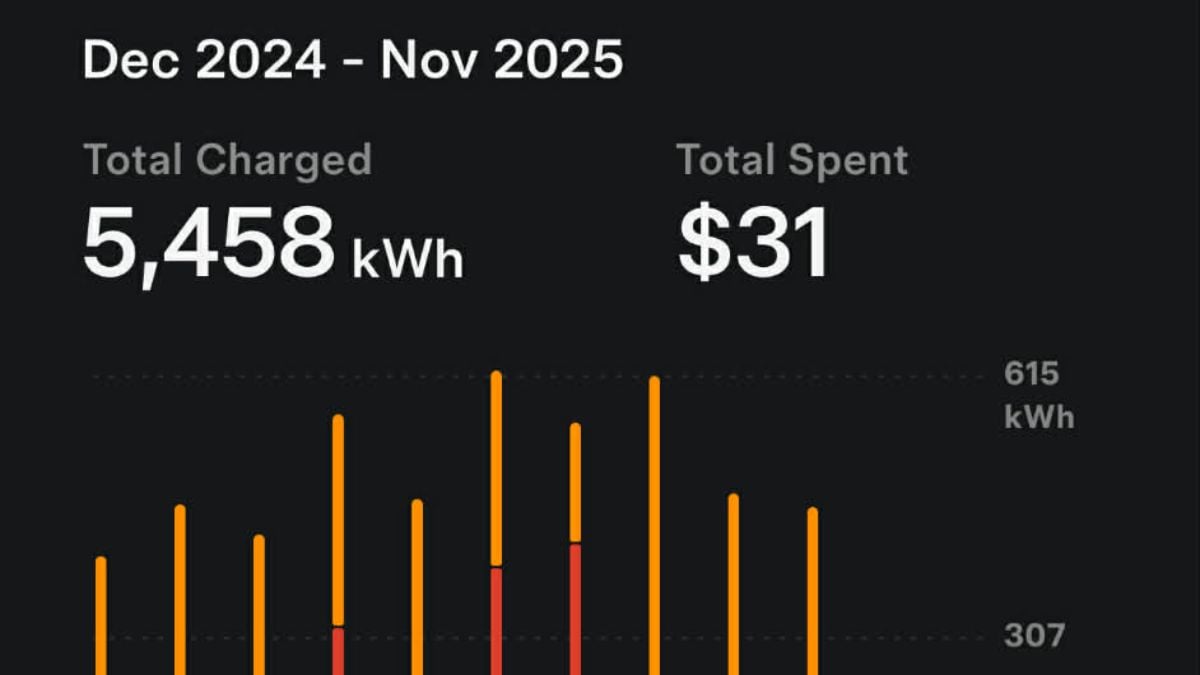
As with every person's situation, a lot of the specific cost will depend on what the electricity rates are and how much the owner drives. But Paul’s numbers are also very consistent in their message. The overall savings from home charging make it seem as though you're paying pennies for each mile of driving on your car when comparing those costs to using gasoline. Seeing multiple people come to the same conclusion can be far more persuasive than any one image or number.
Another commenter, Wyo DP, took a slightly different angle, writing, “If I could get by with only a Cybertruck, I would buy one tomorrow.”
That statement introduces an important point of balance. The Cybertruck clearly works extremely well for some lifestyles, but not every truck owner lives the same way.
The Cybertruck Is Not a Universal Replacement Yet
I believe Wyo DP's post was one of the most realistic posts on this forum. While the Cybertruck is very efficient, performs well, and has lower operating costs than a typical truck, it does not provide a "one size fits all" solution to heavy-duty towing, remote work sites, or extended time spent working or camping in off-grid locations as would be best accomplished with diesel trucks.
The fact that the Cybertruck can't do everything doesn’t negate the significance of the Cybertruck as an example of the current state of electric truck technology, though. It actually shows how much farther electric truck technology has to go to achieve the same sustained work output as a traditional diesel truck. The technology for improving battery energy density, building out charging infrastructure, and managing heat continues to advance; however, sustaining the continuous use of a diesel truck has been difficult to duplicate. This is also perfectly fine. All progress does not have to be in the form of replacing every single vehicle on the road today.
Plus, we can see that trade off from other owner stories. Those who regularly tow boats or trailers have shared their decision-making process when comparing traditional trucks to electric alternatives, weighing real-world performance, range, and practicality before deciding what best fits their needs when choosing between other trucks or a Tesla Cybertruck after real-world use.
Why This Shift Matters More Than the Dollar Amount
What stands out about Ty's post, though, isn't the savings figure itself but the total mindset shift he illustrates. When you buy a truck, there are always tradeoffs. For instance, you have to pay for fuel, which means you also get the advantage of capability. You give up some comfort because you have to accommodate your truck's size. What electric trucks like the Cybertruck are doing is gradually taking away a few of those compromises from a growing segment of truck buyers.
That is why "it is hard to go back" seems to be a very sincere statement to me. Once you've experienced a full year of truck ownership with basically no measurable expense for energy, it will completely alter how you assess all other aspects of owning a vehicle. They won't disappear overnight, but they will begin to create "mental math" problems for owners who need to use a gas or diesel truck when an electric truck meets their needs. I believe this kind of long-term data is far more persuasive than spec sheets or marketing claims, as it shows how technology reshapes expectations slowly, one year at a time, without fanfare.
Key Takeaways for Truck Shoppers
- Long-term data matters more than short tests: A full year of ownership reveals patterns that short drives never will.
- Home charging is a game changer: Predictable electricity costs fundamentally alter operating expenses.
- Electric trucks are not all-or-nothing: They excel in many roles but are not yet ideal for every heavy-duty use case.
- Mindsets evolve with experience: Once savings become routine, it's difficult to ignore their impact on ownership decisions.
Your Turn to Share
If you own a truck, have you ever totaled what you actually spend on fuel for over a full year? Did it change how you think about ownership?
And for those considering an electric truck, what would it realistically take for you to say, "it would be hard to go back to gas or diesel?"
I'd love to hear your opinions in our comments section below.
Aram Krajekian is a young automotive journalist bringing a fresh perspective to his coverage of the evolving automotive landscape. Follow Aram on X and LinkedIn for daily news coverage about cars.
Image sources: The “Cybertruck Owners Only” Facebook group and Tesla’s gallery.
Set Torque News as Preferred Source on Google
Follow us today...







Comments
We're curious if he's also…
Permalink
We're curious if he's also enjoying the steep depreciation curve. Why do no buyers discuss that?
In the same vein, nor do…
Permalink
In reply to We're curious if he's also… by Buzz Wired (not verified)
In the same vein, nor do they discuss estimated battery life and the estimated cost of replacement of said batteries. A 10 year old diesel truck engine is likely good for another 10 years. Is a 10 year old cybertruck (with original battery) going to be good for another 10 years? I’d love to have an electric vehicles, but I just can’t justify paying a premium for a vehicle that I don’t expect to last as long due to the expected life of the battery. Just my opinion, but the reason depreciation is so steep on electric vehicles is that the batteries die slowly over time reducing mileage capability and usefulness of the entire vehicle. People don’t tend to talk about it, but it seems obvious they know that based on the price they’re willing to pay for a used one.
At the cost of purchase for…
Permalink
At the cost of purchase for the cybertruck, this is a dumb argument.
He does not live in…
Permalink
He does not live in California otherwise it would have been in the $4K plus range.
I would also like to know…
Permalink
In reply to He does not live in… by Mark Phillips (not verified)
I would also like to know how many miles he traveled, average speed, and average temperature.
I have solar and could…
Permalink
In reply to He does not live in… by Mark Phillips (not verified)
I have solar and could charge for free, but charging at super chargers would be in excess of $5k. California here. But like another commentator said. “ the initial cost makes this a stupid argument.” plus look at what people pay for insurance. I signed up for one of these trucks right away, but the lie about range, that Access from the cab, and price caused me to cancel it immediately after prices came out.
The app is lying or doesn't…
Permalink
The app is lying or doesn't know how to do math. Where the hell did he live where 11k kwh is only $400?
Anyone with a calculator can…
Permalink
Anyone with a calculator can disprove this. Even at the lowest off peak rates, 5 cents a kWh, 10k kWh is still $500. 5000 kWh is $250. That's about 4 to 5 months of the average American home's usage, and he's trying to say he only paid $31. That comes out to .6 cents per kWh. Not a single provider in the world offers electricity that cheap. Depending on region, time of the year, and even day of the week, rates are higher. Much higher in certain places. California is 20 cents for off peak, and about 35 cents for regular rates. Rather than actually calculating the usage, they're using an app than is obviously giving them fraudulent numbers. If you have to lie to justify your decisions, it wasn't a good decision.
The math doesn't quite pan…
Permalink
The math doesn't quite pan out on the monthly chart. Where on earth does one get 5,458 kWh for $31? That's $0.0056 per kWh — roughly half a penny
My commercial fee In NY is $0.09 kWh, plus delivery charges which adds up to about $0.30 per kWh. I drive my Ioniq 5N 1,500 miles per month, while the cars efficiency averages out at 2.1 miles per kWh
1,500/2.1 = 714.28 kWh
714.28 x $0.30 = $214.29
Still way cheaper than my gas vehicle, but the math in the article needs to be verified.
Imagine putting faith in the…
Permalink
Imagine putting faith in the data your Tesla app gives you like they aren't habitually found to be engaging in fraud.
The national average for 1…
Permalink
The national average for 1 kWh of electricity is 18¢. This means that in the first instance, the price paid, on average would have been $1931.40 for 10,730 kWhs of electricity.
Likewise for the second example as well; $31 for 5,000 kWhs is absolutely fake. And I can just about guarantee that driving any EV for a while year will take a LOT more electricity than 10 kWhs. Heck, I use more than triple that just to keep my lights on and my water hot (outdoor wood boiler, so no electric heat, either).
These numbers are completely untrue.
I really would like to know…
Permalink
I really would like to know where someone is only paying $.04 a KW. The story is flawed. My rate is $.17 so still $1700 better then $4000.
Depreciation Useful load…
Permalink
Depreciation
Useful load
Towing capacity.
For the same gvwr my F-350 outperforms the cyber truck in every category by factors of 2:1 and 3:1. Yes it burns fuel. But it’s also an expense I can write off in my business (better than the catastrophic depreciation )
Okay now post your monthly…
Permalink
Okay now post your monthly payment and monthly insurance costs LOL