

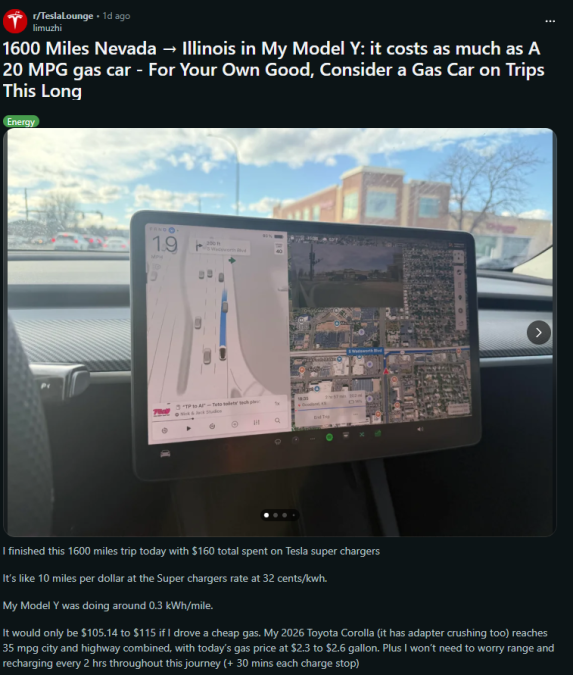
Road-trips have a way of exposing the difference between spreadsheet logic and lived experience, and few recent posts illustrate that better than a Tesla Model Y owner’s 1,600-mile trek from Nevada to Illinois. After tallying the receipts, the owner reported spending about $160 on Tesla Supercharging for the trip. That number alone might sound reasonable, even efficient, until it is framed against the comparison that really stuck with readers: it worked out to roughly the same fuel cost as driving a 20-mpg gasoline car, with none of the five-minute fill-ups that make long days on the interstate flow smoothly.
The owner broke the math down plainly. Supercharger rates averaged around $0.32 per kWh, and the Model Y consumed about 0.3 kWh per mile. That translates to roughly ten miles per dollar, or about ten cents per mile. Over 1,600 miles, the total landed right at $160. By contrast, a basic gasoline car returning 35 mpg at $2.30 to $2.60 per gallon could have completed the same trip for closer to $105 to $115, while stopping whenever and wherever fuel was convenient.
“I finished this 1600-mile trip today with $160 total spent on Tesla superchargers.
It’s like 10 miles per dollar at the Supercharger's rate at 32 cents/kwh.
My Model Y was doing around 0.3 kWh/mile.
It would only be $105.14 to $115 if I drove on cheap gas. My 2026 Toyota Corolla (it has an adapter crushing too) reaches 35 mpg city and highway combined, with today’s gas price at $2.3 to $2.6 gallon. Plus I won’t need to worry about range and recharging every 2 hrs throughout this journey (+ 30 mins each charge stop).”
Cost, however, was only half the frustration. The other half was time. The Model Y required charging roughly every two hours, with each stop taking around 30 minutes. Over a multi-day drive, those pauses added up, not just in minutes but in mental load. Planning stops, waiting for charging to taper, and watching progress bars replace the simple ritual of pump, pay, and go changed the rhythm of the trip. What might feel manageable on a shorter journey became wearing when repeated again and again.
Tesla Model Y:
- The Model Y’s compact crossover shape emphasizes interior efficiency, offering generous passenger and cargo space relative to its exterior size.
- Suspension tuning skews firm, contributing to stable handling but transmitting more road texture on rough or uneven pavement.
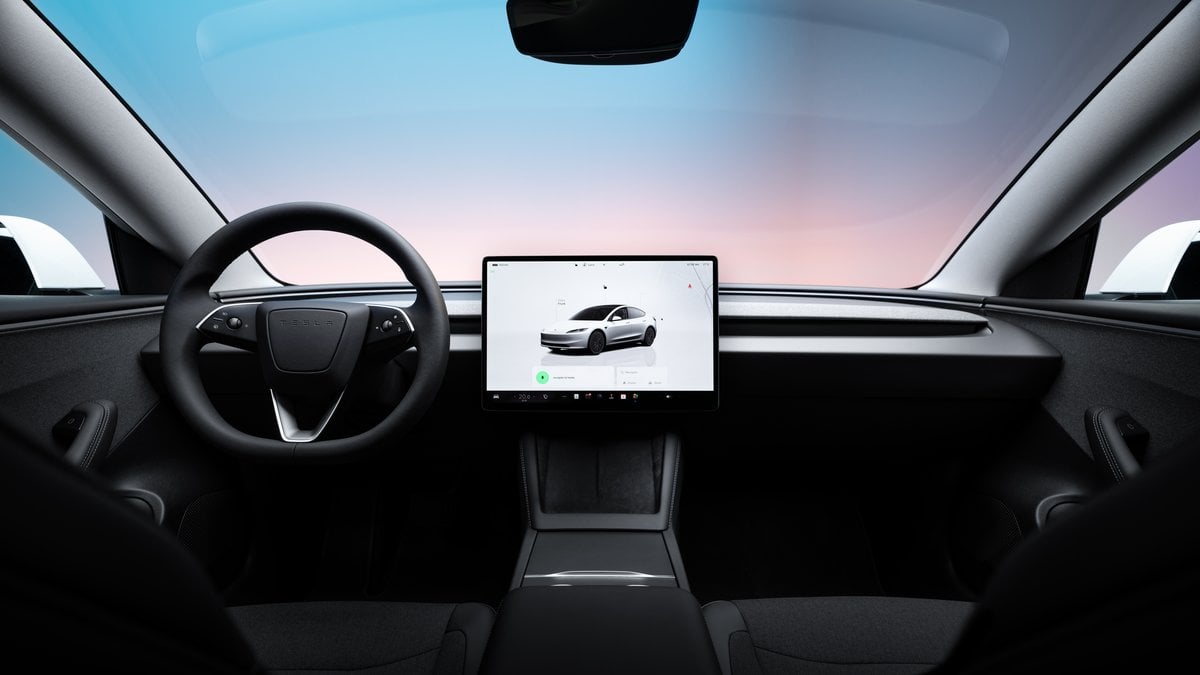
- Most vehicle functions are consolidated into the central touchscreen, simplifying the cabin layout while increasing dependence on software for routine adjustments.
- Efficiency is a consistent strength, with aerodynamic design and relatively low mass supporting a strong real-world range in mixed driving.
This is where the owner’s conclusion sharpened. The argument was not that electric vehicles are inherently more expensive, but that on trips this long, public fast charging erodes the traditional EV advantage.
Highway Supercharging is priced as a premium service, and when electricity costs approach gasoline on a per-mile basis, the trade-off becomes one of convenience rather than ideology. In that light, gasoline starts to feel practical again, not because it is cheaper in absolute terms, but because it is easier.
The comments quickly filled in the missing context. Several owners pointed out that focusing on a single road trip can be misleading. Over tens of thousands of miles, home charging dramatically lowers average energy costs. One commenter noted an average of under five cents per mile over 80,000 miles of ownership, far cheaper than any gasoline car they had owned. Another reminded readers that most EV savings are realized at home, not at highway chargers designed for speed and turnover rather than economy.
Others pushed back on the comparison itself. A Corolla and a Model Y are not the same class of vehicle, they argued, and few people would choose a compact economy sedan for a 1,600-mile road trip if comfort, power, and driver assistance mattered. Some also noted regional differences, pointing out that gasoline prices in the United States are unusually low by global standards, making EV road-trip economics look worse than they would in places like Canada or Europe.
Still, the original post resonated because it captured something numbers alone cannot. Road trips are about momentum. Gasoline infrastructure is built to preserve it, while electric infrastructure still interrupts it. Thirty-minute stops can be pleasant once or twice, but they feel very different when they define the cadence of a long journey. Even drivers who love their EVs often admit that this is where the experience remains compromised.
What makes the discussion useful is its honesty. The owner did not claim regret over buying a Model Y, nor did they argue against EVs as daily drivers. The advice was narrower and more practical: if you regularly do very long highway trips and value flexibility over everything else, a gas car may still be the better tool today. That is not heresy. It is situational awareness.
The broader takeaway is that EV economics are no longer a simple binary of cheap electricity versus expensive gasoline. Public fast charging has matured into its own category, with pricing, congestion, and trade-offs that resemble premium fuel rather than a bargain alternative. As that reality sets in, buyers are learning to separate daily efficiency from road-trip practicality.
The Model Y completed the journey without drama, which itself says something about how far EVs have come. Yet the owner stepped out with a quiet, uncomfortable truth: sometimes the advantage you expect does not show up when you need it most. Until charging is faster, cheaper, or both, there will still be trips where the gas pump, for all its faults, feels like the simpler answer.
Image Sources: Tesla Media Center
Noah Washington is an automotive journalist based in Atlanta, Georgia. He enjoys covering the latest news in the automotive industry and conducting reviews on the latest cars. He has been in the automotive industry since 15 years old and has been featured in prominent automotive news sites. You can reach him on X and LinkedIn for tips and to follow his automotive coverage.
Set Torque News as Preferred Source on Google
Follow us today...







Comments
Well, to be honest for now…
Permalink
Well, to be honest for now EVs are great for city driving especially if you do not live in extreme heat or cold.
Also Tesla is falling behind. In Europe other car companies are upgrading to 800V charging that is much faster.
This is ridiculous. My model…
Permalink
In reply to Well, to be honest for now… by Steve (not verified)
This is ridiculous. My model Y gets nearly 5 miles per KWh, always over 4. This guy is suggesting he’s only getting .3 miles/kwh. I think his math is wrong.
Maybe he was doing 85 other…
Permalink
In reply to This is ridiculous. My model… by Todd (not verified)
Maybe he was doing 85 other 90mph.
Also, if you drive an ICE vehicle 5000 miles. You need to account $100 fir oil change.
Every let's say 30k miles. Brake shoes. These are not required in TESLA if driven properly. With a TESLA in FSD, you're not burned out from long drives and if safety features are on and set properly, it dodges animals crossing the road at night in the rain like a pro. My tire replacement has been at 60k miles and next one, 130k or 140k.
Speaking as an actual EV…
Permalink
In reply to This is ridiculous. My model… by Todd (not verified)
Speaking as an actual EV owner for the past 5 years, this article reeks of oil money.
Agreed. Not comparing apples…
Permalink
In reply to This is ridiculous. My model… by Todd (not verified)
Agreed. Not comparing apples to apples.
What about maintenance costs that were not factored in? IE I’ve had my model 3 since 2018 and have paid for three sets of tires and two 25.00 air filters and a fluid flush for 250.
I charge at home at night with solar stored in my battery back up.
My point is I’m sure the trip to Chicago is 100 percent valid. Overall maintenance of an EV is much less and that too should be factored in.
A Camry hybrid on gas is…
Permalink
In reply to This is ridiculous. My model… by Todd (not verified)
A Camry hybrid on gas is half the price of using the Tesla y at a supercharger per mile
You're comparing a 4,400lb…
Permalink
You're comparing a 4,400lb model Y to a 3,000lb Corolla here. A Highlander would be more appropriate to compare to.
Also, gas is very cheap right now and electricity is very expensive, historically speaking.
I agree that for longer…
Permalink
I agree that for longer trips an EV cane make the trip more complicated an add some time but that is based on your need in my experience. If I need to get somewhere on a long trip fast, gas is the way to go. However, so often enjoy my stops every 2-3 hours in my Tesla to charge so I can stretch my legs and so on. However, when I am at home I have a leased charger through my power company (Florida Power and Light) where I pay $31 a month for the charger lease and no charge for power if I charge between 10pm and 6am. I used to pay around $150 to $200 a month in gas but now $31 a month gets me all the places I need to go around where ai live. I also agree, that I don’t pay for any oil changes, have never had to replace brake pads yet and so on. Honestly, I just like the way my Tesla drives, looks and the technology. The savings on cost to drive (fuel) and maintenance is a nice bonus.
Thanks for the informative…
Permalink
Thanks for the informative article. Being an EV owner(chevy Equinox) and ICE owner(Subaru Outback), I have found the same to be true. EV's excel with home charging and my ICE vehicle excels on long road trips. I think the perfect two car family consists of an EV and a hybrid.
Reporting 15+ year old news?…
Permalink
Reporting 15+ year old news? Weird. I’d still never drive anything other than my Tesla.
Such a shame you have to drive cross country more than your normal commute to an from work where it costs about $7.50 per 300 miles.
Oh, and I’ve never stopped for longer than 20 minutes. You leave when the car tells you to leave which I’ve never seen over 20 minutes. By “playing it safe” you cause your next charging period to be slower on top of adding more minutes to a charge you don’t need.
They should advertise “smart people only” when selling a Tesla.
This entire article is…
Permalink
This entire article is fraught with inaccuracies. The author and editor should be shamed for publishing this as fact. You are doing a bad job if you are trying to build a reputation as a reliable news outlet.
Did anyone even try to do…
Permalink
Did anyone even try to do the math? Where does one find $2/gallon gas
In general I agree with the…
Permalink
In general I agree with the results. If you’re driving from Nevada to Illinois constantly, I’d never have an EV. If your only method of charging is a supercharger, I’d never buy an EV either. But, having an EV doesn’t prevent you from having the occasional road trip, and yes it will take you longer. That said, for day to day living I charge at home, so in that case electricity is around a fourth of the equivalent cost of gas and worth it on that alone to have one.
An EV is an investment with…
Permalink
An EV is an investment with long-term benefits for typical drivers. I agree with Noah. Long trips expose the cost and inconvenience of owning an EV. We had a similar experience with our Model S going from Oklahoma to Iowa in December. Horrible waste of time charging at stations located too far from any convenience stores, so forced to watch Netflix while charging. Superchargers ain’t cheap either! Don’t think we saved any money on that trip.
Since then we’ve learned. We’ve put over 30k miles on the car driving around town and occasional 200-300 mile round trips. We’ve saved thousands in fuel and maintenance. Tesla came to our house to 1) replace and program a FOB - $125, and 2) replace a door handle actuator - $110. No oil changes, no spark plug/ignition/starting/radiator/water pump/belts/pulleys, etc.
We might rent a car if we have to go north for another winter funeral, but we’re not selling the Tesla! We frequently make round trips under 200 miles and don’t have to charge until we get home. Thanks to solar panels, charging this car at home is ridiculously cheaper than buying any amount of gas. (I know solar panels aren’t cheap, so we planned for a way to keep daily expenses as low as possible).
We wake up to a “full tank” for a fraction of the equivalent gas needed to drive a similar sedan the same distance. The impact on our electric bill is negligible and there’s no waiting in our garage, also not concerned with credit card skimming.
Where the Hell can you find…
Permalink
Where the Hell can you find gasoline for $2.30 a gallon,the UAE? Here in Southern California I’ll be lucky to find it for $3.75-$4.00 a gallon for regular so the math this guy made would not be my same math.