
A new Tesla owner posted to a popular Facebook Tesla club this week, asking for help. We can view her profile and posting history, and we can see she is not a troll. She’s been a member for many months, has posted images of her Tesla Model Y (Juniper), and this was not her first post. We’ll call her MMD in our story to keep her identity private. Here’s MMD’s help request as posted. The post was accompanied by a sad face emoji:
So what do you guys do that live in cold climates? My (Model Y Juniper) is frozen solid and is unusable. Had to get in through the back door and climb up to open the front door. The front door now won’t shut because the window is frozen and won’t budge. The windshield wipers are frozen and won’t work. I can’t drive now because the door won’t stay shut.
As a person with a home in Central New Hampshire, whose family has been in the area since it was a colony of England, I can relate to MMD’s situation. There have been many mornings at or below 0F when I have wondered whether my car would start and run after cold-soaking for 12 hours or more. Also, for the past few years, our weather pattern has been very tough. We get one to three inches of snow during the day, which is immediately followed by a warm-up and then severe cold. The place is covered in ice, and vehicles not parked indoors suffer from being coated in ice. De-icing a windshield can take a long time.
This story reminded us of another Tesla owner who reported: Because of a Design Flaw On My Tesla Model Y Juniper I Had to Drive Ten Miles In the Dark With Almost No Headlights Because Snow Accumulated In Its Recessed Light Bar That Blocked Both the Headlights, and the Forward-Facing Camera
We’ll explain some of the pluses and some of the minuses of Tesla Model Y vehicles in severe cold. We’ve tested EVs in her neighborhood for years and know how they can be made to work, and what the challenges are. We can also offer some expertise on which cars are “better in winter” than Tesla cars as delivered from the factory. First, let’s look at some supportive fellow owners’ responses to MMD’s help request, starting with a pair of fellow owners’ validation of this issue with Tesla cars (and perhaps cars in general):
RZ - Even though my Model Y can warm up inside from 23° to 65° in 7 minutes,
the door handles remain frozen, and I am unable to get inside the vehicle.
PA - I’ve had this issue when traveling to ski resorts such as Mammoth or anywhere in Utah with single-digit temps without access to charging, no garage, just parked outside collecting ice, minutes away from super charger.
RW - I suggest a snow car cover or winter car cover. It is designed to shield your vehicle from snow, frost, ice buildup, and freezing temperatures—perfect for harsh winters like those in Cheektowaga, New York.
SRR - Push the skinny part of the door handle to crack the ice, then push the big part. Repeat as necessary.
DN - Use the “ defrost car” mode. Other than a door handle sticking once in a while, all windows are cleared, wipers are heated, inside the car is warm and toasty, seats are warm. After snow and ice, I do find myself having to clear the headlights. LEDs do not produce enough heat, so I have to get out and clear the lenses of snow and ice. Otherwise, it’s like the lights are not even on; that’s how bad the snow / ice-covered lens shields the light from coming through.
AE - Turn the climate controls on through the app. That will heat the car from the inside.
There are many great suggestions for MMD in those comments offering help. Of course, it would not be a Tesla club without the mean and nasty members who can’t wait for a Tesla owner to ask a question so that they can call them dumb and make them feel bad. Here are a few of those comments we noted:
TW - I think it's the driver that is unusable.
CA - A frozen car is not unique to Tesla.
PC - We move to warmer places.
TZ - User error (with image of a cartoon holding a brain)
Sadly, there are people who treat fellow owners as dummies, even when multiple other members in the very same group validate their post by saying the same has happened to them. We know how to deal with this situation, and would like to suggest the following:
1) Use the vehicle’s defrost features well before you need them. Budget 15 minutes of time.
2) Use the very best washer fluid you can in your reservoir. Find the jug with the lowest temperature rating.
3) Use the Tesla app to unlock the doors, not the handle.
4) If ice is in the forecast, leave the wipers up instead of nesting in their usual resting spot. Try Controls > Service > Wiper Service Mode.
Harsh Winters Mean Special Tires
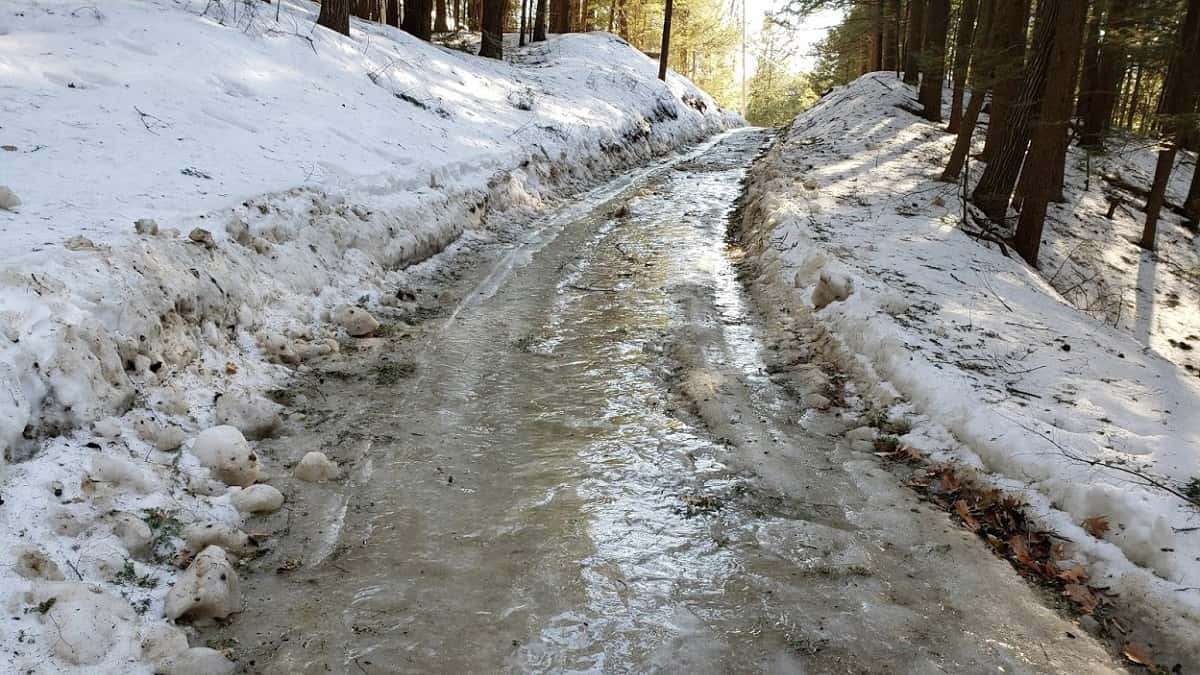
We all know that Tesla’s Model Y has an amazing powertrain. Moving forward is not the big challenge in winter. Stopping and turning is. In addition to the above, we’d strongly recommend dedicated winter tires like the Michelin X-ICE or Bridgestone Blizzak series of tires. If the car is covered in ice, the roads are likely to be challenging. The image above is the actual road I use to access my cabin. Many of my neighbors use studded winter tires, and we all have slip-on ice cleats in our cars in case we need to park at the end of our road and walk in.
Better Winter Cars With Great Winter Features
As good as the Model Y is in winter, there are many commonplace, affordable vehicles that have features that make them better in winter. For example, the Kia Sportage X-Pro has a heated windshield option. Not the little elements along the bottom (which are actually very helpful). A full mesh that warms the entire windshield in seconds and can melt thick ice. This windshield also helps prevent the wipers from freezing up while driving in freezing rain and ice.
Many vehicles have wipers that can be lifted up when the vehicle is parked with one finger. This is extremely helpful for those of us who must park outside in icy weather. With the wipers up, the ice is much easier to clear, including the air entry vents for the defrost system. Sure, most cars have a service mode that lets you lift them, but it’s a hassle in the real world.
Many vehicles from many manufacturers now ship from the factory with tires that display the three-peak mountain snowflake symbol, denoting severe snow-duty capability. These all-weather tires are now extremely popular in MMD’s area of New Hampshire. The Michelin CrossClimate2 is the most popular, but the Goodyear Assurance WeatherReady2 is also great. These tires can stay on in summer, making them more livable than having two sets of tires with a dedicated winter set. You probably already know that Subaru has many models with this type of tire, but did you know that the Ford Mustang Mach-E Rally also has them?
We all know that EVs can plug in and use the line energy for cabin conditioning. ICE cars can also condition their cabins. However, some go further and can be plugged in so that the engine oil stays warm. For example, the Ford Bronco Sport has an engine block heater that is optional on many trims and is standard in some regions.
Most cars have a snow or slippery drive mode, but the best of the best have more than one. Subarus have dual X-mode. One mode for regular snow, and one for deep snow. Ford’s Bronco Sport has four different drive settings for use in snow and on ice. The last Model Y we were in didn't have any snow mode. Just slip start.
Last, but not least, many vehicles have spare tires. In 2026, every top-selling model in America has a spare tire on multiple trims. Except for the Model Y. The RAV4 has a spare tire in every trim, including its plug-in. Why is a spare a winter feature? Because being towed in winter is hazardous, and being without your car while you await a tire means delays.
Tesla’s Model Y is certainly capable of working in cold weather. Most all-wheel drive crossovers are manageable. However, the truth of the matter is, Tesla’s Model Y lacks many of the features that folks who live in areas with very bad winter weather find useful.
What advice would you offer MMD? What have you done in your Model Y that has made winter a bit more tolerable and safer? Tell us in the comments below.
Related Story - Fact Check - Are Snow Days Better In a Tesla Model Y?
Image of icy road in central New Hampshire by John Goreham
John Goreham is the Vice President of the New England Motor Press Association and an expert vehicle tester. John completed an engineering program with a focus on electric vehicles, followed by two decades of work in high-tech, biopharma, and the automotive supply chain before becoming a news contributor. He is a member of the Society of Automotive Engineers (SAE int). In addition to his fourteen years of work at Torque News, John has published thousands of articles and reviews at American news outlets. He is known for offering unfiltered opinions on vehicle topics. You can connect with John on LinkedIn and follow his work on his personal X channel or on our X channel. John employs grammar and punctuation software when proofreading, and he sometimes uses image generation tools.
Set Torque News as Preferred Source on Google
Follow us today...