
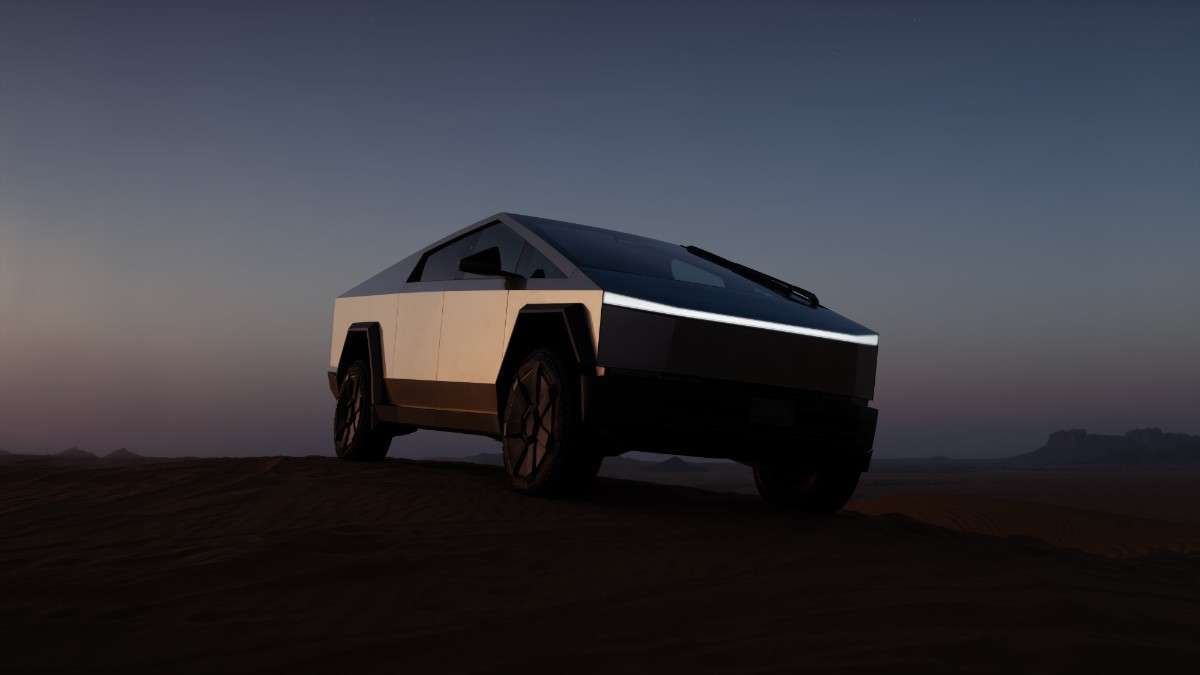

Let’s talk about Alaska, not the cruise ship commercial version, but the real one. It used to be Russia’s. But eventually, they sold this frozen frontier to the United States in 1867 for $7.2 million, which wouldn’t buy a strip mall in Ohio today. And now, 158 years later, we’ve taken that same territory and rolled through it in a 6,800-pound slab of cold-formed stainless steel built in Austin, Texas. That’s the story here: a Tesla Cybertruck towing 2,600 pounds through America’s last frontier, with electricity in its veins and gravel under its all-terrain tires.
Grey Inks of the “Cybertruck Owners Only” Facebook group recently shared a real-world odyssey:.
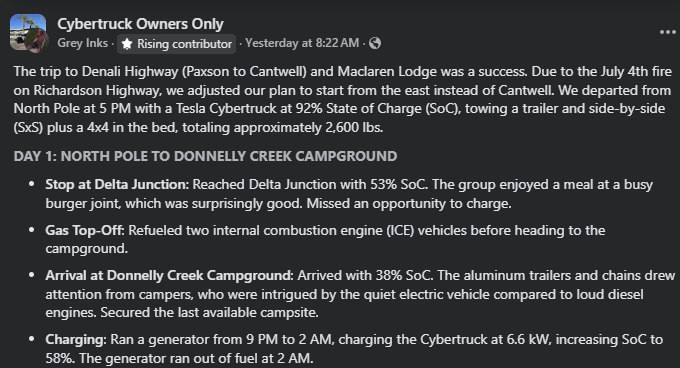
“The trip to Denali Highway (Paxson to Cantwell) and Maclaren Lodge was a success. Due to the July 4th fire on Richardson Highway, we adjusted our plan to start from the east instead of Cantwell. We departed from North Pole at 5 PM with a Tesla Cybertruck at 92% State of Charge (SoC), towing a trailer and side-by-side (SxS) plus a 4x4 in the bed, totaling approximately 2,600 lbs.
Day 1: North Pole to Donnelly Creek Campground
Stop at Delta Junction: Reached Delta Junction with 53% SoC. The group enjoyed a meal at a busy burger joint, which was surprisingly good. Missed an opportunity to charge.
Gas Top-Off: Refueled two internal combustion engine (ICE) vehicles before heading to the campground.
Arrival at Donnelly Creek Campground: Arrived with 38% SoC. The aluminum trailers and chains drew attention from campers, who were intrigued by the quiet electric vehicle compared to loud diesel engines. Secured the last available campsite.
Charging: Ran a generator from 9 PM to 2 AM, charging the Cybertruck at 6.6 kW, increasing SoC to 58%. The generator ran out of fuel at 2 AM.
Day 2: Donnelly Creek to Denali Highway
Morning: Ran the generator for two additional hours while preparing breakfast (eggs, gravy, biscuits, and bacon). This provided enough charge to continue.
Advertising
Drive to Denali Highway: Departed for Denali Highway, arriving at our campsite around 6 PM after a scenic drive. Earlier, we enjoyed a one-hour trail ride, navigating deep water led by my fat-tire electric bike.
Camp Setup: Set up camp and prepare for the next day's off-road adventure.
Day 3: Maclaren Creek Trail
Morning: Woke early, fueled by breakfast, and left the Cybertruck charging at camp via the generator. Departed by 9 AM for the Maclaren Creek Trail.
Trail Ride: Enjoyed a perfect day on the trail under sunny skies. Returned to camp without issues.
Reflection: The trip was a memorable adventure, and I’m eager to return for more off-road exploration.”
The group’s route took them down the Denali Highway, a 135-mile gravel spine running across Alaska’s interior. This road is no place for the faint-hearted or poorly prepared. It’s where suspension geometry matters, and so does knowing how to coax every last amp from a generator at 3,000 feet above sea level.
Why the Tesla Cybertruck’s Stainless-Steel Exoskeleton Faces International Import Bans
- Cybertruck’s stainless‑steel exoskeleton doesn't meet several countries’ crash/safety regulations, resulting in import bans in some regions.
- Major Canadian insurers have declined to cover Cybertrucks, viewing them as “armored vehicles,” citing both safety and repair concerns.
- In parts of the U.S., homeowners’ associations have prevented Cybertruck owners from installing home chargers, leading to legal battles and bans.
- Some Cybertruck owners avoid driving in rain due to the difficulty cleaning its stainless‑steel shell, leading to informal usage bans in wet climates.
The Cybertruck, burdened with two machines in tow and 2,600 pounds of extra mass, didn’t flinch. The story lives in the details: arriving at Donnelly Creek Campground with 38% battery, quietly taking its place among roaring diesels. A few hours of 6.6 kW generator charging later, it was up to 58%. That’s the kind of practical compromise we’re going to see more of as EVs stretch their legs beyond paved roads and curated Supercharger routes. One commenter asked, “How did it handle the washboard sections?” The answer came back steady, with mass and confidence.
Why the Tesla Cybertruck Was Born for Off-Road Adventures (Generator Hack Included)
Let’s be honest, this kind of adventure is exactly what the Cybertruck was made for, even if Tesla didn’t quite say it out loud. Sure, official Tesla literature doesn’t recommend portable generators. But out there, in the middle of nowhere, it's not about corporate policies.
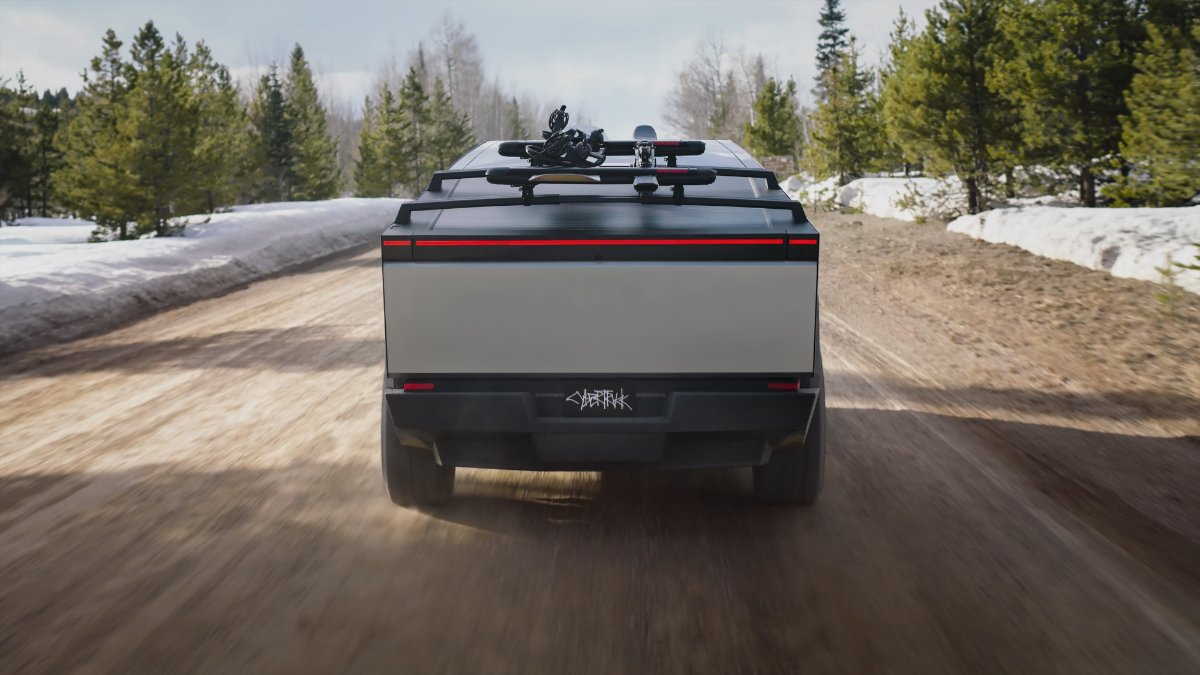
It’s about making it to the next trailhead. “Necessity became the mother of invention,” one user commented, summing it up. These folks cooked breakfast while charging, used a fat-tire e-bike for water crossings, and ran gas into a generator to feed a battery that powered an electric truck. Call it a contradiction, or call it the modern American road trip.
The Maclaren River Lodge, a long-established waypoint on this remote path, stood as a reminder that adventure still needs infrastructure. It’s just far enough from everything to feel like you’re somewhere else. That’s the kind of place where you can talk trail conditions over coffee or troubleshoot a generator over biscuits and gravy. Like the roadhouses of old, it anchors the journey, regardless of what powers your rig.
Why Tesla Cybertruck Still Lacks Its Own Self-Summon Tech (and What’s Coming)
- Tesla’s Smart Summon has been demonstrated navigating flooded parking lots and rainstorms, moving autonomously to its owner’s location without human guidance.
- One Cybertruck owner predicts that voice-activated curbside summon is arriving soon, marking a leap toward autonomous capability.
- As of now, Tesla has not released a Self‑Summon feature tailored to the Cybertruck—owners rely on proven summon tech in other fleet models.
- Some potential buyers are waiting on full-feature Cybertruck availability, particularly summon/autonomy tech, but the Cybertruck still isn’t shipping with these yet.
From a technical standpoint, the numbers tell a compelling story. A 6.6 kW charge rate is no joke, especially from a portable source in the wild. Forums like Cybertruck Owners Club recommend larger diesel units for extended range, noting that “realistically you want something that can supply 40 amps for 8 hours every day you are traveling away from the grid.” This crew’s setup hit the sweet spot, effective without being excessive, efficient enough to keep the trip moving.
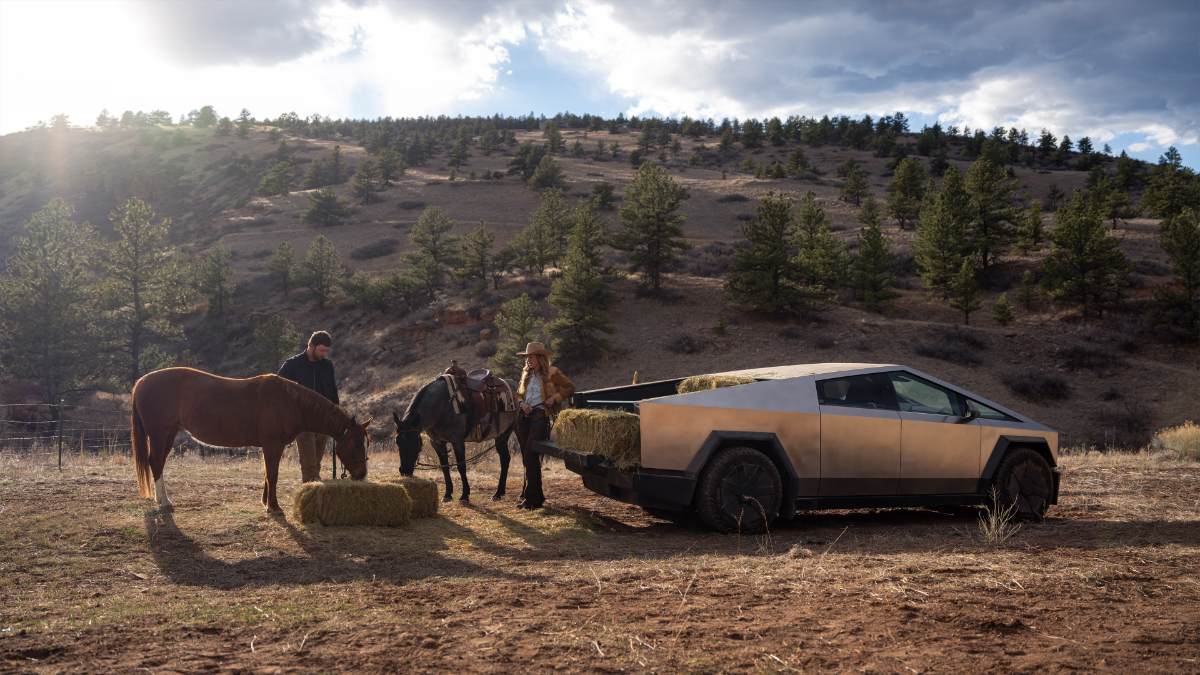
There’s something poetically fitting about Tesla’s angular steel carving its path through the Alaskan wilderness. This land, once ruled by imperial fur traders and sold into American hands, has now become the proving ground for the next chapter of mobility. The Cybertruck doesn’t replace the frontier spirit; it reflects it. It’s not here to end internal combustion. It’s here to join the convoy, bring new tools to the trailhead, and remind us that even the quietest rigs still tell the loudest stories when they roll through the right place.
Image Sources: Tesla Media Center
Noah Washington is an automotive journalist based in Atlanta, Georgia. He enjoys covering the latest news in the automotive industry and conducting reviews on the latest cars. He has been in the automotive industry since 15 years old and has been featured in prominent automotive news sites. You can reach him on X and LinkedIn for tips and to follow his automotive coverage.
Set Torque News as Preferred Source on Google
Follow us today...





Comments
As a former Vehicle Engineer…
Permalink
As a former Vehicle Engineer for Chrysler/DaimlerChrysler at Jeep & Truck Engineering, where "WORKING" vehicles were what we designed. Those are vehicles that haul, tow, climb, real off road too. I looked at the highway and other photos and its mostly dirt road, I looked at the elevation changes (below). I really want to see your 2600 pound trailer setup (that is really small [for us]). It should of been optimized for tires and size and pressure of tires and not 'halved' your range. Plus with all of the downhill portions you'd of had plenty of regen on that vehicle. Yeah, bring a generator, but, that is NOT that 'rugged' or 'hard' of a trip. Hell Towns Pass in Death Valley leaving Stove Pipe Wells going -10ft to +5000ft at 7.5 grade is "HARDER" and a test it has to complete for the Engineering Standards. You want to do some real testing that is worthy of PRINT. CONTACT ME. I have the scars and the t-shirt. Been there and done it and have photos to prove it. In fact, I have a history making challenge it can do that will make the records and get us on VINWIKI. No joke
You provided the argument…
Permalink
You provided the argument for the non acceptance of gas vehicles. I am guessing this was also done when it was not the dead of winter either. The fact you still need a gas powered device to make your EV work says everything.
You could just install an…
Permalink
You could just install an ls7 in it and be done with it
Is it not actually a case…
Permalink
Is it not actually a case for hybrid designs versus full EV?
Keeping the reliability and current availability of fuel while reducing usage with EV capability too?
Why would you drive an EV…
Permalink
Why would you drive an EV towing a generator in the first place?
And only 135 miles?
Noah, do you really think a…
Permalink
Noah, do you really think a couple with 3 young children in the heart of Boston whose biggest adventures was a flight to Disney World is up for this? How many people in the continental United States do you think even own portable generators. I appreciate your point but let's be real here. Outdoorsmen find a way to make just about anything work.