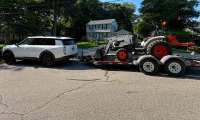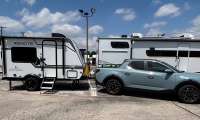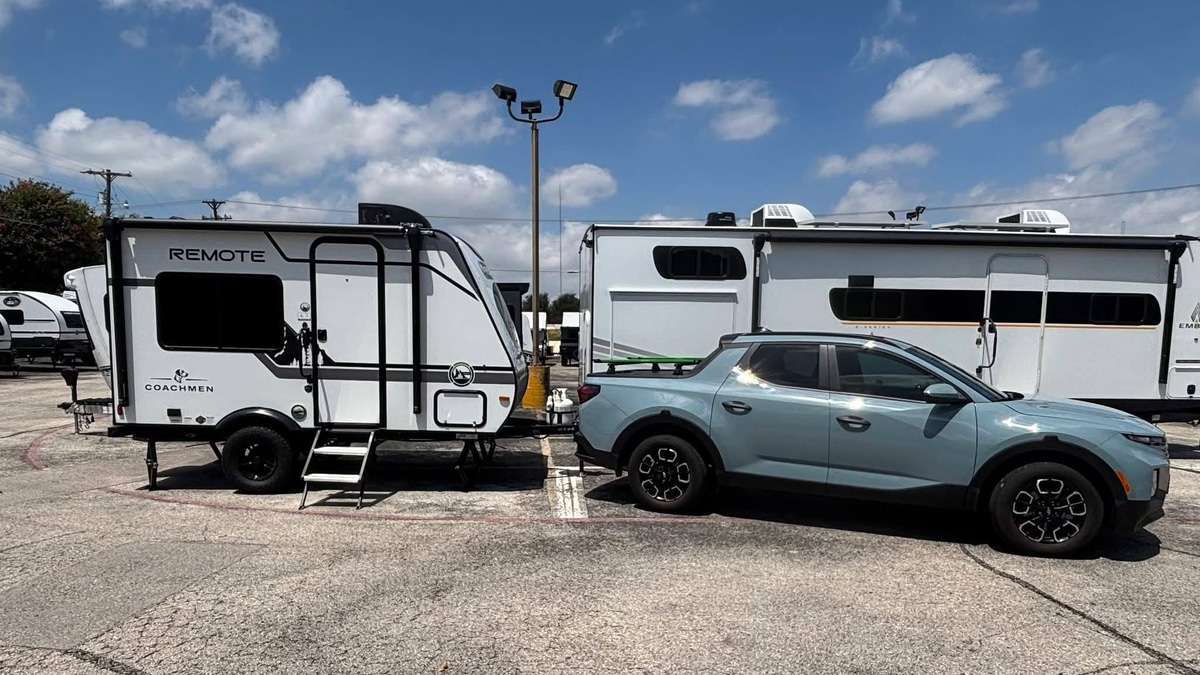

A 2,650-pound camper appears to fit comfortably below a 3,500-pound tow rating. The problem is that the apparent 850-pound cushion may be actual towing margin, or it may be arithmetic built around an unloaded trailer.
Christopher Packer posed the question after looking at a Coachmen Remote camper for his Hyundai Santa Cruz SEL.
“Has anyone tried pulling a small camper? I’m afraid I’m going to need a bigger truck,” he wrote. “The one pictured is 2650lbs; my SEL has a low tow rating.”
He may not need a bigger truck.
He does need to establish what the 2,650-pound figure represents, confirm that the trailer brakes work with his Santa Cruz, and weigh the combination in camping trim.
Those answers are more useful than another owner saying a different Santa Cruz once pulled a heavier trailer without an obvious problem.
The Santa Cruz has two very different towing limits
Hyundai gives the naturally aspirated Santa Cruz SEL a maximum trailer rating of 3,500 pounds with trailer brakes.
Without trailer brakes, the official maximum falls to approximately 1,650 pounds. Hyundai published that same basic split in its first-generation 2023 guide and its updated 2025 specifications.
That changes the meaning of several comments beneath Packer’s Facebook post.
One owner suggested that he “consider” adding trailer brakes. At a reported 2,650 pounds, the brake-equipped rating is already the relevant rating. Trailer brakes are not simply an optional comfort improvement when the alternative manufacturer rating is about 1,000 pounds below the camper’s stated weight.
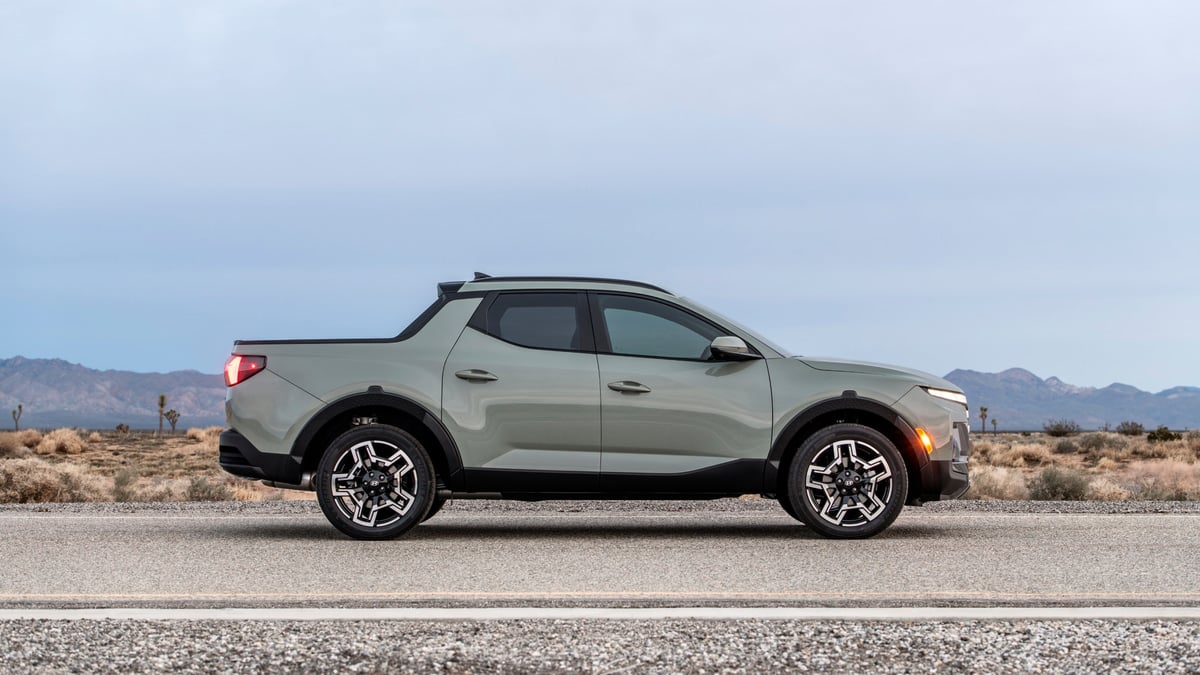
The pictured Santa Cruz’s exact model year cannot be confirmed from the photograph, so its installed wiring must be inspected rather than assumed.
Hyundai’s earlier towing guide listed four-pin trailer prewiring for the 2.5-liter naturally aspirated Santa Cruz and stated that there was no dedicated provision for brake-controller wiring. A factory four-pin lighting connection should not be mistaken for a completed electric-trailer-brake installation. If the Coachmen uses electric brakes, the truck needs the appropriate connection, controller, adjustment, and functional test.
Before discussing a larger truck, Packer should confirm whether his Santa Cruz can command the camper’s brakes.
The 2,650-pound number needs a definition
The weight displayed in an RV advertisement is frequently its unloaded vehicle weight, or UVW, rather than its ready-to-camp weight.
Coachmen defines UVW as the typical factory-manufactured weight, including the trailer’s axle and tongue weight and LP gas. It excludes cargo, fresh water, additional optional equipment, and dealer-installed accessories. Coachmen also states that every unit receives a label identifying the actual unloaded weight and cargo-carrying capacity before leaving the factory.
That trailer-specific label is more useful than a sales listing.
If 2,650 pounds is UVW, Packer has 850 pounds between the advertised figure and Hyundai’s 3,500-pound maximum. Fresh water alone weighs approximately 8.3 pounds per gallon, according to Coachmen.
Thirty gallons would add about 249 pounds, reducing the remaining paper margin from 850 to 601 pounds.
Food, clothing, cookware, hoses, leveling equipment, tools, chairs, bedding, battery upgrades, dealer accessories, and everything stored inside the trailer must fit into what remains. The owner does not have to guess at the result. He can load the camper exactly as it will travel and take it across a commercial scale.
If 2,650 pounds is already the camper’s measured travel weight, the situation is much more favorable. The post does not establish which number Packer was given.
Passengers do not get added to trailer weight
One commenter advised combining the camper’s 2,650 pounds with the driver, passengers, and cargo, then checking whether the sum remained below 3,500 pounds.
That mixes two different ratings.
The 3,500-pound figure applies to the loaded trailer. People and cargo inside the Santa Cruz consume the truck’s payload capacity and contribute to its gross vehicle weight. They do not become part of the trailer’s 3,500-pound total.
Tongue weight is where the two calculations meet.
Hyundai recommends tongue load at approximately 10 percent of total trailer weight. A 3,200-pound loaded camper would therefore place roughly 320 pounds on the hitch. That 320 pounds is carried by the Santa Cruz and must be counted with the occupants and everything in the cab and bed.
Hyundai’s product guide lists a maximum vehicle load limit of 1,411 pounds, but the number on Packer’s own driver-door label should be used for the final calculation because installed equipment and configuration can affect the available capacity.
Payload capacity and towing capacity are separate limits. A towing combination must satisfy both at the same time.
Airbags would not create more capacity
Another commenter recommended adding airbags to level the Santa Cruz.
Hyundai already equips the Santa Cruz with gas-pressurized, self-leveling rear shock absorbers.
An additional suspension aid could change how the truck sits under load, but ride height does not determine whether the truck is within its ratings. Airbags cannot increase the receiver rating, trailer rating, gross vehicle weight rating, rear-axle rating, tire capacity, or payload figure on the door label.
They may make an overloaded truck look less overloaded.
The owner should determine the weight first. Suspension changes come later, and only when they address a handling or ride-quality issue inside the truck’s established limits.
A Night or Limited towing story is not an SEL test
Several owners responded with successful towing experiences involving Night, Limited, and turbocharged Santa Cruz models.
Those reports are relevant as owner experiences, but they are not direct comparisons.
Hyundai has offered turbocharged all-wheel-drive Santa Cruz configurations with ratings as high as 5,000 pounds. The naturally aspirated SEL discussed by Packer carries the lower 3,500-pound braked rating.
Powertrain, drivetrain, cooling equipment, wiring, and trim configuration matter. A 5,000-pound turbo AWD Santa Cruz towing 3,000 pounds has substantially more published margin than a 3,500-pound SEL pulling the same trailer.
A commenter who towed a Lance camper with a 2025 Limited also reported poor fuel economy in strong winds. That is a useful warning even when every weight is legal. A travel trailer presents a tall, broad surface to the air, so speed and headwinds can create a large aerodynamic load that the scale does not show.
The SEL may be enough, but the camper must be weighed
The combination can remain within Hyundai’s published envelope if the loaded trailer stays at or below 3,500 pounds, its brakes are properly controlled, the actual tongue load fits the hitch and payload limits, and the loaded Santa Cruz remains within its vehicle and axle ratings.
A loaded weight near 3,500 pounds would leave little room for estimation errors, added equipment, or future camping gear. A measured travel weight closer to 3,000 pounds would create a more useful reserve.
The decision should come from four numbers: the camper’s loaded weight, its tongue weight, the Santa Cruz’s door-label payload capacity, and the truck’s loaded axle weights.
That information may show that the SEL is suitable for this camper. It may also show that a lighter camper or a higher-rated tow vehicle would provide the needed margin. Either result is more dependable than deciding from dry weight or from another owner’s turbo-trim towing story.
Does this Coachmen truly require a bigger truck, or would you tow it with the 3,500-pound Santa Cruz SEL after verifying the loaded weight and trailer brakes?
Tell us which way you would go. Owners who have done it, share your trim, loaded camper weight, and the condition that tested the truck most.
One image by Christopher Packer
About The Author
Noah Washington is an automotive journalist based in Atlanta, Georgia, covering sports cars, luxury vehicles, and performance culture. His reporting focuses on explaining the engineering, design philosophy, and real-world ownership experience behind modern vehicles.
Noah has been immersed in the automotive world since his early teens, attending industry events and following the enthusiast communities that shape how cars are built and driven today. His work blends industry insight with enthusiastic storytelling, helping readers understand not just what a car is, but why it matters.
Noah is also a member of the Southeast Automotive Media Association (SAMA), a professional organization for automotive journalists and industry media in the Southeast.
His coverage regularly explores sports cars, luxury vehicles, and performance-driven segments of the automotive industry, including the evolving culture surrounding Formula Drift and enthusiast builds.
Read more of Noah's work on his author profile page.
You can also follow Noah here:
Set Torque News as Preferred Source on Google
Follow us today...