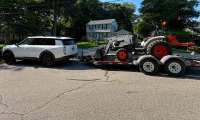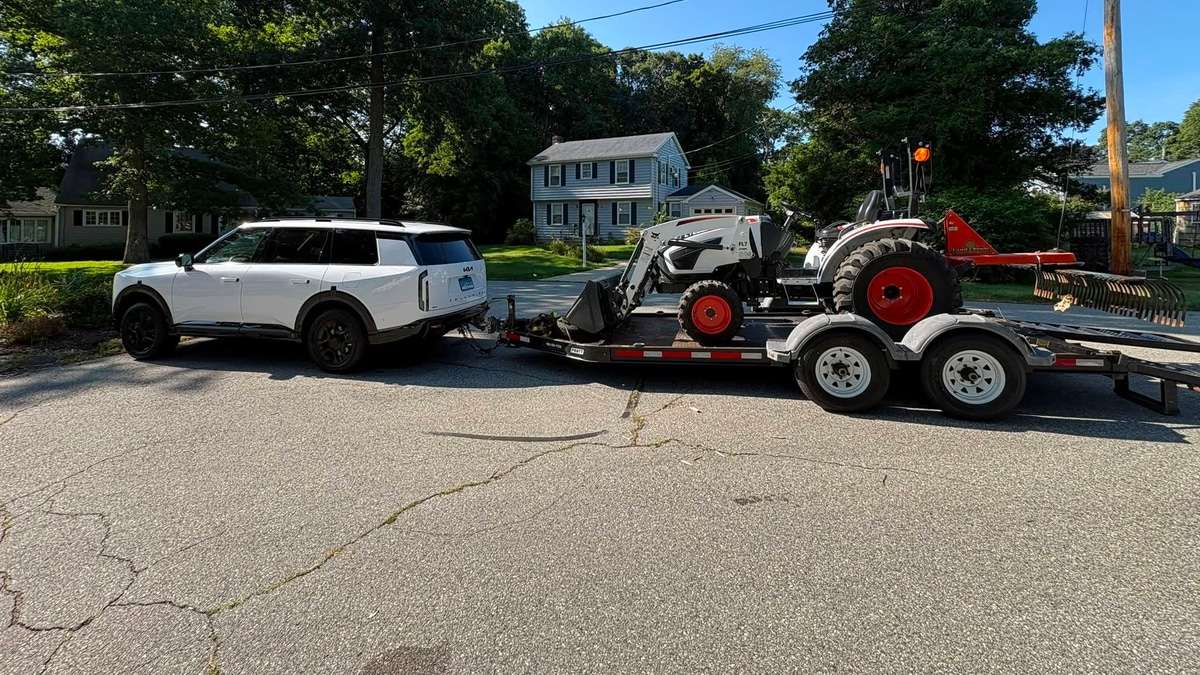

A three-row family SUV with a Bobcat compact tractor behind it will draw a verdict before anyone sees a scale ticket.
The owner of this 2027 Kia Telluride supplied a more measured assessment.
“Just because you CAN doesn’t mean you SHOULD,” he wrote. “Tongue weight was a little off because of the rake attachment. Other than that, it wasn’t terrible. Only had to go a mile down the road. Definitely wouldn’t be doing highway speeds with this setup.”
The owner described a one-mile exception, not a highway towing recommendation. He also recognized that the load placement was wrong before commenters began predicting transmission failure.
Still, moving the load for one mile only proves that the Telluride had enough low-speed tractive force to get it moving. It does not answer whether the trailer was within the SUV’s weight ratings, whether either axle was overloaded, or whether the tongue weight was sufficient to keep the trailer stable at speed.
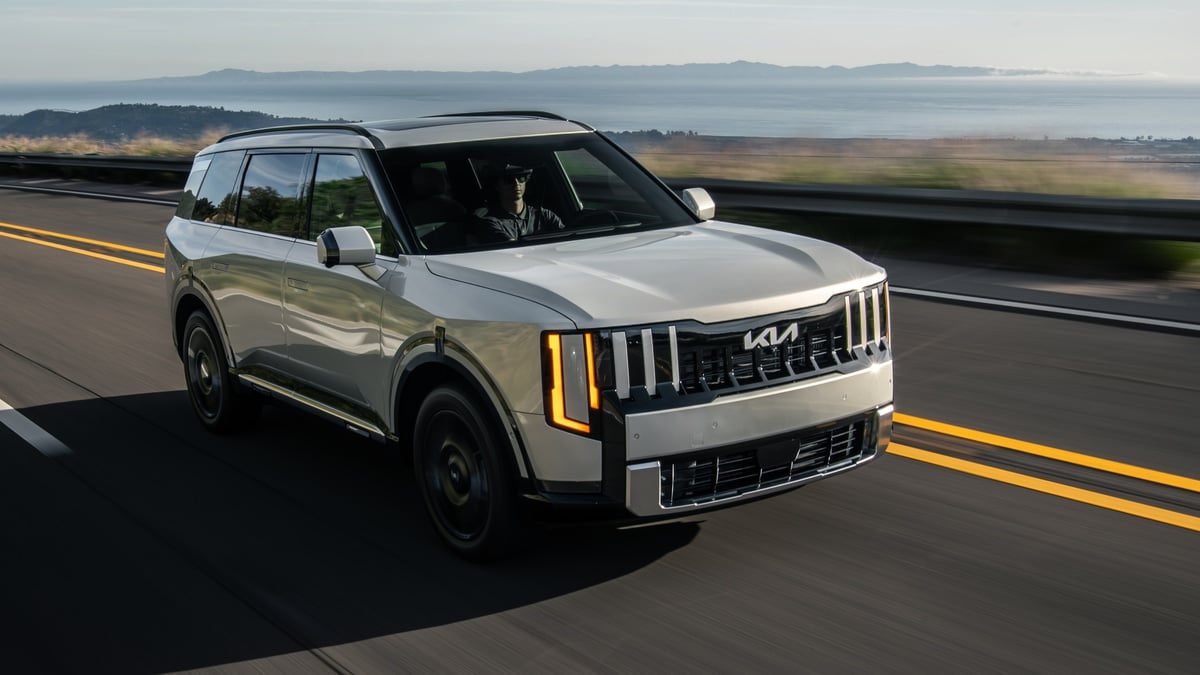
The Telluride owner later confirmed on Facebook that his SUV was the gas model. Kia rates the 2027 Telluride’s turbocharged gas powertrain to tow up to 5,000 pounds when properly equipped. The available self-leveling rear suspension may help maintain the vehicle’s stance while towing, but the published ceiling remains 5,000 pounds.
The lightest published comparison reaches 5,049 pounds
The photograph does not provide an exact scale weight. It also does not expose enough of the tractor’s hood badge or the trailer identification plate to confirm every model.
It does provide enough information for a conservative plausibility check.
The loader is visibly marked FL7. Bobcat lists the FL7 front-end loader at 915 pounds. The lightest tractor in Bobcat’s visually matching 2000 Platform is the CT2025, with a published operating weight of 2,634 pounds.
That produces 3,549 pounds before counting the trailer or the rear rake.
PJ lists its lighter UL tandem-axle utility trailers at 1,500 to 2,150 pounds empty. Using only the lowest 1,500-pound figure brings the combination to 5,049 pounds.
The pictured trailer more closely resembles PJ’s open C5 5-inch channel car hauler, which has the same general tandem-axle, open-deck layout and is listed at 2,000 to 2,350 pounds empty. Substituting its lowest published weight produces an estimated 5,549 pounds.
Neither estimate includes the rear rake.
This is a published-component comparison, not a substitute for an actual scale ticket. A different tractor or trailer model would change the total. The important point is that this calculation was deliberately built from low figures. It does not require an 8,000-pound estimate to raise a legitimate concern.
Even the lighter trailer comparison crosses the Telluride’s 5,000-pound maximum before the rake receives a single pound.
The rear rake changes the balance as well as the total
The owner’s comment about tongue weight may be the most consequential detail in the post.
The rake is attached behind the tractor and appears to place additional mass behind the trailer axles. Unless the tractor was moved farther forward to compensate, that rearward mass would tend to reduce the load pressing down on the Telluride’s hitch.
Too little tongue weight can make a trailer more susceptible to sway. Too much can overload the hitch, the Telluride’s rear axle, or the vehicle’s payload capacity.
Kia tells 2027 Telluride owners that tongue load should measure 10 to 15 percent of the fully loaded trailer weight. Its manual also recommends placing approximately 60 percent of a trailer’s load toward the front and 40 percent toward the rear. Kia specifically tells owners to weigh the loaded trailer and tongue separately rather than judging the setup by appearance.
That makes “a little off” impossible to evaluate without the missing number.
A combination can pull smoothly at neighborhood speed and become unstable after speed, crosswinds, steering corrections, or pavement disturbances begin acting on it. The owner’s refusal to attempt highway speeds was a sensible limit, but speed reduction cannot increase the vehicle’s rated capacity.
Self-leveling suspension can hide squat, not weight
One commenter suggested that the Telluride’s rear shocks would pump the SUV back to a level ride height.
Kia does offer the 2027 Telluride with self-leveling rear suspension. That feature can make a loaded vehicle look composed because the suspension compensates for rear-end sag.
A level body is still not a scale ticket.
Self-leveling suspension does not remove trailer mass, reduce tongue load, create additional rear-axle capacity, or raise the rating printed by the manufacturer. It can actually make visual judgment less useful because the SUV may sit level while carrying substantial weight on the hitch.
The same principle applies to Tow Mode. Kia says Tow Mode alters power output, transmission behavior, braking, and stability-control programming to assist with a trailer. Those changes help the vehicle manage an approved load. They do not authorize a heavier one.
The transmission predictions go beyond the evidence
“RIP transmission” was one of the early reactions.
That conclusion cannot be drawn from the photograph. There is no temperature data, diagnostic information, service history, or evidence that the transmission failed after this move.
Kia does warn that a trailer places additional load on the engine, transmission, wheels, and tires, while also generating more heat and wind resistance. That is a reason to observe the ratings, especially during longer trips, hills, hot weather, and repeated towing. It is not proof that one low-speed mile destroyed this Telluride.
The more supportable criticism concerns the apparent trailer weight and balance.
Before repeating this move, the owner would need the tractor’s exact model and operating weight, the trailer’s empty weight, the rake’s weight, and a loaded scale measurement. He would also need separate tongue and axle weights, the Telluride’s door-jamb payload figure, the hitch rating, and confirmation that the trailer brakes were fully operational.
Kia’s manual requires total trailer weight, gross combination weight, gross vehicle weight, axle weight, and tongue load to remain within their respective limits. Its factory trailer electrical connection also includes a circuit for electric brakes, but Kia places responsibility on the driver to verify that the entire braking system is connected and working.
The owner’s opening warning remains the fairest description of the photograph. A Telluride may be able to move this equipment down the road, but the ability to move it does not establish that the combination fits inside a 5,000-pound towing envelope.
Would you have made this same one-mile move in the Telluride, or would the unknown tongue weight and apparent trailer weight make it a hard no? Tell us where you draw the line, and what you would change before this setup moved again.
One image by Trey Larson
About The Author
Noah Washington is an automotive journalist based in Atlanta, Georgia, covering sports cars, luxury vehicles, and performance culture. His reporting focuses on explaining the engineering, design philosophy, and real-world ownership experience behind modern vehicles.
Noah has been immersed in the automotive world since his early teens, attending industry events and following the enthusiast communities that shape how cars are built and driven today. His work blends industry insight with enthusiastic storytelling, helping readers understand not just what a car is, but why it matters.
Noah is also a member of the Southeast Automotive Media Association (SAMA), a professional organization for automotive journalists and industry media in the Southeast.
His coverage regularly explores sports cars, luxury vehicles, and performance-driven segments of the automotive industry, including the evolving culture surrounding Formula Drift and enthusiast builds.
Read more of Noah's work on his author profile page.
You can also follow Noah here:
Set Torque News as Preferred Source on Google
Follow us today...